

Every renovation-firm owner eventually solves the first budget question — how much should I spend on marketing — and immediately trips over the second, harder one: where do I actually put it? And the instinct is almost always the same. Run the numbers, find the channel with the lowest cost per lead, and pour the budget there. It feels disciplined. It is actually how a firm ends up one algorithm change away from a silent WhatsApp.
The right way to answer "where" is to stop thinking like a bargain-hunter and start thinking like a portfolio manager. You are not looking for the single cheapest lead. You are building a mix of channels that, together, keep qualified enquiries coming through a good quarter and a bad one — and that you can rebalance as the numbers come in. This piece is about that split: the layers to build, the frameworks that shape them, and the one number that tells you when to move money. (How much to spend is a different question — we cover the percentage-of-revenue sizing decision separately.)
How should a renovation firm split its marketing budget across channels?
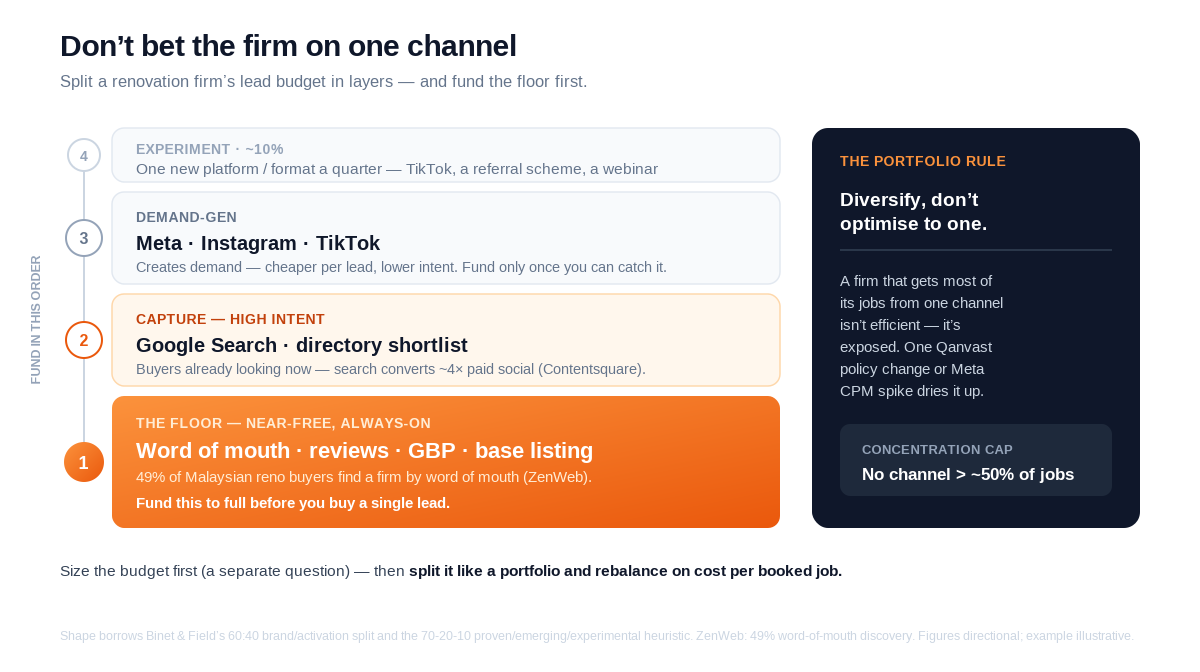
Split it in layers and fund them from the bottom up: a near-free floor first, then a high-intent capture layer, then demand generation, with a small slice held back for experiments. Fund each layer to "enough" before you feed the one above it. The point of the order is that each layer up the stack costs more per qualified lead than the one below, so you only climb once the cheaper floor is maxed out.
That is the whole model, and it inverts the cost-per-lead hunt. A firm optimising for the cheapest lead usually lands entirely in one paid channel. A firm building a portfolio spreads across four roles — reputation, capture, reach, and a bet on the future — because those roles behave differently when conditions change. The sections below define each layer, map the real Malaysian channels onto them, borrow two well-known frameworks to set the proportions, and then put ringgit on it.
Why is chasing the single cheapest channel the expensive mistake?
Because "cheapest cost per lead" optimises for one number while quietly maximising a risk nobody prices: concentration. The channel that looks most efficient today is also the one that can take most of your pipeline down overnight — and in renovation marketing, it usually does, eventually.
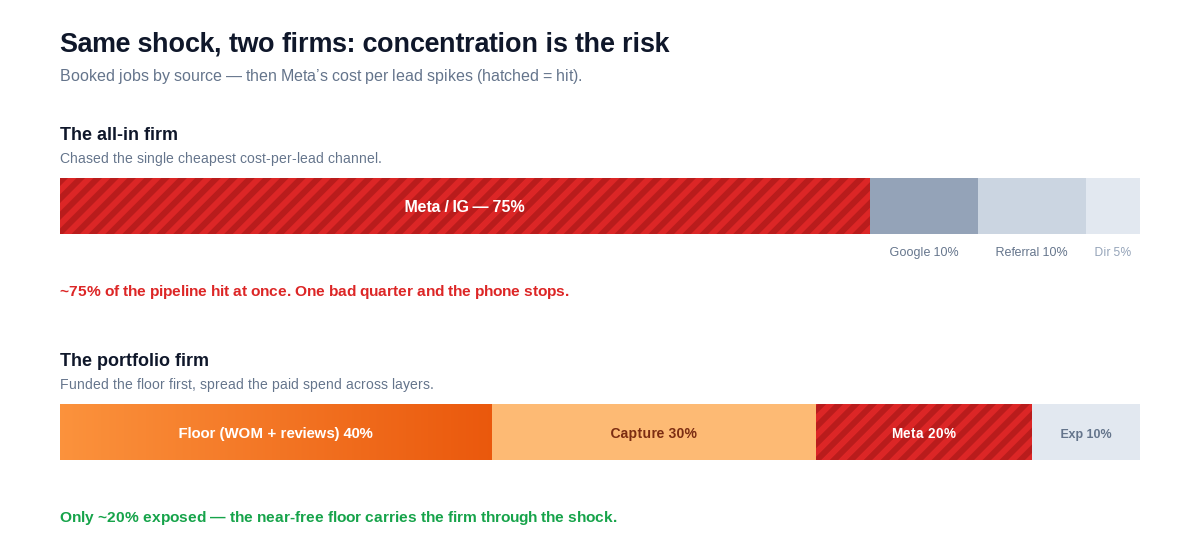
Here is the mechanism. Say a Klang Valley firm finds that Meta leads are its cheapest, so over a year it drifts to spending almost everything there. On a cost-per-lead scoreboard it looks like a genius. Then one of three ordinary things happens: Meta's cost per lead climbs as the cheap audience gets used up (Malaysian agency benchmarks already show reno CPLs drifting up year on year, per ZenWeb), a vertical directory changes the rules of who gets shown — Qanvast's SuperTrust badge, for instance, requires a firm to have closed more than RM500,000 of projects through the platform, hold a 4-to-5-star rating and be listed at least a year, so a tier change can reshuffle visibility — or an ad account gets restricted for a fortnight. Any one of them, and three-quarters of the pipeline is hit at once.
The portfolio firm spreads the same budget across layers. When Meta's cost per lead spikes, only the ~20% of its pipeline that rides on Meta is affected, and the near-free floor — the reputation, the reviews, the repeat-and-referral flow — carries it through the bad quarter. Same shock, very different outcome.
What are the three layers — floor, capture, demand-gen?
Each layer plays a distinct role and sits at a different point on the cost-and-intent curve. The floor is near-free and earned; capture is paid but high-intent; demand-gen is cheaper per lead but lower-intent. You want all three, in that funding order, plus a small experiment slice.
| Layer | Malaysian channels | What it is | Intent | Cost model |
|---|---|---|---|---|
| 1 · Floor | Word of mouth, reviews, Google Business Profile, base Qanvast/Atap listing | Your reputation engine — the demand you earn, not buy | Highest | Near-free (effort + a base listing fee) |
| 2 · Capture | Google Search, high-intent directory shortlists | Catches buyers already looking now | High | Paid, scales with searches available |
| 3 · Demand-gen | Meta, Instagram, TikTok | Creates demand by interrupting a scroller | Lower | Paid, scales freely with spend |
| 4 · Experiment | One new platform or format a quarter | A small, deliberate bet on the next channel | Unknown | ~10%, written off as learning |
The floor comes first because it is the cheapest demand you will ever get and the only channel whose cost falls as you grow. In Malaysia, word of mouth is the No.1 way buyers find a renovation firm — around 49%, ahead of Google and Facebook/Instagram used in parallel (ZenWeb) — and an informal Malay Mail reader poll pointed the same way, with nearly half saying they chose a renovator recommended to them (a straw poll, so indicative only). You don't buy word of mouth with ringgit; you buy it with fast replies, delivered jobs and a steady habit of asking happy clients for reviews. That is why the floor's budget is mostly discipline, not cash.
Capture is the first place paid money earns its keep, because you are paying to be found by someone already in-market. Across industries, paid search converts at roughly four times the rate of paid social and its visitors are far less likely to bounce (Contentsquare, via eMarketer) — the plainest evidence that intent, not price, drives conversion. The ceiling on capture is simply how many people are searching; once you have cleared that demand, more money there just bids up the same clicks.
Demand-gen is where you go for volume beyond what already exists — Meta, Instagram and TikTok create interest you then convert. It is cheaper per lead and genuinely powerful, but only once your capture-and-speed system can catch a sudden burst without dropping half of it. Fund it before you can answer it and you are mostly paying for unanswered 2am enquiries. Which channel to actually buy, directory versus ads, is its own decision — we work it through in which renovation lead source is worth paying for.
What do the frameworks say — and how should a small reno firm bend them?
Two well-known allocation frameworks give you the shape of a sensible split. Neither is a law, and both need bending toward activation and proven channels for a small, young renovation firm.
The first is Binet and Field's roughly 60:40 rule — from their analysis of the IPA Databank (996 campaigns, 1980–2010, in The Long and the Short of It), where the long-run sweet spot averaged about 60% brand building and 40% sales activation. The useful idea is that you need both the long game (reputation — your floor) and the short game (converts-now capture). The catch: the authors call it an average across many categories, not a formula, and small young firms typically tilt the other way. A Malaysian reno firm with no referral flywheel yet should weight activation — the capture layer and the reputation floor that converts now — ahead of broad awareness, and let brand-building grow as it matures.
The second is the 70-20-10 heuristic — popularised for resource allocation in How Google Works and borrowed by marketers as proven/emerging/experimental: roughly 70% on what already works, 20% on an emerging channel, 10% on experiments. Treat it strictly as a risk-management rule of thumb (it is a heuristic, not measured data), and it maps cleanly onto the stack — proven ≈ your floor and capture, emerging ≈ demand-gen you are scaling, experimental ≈ the 10% slice.
A worked split: RM6,000 a month across the layers
Here is what the model looks like with ringgit on it — illustrative, for a small Klang Valley renovation firm spending RM6,000 a month on paid acquisition, with the floor's labour running separately. Replace every figure with your own; the structure is the point, not the numbers.
| Layer | Monthly spend | Share | What it buys |
|---|---|---|---|
| Floor | RM1,200 | 20% | A base Qanvast/Atap listing + the review-and-referral habit (mostly effort) |
| Capture | RM2,400 | 40% | Google Search on high-intent reno/ID keywords |
| Demand-gen | RM1,800 | 30% | Meta/Instagram to a fast WhatsApp capture flow |
| Experiment | RM600 | 10% | One test a quarter — TikTok, a referral incentive, a new directory |
That split deliberately leans toward activation and proven channels — capture is the biggest slice because it converts now and the firm is still proving its close rate. Fold floor and capture together and you get ~60% on proven, high-intent demand, ~30% on scalable reach, ~10% on the future: the 70-20-10 shape, tilted for a small firm. It is a starting allocation. The next section is how you earn the right to change it.
What's the one number that says "rebalance"?
Cost per BOOKED job by channel, reviewed every quarter — not cost per lead, and not instinct. It is the only number that tells you where the next ringgit actually belongs, and it is the one almost every firm fails to track.
The arithmetic is trivial: each channel's spend divided by the jobs it actually won. The hard part is step one — tagging every enquiry with its source the moment it lands, and carrying that tag all the way to won or lost, often months later after the quote and the site visit. In Malaysia a Qanvast handoff, a Meta click-to-WhatsApp, a Google-search enquiry and a referral all pour into the same WhatsApp number, and a spreadsheet only stays accurate if a busy salesperson back-fills every source and outcome — which collapses in exactly the busy months the data matters most. Without source attribution that survives to the deposit, you are rebalancing on a spend report and a feeling.
Once you have the number, rebalancing is a discipline, not a gamble:
- Move money gradually toward the channels with the lowest cost per booked job — shift maybe 10–20% of a layer at a time, not the whole budget, so one noisy month doesn't whipsaw you.
- Trim channels that only produce cheap leads you never close — a low cost per lead and a high cost per booked job is the classic trap.
- Hold the concentration cap. If any one channel creeps past ~50% of booked jobs, deliberately feed another even if it looks less efficient — you are buying resilience, and it is cheap.
- Keep the 10% experiment running so you always have a candidate for the next proven channel before you need it. Many firms see demand pile up around the year's predictable enquiry spikes — the experiment slice is how you find the channel that catches the next one.
How HotLead fits in
HotLead does not buy your ads, place your directory listing, write your reviews or decide your budget — those are yours. What it does is give a Malaysian renovation, interior-design or construction firm the one thing portfolio allocation depends on: an honest read of which channel actually pays, on top of the WhatsApp you already use. It captures every enquiry with its source attached — a Qanvast handoff, a Meta click-to-WhatsApp, a Google-search lead and a referral stay distinct instead of blurring into one inbox. Its auto-greeting and one-owner routing give every lead the fast first reply that decides whether your capture and demand-gen spend converts or leaks. Its next-action and overdue reminders stop a paid lead rotting unanswered. And its funnel and per-channel ROI view shows enquiries, qualified leads and won jobs by source — which is exactly the cost-per-booked-job-by-channel you rebalance the whole portfolio on.
Start with the complete guide to managing renovation leads in Malaysia, size the budget with how much a reno firm should spend on marketing, then work out how many leads you actually need a month. Go deeper on the renovation lead playbook or managing leads for an interior-design studio.
Sources: ZenWeb — how Malaysian renovation buyers find firms (word of mouth ~49%, the No.1 discovery channel, ahead of Google and Facebook/Instagram used in parallel; Malaysian Meta reno CPL drifting up year on year — agency data, directional); Contentsquare 2024 digital experience benchmark, via eMarketer (paid search converts ~4× the rate of paid social, and paid-social visitors ~41% more likely to bounce); Les Binet and Peter Field, The Long and the Short of It (IPA Databank of 996 campaigns, 1980–2010; long-run optimum averaged roughly 60% brand building / 40% sales activation — an average across categories, not a fixed rule), summarised by Marketing Week; the 70-20-10 proven/emerging/experimental split popularised in Eric Schmidt and Jonathan Rosenberg's How Google Works and adapted as a marketing risk-management heuristic (Entrepreneur); Qanvast Malaysia — SuperTrust badge criteria (firm must have closed more than RM500,000 of projects through Qanvast, hold a 4-to-5-star rating, and be listed at least a year; RM50,000 Qanvast Guarantee on deposits); Malay Mail, 2024 (an informal reader poll where nearly half chose a renovator recommended by word of mouth — a straw poll, indicative only). Ringgit figures and the worked split are illustrative — replace them with your own spend, qualified-lead and won-job counts by source to find your real cost per booked job by channel.
Frequently asked questions
How should a small renovation firm divide its marketing budget across channels?
Treat it as a portfolio, not a single bet, and fund it in layers from the bottom up. First fund the near-free floor — word of mouth, reviews, a complete Google Business Profile and a base directory listing — because it is the cheapest demand you will ever get. Next fund a high-intent capture layer, mainly Google Search and directory shortlists, where buyers are already looking. Then fund demand generation on Meta, Instagram or TikTok, which is cheaper per lead but lower intent, so it only pays once your capture-and-reply system can handle the volume. Keep roughly 10% for an experiment each quarter. A common starting split for a small Malaysian firm is something like 20% floor, 40% capture, 30% demand-gen and 10% experiment — then let the numbers move it.
Is Google Search or Facebook and Instagram better for renovation leads in Malaysia?
They do different jobs, so the honest answer is both, in order. Search captures demand that already exists — someone typed "renovation contractor KL" and is looking now — while paid social creates demand by interrupting a scroller. Across industries, paid search converts at roughly four times the rate of paid social and its visitors are far less likely to bounce (Contentsquare, via eMarketer), which is why a small firm with limited budget should fund high-intent search before scaling lower-intent social. But search volume is capped by how many people are actively searching, so once you have cleared that, social is how you buy more reach. For the head-to-head economics of directories versus ads, see our companion piece on which lead source is worth paying for.
How much of the budget should go to word of mouth and reviews?
In ringgit, very little — in priority, it comes first. Word of mouth is the No.1 way Malaysian renovation buyers find a firm (about 49%, per ZenWeb), and it costs almost nothing to buy because it is earned, not purchased. The spend it needs is mostly effort and systems — fast replies, delivered jobs, and a steady habit of asking happy clients for a review on Google or Qanvast. So the floor rarely needs more than a base directory listing fee as cash; the real investment is the discipline that keeps past clients recommending you. Protect it before you fund any paid channel, because paid leads that get slow replies actively damage it.
How do I know when to move budget off a channel?
Rebalance on cost per BOOKED job by channel, reviewed each quarter — not cost per lead, and not a gut feeling. Tag every enquiry with its source the moment it lands, carry that tag all the way to won or lost months later, and divide each channel's spend by the jobs it actually booked. Move money gradually toward the channels with the lowest cost per booked job, trim the ones that only produce cheap leads you never close, and keep a small slice testing the next channel. Also watch concentration — if any single channel is producing more than about half your booked jobs, deliberately diversify even if it looks efficient, because that is where platform risk hides.
Does the 60/40 marketing rule apply to a renovation firm?
Use it as a shape, not a formula. Binet and Field's analysis of the IPA Databank (996 campaigns, 1980–2010) found the long-run sweet spot was roughly 60% brand building and 40% sales activation on average — but they describe it as an average across many categories, not a law, and small, young firms typically tilt the other way, toward activation. For a Malaysian reno firm with no referral flywheel yet, that means weighting high-intent, converts-now channels (your capture layer and the reputation floor) ahead of broad awareness spend, and letting brand-building grow as the firm matures. Borrow the idea that you need both the long game and the short game; don't treat 60:40 as your exact split.
Keep reading
- Can AI Reply to Your Renovation Firm's 1-Star Review? I Built It — and the Risk Is How Fast It ApologisesA 2-star review on Google or Qanvast is the first thing your next renovation lead reads — and most firms either ignore it or fire back and make it worse. The 2026 reflex is to let AI write the reply. I built it, and drafting a calm response costs a fraction of a sen. But an AI tuned to be helpful apologises too fast — it will concede a fault in writing, promise a refund that never happened, and grovel to a fake review from a competitor. Here's the build that protects your rank instead of torching it.
- Which Lead Signals Actually Predict a Sale? Reverse-Audit Your Own Won JobsMost firms grade a renovation lead on signals that feel predictive — enthusiasm, a long message, a fast reply — and never check whether those signals actually separate won jobs from lost ones. Here is how to run a reverse-audit on your own closed deals, which signals usually survive it, and why your pipeline is too small to pretend the score is more than directional.
- The "I Only Deal With the Boss" Lead: When the Buyer Refuses Your TeamYou finally hired someone to share the load — then the buyer messages "can I deal with you direct ah, boss?" and refuses to engage your staff. Every big lead quietly re-centralises onto the one person already maxed out, and your firm can never grow past the owner. Here's why caving caps you, why a flat "my staff will assist" loses a nervous buyer, and the move that keeps both.