

Ask a renovation-firm owner how much contingency is in their last quote and you'll often get a blank look, then a shrug: "contingency is the homeowner's problem — they should keep 10 to 20 percent spare." That's true advice for the buyer, and it's on every renovation blog in Malaysia. But it quietly assumes the risk belongs to someone else. It doesn't. Every quote you send carries a risk line whether you name it or not — and if you don't price it, you pay for it out of your own margin the first time a wall comes open.
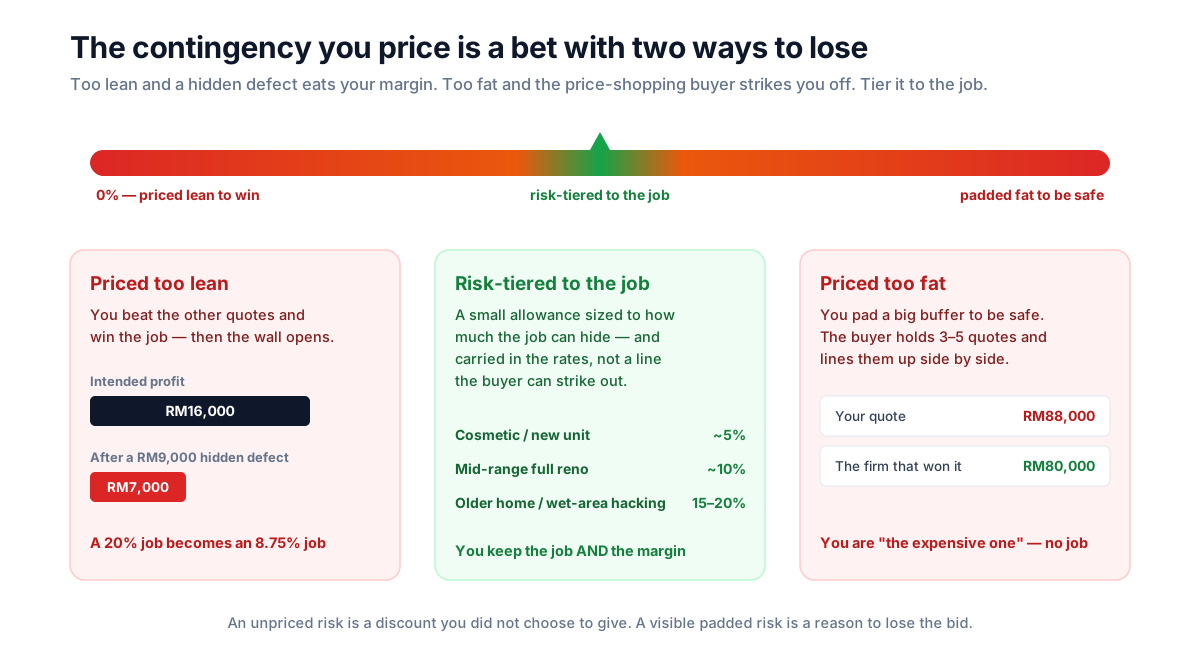
Here's the decision in one sentence: contingency is a bet with two ways to lose. Price it too lean and you win the bid, then a hidden defect eats the profit and a healthy 20 percent job limps home at 8 percent. Price it too fat and the buyer comparing three to five quotes strikes you off as the expensive one, and you don't win the job at all. This piece does the arithmetic with Malaysian numbers, shows why an unpriced overrun is a discount you didn't choose to give, and gives you a way to size the risk line that avoids both failure modes.
What is contingency in a renovation quote, really?
Contingency is money you set aside for the costs you can't see when you quote — and the important question isn't how big it is, but whose it is and where it lives. Construction finance draws a clean line between two kinds, and small reno firms blur them at their peril.
Contractor contingency is money you build into your own number to cover risks you carry: hidden site conditions, small estimating gaps, the difference between what the drawings and photos showed and what the wall actually holds. Owner contingency is a separate reserve the client keeps for changes they decide to make along the way. As Procore and the Construction Contracts Guy both put it, owner-directed scope changes should be funded through change orders and the owner's own reserve — not quietly absorbed by the contractor's contingency.
That distinction is where a lot of Malaysian reno margin dies. When a client says "since you're already here, can you also do the balcony?" mid-job, that's a variation order — the owner's contingency, priced fresh. When hacking a 1980s bathroom reveals the screed has to come out before you can tile, that's your contingency doing its job. If you let one line cover both, you've priced for hidden defects and ended up paying for the client's change of mind as well.
Why does an unpriced overrun come straight out of your margin?
Because the price is fixed the moment the buyer agrees the quote — so any cost you didn't price doesn't raise what they owe, it lowers what you keep. This is the single most expensive misunderstanding in reno pricing, and it's the same leverage that makes a discount hurt.
Walk it through with the figures used across this series. Your quote is RM80,000 on a mid-band condo or older-terrace job; your cost — materials plus subcontracted labour — is RM64,000; your gross profit is RM16,000, a clean 20 percent margin. You priced no contingency, because the other two quotes were tight and you wanted to win. You win. Then the crew starts hacking:
- The two bathrooms' waterproofing and screed have failed and must be fully redone before tiling — RM7,000.
- The kitchen wiring was run without conduit and won't pass, so it needs rewiring — RM2,000.
That's RM9,000 of work nobody priced. It doesn't come off the RM80,000 the client already agreed. It comes off your RM16,000, leaving RM7,000. The job you priced at a 20 percent margin actually returns 8.75 percent — and RM9,000 is 56 percent of the profit you thought you'd booked.
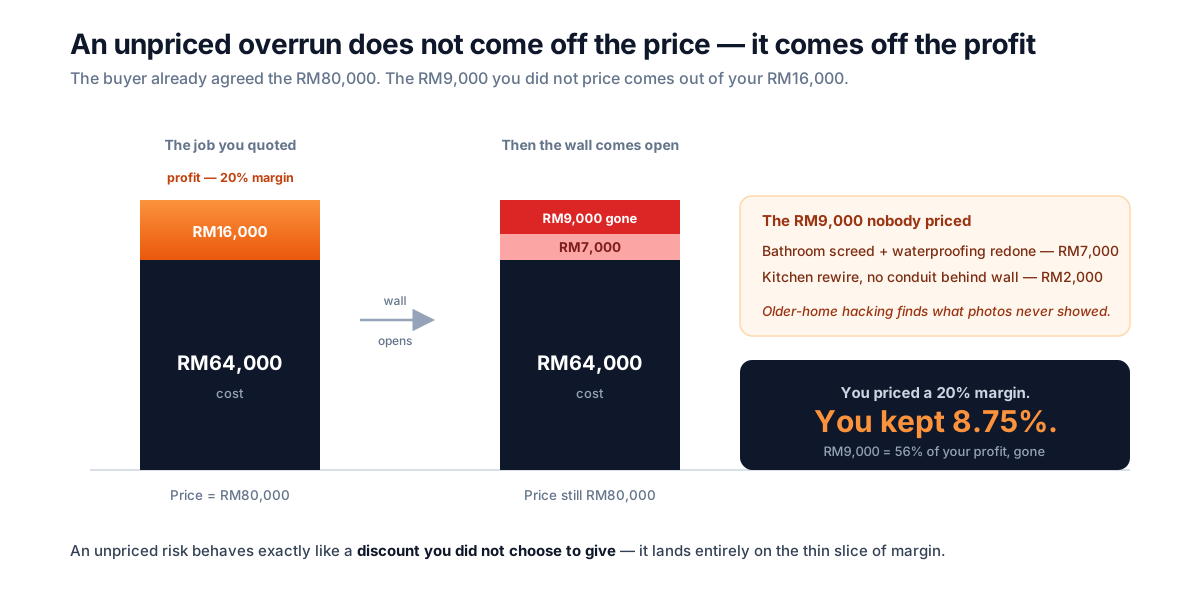
This is exactly the arithmetic behind what a discount really costs you, arriving through a different door. A "boleh kurang?" discount lands on your margin because you chose to give it; a hidden defect lands on your margin because you didn't choose to price it. Either way, the thin slice of profit absorbs the whole hit. And as the markup-versus-margin math shows, if you also built the price on a markup instead of a margin, that slice was thinner than you thought before the wall ever opened.
How big does an overrun have to be to matter? Smaller than you'd like — and it scales with how thin your margin already is.
| Your gross margin on an RM80k job | Overrun that halves your profit | Overrun that wipes it out |
|---|---|---|
| 15% (RM12,000 profit) | RM6,000 | RM12,000 |
| 20% (RM16,000 profit) | RM8,000 | RM16,000 |
| 25% (RM20,000 profit) | RM10,000 | RM20,000 |
On a 20 percent margin job, an unbudgeted overrun of RM16,000 — one bad bathroom, some rewiring, and a floor that needs levelling — takes you to zero. That's why "we'll absorb it if something comes up" is not a plan. It's a coin toss with your whole profit on the table.
How much contingency should the quote actually carry?
Tier it to how much the job can hide — a flat percentage is wrong in both directions at once. The single most common mistake after pricing no contingency is pricing the same contingency on every job: "just add 15 percent." That number over-prices your safe work and under-prices your risky work, so you lose the easy bids and blow up the hard ones.
The risk isn't spread evenly. A newly handed-over unit has nothing aged behind its walls; a 1970s house that's been renovated twice by unknown hands is a lucky dip. Malaysian renovation guides converge on the same tiers when advising homeowners how much to set aside — and the same logic tells you what to price in:
| Job type | Hidden-condition risk | Contingency to price in |
|---|---|---|
| New / recently handed-over unit, cosmetic (paint, light fit-out) | Very low — nothing behind the walls has aged | ~5% |
| Mid-range full reno, unit under ~15 years old | Moderate — some wet-area and wiring unknowns | ~10% |
| Older home (pre-2000), wet-area hacking, structural, unknown prior work | High — screed, waterproofing, wiring, termite, rot | 15–20% |
| Takeover / rescue of an abandoned job | Highest — you inherit shortcuts you can't see | Price after a paid assessment, never off photos |
Those bands aren't invented. Malaysian renovation cost guides advise homeowners to "always set aside 10 to 15 percent for hidden issues like old wiring, leaks behind tiles or unforeseen hacking, especially in homes built before 2000," and put the "industry standard for structural discoveries at 15 to 20 percent" (EverKitchen, ClickBina). In construction estimating more broadly, contingencies run about 5 percent for new build and 7 to 8 percent for renovation precisely because renovation carries more unknowns than new work. The point isn't the exact figure — it's that a firm quoting the same buffer on a new-condo repaint and a pre-war shophouse gut is mispricing both.
What's the smart way to size it — a premium, not a guess?
Price contingency the way an insurer prices a policy: expected cost across many jobs, not the worst case on one. This is the part almost no one does deliberately, and it's what separates a firm that prices risk from one that gambles on it.
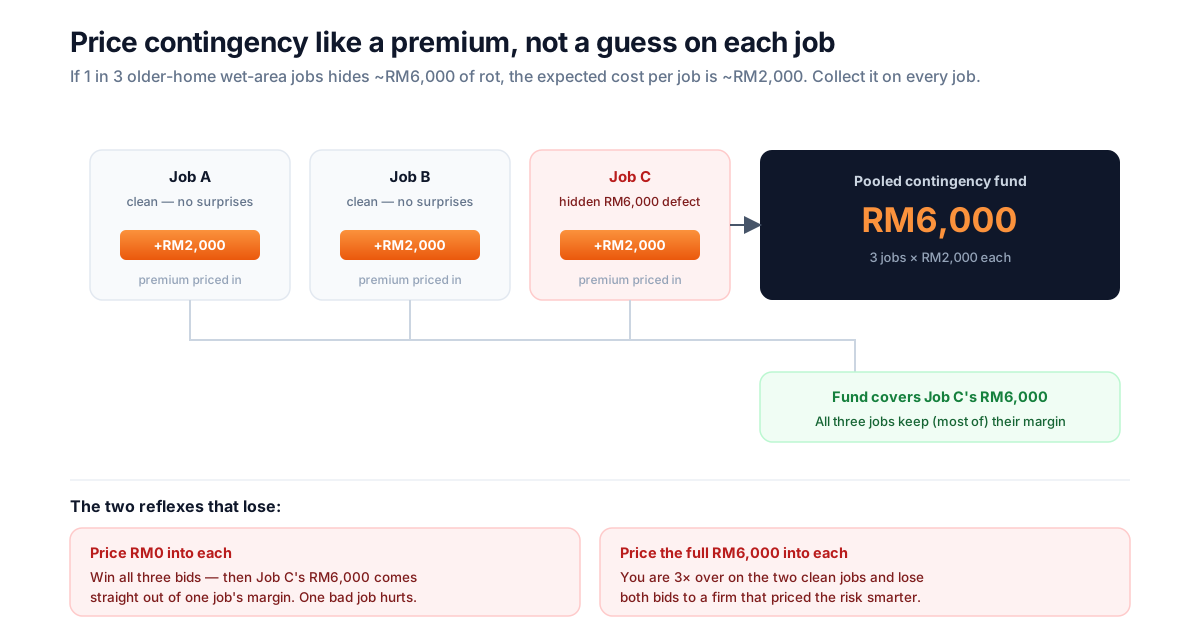
Here's the logic. Suppose that across your older-home wet-area jobs, roughly one in three hides serious screed-and-waterproofing rot costing about RM6,000 to put right. The expected hidden cost on any one of those jobs isn't RM6,000 and it isn't zero — it's the probability times the cost: one-third of RM6,000, or about RM2,000. Price a RM2,000 allowance into every job of that type — roughly 3 percent on an RM64,000 cost base — and you've collected a pool of RM6,000 across three jobs. That pool pays for the one that goes bad, and all three keep their margin. The two clean jobs quietly funded the disaster on the third. That's self-insurance across your own portfolio.
Now look at the two reflexes that lose, side by side with this:
- Price RM0 into each (the win-the-bid reflex). You take all three jobs, then Job C's RM6,000 comes entirely out of one job's margin. You didn't spread the risk; you concentrated it onto whichever unlucky job hit it.
- Price the full RM6,000 into each (the never-get-burned reflex). You're now three times over on the two clean jobs. A buyer comparing three to five quotes lines you up against a firm that priced the risk smarter, and you lose both easy bids to protect against a defect that mostly won't appear.
The expected-cost approach sits between them: enough to fund the real rate of trouble, not so much that you're uncompetitive on the jobs that go clean. It requires one thing most firms don't yet have — a rough sense of how often each kind of job actually springs a surprise, and how much it costs when it does. Which is a records problem, and we'll come back to it.
Why does a fat contingency lose the bid — and how do you carry it instead?
Because in Malaysia's price-shopped renovation market, a visible padded line is an invitation to negotiate it away — and how you carry the risk matters as much as how much. The buyer isn't just comparing totals; serious homeowners collect three to five itemised quotes and read them line by line, trained by a thick local ecosystem of renovation-scam warnings to be suspicious of anything that looks like padding.
Put a bald "Contingency: 15% — RM12,000" on your quote and you've handed the buyer a line to strike. "Cannot ah, remove that one, other contractor don't have." Now you either drop it and carry the risk unpaid, or defend an abstract buffer against a competitor whose quote simply didn't show one. Either way, the visible line worked against you.
The better move is to build a sensible allowance into your rates so the risk is priced without being a target, and to be precise about the genuinely unknowable items rather than padding across the board. For work you truly can't scope until you open it up — waterproofing to existing screed, rewiring behind an old wall — use a clearly labelled provisional sum: "Bathroom waterproofing to existing screed — provisional RM3,500, subject to condition on hacking, confirmed before work proceeds." That reads as competence, not expense. It tells the buyer you know exactly where the unknowns are, protects you when the screed is rotten, and — because it's tied to a condition, not a mood — survives the line-by-line comparison a flat buffer doesn't.
What about material prices moving between the quote and the build?
That's a second, separate risk from hidden defects — the gap between your price when you quote and your cost when you actually buy — and in Malaysia it runs in more than one direction. A renovation quote can sit for weeks while the buyer compares firms and waits on a loan, and only when the deposit clears do you place the material orders. If prices moved in between, the movement comes out of the same margin slice.
The numbers move, but not uniformly. Malaysian material prices in 2025 and 2026 have been mixed: steel reinforcement bar drifted down a few percent year on year as Chinese mills exported aggressively into a soft regional market, while cement rose roughly 2 to 6 percent year on year (highest in Pahang at +6.1%), per the Department of Statistics Malaysia's building-materials cost indices. CIDB put overall construction tender price growth at about 3 percent for 2024. On top of the materials themselves, RON95 and diesel subsidy rationalisation raised delivered cost — unsubsidised diesel adds several ringgit per tonne-kilometre to bulk material haulage. Steel falling doesn't help you if your job is cement, tiling and labour heavy.
You don't need to forecast commodity markets. You need two cheap defences: a small price-movement allowance on material-heavy jobs, and a quote-validity clause — "prices held for 30 days from the date of this quote" — so a buyer who signs three months later re-confirms against current rates rather than locking you into last quarter's costs. Both are contingency by another name: pricing a risk you can see coming instead of hoping it doesn't arrive.
Why is this a lead-management decision, not just an estimating one?
The contingency lives in your quote, but whether you priced it right depends on things you learn at the lead stage — long before the estimator opens a spreadsheet. Two facts decide almost the whole risk tier: how old the property is and how much wet-area or structural hacking the job involves. Both are knowable from the first WhatsApp conversation, if you capture them.
The reflexive way firms work today, that context is scattered — a photo here, a "1970s house near Cheras" there, a voice note about "want to hack the whole kitchen and two bathrooms" that never makes it into the quote brief. So the estimator prices off an incomplete picture, defaults to a flat number or no number, and discovers the risk on site. The fix isn't more software cleverness; it's making sure the risk signals a lead already gave you actually reach the person pricing the job.
That's the honest boundary on where a system helps. HotLead doesn't estimate your job or set your contingency — the risk call is your expertise, and no tool should pretend otherwise. What it does is capture and tag every enquiry so the property age, scope and condition a buyer mentioned are attached to the lead, not lost in a chat; qualify on the first reply so a high-risk older-home gut is flagged before you quote it like a fresh condo; and keep the provisional-sum-and-condition conversation a tracked next action instead of a forgotten promise. Over time its funnel and per-channel records are also what let you answer the pooled-premium question — how often do older-home jobs from this source actually spring a surprise, and how much did it cost? — so your contingency stops being a guess and becomes a number you've earned the right to.
The firms that survive their own busy years aren't the ones who never hit a hidden defect. They're the ones who priced the risk before they signed, carried it where the buyer couldn't strike it out, and knew — from their own records, not a blog's rule of thumb — how big the buffer needed to be.
Pricing the risk is one half; managing the leads that reveal it is the other. Start with the complete guide to managing renovation leads in Malaysia, then read what a discount really costs you, why a busy firm can still feel broke, and how to handle the mid-job "can you also" add-on. For contractors, the same risk logic runs through the construction lead playbook.
Sources: ConsensusDocs, Procore and the Construction Contracts Guy on contractor-versus-owner contingency and change orders; Young Architect on typical construction contingency percentages (~5% new build, 7–8% renovation); EverKitchen and ClickBina on Malaysian hidden-cost norms (10–15% older homes, 15–20% structural discoveries) and the defects that hide behind older walls; Department of Statistics Malaysia building-materials cost indices (steel down, cement +2–6% YoY) and CIDB on ~3% tender-price growth for 2024. House figures (RM80k job, RM64k cost, RM16k gross profit, 18–25% MY residential gross margin, one-in-three older-home defect rate) are consistent across this series and illustrative, not sourced to any single external claim.
Frequently asked questions
How much contingency should a renovation firm add to a quote in Malaysia?
It depends on how much the job can hide, so tier it rather than using one flat number. Cosmetic work on a new or recently handed-over unit carries very little hidden-condition risk, so around 5 percent is enough. A mid-range full renovation on a unit under about 15 years old sits around 10 percent. An older home — pre-2000, with wet-area hacking, unknown prior workmanship or structural work — should carry 15 to 20 percent, which matches what Malaysian renovation guides advise homeowners to set aside for structural discoveries. The contingency covers hidden site conditions you could not see when quoting, not changes the client asks for later, which are separate variation orders.
What is the difference between contractor contingency and owner contingency?
Contractor contingency is money you build into your own quote to cover risks you carry — hidden site conditions, small estimating gaps, the difference between what you could see and what the wall actually holds. Owner contingency is a separate reserve the client keeps for changes they decide to make along the way. The distinction matters because owner-requested additions and scope changes should be funded through variation orders and the client's own reserve, not absorbed by your contingency. If you let your risk line quietly cover the client's change-of-mind requests, you have priced for hidden defects and paid for scope creep instead.
Why does an unpriced overrun come out of my margin instead of the price?
Because the price is already fixed the moment the buyer agrees the quote. If you did not price a contingency and hacking reveals rotted screed or wiring with no conduit, the extra cost does not raise the number the client owes — it lowers the profit you keep. On an RM80,000 job costing RM64,000 you have RM16,000 of gross profit; a RM9,000 hidden defect leaves RM7,000, so a job you priced at a 20 percent margin returns 8.75 percent. This is the same leverage as a discount — the overrun lands entirely on the thin margin slice, which is why an unpriced risk is a discount you did not choose to give.
Won't adding a contingency make my quote too expensive to win?
Only if you carry it wrong. A large, visible "contingency 15 percent" line is easy for a buyer comparing three to five quotes to question or strike out, and a padded round number makes you look like the expensive option. The fix is to size the allowance sensibly using expected cost, not the worst case, and to build it into your rates rather than bolting on a fat line. For genuinely unknowable items — waterproofing to existing screed, rewiring behind an old wall — use a clearly labelled provisional sum subject to condition on hacking, so the buyer sees you are being precise, not padding. That reads as competence, not expense.
How do Malaysian material price changes affect the contingency in a quote?
They add a second, separate risk from hidden defects — the gap between the price when you quote and the cost when you actually buy. Malaysian material prices in 2025 and 2026 have been mixed and still move — steel reinforcement bar has drifted down a few percent year on year while cement has risen roughly 2 to 6 percent, and diesel at unsubsidised rates after subsidy rationalisation has added to delivered material cost. Because a renovation quote can sit for weeks before the deposit clears and you order, a small price-movement allowance or a short quote-validity clause — for example, prices held for 30 days — protects the margin you priced from being eroded before the job even starts.
Keep reading
- The Three Numbers That Predict Your Next Quarter of Renovation LeadsYour paid-lead numbers tell you about this month. Reviews earned per won job, your referral rate and your repeat rate tell you about next quarter — they're leading indicators of the free pipeline most reno firms only notice once it dries up. Here's how to read the three trust numbers, why you should measure behaviour instead of a loyalty survey, and how to spot a dry quarter while there's still time to prevent it.
- A Main Contractor Just Asked You to Quote a Package. Qualify the Payer First.When another contractor WhatsApps you to price a trade package, it looks like the cleanest lead of the month — a pro who knows what he wants. It's actually your riskiest, because the risk isn't the project, it's the payer. Here's how to handle it.
- 15 Live Leads, One Free Hour: Which Renovation Lead Do I Call First? I Let AI Rank My MorningA Kajang contractor opens WhatsApp at 8:40am with 15 live leads and one free hour before he's on-site in Semenyih. Who does he call first? The 2026 reflex is to ask AI to score the pipeline and rank the hot ones. I built it. The score read like data, so he worked the list it gave him for a week — and it quietly buried his best lead at the bottom. Here's why a confident 0-to-100 score is worse than no score, and the honest way to order a morning that actually earns its keep.