

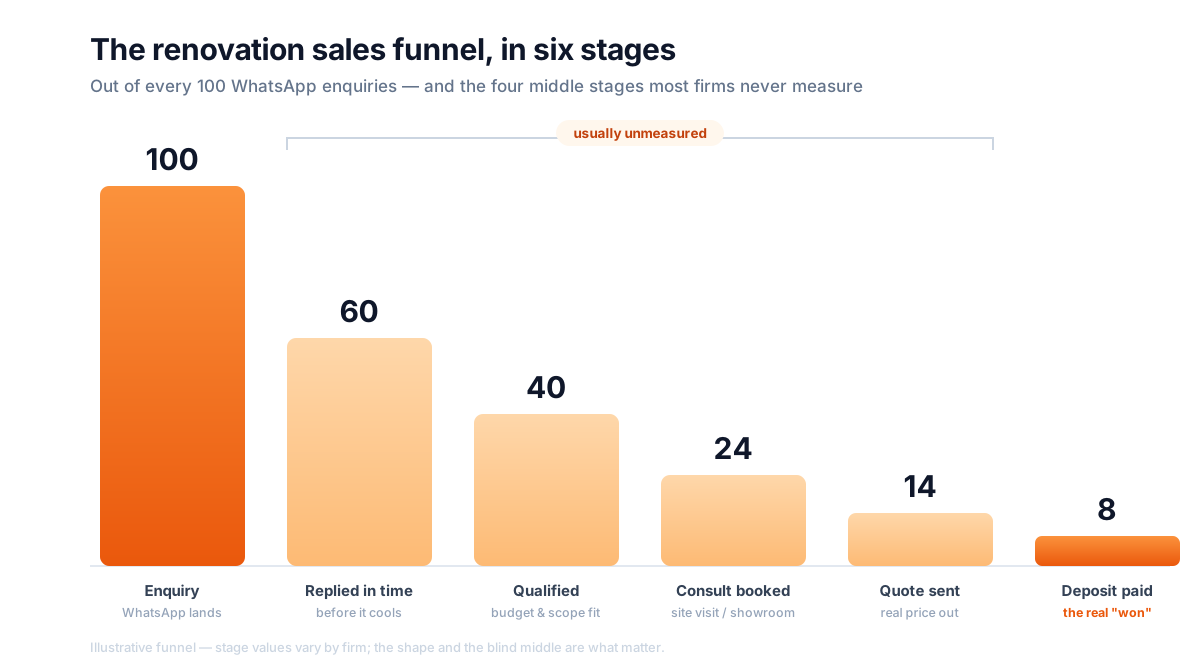
A renovation lead does not jump straight from "enquiry" to "won." It travels through six distinct stages — and the uncomfortable truth is that most Malaysian reno firms measure exactly two of them: a lead came in, and a job did or didn't happen. Everything in between is a black box.
A sales funnel is simply that journey, broken into countable stages so you can see where leads fall out. Get the stages right and your messy WhatsApp inbox becomes a pipeline you can actually manage. Get them wrong — or skip them — and you're flying blind on the most expensive asset your firm has: the enquiries you already paid for.
What is a sales funnel for a renovation business?
A sales funnel is the path an enquiry takes from first contact to paid job, split into stages that get smaller as you go. For a renovation firm it runs from a WhatsApp message to a cleared deposit, with measurable steps in between. The point of naming the stages is simple — you can only fix a leak you can see.
It's called a funnel because it narrows. A hundred people message you; far fewer become jobs. That narrowing is normal and healthy. What's not healthy is not knowing where the narrowing happens — because the stage that leaks the most is the one cheapest to fix.
What are the six stages of a renovation sales funnel?
Here's the full funnel for a Malaysian renovation or interior-design firm, with what each stage measures and what makes it leak:
| # | Stage | What it measures | Why it leaks |
|---|---|---|---|
| 1 | Enquiry | A lead lands — FB/IG ad, Qanvast, Recommend.my, referral, Maps | Nothing yet; this is your top of funnel |
| 2 | Replied in time | You answered before the lead went cold | Salesperson on a site visit; lead sits unseen for hours |
| 3 | Qualified | Budget, scope and timeline are a real fit | No questions asked, so tyre-kickers and real buyers blur together |
| 4 | Consultation booked | A site visit or showroom appointment is set | The chat never converts into a real-world meeting |
| 5 | Quote sent | A genuine price or proposal goes out | Quote promised "next week," then forgotten |
| 6 | Deposit paid | The client commits with money — the job is real | Verbal yes, then silence; no follow-up to close |
Notice that only stages 1 and 6 produce an obvious event — an enquiry buzzes your phone, and a deposit hits your account. Stages 2 to 5 leave no trace unless you deliberately track them. That's the gap this whole article is about.
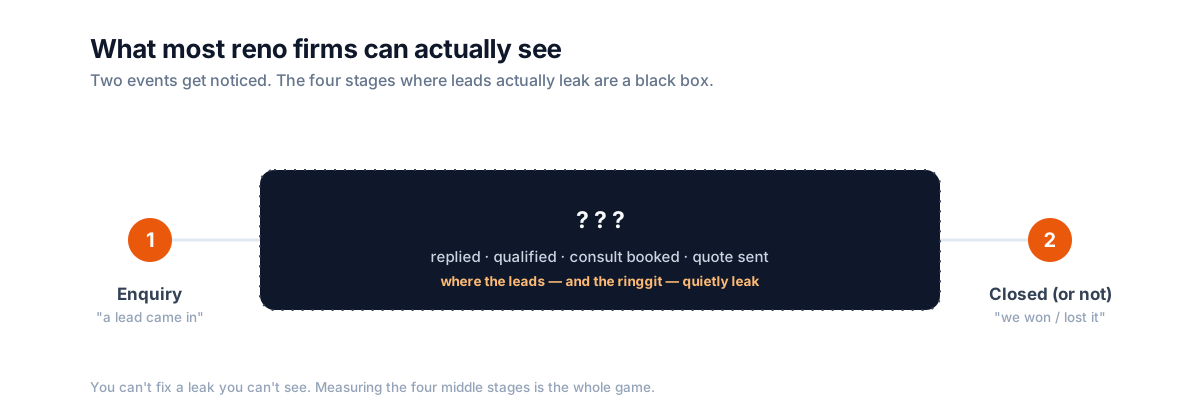
Why are the four middle stages where the money leaks?
Because that's where leads actually die — and almost nobody is watching. The popular belief is that you lose deals at the price stage, when a client balks at the quote. The data says otherwise: most renovation leads are lost long before a price is ever discussed, in the silent gaps between reply, qualify, consult and quote.
Consider what the benchmarks tell us about stage 2 alone. The first firm to respond wins about 78% of deals, the average business takes 47 hours to reply, and calling within the first minute can lift conversion by around 391% versus the second minute. A lead that sits in a shared WhatsApp number for a day hasn't been "lost to price" — it's been lost at stage 2, before anyone even tried.
The same logic applies at stage 4. A WhatsApp conversation that never becomes a booked site visit almost never becomes a job — the consultation is where a curious browser turns into a committed buyer. Yet "did this chat convert into a booked appointment?" is a number most firms have never once calculated.
Which stage leaks the most for a renovation firm?
For most Malaysian reno firms, the biggest single drop is between Enquiry → Replied in time (speed) and Consultation booked → Quote sent (follow-through). The earliest leak compounds hardest, because every later stage depends on it.
Think about a real example. A Petaling Jaya interior-design studio runs Meta ads and also gets enquiries through Qanvast — the platform over 95,000 Malaysian homeowners have used since 2013 to find a designer. The leads are genuinely good. But the two salespeople share one WhatsApp number, and during a busy month the Mont Kiara condo enquiry that came in at 2pm doesn't get a reply until the next morning. By then the homeowner has already booked a consultation with the firm that answered in ten minutes.
This is why a funnel view changes decisions. Without it, the studio assumes it needs more leads. With it, they realise they need to plug stage 2 first — a far cheaper fix than buying more enquiries to pour into a leaky pipe. (If you suspect one person is the leak, here's how to find which salesperson is dropping leads.)
Why is "deposit paid" the only honest definition of "won"?
Because in renovation, everything before the money can still fall through. A client who says "okay, let's go ahead" on WhatsApp has not committed. A quote you've sent can be ghosted while they compare two more firms. Malaysian renovation work is paid in stages, and the first stage — the deposit on signing — is the moment intent becomes a binding job.
This matters for your funnel in two ways:
- It keeps your forecast honest. If you mark deals "won" at the verbal-yes stage, your pipeline looks healthier than your bank account. Counting "won" at the deposit aligns the two.
- It exposes a real, separate leak. The gap between Quote sent → Deposit paid is its own stage with its own follow-up problem. Around 80% of sales need five or more follow-ups, yet most salespeople quit after one or two. Plenty of quotes that would have converted simply never got the fifth nudge.
A sent quote is not a won job. It's a stage-5 lead waiting for a stage-6 follow-up. Treat it that way and you'll close deals your competitors already wrote off.
How long should a renovation funnel take to close?
Expect weeks, not days. Home-services sales cycles average around 60 days, and full renovations often run longer — clients compare quotes, sort out financing, and align the family on scope and timeline. That long window is not a problem to be rushed; it's the reason follow-up wins.
The mistake is treating a slow funnel as a dead one. A lead that's gone quiet for a week hasn't necessarily said no — they may be mid-decision. The firm that keeps a polite, scheduled nudge in front of them through that 60-day window is the one holding the relationship when the client finally commits. Speed gets you into the funnel; persistence gets you out the bottom.
How do you actually measure your funnel?
You don't need analytics software to start — you need to count four drops. For one month, tally the count at each stage and look at the percentage that survives to the next:
- Enquiries → Replied in time. What share did you answer quickly? (Your speed leak.)
- Replied → Consultation booked. What share turned into a real appointment? (Your qualifying leak.)
- Consultation → Quote sent. What share got a genuine price? (Your follow-through leak.)
- Quote → Deposit paid. What share actually committed? (Your closing leak.)
The biggest drop is your priority. Fix the earliest big leak first, because everything downstream multiplies off it — improving stage 2 lifts every stage after it for free.
The catch is that a shared WhatsApp number and a spreadsheet show you none of these numbers reliably — the spreadsheet only works if a busy salesperson updates it religiously, which is exactly what falls apart in a busy month. That's the practical case for a lightweight system: not more features, just an honest, automatic view of where your funnel actually leaks.
How HotLead fits in
HotLead is built to make this funnel visible for Malaysian renovation, interior-design and construction firms. It sits on top of the WhatsApp you already use and:
- Captures every enquiry and gives each lead one clear owner, so stage 2 stops leaking to "I thought you replied."
- Keeps the next follow-up in front of your team with overdue nudges, so quotes reach the fifth contact instead of dying at the first.
- Shows you the funnel — enquiries, quotes, wins and the drop-offs between them — and your per-channel ROI, so you can see which stage and which source actually leak.
The goal is the one this article is about: stop losing jobs you already paid to find. Start with the complete guide to managing renovation leads in Malaysia, see the renovation lead playbook or the interior-design version, or see how HotLead works.
Sources: Estatehub and WebFX 2026 home-services lead-conversion benchmarks (overall 7.8%; remodeling 3–7% band); WebFX / industry data on home-services sales-cycle length (60 days); MIT / Dr. James Oldroyd and Harvard Business Review, "The Short Life of Online Sales Leads" on response time and the first-responder advantage; Velocify on the first-minute conversion lift; Qanvast Malaysia (homeowners served since 2013); PropertyGuru and Houz Malaysia 2026 renovation-cost guides (condo and terrace job values); Ken Research / Euromonitor on Malaysia's home-improvement market.
Frequently asked questions
What is a sales funnel for a renovation business?
It's the path a renovation enquiry travels from first WhatsApp message to a paid job, broken into measurable stages — enquiry, replied in time, qualified, consultation or site visit booked, quote sent, and deposit paid. Each stage has fewer leads than the one before, and the drop between any two stages shows you where you're losing work.
What are the stages of a renovation sales funnel in Malaysia?
Six practical stages. An enquiry lands (usually on WhatsApp, from ads or a platform like Qanvast); you reply before it cools; you qualify the budget, scope and timeline; you book a consultation or site visit; you send a real quote; and the lead pays a deposit. Most firms only notice the first and last — the four in the middle are where leads quietly go cold.
What is a good lead-to-sale conversion rate for a renovation firm?
Across home-improvement and remodeling firms, industry benchmarks put overall enquiry-to-sale conversion around 7–8%, with remodeling specifically in the 3–7% band. Your own number depends heavily on lead quality and response speed — a firm that replies in minutes and follows up consistently can sit well above a firm relying on a shared inbox and memory.
When is a renovation lead actually "won"?
When the deposit clears — not when the client says "okay let's do it" and not when you've sent the quote. Malaysian renovation work is paid in stages starting with a deposit on signing, and a verbal yes or an un-signed quote can still fall through. Tracking "won" at the deposit keeps your funnel honest and your forecast real.
How long does a renovation sales funnel take to close?
Home-services sales cycles average around 60 days, and full renovations often run longer because clients compare quotes, arrange financing and align on scope. That long window is exactly why follow-up matters — most jobs are won between the fifth and twelfth contact, not on the first reply.
Keep reading
- Did We Already Say RM68k? Using AI to Stop Quote Drift Across a Long Renovation ThreadOver a weeks-long WhatsApp thread with two or three quote revisions, a rep re-states a number that contradicts an earlier promise — and re-opening a settled price quietly invites a discount that eats a whole job's profit. So I pointed AI at the drift. It works beautifully as a flag, and dangerously as an auto-corrector.
- The Warranty as a Closing Lever: Why a Longer Guarantee Beats a Discount on a Renovation DealA quote is stalling and the buyer wants a reason to say yes. Before you drop the price, look at the other lever in your hand — a longer workmanship warranty. It is the same expected-value decision as a discount, but the math runs the opposite way — a price cut costs you thousands with certainty, while extending the defects cover costs you a couple of hundred ringgit in expectation, for arguably more trust with a scam-wary buyer. Here is the EV case for the non-price concession, the trap that turns it into a hidden liability, and which leads it actually moves.
- "Can You Just Build It, My Neighbour Also Did" — Handling the Renovation Lead That Needs Council Approval FirstSome renovation enquiries can't legally start next month, no matter how ready the buyer is — a kitchen extension, a hacked-through wall, a roofed-over air well all need the council's written approval first. Quote a fast build price to win the job and you either lose it to a "boss, can start" cowboy, or win it and inherit the stop-work order, the RM50,000 fine and a client who later can't sell the house. Here's how to spot the permit-first lead and sell the approval as protection.