

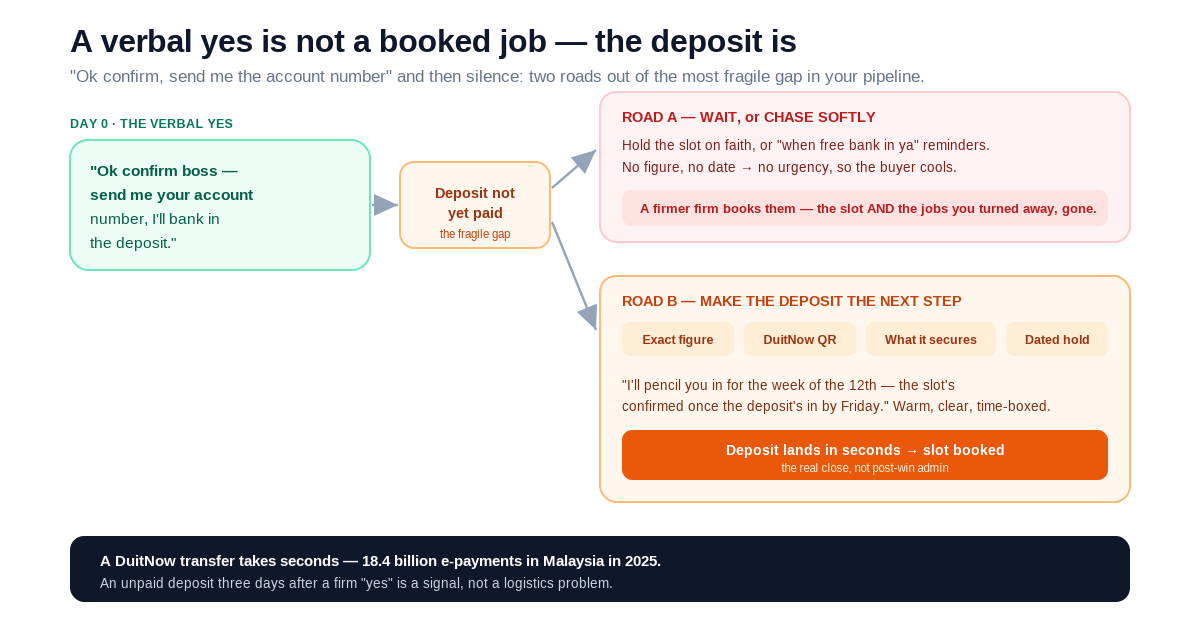
Every renovation and interior-design firm owner knows this message, and the awful quiet that follows it.
You've done everything right. Fast first reply, a good site visit, a quote they liked. Then the buyer sends the sentence you've been working toward: "Ok boss, confirm. Let's go. Send me your account number, I'll bank in the deposit." You send the details, maybe with a little thank-you. You pencil them into the week they wanted. You tell your crew that slot's taken.
And then… nothing. No transfer. Day one, you assume they're busy. Day two, you don't want to seem desperate. Day three, you're staring at the chat wondering: do I chase — and risk looking pushy, killing the goodwill of a buyer who literally just said yes? Or do I wait — and hold that slot open on faith while two other enquiries I could have booked go cold?
Here's the hard truth that unlocks it: a verbal yes is not a booked job. The deposit is. The firm that treats "send me the account number" as the finish line keeps losing jobs it genuinely believes it won — because the real close, the thing that actually locks the calendar and the commitment, is money landing in the account. Until it does, you don't have a job. You have a very warm, very fragile lead sitting in the most dangerous gap in your whole pipeline.
Why does a verbal yes feel like a booked job when it isn't?
Because the words sound final, and because you want them to be. "Confirm, let's go" lands like a handshake, so your brain files the job as won: you update the pipeline, you turn down the next enquiry for that week, you mentally spend the deposit. The problem is that in a WhatsApp reno conversation, "ok confirm" almost always means "I'm interested and I've decided you're my firm" — not "I am committing right now, today, with money." Those are two different moments, and the gap between them is where winnable jobs quietly die.
A Malaysian buyer saying yes on WhatsApp is still, very often, holding your quote alongside two or three others. Qanvast lets a homeowner shortlist up to five firms at once; serious buyers compare in parallel. So a verbal yes to you can genuinely coexist with a "let me think" to someone else — and whoever makes paying easiest and clearest often wins the real commitment, not whoever got the first "ok confirm." The yes is real. It's just not binding, and it's not exclusive, until the deposit lands.
This is the same trap as the buyer who goes silent after a great meeting — but with one crucial difference. There, the buyer never said yes, so you're reading cold tea leaves. Here, they did say yes, which makes the silence more confusing and the freeze worse: it feels rude to chase someone who just committed. That feeling is exactly what lets the deposit drift.
In Malaysia, an unpaid deposit after three days is a signal — not a logistics problem
This is the part most owners get backwards, and it's the most useful thing in this article. We instinctively treat a missing deposit as a logistics issue — "they haven't gotten around to it," "maybe the bank's slow," "they'll do it this weekend." In a lot of countries, with cheques and bank drafts and three-day clearing, that would be fair. In Malaysia, it isn't.
Paying a deposit here is one of the most frictionless acts in daily life. Malaysia ran 18.4 billion e-payment transactions in 2025 — a 25% jump from 14.7 billion the year before, per Bank Negara Malaysia, and the country now averages 538 cashless payments per person a year. DuitNow transfers are instant, free to the sender, and need nothing more than a phone number or a QR scan — DuitNow QR volume alone more than doubled to 3 billion transactions in 2025. The same buyer who hasn't "found time" to bank in your deposit has almost certainly DuitNow-ed a kopi, a Grab ride, and their share of last night's dinner in the time you've been waiting.
So when a firm "yes" doesn't turn into a transfer within a couple of days, the honest reading usually isn't they couldn't. It's they haven't decided to yet — they're still comparing, waiting on a spouse or a loan, or the yes was softer than it sounded. That reframe changes your whole response. You stop politely waiting for a logistics problem to resolve itself (it won't) and you start gently resolving the real one: helping them cross from interested to committed. The deposit isn't the admin that follows the decision. For a Malaysian buyer, transferring the deposit IS the decision — made visible in the one currency that can't be faked.
What does holding a slot open on faith actually cost you?
More than the one job, because the cost compounds silently. When you treat a verbal yes as booked and hold the calendar slot for a deposit that never comes, you pay twice.
First, the opportunity cost of the slot. Your crew-weeks are physically finite — you can only build so many jobs at once. Hold a week in June for a buyer who ghosts the deposit, and the two genuine enquiries you brushed off ("sorry, we quite full that period") have already booked someone else. You didn't lose one job; you lost the real one and turned away the replacements. On the house numbers we use across this series — a typical RM80,000 job at a ~20% gross margin is RM16,000 of gross profit — a single phantom booking that blocks a real job is a four- or five-figure hole that never shows up on any report, because it looks like you were simply "full."
Second, the cost of soft chasing. The other reflex — not holding firm, but nagging gently — leaks differently. "Hi, just checking, whenever free can bank in the deposit ya 🙏" every few days does two bad things: it trains the buyer that your slot isn't really scarce (so there's no urgency to pay), and it slowly spends your goodwill on a drip of low-status reminders. Weeks pass, the buyer cools, and a firm that asked clearly — "here's the figure, here's the QR, the slot's held till Friday" — closes them while you're still sending polite question marks.
| Hold the slot on faith | Chase softly forever | Make the deposit the next step | |
|---|---|---|---|
| What you do | Assume "confirm" = booked, block the week | Send gentle reminders, no number, no date | Exact figure + DuitNow QR + what it secures + a dated hold |
| Signal to the buyer | None — they feel no urgency | "Our slot isn't really scarce" | "This is a normal, easy, time-boxed step" |
| Who wins the job | Whoever asks them firmly next | The firmer competitor, eventually | You — paying is one tap and the clock is honest |
| The hidden cost | The slot and the jobs you turned away | Weeks of drift + spent goodwill | None — it either pays or frees up fast |
How do you ask for the deposit without killing the goodwill?
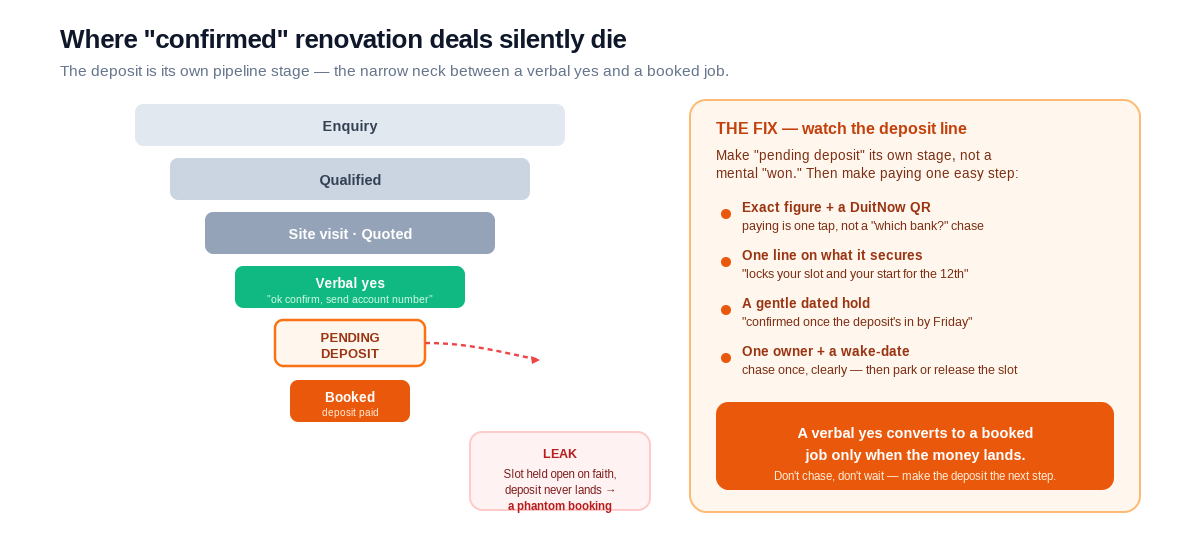
You make paying the clear, easy, obviously-normal next step — and you put a gentle, honest clock on it. The whole skill is replacing a vague wait with a specific move. When the buyer says "ok confirm, send me the account number," your reply isn't just the account number. It's five small things bundled into one warm message:
- The exact figure, not "the deposit." "The booking deposit to lock your slot is RM___." A named number is payable; "the deposit" is a to-do for later.
- Friction-free payment. A DuitNow QR they can scan, or the account number and name ready to paste. In a country of 538 cashless payments per person, your job is to make paying take ten seconds, not ten minutes of asking which bank.
- What it secures — in their terms. "This holds your slot and locks your start for the week of the 12th." People pay for their outcome (a confirmed start), not for your cash flow.
- A gentle dated hold. "I'll pencil you in for the week of the 12th — the slot's confirmed once the deposit's in by Friday." This is the quiet engine of the whole thing: it makes the scarcity real and honest without a single pushy word. It's not a threat; it's just true.
- One owner, warm tone. The same person who's been in the chat sends it, sounding like a partner helping them move forward — not an accounts department issuing an invoice.
Notice what this isn't. It isn't "when free bank in ya" (no figure, no date, no urgency). And it isn't "PLEASE TRANSFER TO CONFIRM OR WE RELEASE YOUR SLOT" (pushy, cold, desperate). It's the same clarity the buyer gave you when they asked for your account number, handed back. A real buyer finds this reassuring — it's a firm that clearly knows its process. The only buyer it unsettles is the one who wasn't actually ready to commit, and that's information you want now, not after you've turned away two jobs.
What if they've genuinely said yes but still don't pay?
Then you stop holding the slot on faith, and you move the lead to a dated parked state instead of chasing it weekly. Ask clearly once, the way above. If the deposit still isn't in by the hold date, send one warm, face-saving release: "Totally understand timing can be tricky — I can't hold the week of the 12th past Friday as others are asking for it, but the moment you're ready just ping me and I'll find you the next good slot." Then free the calendar so a paying job can take it, and set a single wake-date to check back later.
This does three things at once. It protects your crew-weeks (the real constraint on how much you can sell). It keeps the door genuinely open without a drip of needy reminders — you've been gracious, not pushy, so the relationship survives. And it forces honesty into your pipeline: a said-yes-didn't-pay lead is no longer quietly sitting in your head as "confirmed," silently blocking the jobs behind it. As with the diminishing returns of following up, the move that pays isn't chasing harder — it's parking cleanly and getting on with real work.
The trap to avoid at both ends: don't turn the deposit into a weeks-long negotiation, and don't pretend an unpaid "confirmed" job is revenue. The deposit line is where a lead is at once hottest and most fragile. Handle that moment with clear, warm, time-boxed structure, and you convert far more of your verbal yeses into booked jobs — and you stop losing the quiet, invisible war against your own calendar.
The bottom line
The lead that says "confirm, send me the account number" and then never transfers isn't a mystery, and it isn't a reason to freeze. It's the pipeline telling you that a decision hasn't fully crossed the line yet — and in a country where paying a deposit is a ten-second DuitNow transfer, that gap is about commitment, not logistics. The firm that treats the verbal yes as the finish line keeps mourning jobs it never actually had. The firm that treats the deposit as the close — asking for it clearly, easily and with a gentle dated hold the moment the buyer says yes — books the ones its rivals are still politely waiting on.
So don't chase, and don't wait. Make the deposit the explicit next step: the figure, the QR, what it secures, and an honest clock. Keep "pending deposit" as its own stage with one owner and a wake-date, so no said-yes-never-paid lead can drift in limbo or block a paying job. A verbal yes is a wonderful start. It just isn't the close — money in the account is.
For the whole system this sits inside — capture, qualify, quote, close and follow up — start with the complete guide to managing renovation leads in Malaysia. Read this alongside the buyer who ghosts after a great meeting, how much deposit a reno firm should actually ask for, and what a renovation sales funnel really looks like.
How HotLead helps you close the deposit gap
HotLead can't move money or have the conversation for you — the warm, clear ask is yours, and no tool can make a hesitant buyer commit. What it does is make sure a verbal-yes-no-payment lead can never quietly vanish into the gap between "ok confirm" and money in the bank:
- Tag a "pending deposit" stage, so a said-yes-didn't-pay lead is visibly its own thing, not mentally filed as "won" and forgotten.
- One named owner per lead, so the deposit ask is consistent, warm and time-boxed — sent by the person already in the chat, not improvised by whoever happens to pick up.
- A next action with a wake-date, so the deposit is chased once, clearly, by the hold date — then parked or released, never left drifting for weeks.
- A funnel view that shows the deposit line, so you can finally see how many "confirmed" deals die between the verbal yes and the paid deposit — usually a leak owners never knew they had.
If "confirm, send account number" keeps turning into silence and held-open slots that never pay, the problem isn't the buyer — it's that the deposit was treated as paperwork instead of the close. See how HotLead works, or how it fits a renovation firm or an interior-design studio.
Sources: Bank Negara Malaysia / PayNet — Malaysia recorded 18.4 billion e-payment transactions in 2025, up ~25% from 14.7 billion in 2024; Billplz — 538 cashless payments per person in Malaysia, 2025 digital-payments data; Fintech News Malaysia — DuitNow QR payment volume more than doubled to 3 billion transactions in 2025; PayNet processed 8.44 billion transactions in 2025 (The Star); Recommend.my — rules for hiring renovation contractors, including deposit norms and avoiding scams; deposit-range guidance (10–20% on signing, 30–40%+ a red flag, and a separate RM500–2,000 condo management reno deposit) is drawn from Malaysian consumer renovation guides (PropertyGuru, builder guides) and summarised in how much deposit a reno firm should actually ask for. The Qanvast up-to-five-firm shortlist behaviour and the house figures — a typical RM80,000 job at a ~20% gross margin (RM16,000 gross profit) — are as cited across this series. Deposit-size figures are consumer-guide conventions, not legal caps, and are used directionally.
Frequently asked questions
A buyer said 'ok confirm, send me the account number' but never transferred the deposit. Do I chase or wait?
You do neither of those two things as usually imagined — you make the deposit the clear next step and put a short, honest clock on it. Reply warmly with the exact figure, a DuitNow QR or account details, one line on what the deposit secures (the slot and the start date), and a gentle dated hold: 'I'll pencil you in for the week of the 12th — the slot's locked once the deposit's in by Friday.' That isn't pushy; it's the same clarity a buyer gives you when they ask for your account number. Silence ('wait and see') loses the slot to a firmer firm; soft nagging ('whenever free can bank in ya') lets the deposit drift for weeks. A specific, friction-free, time-boxed ask is the move that respects the goodwill and still books the job.
Isn't asking firmly for the deposit going to make me look desperate or kill the relationship?
No — being vague is what quietly costs you both. A buyer who genuinely said yes expects to pay a deposit; it's normal, and in Malaysia it's a ten-second DuitNow transfer. What reads badly is a firm that won't name a number or a date, because it signals you're unsure of your own process. Clarity reads as professionalism: the exact figure, what it secures, and when the hold expires. If a warm, qualified buyer cools because you politely asked them to confirm with a deposit, the commitment was never really there — and you've learned that now, before you turned away two other jobs for their slot.
How big should the booking deposit be, and when do I ask for it?
Ask for it the moment they say yes — the deposit is the close, not paperwork you do afterwards. On size, Malaysian consumer guides cluster at 10–20% of the job on signing, with anything above 30–40% treated as a scam red flag, so a sensible booking deposit sits inside that band (some firms take a smaller fixed booking sum to lock the slot, then the balance of the deposit on contract signing). If you're renovating in a condo or gated community, the management office often wants its own separate reno deposit, commonly around RM500–2,000 — that's not yours, so don't confuse the two. For the full reasoning on sizing, see our piece on how much deposit a reno firm should actually ask for.
What if they still don't pay after I've asked clearly?
Then you stop holding the slot on faith and move the lead to a dated 'parked' state rather than chasing weekly. Release the calendar slot so a paying job can take it, tell the buyer honestly and warmly that you can't hold it open but you'd love to work with them when they're ready ('totally understand timing — the week of the 12th is open to others now, but ping me when you want to lock a new slot and I'll sort it'), and set a wake-date to check back once. This protects your calendar, keeps the door open without desperation, and stops one unpaid 'confirmed' job quietly blocking the two real ones behind it.
Can HotLead take the deposit or chase it for me?
No — it can't move money or have the conversation for you; the ask and the warmth are yours. What it does is make sure a verbal-yes-no-payment lead can't vanish into limbo. You can tag a 'pending deposit' stage so a said-yes-didn't-pay lead is visibly its own thing, keep it with one owner so the follow-up is consistent and warm rather than improvised, and set a next action with a wake-date so the deposit is actually chased once and then parked or released — never left drifting. The funnel view then shows you how many 'confirmed' deals die at the deposit line, which is usually a leak owners never knew they had.
Keep reading
- Can AI Reply to Your Renovation Firm's 1-Star Review? I Built It — and the Risk Is How Fast It ApologisesA 2-star review on Google or Qanvast is the first thing your next renovation lead reads — and most firms either ignore it or fire back and make it worse. The 2026 reflex is to let AI write the reply. I built it, and drafting a calm response costs a fraction of a sen. But an AI tuned to be helpful apologises too fast — it will concede a fault in writing, promise a refund that never happened, and grovel to a fake review from a competitor. Here's the build that protects your rank instead of torching it.
- Which Lead Signals Actually Predict a Sale? Reverse-Audit Your Own Won JobsMost firms grade a renovation lead on signals that feel predictive — enthusiasm, a long message, a fast reply — and never check whether those signals actually separate won jobs from lost ones. Here is how to run a reverse-audit on your own closed deals, which signals usually survive it, and why your pipeline is too small to pretend the score is more than directional.
- The "I Only Deal With the Boss" Lead: When the Buyer Refuses Your TeamYou finally hired someone to share the load — then the buyer messages "can I deal with you direct ah, boss?" and refuses to engage your staff. Every big lead quietly re-centralises onto the one person already maxed out, and your firm can never grow past the owner. Here's why caving caps you, why a flat "my staff will assist" loses a nervous buyer, and the move that keeps both.