

Every renovation and interior-design firm in Malaysia eventually gets the same pitch, from Recommend.my, Qanvast, Atap, ServisHero or a "buy verified reno leads" Facebook operator: pay a small fee and a project enquiry lands in your inbox. Set that fee — often tens of ringgit — against the roughly RM2,025 it costs to win a customer through your own ads and sales time, and the maths looks obvious. Why grind on marketing when you can just buy the leads?
Because the price of a lead is not what it costs you. The number that decides this is cost per won job — the fee divided by the close rate — and a marketplace lead is built to make that close rate collapse. A bought lead is priced per lead, but most of them are shared with up to five firms at once, so you're in a speed race from the first second, and the same enquiry that would close well if it were yours alone closes far worse when four rivals got it too. This isn't a "never buy leads" argument. It's an argument for buying them with your eyes open, on the one number that matters and the one situation where they genuinely pay.
What are you actually buying when you buy a marketplace lead?
A shortlist ticket, not a job — and usually one shared with several rivals. That single fact reshapes every number that follows, so it's worth being precise about how the Malaysian platforms actually work before running any economics.
- Recommend.my takes a homeowner's request and, for a big project like a renovation, routes it to up to five pros who each quote. The firm pays in Recommend Credits as a "connection fee," deducted only when the customer responds to your quote — not up front, and not only when you win. So you can pay to "connect" on a job that ultimately goes to one of the other four.
- Qanvast matches a homeowner with a shortlist of up to five interior firms that fit their brief. As we've written before, a Qanvast or Atap enquiry is a shortlist ticket, not an order — you're being compared from the first message.
- Atap runs a Lead Marketplace where designers spend credits to contact property owners with verified project requirements — again, a lead available to be bought by more than one firm.
- ServisHero and general "buy verified leads" operators sit in the same family: a vetted marketplace that distributes a homeowner's request to multiple providers.
The common thread is non-exclusivity. With a rare exception, you are not buying the enquiry — you are buying the right to compete for it alongside up to four other firms who paid for the same right at the same second. That is a completely different product from a referral or a direct WhatsApp enquiry, and it has to be priced completely differently.
Why is the deciding number cost per won job, not the fee?
Because the fee measures what it costs to receive an enquiry, and enquiries don't pay you — closed jobs do. The number that ranks any lead source by profit is cost per won job = fee ÷ close rate, the same discipline that flips the ranking in cost per lead versus cost per job across your channels. Apply it to a marketplace lead and the "cheap fee" story falls apart, because the sharing attacks the denominator.
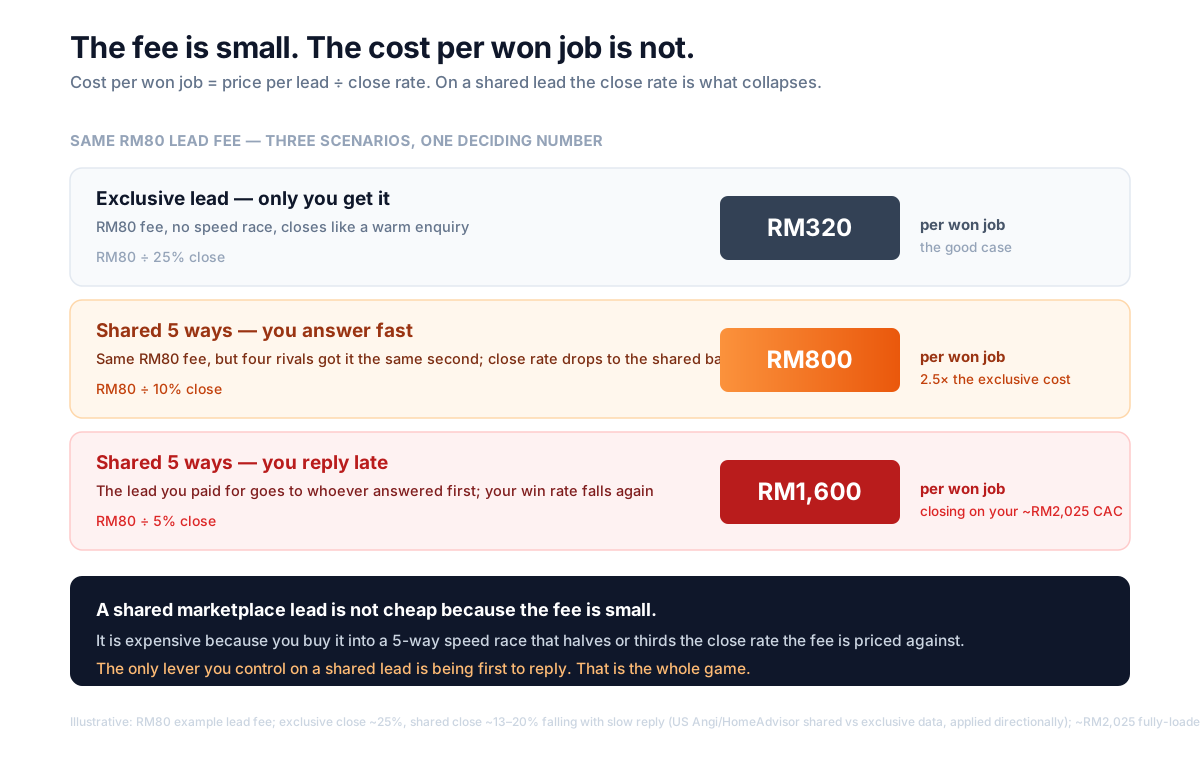
Take an illustrative RM80 lead and watch what exclusivity does to the only number that counts:
| Scenario | Fee | Close rate | Cost per won job |
|---|---|---|---|
| Exclusive — only you get it | RM80 | 25% | RM320 |
| Shared 5 ways — you reply fast | RM80 | 10% | RM800 |
| Shared 5 ways — you reply late | RM80 | 5% | RM1,600 |
The fee never changed. The cost per won job went up five-fold, entirely because the close rate fell — and it fell because you were sharing the lead and, in the last row, losing the race to answer. A firm that judges marketplaces by "RM80, that's cheaper than a Google click" is reading the wrong number off the wrong line.
How much does sharing really cost you?
Roughly half to two-thirds of your close rate, and it's the best-measured part of this whole decision. Malaysia doesn't publish shared-versus-exclusive conversion data, but the mature US home-services marketplaces — Angi and HomeAdvisor — do, and the pattern is consistent enough to use directionally: a single lead is commonly sold to three to eight contractors at once, and shared leads convert in the low-to-mid teens (around 13–20%) against roughly 27–30% for exclusive leads — so exclusive leads close at about two to three times the rate. Because every firm pays whether or not they win, that gap doesn't just cost you jobs; it multiplies your cost per won job.
This is the uncomfortable core of marketplace economics: the only lever you fully control on a shared lead is being first. You can't make it exclusive, you can't lower the fee, and you can't change the homeowner's shortlist. You can only out-answer the other four — which is exactly why a slow, WhatsApp-buried firm should be the most sceptical of buying shared leads, not the most eager.
Are you paying for demand you already had?
Often, yes — and that's the trap that turns a cheap fee into a bad deal even when you win. In a market where word of mouth is roughly 49% of how renovation buyers find a firm, a meaningful share of the homeowners a platform "sends" you are people who would have found you anyway — through a past client, a repeat relationship, or your own free Qanvast listing. Pay a fee on those, and you've bought a job you would have won for nothing.
This is the same cannibalisation logic that undoes a blanket referral fee: the money only earns its keep on the incremental jobs — the ones your own channels genuinely would not have reached. A firm with a strong referral base and an active Qanvast profile is precisely the firm most likely to be re-buying its own demand at RM80 a time. The platform's fee looks like a discount against your RM2,025 owned-channel cost; the discount is illusory if the lead was already coming to you free.
So when is buying marketplace leads actually worth it?
When the lead is incremental — when it fills capacity that would otherwise earn RM0 — and only then. The honest test isn't the price of the lead. It's whether the lead adds work you didn't have, or competes with work you already had.
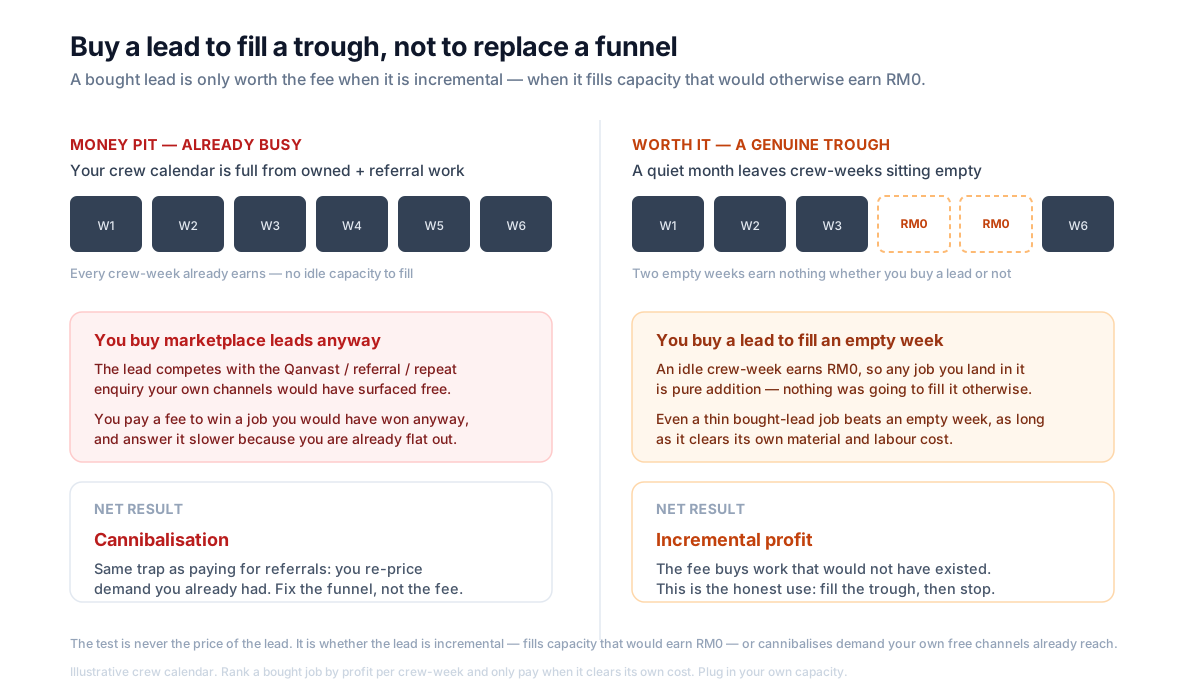
The right-hand case is the whole justification. An idle crew-week is pure loss — a mounting fixed cost with no revenue against it — so ranked by profit per crew-week, a thin bought-lead job that merely clears its own material and labour cost still beats the empty week it replaces. That's the one situation where a shared, lower-margin lead is defensible: you're not choosing it over a better job, you're choosing it over nothing.
| Buying leads is worth it when… | It's a money pit when… |
|---|---|
| A genuinely quiet month leaves crew-weeks idle | You're already booked out and buying more |
| You're a new firm with no referral base yet | You have a strong referral / repeat pipeline the leads just re-price |
| The job is commercial or out-of-area, beyond your word of mouth | It's the exact reno job your free channels already reach |
| You reply first and can win the speed race | Enquiries sit in a shared WhatsApp for an hour |
| You tag source and watch close rate by platform | You have no idea which platform, if any, actually pays |
How much should you pay before it's too much?
Cap the cost per won job below what it costs to win a customer through your own channels — and remember it's the won-job number, not the fee, that has to clear the bar. Your owned-channel benchmark from this playbook is a fully-loaded ~RM2,025 to win a paid customer. So the ceiling isn't "is the fee under RM2,025?" — almost any single fee is. It's:
fee ÷ your real close rate on that platform < ~RM2,025
At an exclusive-style 25% close, an RM80 lead clears easily (RM320). At a slow-on-a-shared-lead 5% close, the same RM80 lead is RM1,600 per won job — under the ceiling on paper, but perilously close, and worse than it looks once you subtract the share that was cannibalising free demand. Push the fee up or the close rate down much further and the marketplace becomes your most expensive channel while feeling like your cheapest. The discipline is the same one that separates a vanity metric from a real one: judge the source by cost per won job, tracked to the signed deposit, per platform — never by the sticker price of the lead.
How HotLead fits in
HotLead doesn't sell leads — it's a lead-management tool, not a marketplace — so it has no stake in whether you buy them. What it does is decide whether the leads you do buy actually pay, by fixing the three things that make or break marketplace economics.
- Win the speed race. Speed is the only lever you control on a shared lead. HotLead captures every enquiry, sends an instant auto-greeting, and assigns each lead one owner with a clear next action and overdue flags — so a routed marketplace enquiry gets a fast, warm first reply instead of sitting in a shared inbox while a rival closes it.
- See the real cost. HotLead tags every lead with its source and tracks it to won or lost, and its funnel and per-channel view shows your close rate and cost per won job by platform — the exact numbers this decision turns on. That's the difference between knowing Recommend.my pays and Atap doesn't, and just topping up credits on faith.
- Stop cannibalising. Because every enquiry carries its source, you can finally see whether a platform is bringing incremental jobs or re-pricing referrals and repeat clients you'd have won free — and cut the ones that are just taxing your own demand.
To be clear about the boundary: HotLead won't buy leads for you, run a marketplace, or promise a supply of enquiries. It makes the leads you already get — bought or free — convert better and prove their own worth. On a shared lead, where being first is the whole game, that's often the difference between a marketplace that pays and one that quietly bleeds you.
Start with the complete guide to managing renovation leads in Malaysia, see the playbook for your trade at /renovation or /interior-design, and once you've decided to buy, read the operations side of this coin — how to handle a paid marketplace lead without bleeding money.
Sources: Recommend.my model (a big-project request is routed to up to five pros; firms pay in Recommend Credits as a "connection fee" deducted only when the customer responds to a quote; Recommend Pay projects insured by Allianz Malaysia up to RM100,000) — Recommend.my "How it works" and Recommend.my service-provider charging FAQ. Qanvast shortlist model (a homeowner is matched with a shortlist of up to five interior firms) — Qanvast Malaysia. Atap Lead Marketplace (designers with credits contact property owners with verified requirements) and platform background — Atap.co launch coverage, Malaysiakini. ServisHero as a vetted Malaysian home-services marketplace — ServisHero. Shared-versus-exclusive lead economics (a single lead commonly sold to three to eight contractors at once; shared leads convert 13–20% vs ~27–30% for exclusive, exclusive closing ~2–3× the rate; every firm pays whether or not they win) — US home-services lead-generation analyses of Angi/HomeAdvisor (Rocket Media, Minyona, The Valley Marketing Group, LeadTruffle), applied directionally to the Malaysian marketplaces, which share the non-exclusive model. Malaysian buyer-discovery channels (49% word of mouth) — ZenWeb Malaysian renovation buyer discovery-channel survey. The 5-minute reply window (~100× odds of connecting), the ~RM2,025 fully-loaded cost to win a customer, close-rate ranges by channel, and job/margin figures reuse the house figures established across this playbook. All ringgit fee and cost-per-won-job figures in this article are illustrative worked examples anchored to these ranges — plug in your own platform fee, close rate and reply speed for your real number.
Frequently asked questions
Is it worth buying renovation leads from Recommend.my, Qanvast or Atap in Malaysia?
It depends entirely on incrementality and exclusivity, not on the fee. It's worth it when the lead is genuinely new business your own channels would not have reached — a quiet month with idle crew capacity, a new firm with no referral base yet, or a commercial or out-of-area job your word of mouth doesn't touch. It's a money pit when you're already busy and buying leads you'd have won free through referrals or repeat clients, when you chase shared leads slowly, or when you can't even see your close rate by platform. The deciding number is cost per won job — the fee divided by that platform's close rate — measured against what it costs to win a customer through your own channels.
What is the difference between a shared lead and an exclusive lead?
An exclusive lead is sold only to you; a shared lead is sold to several firms at once. Most home-services marketplaces run on the shared model — Recommend.my sends a big renovation request to up to five pros, Qanvast matches a homeowner with a shortlist of up to five firms, and US platforms like Angi and HomeAdvisor commonly share a single lead with three to eight contractors. The consequence is a close-rate gap: industry data on shared versus exclusive leads shows shared leads converting in the low-to-mid teens (roughly 13 to 20 percent) against exclusive leads at around 27 to 30 percent — so exclusive leads close at roughly two to three times the rate. Because every firm pays for a shared lead whether or not they win, that gap lands directly on your cost per won job.
How do you calculate cost per won job from a marketplace?
Divide the lead fee (or the average credit cost of a connection) by that platform's close rate. An RM80 lead that you close at 25 percent costs RM80 divided by 0.25, which is RM320 per won job. The same RM80 lead shared five ways, closing at 10 percent, costs RM80 divided by 0.10, which is RM800 per won job; if you reply late and close at 5 percent it's RM1,600 per won job. Track it per platform, all the way to the signed deposit — a lead count and a spend total both hide which platform is actually buying you jobs.
Why does buying leads sometimes cost more than winning a customer for free?
Because a marketplace fee can re-price demand you already had. In a market where word of mouth is roughly 49 percent of how buyers find a firm, a large share of the enquiries a platform sends you are homeowners who would have found you anyway through a referral, a repeat relationship or a free listing. When you pay a fee on those, you've bought a job you would have won for nothing — the same cannibalisation trap as paying a blanket referral fee. The fee only earns its keep on the incremental jobs your own channels would not have reached.
Does HotLead buy or sell renovation leads?
No. HotLead is a lead-management tool, not a lead marketplace — it doesn't sell you leads. What it does is make the leads you already get, bought or free, convert better: it captures every enquiry with its source attached so a bought platform lead is tracked all the way to won or lost, keeps first replies fast and every lead owned with a next action so you can actually win the shared-lead speed race, and shows close rate and cost per won job by channel so you can see which platforms clear their cost and which are money pits.
Keep reading
- Did We Already Say RM68k? Using AI to Stop Quote Drift Across a Long Renovation ThreadOver a weeks-long WhatsApp thread with two or three quote revisions, a rep re-states a number that contradicts an earlier promise — and re-opening a settled price quietly invites a discount that eats a whole job's profit. So I pointed AI at the drift. It works beautifully as a flag, and dangerously as an auto-corrector.
- The Warranty as a Closing Lever: Why a Longer Guarantee Beats a Discount on a Renovation DealA quote is stalling and the buyer wants a reason to say yes. Before you drop the price, look at the other lever in your hand — a longer workmanship warranty. It is the same expected-value decision as a discount, but the math runs the opposite way — a price cut costs you thousands with certainty, while extending the defects cover costs you a couple of hundred ringgit in expectation, for arguably more trust with a scam-wary buyer. Here is the EV case for the non-price concession, the trap that turns it into a hidden liability, and which leads it actually moves.
- "Can You Just Build It, My Neighbour Also Did" — Handling the Renovation Lead That Needs Council Approval FirstSome renovation enquiries can't legally start next month, no matter how ready the buyer is — a kitchen extension, a hacked-through wall, a roofed-over air well all need the council's written approval first. Quote a fast build price to win the job and you either lose it to a "boss, can start" cowboy, or win it and inherit the stop-work order, the RM50,000 fine and a client who later can't sell the house. Here's how to spot the permit-first lead and sell the approval as protection.