

Your renovation firm probably doesn't have a lead-generation problem. Facebook and Instagram ads, Qanvast, Recommend.my, referrals — the enquiries come in. The problem is what happens after the "Hi, interested in renovation" message lands in WhatsApp.
Most reno firms lose leads in WhatsApp not at the price stage, but in the first few hours — to slow replies and forgotten follow-ups. Here's exactly where the leaks are, and how to plug them without changing how your customers message you.
The six ways WhatsApp leaks your leads
WhatsApp reaches about 90% of Malaysian internet users, so it's the right place to receive leads. But it was built for chatting, not for running a sales pipeline. Six gaps cost you jobs:
- No owner. A lead lands in a shared number or the boss's phone. Everyone assumes someone else replied. Nobody did.
- Slow first reply. The salesperson is on a site visit; the message sits for hours. By the time they reply, the homeowner has already messaged two competitors.
- No follow-up. "I'll follow up tomorrow" becomes next week, then never. The job was waiting at follow-up #5.
- Double replies. Two salespeople answer the same lead, contradict each other, and the customer loses confidence.
- No record. Chat scrolls away. Nobody remembers what was quoted, what the customer wanted, or what was promised. Worse, some enquiries are never even seen — read on a site visit and swiped away.
- No visibility. You can't see how many enquiries came in, how many got quoted, or where they stalled — so you can't fix anything.
Each one is small. Together they're the difference between a busy WhatsApp and a full project calendar.
How slow is "too slow"?
Slower than you think. Speed is the most-studied number in lead management, and it's unforgiving.
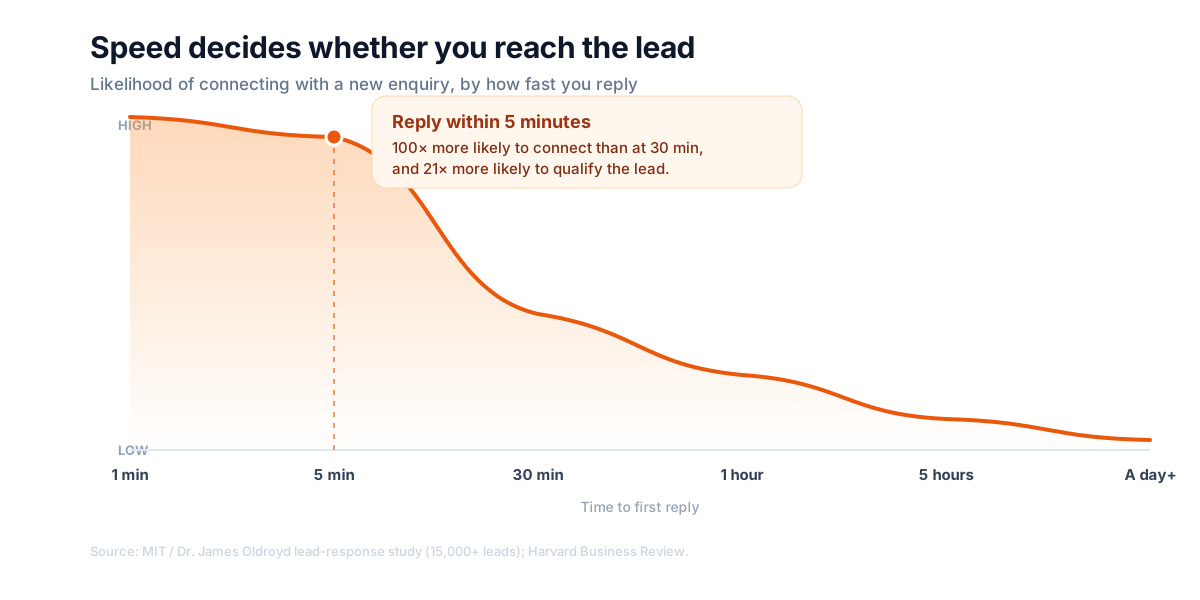
MIT research on 15,000+ leads found that replying within 5 minutes makes you roughly 100× more likely to connect and 21× more likely to qualify than waiting 30 minutes. Meanwhile the average business takes 47 hours to respond, and the first to reply wins about 78% of deals.
You can't always reply in 5 minutes when you're on-site. But the lead can still be instantly acknowledged and assigned so it doesn't vanish for two days. (We go deeper on this in the complete guide to managing renovation leads.)
The follow-up most firms never send
Here's the part that quietly costs the most money: around 80% of sales need 5 or more follow-ups, but 44% of salespeople give up after one, and 92% quit by the fourth.
The renovation job is usually sitting at follow-up #5 — after the homeowner has compared quotes, talked to their spouse, and sorted their budget. The firm that simply keeps following up, politely, on a schedule, wins jobs its competitors already abandoned. Spacing nudges 2–3 days apart works better than daily messages.
Five habits that plug the leaks
You can fix most of this before buying any tool:
- One owner per lead. Decide who handles each new enquiry, and make it explicit so nobody double-replies or assumes.
- Acknowledge in 5 minutes. Even a one-line "Thanks for reaching out — sending details shortly" keeps the lead from shopping around.
- A written follow-up rhythm. Day 2, day 4, day 7, day 14. Every open lead, every time.
- A weekly funnel count. Enquiries → quoted → won. Find the biggest drop and attack it.
- A reassignment rule. If an owner goes silent on a lead for 24 hours, it moves to someone else.
When to put a system on top of WhatsApp
Habits work until a busy month overwhelms them — exactly when your most valuable leads leak the most. That's the moment to add a lightweight layer on top of WhatsApp that does the remembering for you: assigns each enquiry an owner, nudges the follow-ups, and shows the funnel so you can see the leaks.
You don't need a heavy CRM, and you don't need to move your customers off WhatsApp. You need the pipeline structure WhatsApp is missing.
The bottom line
Your ad budget is buying enquiries that die in an inbox with no owner, no reminders, and no funnel view. Fix speed and follow-up first — that's where the money is — and give every lead a single owner. Do that, and you'll close jobs you're currently paying to lose.
For the full playbook — channels, routing, the funnel metrics, and a week-one system — read Lead Management for Malaysian Renovation Firms: The Complete Guide.
Sources: MIT / Dr. James Oldroyd lead-response study and Harvard Business Review; industry speed-to-lead and follow-up statistics; DataReportal data on WhatsApp usage in Malaysia.
Frequently asked questions
Why do renovation leads go cold in WhatsApp?
Usually not because of price — because of speed and follow-up. A shared number has no clear owner, no reminders, and no funnel view, so enquiries sit unseen and follow-ups get forgotten. Most leads are lost before a quote is ever sent.
Is WhatsApp Business enough to manage leads?
WhatsApp Business adds labels and quick replies, which helps a solo owner. But once you have more than one salesperson, it still has no per-lead owner, no follow-up reminders, and no funnel reporting — so leads still slip through. You need a light layer on top, not a different chat app.
How do I stop double-replies when my team shares one WhatsApp number?
Give every new enquiry a single owner the moment it arrives, make that owner visible to the team, and reassign the lead if the owner goes quiet. One owner per lead removes both double-replies and "I thought you got it" gaps.
Keep reading
- "We Went With Another Contractor" — I Built an AI to Win Back a Lost Renovation Lead Instead of Slamming the DoorA Shah Alam firm quotes a RM70k job, chases it for three weeks, and finally gets the message every owner dreads — "thanks, we've decided to go with another contractor." The reflex is a terse "ok, all the best 🙏" and a closed chat. The 2026 reflex is to ask AI to detect the rejection and auto-fire a win-back discount. I built it, and it begged. Here's the version that keeps a near-free option on a re-win without ever chasing a no.
- The Only Three Ways to Grow a Renovation Firm — and Which Lever to Pull FirstEvery renovation firm's revenue comes down to three levers — how many leads you get, how many you close, and how big each job is. They multiply, so a modest lift on each compounds. But they cost wildly different amounts to pull, and most owners reach first for the one they should reach for last. Here's the ranking, with Malaysian numbers.
- Sight Unseen: Winning the Overseas Malaysian Who Renovates a Unit They Can't VisitA Malaysian working in Singapore collects the keys to a KL condo and messages you to fit it out — but they can't come to a site visit, can't walk your showroom, and will wire a deposit to a firm they've never met. Most firms treat this lead like a walk-in, go quiet when the buyer can't pop by, and lose the highest-budget job in the inbox. Here's why the remote buyer is your hardest-trust but best-paying lead, and how to build a remote lane that actually closes it.