

I watched a reno firm in Puchong nearly turn a happy customer into a Strata Tribunal case, and the whole thing started with a quote that looked like a win.
The enquiry was textbook. A WhatsApp from a condo owner in the same township: "Hi, want to redo my master bathroom, old already, got some ponding also. Can quote ah?" Photos of tired tiles, a stained grout line, a floor that held water in one corner. The firm did what it does with every bathroom lead — measured up, quoted a clean all-in number, and won it against two other firms because it was the lowest. Tiles, fittings, labour, a quick re-screed. Done in nine days. The owner loved it. Paid in full.
Four months later the owner messaged again, and this time there was no "hi." The unit below had a brown bloom spreading across the bathroom ceiling. That neighbour had already complained to the management, the JMB had issued a notice, and everyone was now looking at the freshly renovated bathroom directly above. The firm's "cheapest quote" had quietly left out one line — a proper waterproofing membrane and a flood test before tiling — because that's the line you delete when you're racing to be the lowest number. Now they were back on site, re-hacking the beautiful tiles they'd laid, to reach a membrane that should have gone in the first time. For free. Under warranty. With a nervous customer and an angry downstairs neighbour watching.
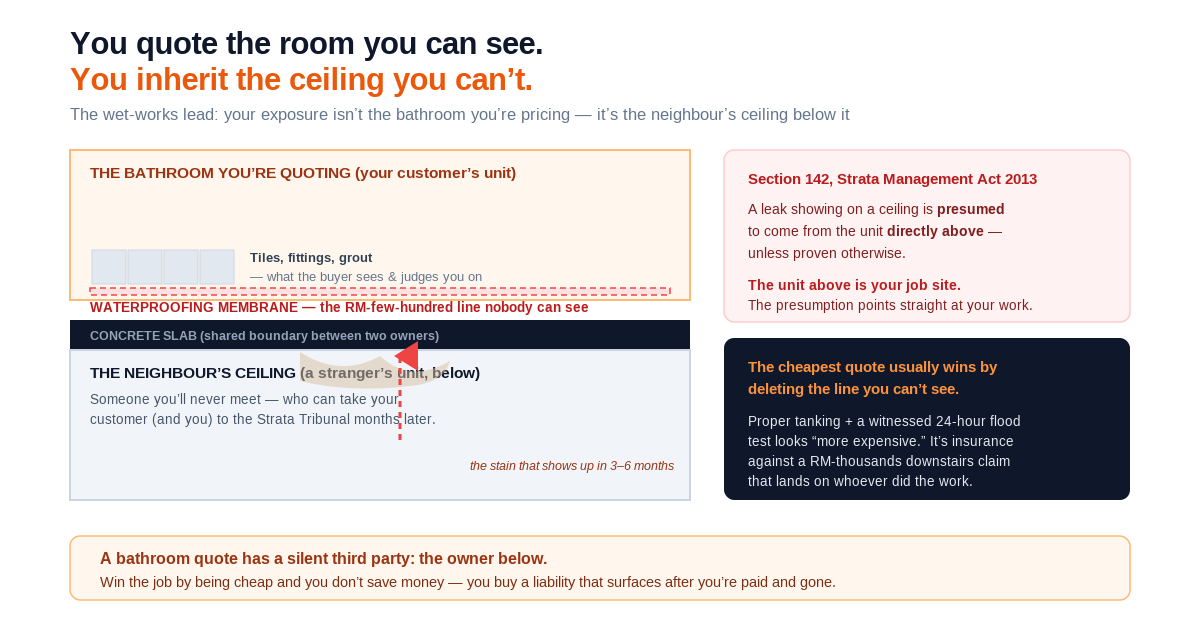
That's the trap in this piece, and it's specific to the kind of job nobody flags as special. In a high-rise, a wet-area reno isn't a renovation of the room you're standing in — it's a renovation of the ceiling in the unit below. You just can't see that unit, you'll never meet its owner, and in Malaysian strata law, when their ceiling leaks, the law assumes it's your work.
Why isn't a condo bathroom reno just a normal wet-area job?
Because the failure crosses a boundary you don't own. In a landed house, if your waterproofing fails, the water damages your own customer's floor slab — bad, but it's contained inside the job you were paid for. In a high-rise, the water goes down, through the concrete slab, onto the ceiling of a completely separate parcel owned by a stranger. The moment that happens, a workmanship problem becomes a three-party legal problem, and you're one of the three.
This isn't a rare edge case. In a study of high-rise residential defects in Kuala Lumpur cited in local engineering research, inter-floor leakage made up 30.6% of the defects recorded — nearly a third of everything that goes wrong in these buildings. And a member of the Standards Malaysia waterproofing committee has said inter-floor leakage is the second most common complaint reaching the Strata Management Tribunal, behind only unpaid maintenance fees. The Tribunal has handled thousands of cases in a single reporting period; leakage is right at the top of the pile. This is the most litigated defect in Malaysian strata living — and new wet-works jobs are where a lot of it is born.
The law quietly makes your new work the defendant
Here's the part most contractors have never read. Under Section 142 of the Strata Management Act 2013, when water damage shows up on a ceiling, it is presumed to originate from the parcel directly above — unless the owner of that upstairs parcel can prove otherwise. The law starts by pointing up.
Now follow that arrow. In a few months' time, the unit directly above that stained ceiling is the exact bathroom you just renovated. The presumption lands on your customer's unit, the building's inspection traces the water to the wet area you rebuilt, and your customer turns around and points at you under your workmanship warranty. You don't get to argue it was "pre-existing" — you re-did the whole wet area. The cheap quote didn't save anyone money. It wrote a liability, post-dated it a few months, and signed your name to it.
This is the mirror image of a piece we've already written. The inter-floor leakage repair lead is the job where a leak has already happened and someone wants it fixed and blamed — a dispute you walk into. This piece is the lead that creates that dispute. Handle the new job right and you make sure you're never the contractor someone else's lawyer is pointing at next year.
What actually makes the cheapest wet-works quote so dangerous?
It wins by deleting the one line the buyer can't see. Every firm bidding a bathroom is being compared on a single number, and the fastest way to shave that number is to skimp on the layer that gets buried: the waterproofing membrane and the test that proves it works. Tiles, fittings, a vanity — the buyer can see all of it and will notice if it's cheap. The tanking under the floor screed? Invisible the day after it's laid. So it's the first thing a price war quietly removes.
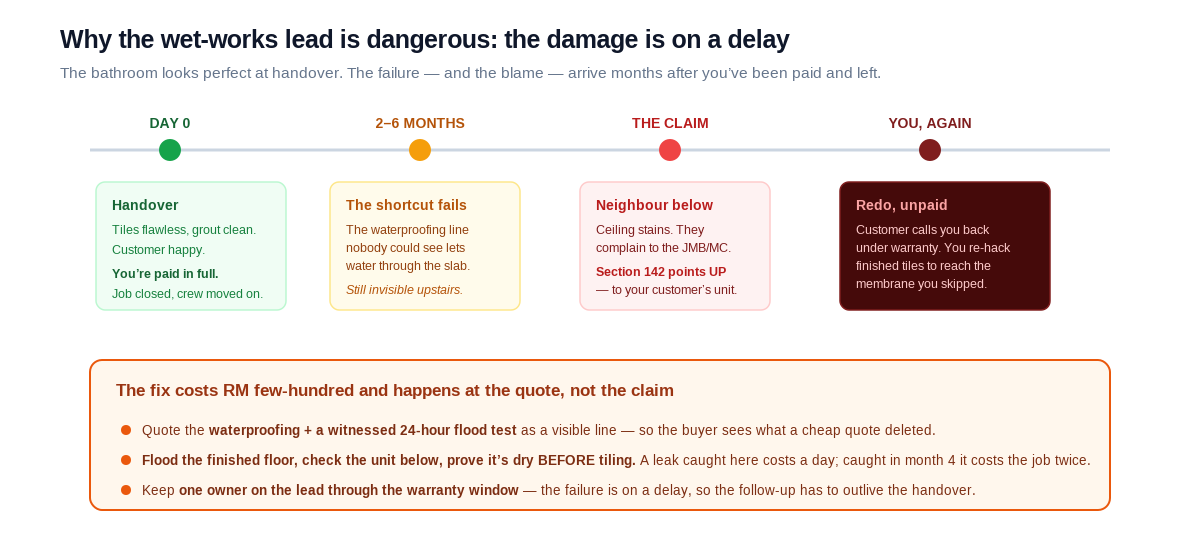
The timeline is the whole danger in one picture. The damage is on a delay. At handover everything looks perfect and you're paid. The skipped or sloppy membrane doesn't fail on day one — it fails in month three or four, long after the crew has gone and the invoice is settled, when a stranger's ceiling finally browns. By the time the problem is visible, you've mentally closed the job. That gap between "paid" and "failed" is exactly why wet-works leads need a different kind of follow-up from the firm — the kind that outlives the handover.
The flood test: the cheapest insurance in the whole job
A flood (or ponding) test is how you prove a wet area is watertight before you bury it under tiles. You seal the floor trap, flood the finished floor to roughly 25mm of standing water, leave it for at least 24 hours, then go and look at the unit below for any trace of moisture. It's the regional standard — the method used across the industry and written into quality yardsticks — and it costs you a day and a bit of water.
It's also the thing Malaysia's own quality standard checks for. QLASSIC (CIS 7), the Construction Industry Development Board's Quality Assessment System in Construction, includes a wet-area water-tightness test among its functional checks — and an item is marked a fail the moment there's evidence of water seepage in a slab or ceiling. The country's official measure of good building workmanship treats "does the wet area leak" as a pass/fail. If it's a yardstick for the building, it should be a line on your quote.
How is a wet-works lead different from a normal reno lead?
Almost every reflex flips. The thing you compete on changes, the real risk moves out of the room, the timeline gets a warranty tail, and "cheapest" becomes a warning sign instead of a selling point. It's worth seeing them side by side, because the enquiry that lands in your WhatsApp looks the same either way.
| Normal reno lead | Wet-works lead (this piece) | |
|---|---|---|
| What you're really selling | Finish, taste, price | Watertightness the buyer can't see |
| Where the risk lives | The room you're quoting | The ceiling in the unit below |
| Who else is affected | Your customer | A stranger downstairs + the building |
| The cheap quote means | A keener price | A deleted waterproofing line |
| When problems show up | During the job | 2–6 months after handover |
| The law in the background | Contract with your customer | Section 142 presumption points at your work |
| The follow-up you need | Until handover | Through the warranty window |
Read that table and the move is obvious: tag the lead the moment it lands. A bathroom, kitchen, balcony, yard, laundry or any "re-screed / move the floor trap" job in a high-rise is not a normal reno lead — it's a wet-works risk lead, and it should go into a lane that remembers the downstairs neighbour exists.
So what do you actually do with a wet-works enquiry?
Price the risk in, make it visible, get the building's blessing, and keep one owner on it long past handover. None of this is about working harder — it's a short discipline that the cheapest bidder skips and the firm that keeps its reputation doesn't:
- Tag it as wet works on the first reply. The second you see "bathroom", "toilet", "kitchen", "balcony", "yard" or "waterproofing" in a high-rise enquiry, flag it as a different lead type — not a cosmetic reno. That one tag changes how you quote and who handles it.
- Ask the downstairs question early. Is anyone living in the unit below? Is this a full re-waterproof or a cosmetic retile over an old membrane? Has the building got wet-works rules? The same qualify-on-the-first-reply discipline, pointed one floor down.
- Quote the tanking and the flood test as a visible line. Don't bury waterproofing inside a lump sum where a price war can quietly delete it. Put "proper membrane + witnessed 24-hour flood test before tiling" on the quote as its own item. It protects you, and it makes your higher number legible — the buyer can finally see what the cheaper firm left out. It's the same logic as an itemised quote that survives the price comparison.
- Get the building's wet-works sign-off before you hack. Most JMBs and MCs require prior written approval and a deposit, and watch wet works hardest because of the leak risk. That sign-off is also your paper trail if a dispute ever lands — handle it the way we lay out in the condo management-approval lead.
- Keep one owner on the lead through the warranty window. Because the failure is on a delay, the job isn't really "closed" at handover — it's closed when the warranty period passes dry. One person should own that lead from enquiry right through the quiet months when a leak could still surface, so the warranty and defect conversation is a planned follow-up, not a panic.
Where HotLead fits — and where it doesn't
Let's be straight about the tool, because this is a trade problem, not a software one. HotLead cannot waterproof a floor, run your flood test, or certify that a wet area is dry — that's your crew's expertise and your name on the warranty, full stop. What it does is make sure a wet-works lead never leaks at the capture-and-follow-up step, which is exactly where a liability-heavy job slips when you're busy on site:
- Capture and tag the enquiry as a wet-works risk lead the moment it lands, so it's handled as a liability job from the first reply, not lumped in with cosmetic renos.
- One owner, by rule (round-robin, manual, or a custom rule), so the person who knows that building's wet-works rules — and who'll carry the warranty conversation — owns it end to end, and the pitch stays consistent.
- Next-action and overdue reminders that outlive the handover, so the flood-test step, the building sign-off, and the post-handover warranty check-in all get a date and don't vanish the day you're paid.
- Funnel and per-channel reporting, so you can see which channels send wet-works enquiries and whether they convert cleanly or come back as warranty headaches — the kind of pattern you only spot across many jobs.
That's the honest line: the software holds the lead, the tags and the follow-ups so nothing drops while you do the real work. It doesn't make the work waterproof — you do.
A bathroom quote in a high-rise has a silent third party nobody puts on the form: the owner of the ceiling below. Win that job by being the cheapest number and you haven't saved your customer money — you've sold them a leak with a delay timer, and attached your name to the claim when it goes off. The firms that keep their reputation in strata work are the ones that treat wet works as its own kind of lead: priced for the risk, tested before it's buried, blessed by the building, and followed long after handover.
Start with the full renovation-lead playbook, and if you work high-rise bathrooms and kitchens, see how this ties into the renovation and construction lead playbooks for the rest of the journey.
Frequently asked questions
What makes a bathroom or kitchen reno a "wet-works" lead rather than a normal one?
Wet works are any renovation that breaks or re-lays the waterproofing in a wet area — a bathroom, kitchen, balcony, yard or laundry, or anything that moves a floor trap or re-screeds a floor. In a landed house a failure there damages your own customer's floor. In a high-rise it damages the ceiling of the unit below, which belongs to someone else, and that turns a workmanship question into a liability question with strata law attached. The enquiry wording is identical to a normal reno ("can you redo my bathroom?"), so the firm that doesn't tag it as wet works prices it like a normal job and carries a risk it never charged for.
Who is liable if my waterproofing fails and the downstairs neighbour's ceiling leaks?
Practically, you are, through your customer. Under Section 142 of the Strata Management Act 2013, a leak appearing on a ceiling is presumed to come from the parcel directly above unless proven otherwise — so the finger points at your customer's unit, and the work in that unit is yours. Once the building's inspection traces it to the bathroom you re-waterproofed, your customer comes back to you under your workmanship warranty, usually wanting it redone for free. That's why the cheap quote that skipped proper tanking isn't cheaper at all — it just moves the cost to month three and attaches your name to it.
What is a flood test and why should it be on the quote?
A flood (or ponding) test is how you prove a new wet area is actually watertight before you tile over it. You seal the floor trap, flood the finished floor to roughly 25mm, leave it for at least 24 hours, and check the unit below for any sign of moisture. It's the single cheapest insurance in the whole job, and most homeowners have never heard of it — which is exactly why putting it on the quote as a visible, witnessed line both protects you and makes your higher number legible. A leak caught at the flood test costs you a day; the same leak caught after the tiles are down and the neighbour has complained costs you the job twice.
Do I need the building management's approval for a bathroom reno in a condo?
Usually yes, and wet works are exactly the kind the building watches most closely because of the leak risk to other units. Most JMBs and MCs require prior written approval, a refundable renovation deposit, work within permitted hours, and sometimes proof that your waterproofing will be flood-tested. Getting that sign-off before you start isn't red tape slowing you down — it's the paper trail that protects you if a dispute ever lands at the Commissioner of Buildings or the Strata Management Tribunal. We cover the approval side in detail in the condo management-approval lead.
How is this different from the inter-floor leakage repair lead you already wrote about?
They're two ends of the same pipe. The inter-floor leakage repair lead is the one where a leak has already happened and a homeowner wants it fixed and someone blamed — a dispute you walk into. This piece is the lead that creates that dispute — a brand-new wet-works job where skipped or sloppy waterproofing becomes next year's downstairs leak. If you handle the new job properly — tank it, flood-test it, document it — you never become the contractor someone else's lawyer is pointing at later.
Keep reading
- Can AI Reply to Your Renovation Firm's 1-Star Review? I Built It — and the Risk Is How Fast It ApologisesA 2-star review on Google or Qanvast is the first thing your next renovation lead reads — and most firms either ignore it or fire back and make it worse. The 2026 reflex is to let AI write the reply. I built it, and drafting a calm response costs a fraction of a sen. But an AI tuned to be helpful apologises too fast — it will concede a fault in writing, promise a refund that never happened, and grovel to a fake review from a competitor. Here's the build that protects your rank instead of torching it.
- Which Lead Signals Actually Predict a Sale? Reverse-Audit Your Own Won JobsMost firms grade a renovation lead on signals that feel predictive — enthusiasm, a long message, a fast reply — and never check whether those signals actually separate won jobs from lost ones. Here is how to run a reverse-audit on your own closed deals, which signals usually survive it, and why your pipeline is too small to pretend the score is more than directional.
- The "I Only Deal With the Boss" Lead: When the Buyer Refuses Your TeamYou finally hired someone to share the load — then the buyer messages "can I deal with you direct ah, boss?" and refuses to engage your staff. Every big lead quietly re-centralises onto the one person already maxed out, and your firm can never grow past the owner. Here's why caving caps you, why a flat "my staff will assist" loses a nervous buyer, and the move that keeps both.