

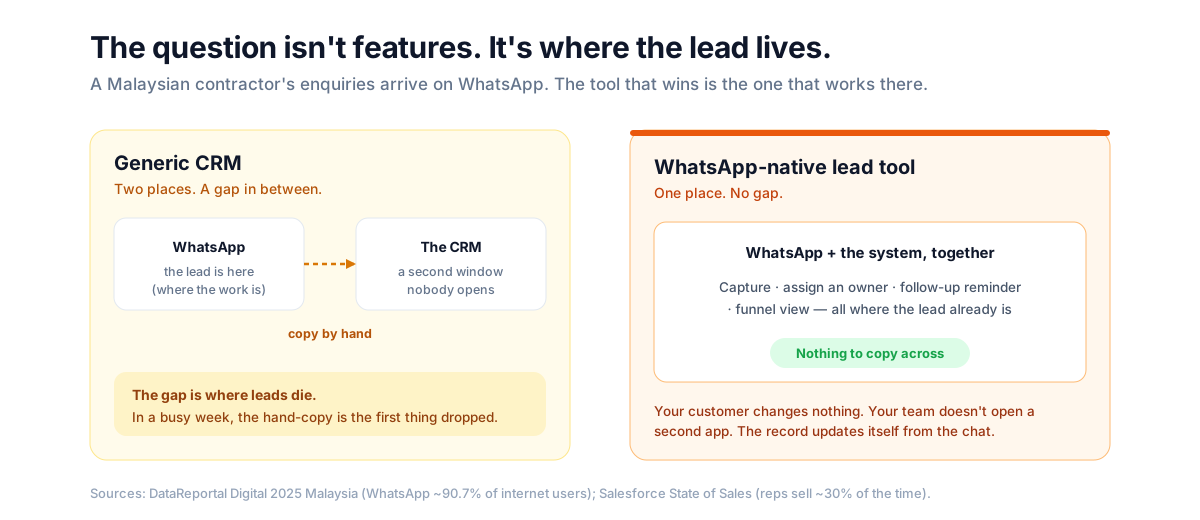
There are two honest ways for a Malaysian contractor to manage leads with software, and they get compared as if it's a feature fight: which one has more fields, more automations, more dashboards. That comparison misses the point. A generic CRM and a WhatsApp-native lead tool aren't really competing on capabilities — they're competing on location. One puts your system where your leads already are. The other puts it in a second window across the room.
Here's the decision, made on the terms that actually decide it.
What's the actual difference between the two?
The difference isn't features — it's where the conversation lives. A generic CRM is a standalone system your team logs into and updates by hand; WhatsApp is a bolt-on at best. A WhatsApp-native lead tool runs on top of the WhatsApp you already use, so capture, assignment, reminders and reporting happen where the lead already is.
A generic CRM — Salesforce, HubSpot, Zoho and the dozens that look like them — was designed for a sales team sitting at desks, working a pipeline inside one application. The CRM is the workplace. That model is excellent when your sales motion lives inside the software.
A Malaysian contractor's sales motion does not. The enquiry arrives on WhatsApp from a Facebook ad, a referral, or a "saw your work at my neighbour's place" message. The quote goes out on WhatsApp. The "still thinking about it, boss" comes back on WhatsApp. The conversation never leaves the app — so a system that lives outside the app is, structurally, in the wrong place.
Why does "where it lives" matter more than features?
Because the gap between the conversation and the system is where leads die — and someone has to bridge it by hand, every single time. A generic CRM only reflects reality if a busy salesperson copies each WhatsApp chat into it. That manual sync is the first thing dropped in a busy week, which is exactly why most CRM rollouts quietly fail.
This isn't a hunch. Salesforce's State of Sales research consistently finds reps spend only about 30% of their time actually selling — the rest goes to admin, meetings, research and manual data entry, with CRM updates a notable chunk of it. A generic CRM that needs hand-keying doesn't shrink that admin slice; it feeds it.
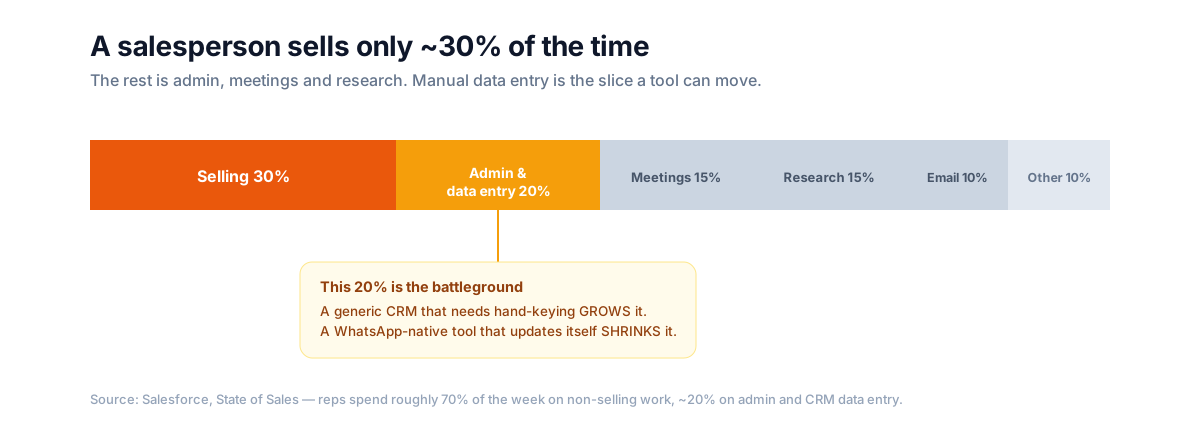
That's the mechanism behind the number every CRM buyer should fear: as many as 70% of CRM implementations fail because of low user adoption (CSO Insights), not because the software lacked features. The tool can be objectively more powerful and still end up dead weight — because power you don't use is a cost, not a benefit. We've written before about why reno firms abandon a heavy CRM and revert to WhatsApp and Excel; the location gap is the engine of that abandonment.
The honest side-by-side
Strip out the marketing and compare the two on the dimensions that decide it for a contractor:
| Generic CRM (Salesforce / HubSpot / Zoho) | WhatsApp-native lead tool | |
|---|---|---|
| Where the lead lives | In WhatsApp; the CRM is a separate window | In WhatsApp, where the system also runs |
| Keeping it accurate | Manual data entry by each salesperson | Captures from the conversation itself |
| Customer experience | Often pushed to a form or new channel | Messages you exactly as before |
| Onboarding | Setup project, often a consultant/admin | Light; usable in week one |
| Pricing | Per user, usually in USD | Built and priced for the local market |
| Strength | Quoting, invoicing, multi-channel, forecasting | Speed, ownership, follow-up, funnel — done simply |
| Fails when | Team won't maintain it; reverts to WhatsApp | You truly need full back-office, not just leads |
Notice the second row. Accuracy is the whole game, and the two tools achieve it in opposite ways — one depends on human discipline that evaporates under pressure, the other doesn't depend on it at all.
What about the price tag?
A generic CRM's sticker price is the smallest part of its real cost, but it's worth naming because it's priced in a way that bites a Malaysian SME twice. Generic CRMs charge per user, per month, almost always in US dollars — so your bill scales with both your headcount and the ringgit's exchange rate.
Published list prices make the point. Salesforce's Sales Cloud Enterprise tier lists around USD$165 per user per month; HubSpot's Sales Hub Professional runs a four-figure USD base plus per-seat costs; Zoho is cheaper at roughly USD$14–52 per user. Take a modest four-salesperson contractor on a mid-tier plan at, say, USD$165/user — that's USD$660 a month, or roughly RM2,900 a month at about RM4.4 to the dollar (an illustrative conversion — the real figure moves with FX). That's before the consultant to set it up and the admin time to keep it fed.
But the bigger cost isn't the subscription — it's the abandonment. A RM2,900/month system that the team stops updating by month three isn't expensive software; it's a complete write-off, plus the leads you lost while trusting a CRM that no longer reflected reality.
So can't you just connect WhatsApp to a generic CRM?
You can — through the WhatsApp Business API and connectors — but an integration is a bridge, not a home, and it doesn't remove the underlying problem. The conversation still happens in WhatsApp and the record still lives in the CRM, so something or someone still has to keep two places in sync.
It's also less common than the marketing suggests: WhatsApp Business API penetration among Malaysian businesses sits at only around 19%, because the API route adds setup, message-template approval and often a per-conversation cost. For a small contractor, bolting a heavyweight API integration onto a generic CRM is a lot of plumbing to end up with the same two-window problem you started with — just more expensive.
The honest version: a WhatsApp connector on a generic CRM helps a firm that genuinely needs the CRM for other reasons. It does not turn a generic CRM into a WhatsApp-native tool.
When is the generic CRM actually the right call?
To be fair to the generic CRM — it wins in real situations, and pretending otherwise would be dishonest. Choose a generic CRM when your sales motion spans far more than WhatsApp and far more than leads, and you have someone to administer it.
That's a real description of some firms:
- A larger construction company running formal tenders, multi-stage approvals and detailed forecasting across email, phone and portals — not just WhatsApp chats.
- A firm that needs quoting, invoicing, project scheduling and the sales pipeline in one system, and has a back-office person whose job includes keeping it accurate.
- A business selling through several channels at once, where WhatsApp is one of five, not the dominant one.
If that's you, the generic CRM's breadth earns its complexity. The mistake is buying that breadth when your actual problem is narrower: enquiries arriving on WhatsApp that get a slow reply, no clear owner, and a forgotten follow-up. That problem is four jobs wide — capture, assign, remind, show the funnel — and a 200-field CRM is the wrong shape for it.
The Malaysian reality that tips the decision
For most small contractors here, the decision tips one way because of where customers already are. WhatsApp reaches about 90.7% of Malaysian internet users aged 16–64 and holds roughly 80% of the messaging market (DataReportal, Digital 2025: Malaysia) — there is no realistic world where your homeowner enquiries route through a CRM portal instead.
Set against that, only about 44% of Malaysian SMEs use cloud computing at all (Khazanah Research Institute) — so the bar isn't "buy the most powerful CRM." The bar is "use anything that reliably captures and works your WhatsApp leads." A tool that meets customers where they already are clears that bar; a tool that asks your team to live in a second window usually doesn't, no matter how good its feature list reads.
This is the same logic that decides a contractor's tender-versus-direct lead routing and the interior-design and renovation firms next door: the channel chose itself a long time ago, and the right tool respects that.
A 60-second decision
Score yourself honestly:
- Do your leads arrive mostly on WhatsApp? If yes, lean WhatsApp-native — the location advantage is decisive.
- Do you have someone whose job is to maintain a system? If no, a generic CRM will be abandoned; don't buy one.
- Do you need quoting, invoicing, scheduling and multi-channel forecasting in one place? If yes, a generic CRM (or a dedicated construction-ops platform) may be worth its complexity.
- Could your busiest, least tech-keen salesperson use it on a Friday site visit? If you can't picture it, you've found your future dead subscription.
For most small Malaysian contractors, that scorecard points the same way: the leads are on WhatsApp, there's no admin to feed a CRM, and the real need is the four lead jobs done simply. The decision isn't "more powerful versus less powerful." It's "used versus abandoned" — and used always wins.
How HotLead fits
HotLead is a WhatsApp-native lead tool, built for exactly this decision. It sits on top of the WhatsApp you already use — your customers message you as before, nothing to copy across — and does the four jobs that move money: it captures every enquiry, assigns each lead one owner (round-robin, manual, or by your own rules), reminds the owner of the next action and flags overdue follow-ups, and shows your funnel and per-channel ROI by stage and by salesperson. It's priced for the local market with a done-for-you setup, and there's a money-back guarantee — a full refund if you're not happy after a month — so "will my team actually use it" is on us to prove.
Not sure you've outgrown your current setup yet? Start with the complete guide to managing renovation leads in Malaysia, or read the honest take on spreadsheet vs WhatsApp vs a lead system.
Sources: DataReportal, Digital 2025: Malaysia (WhatsApp 90.7% of internet users 16–64; ~80% messaging market share); Salesforce, State of Sales (sales reps spend ~30% of time selling; ~20% on admin/CRM data entry); CSO Insights (70% of CRM rollouts fail on low user adoption); Khazanah Research Institute (~44% of Malaysian SMEs use cloud computing); published list pricing for Salesforce Sales Cloud, HubSpot Sales Hub and Zoho CRM (USD, subject to change).
Frequently asked questions
What is the difference between a WhatsApp CRM and a generic CRM?
A generic CRM (think Salesforce, HubSpot, Zoho) is a standalone system your team logs into separately and updates by hand; WhatsApp is, at best, a bolt-on. A WhatsApp-native lead tool runs on top of the WhatsApp you already use — it captures, assigns, reminds and reports where the conversation already happens, so there's no second window to copy leads into. For a contractor whose enquiries arrive on WhatsApp, that location difference matters more than any feature list.
Do Malaysian contractors need a full CRM?
Usually not. A full enterprise CRM is built for sales teams with a dedicated admin to maintain it, and around 70% of CRM rollouts fail on low user adoption, not missing features. A contractor whose salespeople are on-site all day rarely sustains the manual data entry a generic CRM needs. A lightweight WhatsApp-native lead tool does the four jobs that move money — capture, assign, remind, show the funnel — without that admin burden.
Can a generic CRM connect to WhatsApp?
Yes, through the WhatsApp Business API and connectors — but that's an integration, not a home. The conversation still happens in WhatsApp and the record still lives in the CRM, so someone has to keep the two in sync. WhatsApp Business API penetration among Malaysian businesses is still only around 19%, and a bolt-on doesn't remove the core problem — a second window your busiest salesperson won't open on a Friday site visit.
When is a generic CRM the better choice for a construction firm?
When your sales motion genuinely spans more than WhatsApp and more than leads — you need quoting, invoicing, project scheduling, multi-channel pipelines and detailed forecasting in one system, and you have someone to administer it. A larger contractor with a back-office team can absorb that. A small reno or build outfit running enquiries through WhatsApp almost never needs it, and pays for complexity it won't use.
Keep reading
- The Only Three Ways to Grow a Renovation Firm — and Which Lever to Pull FirstEvery renovation firm's revenue comes down to three levers — how many leads you get, how many you close, and how big each job is. They multiply, so a modest lift on each compounds. But they cost wildly different amounts to pull, and most owners reach first for the one they should reach for last. Here's the ranking, with Malaysian numbers.
- Sight Unseen: Winning the Overseas Malaysian Who Renovates a Unit They Can't VisitA Malaysian working in Singapore collects the keys to a KL condo and messages you to fit it out — but they can't come to a site visit, can't walk your showroom, and will wire a deposit to a firm they've never met. Most firms treat this lead like a walk-in, go quiet when the buyer can't pop by, and lose the highest-budget job in the inbox. Here's why the remote buyer is your hardest-trust but best-paying lead, and how to build a remote lane that actually closes it.
- "Ok, Proceed" Isn't Money in the Bank — I Built an AI to Ask for the Deposit the Moment a Renovation Buyer Says YesA Cheras contractor closes a RM62k job on WhatsApp, the buyer says "ok proceed lah", and then the owner — mid-site, phone in a dusty hand — has to stop, pull the bank details, the agreed deposit and the scope, and type a careful money message. In that gap a hot yes quietly cools back to "let me think." The 2026 reflex is to ask AI to detect the yes and auto-fire the invoice. I built it, and it asked a half-committed buyer for 40% to a personal account two seconds after a soft "ok ok". Here's the version that kills the typing delay without asking for money off a misread.