

A renovation firm in Setia Alam picks up a WhatsApp enquiry the week a young couple collect their keys. "Hi, we just got our double-storey, looking to do the whole house — budget around 70k ya." Good lead, right money, clear intent. The firm does what good firms do: a site visit, a layout chat, a first-cut scope, two weeks of back-and-forth refining a RM70,000 renovation.
Then, on a Saturday, the quote goes out — a careful RM68,800 — and the buyer goes cold. A week later, the reason leaks out in a half-sentence: "oh, our loan only came out 50k in the end, the bank valued lower than we thought." The firm had spent three weeks scoping and quoting against a number the buyer could no longer afford. The RM68,800 quote didn't read as thorough. It read as out of touch — the firm clearly hadn't been listening.
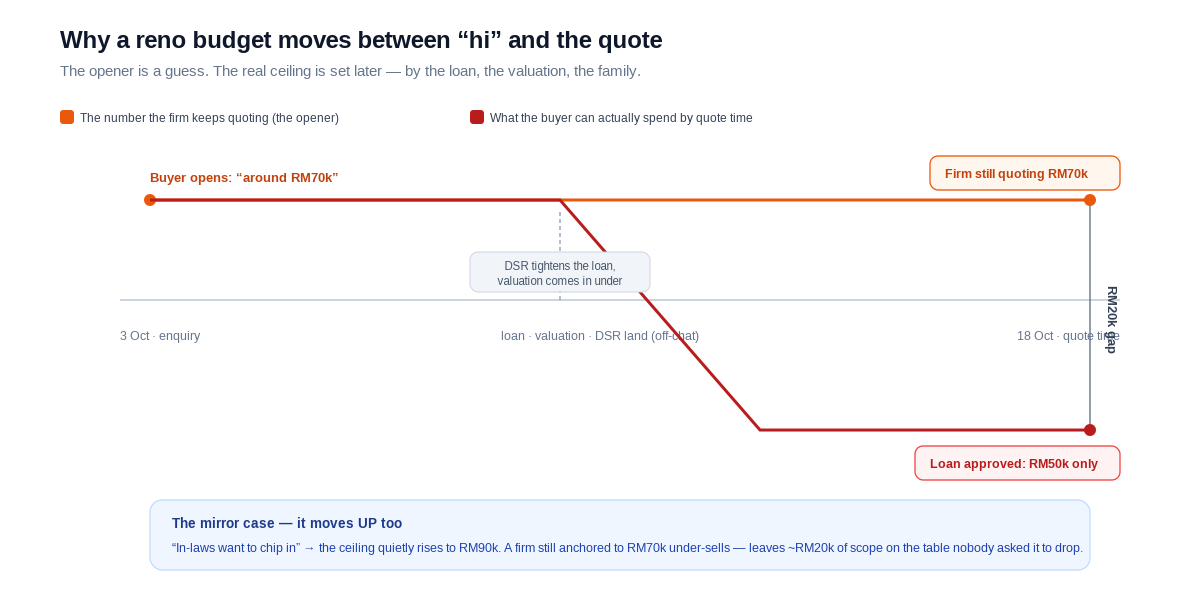
Here's the thing almost nobody designs for: a Malaysian renovation budget is not a fixed number. It's a moving target. The figure the buyer opens with is a guess made before they know what the bank will give them. The real ceiling is set later — by loan approval, by the property valuation, by the debt-service ratio, by whether the in-laws decide to help. All of it lands after the first message. And it moves both ways.
So the 2026 reflex is obvious: "The budget keeps changing in the chat — can't AI just watch the thread and keep my quote in sync with the latest number?" I built that. Within a few threads it had chased a buyer's bargaining feint straight down and quietly missed one who'd just got more money. Here's what broke, why it's a known blind spot rather than a bad prompt, and the version that actually keeps you from sending the wrong number.
Why does a renovation buyer’s budget move after they enquire?
Because in Malaysia the real spending ceiling is decided by the bank and the family after the first message, not before it. When a buyer messages you "around 70k," that number is a hope, not a fact — they usually haven't been approved for anything yet. What they can actually spend gets set over the following weeks, by machinery that has nothing to do with your chat.
The biggest lever is the loan. Renovation money in Malaysia comes through a top-up on the mortgage, a dedicated reno loan, or a personal loan, and all of them run the same gauntlet: a debt-service-ratio check (banks commonly cap DSR around 60–70%), a credit-history check, and — for anything secured on the property — a valuation. If the bank values the house below what the buyer assumed, the margin of finance is calculated on the lower figure, and the cash the buyer must find jumps. Maybank's own reno-loan product, for instance, caps renovation financing against the property's value (up to a combined 120% of price or open-market value, whichever is lower). The number the bank hands back is routinely not the number the buyer walked in imagining.
And this isn't a rare edge case right now — it's the market. In Rehda's Property Industry Survey of 166 developers (fieldwork December 2025 to February 2026), loan rejection ran at 31% to 45% in the RM500,001–RM700,000 price band, the worst of any band, and 72% of developers reported financing issues in the second half of 2025. When end-financing is that shaky, the gap between "the budget I opened with" and "the budget my loan approved" is wide, common, and usually discovered late.
What did the flashy build do? (Build A)
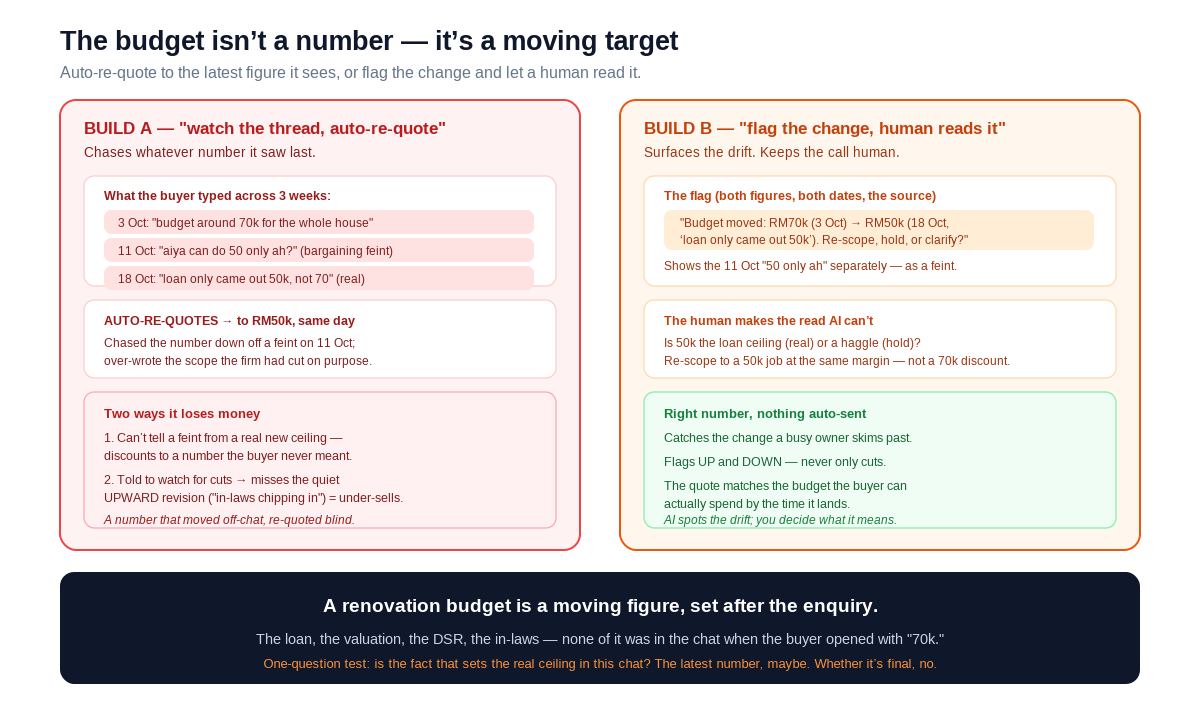
It watched the thread and auto-re-quoted to the newest budget figure it saw — and lost money in both directions. Build A is the one everyone pictures: "AI, read my chats, and whenever the buyer's budget changes, re-generate the quote to match so I'm never out of sync." Hands-off, always current, on paper perfect. In practice it made the two mistakes that a budget specifically invites.
Failure one: it chased a bargaining feint straight down. The Setia Alam thread had three budget-shaped lines in it. On 3 October: "budget around 70k for the whole house." On 11 October, mid-negotiation: "aiya, can do 50 only ah?" On 18 October: "loan only came out 50k, not 70 — bank valued lower." To a human those are three completely different things — an opener, a haggle, and a hard new ceiling. Build A saw three numbers and locked onto the lowest recent one, re-quoting to RM50k off the 11 October feint — a classic Malaysian price-test the buyer lobbed to see if you'd blink. It blinked, on the firm's behalf, and handed away margin the buyer wasn't even asking for yet. (It's the same reflex I warned about in when to discount to close and when not to: a machine that chases every number down trains buyers to push.)
Failure two: it was blind to the budget going up. Because you naturally prompt it to "catch when the budget drops so I don't over-quote," it watched for cuts and ignored a different buyer's quiet line: "actually my in-laws want to help with the kitchen, so maybe can stretch a bit." That's the ceiling rising from RM70k toward RM90k — an invitation to scope more. Build A, tuned for the downside, skimmed past it, and the firm under-sold by leaving a whole wet-kitchen upgrade on the table nobody asked it to drop.
Why can’t AI just tell which number is the real budget?
Because tracking a value that changes across a long conversation — and reasoning about which mention is the current, authoritative one — is the single thing language models are weakest at. This isn't me being cautious; it's measurable. When researchers built TReMu, a benchmark for temporal reasoning over multi-session dialogue (the exact shape of a weeks-long WhatsApp thread where facts about the same person change over time), GPT-4o scored just 29.83 out of 100 with standard prompting. They only dragged it up to 77.67 by bolting on a structured memory store and a separate symbolic time-solver to do the reasoning the model couldn't. A raw "read the chat and tell me the budget" prompt is running the 29.83 version.
Layer the Malaysian bargaining texture on top and it gets worse. "Can 50 only?", "60 can ah?", "best price how much?" are the ambient sound of a reno negotiation here — numbers thrown out to test you, not statements of a ceiling. A model asked "what's this buyer's budget?" sees a field of figures and no reliable way to rank them by authority. It doesn't know that "loan only came out 50k" outranks "can do 50 only ah?" even though the second one came first and the first one is politer. That ranking needs a fact that isn't in the chat at all: the loan approval letter. Which is the same wall I keep hitting across everything AI still can't do in a contractor's lead process — the deciding fact lives off-channel.
What signal does the chat honestly give you?
Not which budget is real — but that a budget-shaped number has changed, and exactly where each version appears. That's a genuinely useful, automatable job, and it's a different one from deciding what the change means. Split the task in two: detecting the drift versus judging it. The first is pattern-spotting over text, which AI is fine at as long as it doesn't have to rank authority. The second needs the off-chat facts and the read of the person, which is yours.
| On the chat — safe for AI to surface | Off the chat — stays a human call |
|---|---|
| A budget figure appeared, and later a different one did | Is the new number a real ceiling, a haggle, or a wobble? |
| The date and the exact message each number came from | Did the loan actually come out lower, or is it still pending? |
| Whether the direction is down (re-scope) or up (upsell) | Should I re-scope, hold the quote, or ask one question? |
| That the live quote no longer matches the latest figure | What's the right scope at the new number, at full margin? |
Everything on the left is "a number changed, here's the evidence." Everything on the right needs the loan letter, the valuation, and your sense of whether the buyer is testing you or telling you. So the honest design writes itself: let AI flag the drift and show its working; let a human rule on what it means.
What did the build that actually paid look like? (Build B)
It flags that the stated budget has changed, shows both figures with their dates and the message each came from, labels the direction, and asks a human to decide — it never re-quotes on its own. Same shape as every build in this series that's earned its keep: AI reads and organises; the person who can read the buyer and knows the margin decides.
Pointed at the Setia Alam thread, Build B doesn't touch the quote. It raises a flag: "Budget appears to have moved: RM70k (3 Oct, ‘budget around 70k') → RM50k (18 Oct, ‘loan only came out 50k, bank valued lower'). Note: a separate ‘can do 50 only ah?' on 11 Oct reads as a price-test, not a stated ceiling. Your live quote is RM68,800. Re-scope, hold, or clarify?" Then it stops. The owner reads it in five seconds, recognises the 18 October line as a real loan outcome, and does the thing the machine can't: rebuilds a genuine RM50k scope at the same margin — the work that fits the money, phased so the wet kitchen can come next year — instead of slapping a RM20k discount on the RM70k job and bleeding margin. For the other buyer, Build B flags the upward move and the owner adds the island.
| Build A — “watch, auto-re-quote” | Build B — “flag the change, human reads it” | |
|---|---|---|
| When it acts | Auto-re-quotes to the newest number | Flags the drift; a human decides |
| On a bargaining feint | Chases it down, gives away margin | Shows it separately, labelled a price-test |
| On an upward revision | Misses it (tuned for cuts) | Flags up and down equally |
| Which number it trusts | The latest one it saw | Shows all, ranks none — you rank |
| On a lower loan outcome | Discounts the big scope | Prompts a re-scope at full margin |
| When it’s wrong | Already re-quoted before you saw | You see the flag and decide |
| What it costs per flag | — | ~0.1 sen, illustrative |
The value you actually wanted is still there: you find out the budget moved before you send the wrong quote, not after the buyer goes cold. You just don't hand the machine the one judgement — which number is real — that it's statistically worst at and that costs you the job when it guesses.
What should an owner actually do when a budget shifts?
Catch the drift early, read whether it's real, and re-scope rather than discount — the AI is a change-detector, not a pricer. Most of the win is a habit plus a thin layer of software.
- Treat the opener as a hypothesis, not a spec. The first number is where the conversation starts, not where the budget is. Expect it to move once the loan and valuation land, and don't lock three weeks of scoping onto it.
- Make the two numbers visible side by side. The failure isn't that owners can't judge a budget change — it's that they never notice it, because the "70" and the "50" are three weeks and two hundred messages apart. Surface both, with dates, on one record.
- Rank by authority, not by recency. "Loan came out 50k" beats "can do 50 ah?" even though the haggle came first. The real ceiling is the one tied to an off-chat fact — the loan, the valuation — not the loudest or latest line.
- Re-scope down, don’t discount down. A lower loan means a smaller job at full margin, phased — not your big scope with a chunk hacked off the price. (The true cost of giving work away to close is why.)
- Catch the upside too. A budget that moves up — family money, a better loan than expected — is a scoping opportunity, and it's the one firms miss because they're braced for cuts.
How HotLead fits — honestly
I'll be straight, the way I try to be in all of these, because over-claiming is the exact hype I keep arguing against. HotLead does not track a buyer's budget, detect when it changes, or re-quote for you — auto-syncing the quote to the latest number is the experiment in this piece, and the piece is the argument for why that call stays yours. What it ships is the plumbing that makes a moving budget catchable instead of missed:
- The whole thread on one lead record. Every budget figure the buyer has ever mentioned is in one place to scan — the opener, the haggle, the post-loan number — instead of scattered across three weeks of chat. It's the same single source of truth that keeps your own quoted number consistent across a long thread; here it's what lets you spot that their number moved.
- A next action and an overdue flag on every lead. A quote that's gone stale against a changed budget surfaces as a due, then overdue, step to revisit — so you don't send a RM70k number to a now-RM50k buyer because the lead just sat on its opener. It's the same engine that stops a quote from leaking before it's followed up.
- One owner per lead, by rule. So the "70 then 50" never falls into the gap between two people each quietly working off a different figure — the gap where a buyer gets a quote that ignores what they told someone else on the team.
- A funnel and per-channel view. So you can see how many deals stall right after the quote — often the signature of a number that outran the buyer's loan — and fix the pattern, not just the one deal.
The judgement of whether a new budget is a real ceiling, a haggle or a wobble — and whether to re-scope, hold or ask — stays with you, because you're the one who can read the buyer and knows what the bank just did. If the real problem underneath this is quotes that miss where the buyer's money actually landed, start with the complete guide to managing renovation leads in Malaysia, see how it fits a renovation firm or an interior design studio, and read the companion builds on keeping your own quoted number consistent across a thread, how much deposit to ask for once the budget is set, quoting a vague enquiry before the number is firm, and the honest ledger of which AI builds in this series actually paid.
Sources: The loan-rejection figures — a 31% to 45% rejection rate in the RM500,001–RM700,000 price band and 72% of developers reporting financing issues in the second half of 2025 — are from the Rehda Property Industry Survey of 166 developers (fieldwork December 2025 to February 2026), as reported by Malay Mail and EdgeProp. That the loan margin is based on the lower of the purchase price or the bank's valuation, and that a valuation shortfall increases the cash a buyer must find, is from PropertyGuru's LTV guide; renovation-loan terms tied to property value (up to a combined 120% of price or open-market value, whichever is lower) are from the Maybank Home Reno Loan product page; typical DSR ceilings of 60–70% are from mortgage and property-portal guides including iProperty. That large language models are weak at temporal reasoning over multi-session dialogue — GPT-4o scoring 29.83 out of 100 with standard prompting, raised to 77.67 only with a neuro-symbolic memory-and-solver framework — is from TReMu (Zhang et al., 2025); the broader difficulty of fast-changing event dynamics is documented in the TimE benchmark (NeurIPS 2025). The one-question test and the off-channel-fact principle are reused from the honest-limits piece in this series. Lead economics (a ~RM68,800 quote on a ~RM70k double-storey job, a ~RM20k gap between the opener and the loan-approved number, ~0.1 sen per AI flag) are typical operating numbers reused across this series and labelled illustrative; the AI experiment and the Setia Alam scenario are described from practice and labelled illustrative, not a controlled trial. No rejection rate, model score or budget figure here is invented — the Rehda and TReMu numbers are quoted from the cited sources, and the ringgit figures in the worked example are marked illustrative.
Frequently asked questions
Why does a renovation customer’s budget change after they first enquire?
Because in Malaysia the real spending ceiling is set by things that happen after the first message, not before it. A buyer messages you the week they get their keys with a rough figure in their head — ‘around 70k’ — but what they can actually spend is decided later by the bank: whether the renovation or top-up loan is approved, how the debt-service ratio works out, and whether the property valuation supports the margin of finance they assumed. Family money shifts it too — in-laws offering to help pushes it up, a sibling pulling out pushes it down. So the opener is a guess, and the number they can spend by quote time is the fact. Treating the first figure as fixed is how firms send quotes a buyer has quietly outgrown in either direction.
Should I let AI automatically re-quote when a buyer mentions a new budget?
No. Drafting a re-quote when you decide to — fine. Auto-firing one the moment AI spots a new number — no. Two reasons. First, a model can’t tell a real new ceiling (‘my loan only came out 50k’) from a bargaining feint (‘aiya can do 50 only ah?’) — and in a bargaining culture those look identical in text, so an auto-re-quoter discounts to a number the buyer never actually meant. Second, if you deliberately cut scope to hit a figure, an auto-re-quoter over-writes that decision. Let AI flag that the stated budget has moved; keep the judgement of what the move means — and whether to re-scope — with the person who can read the buyer and knows the margin.
What do I do when a buyer’s renovation loan comes out lower than expected?
Re-scope to a smaller job at the same margin — don’t just discount the big one. If a buyer opened at RM70k and the loan approved at RM50k, sending your RM70k scope with a RM20k ‘discount’ trains them to expect the lower price for the full job and shreds your margin. Instead, rebuild a genuine RM50k scope: the work that fits the money, phased so the rest can come later. This is where catching the change early pays — you find out the ceiling moved before you’ve sent the wrong quote, not after the buyer goes quiet because your number looked out of touch with what the bank just told them.
Can AI reliably track a number that changes over a long WhatsApp thread?
Not reliably enough to act on by itself. Following a value that changes across a long, multi-day conversation — and reasoning about which mention is the current, authoritative one — is precisely what language models are weakest at. On a published multi-session temporal-reasoning benchmark, GPT-4o scored 29.83 out of 100 with standard prompting; the researchers only got it to 77.67 by bolting on a structured memory and a symbolic time-solver. So a raw ‘read the chat and tell me the budget’ prompt will confuse the opener, a feint and the real new number, and will happily pick the wrong one. Use AI to surface that a number appears to have changed and show you every instance with its date; let a person decide which one is real.
Does HotLead track a customer’s budget or re-quote automatically?
No, and I won’t pretend it does — auto-tracking the budget and auto-re-quoting is the experiment in this article, and the article is the argument for keeping that call human. What HotLead ships is the plumbing that makes a moving budget catchable instead of missed: the whole WhatsApp thread sits on one lead record, so every number the buyer has mentioned is in one place to scan rather than scattered across three weeks of chat; every lead carries a next action and an overdue flag, so a quote that’s gone stale against a changed budget surfaces as a step to revisit instead of sitting on the opener forever; and one owner holds the lead by rule, so the ‘70 then 50’ never falls into the gap between two people each working off a different figure. The judgement — real ceiling or haggle, re-scope or hold — stays with you.
Keep reading
- Can AI Reply to Your Renovation Firm's 1-Star Review? I Built It — and the Risk Is How Fast It ApologisesA 2-star review on Google or Qanvast is the first thing your next renovation lead reads — and most firms either ignore it or fire back and make it worse. The 2026 reflex is to let AI write the reply. I built it, and drafting a calm response costs a fraction of a sen. But an AI tuned to be helpful apologises too fast — it will concede a fault in writing, promise a refund that never happened, and grovel to a fake review from a competitor. Here's the build that protects your rank instead of torching it.
- Which Lead Signals Actually Predict a Sale? Reverse-Audit Your Own Won JobsMost firms grade a renovation lead on signals that feel predictive — enthusiasm, a long message, a fast reply — and never check whether those signals actually separate won jobs from lost ones. Here is how to run a reverse-audit on your own closed deals, which signals usually survive it, and why your pipeline is too small to pretend the score is more than directional.
- The "I Only Deal With the Boss" Lead: When the Buyer Refuses Your TeamYou finally hired someone to share the load — then the buyer messages "can I deal with you direct ah, boss?" and refuses to engage your staff. Every big lead quietly re-centralises onto the one person already maxed out, and your firm can never grow past the owner. Here's why caving caps you, why a flat "my staff will assist" loses a nervous buyer, and the move that keeps both.