

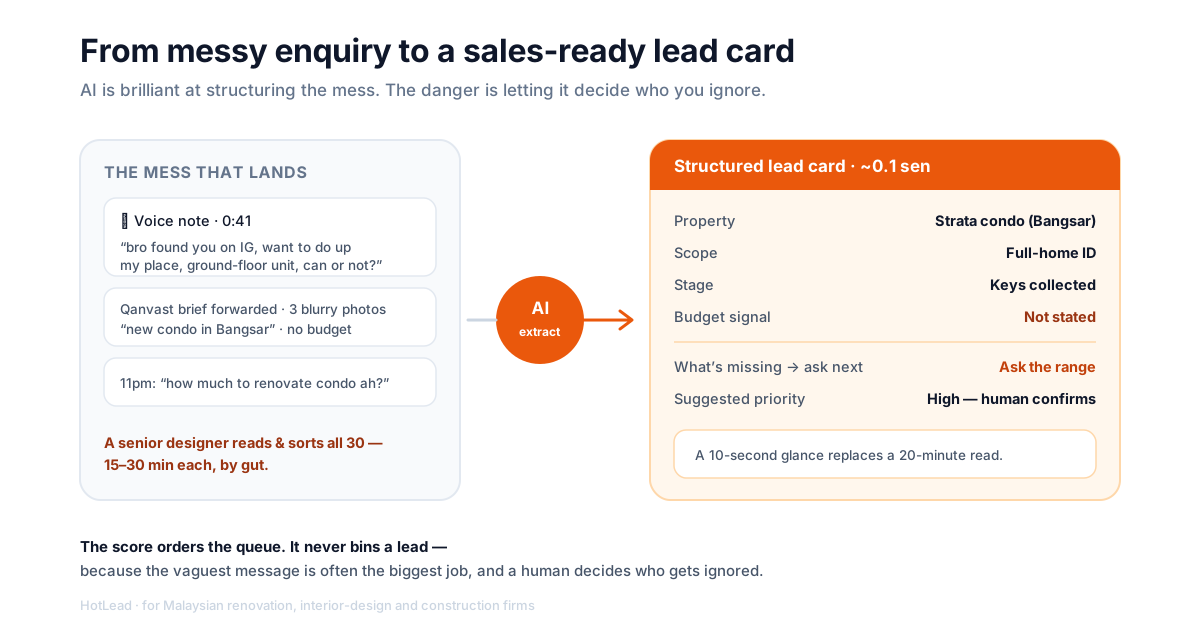
Here is a problem every interior-design studio in the Klang Valley knows in its bones. Thirty enquiries land on the studio WhatsApp in a week, and almost none of them are tidy. One is a 40-second voice note in Manglish — "bro, found you on IG, want to do up my place, ground-floor unit, can or not?" One is a forwarded Qanvast brief with three blurry photos and no budget. One is a single line at 11pm: "how much to renovate condo ah?" And one — buried, easy to miss — is a careful paragraph from someone who collected their keys last week and has RM150k ready.
A senior designer has to read all thirty, work out which is a real job, and decide who to call first. So the obvious 2026 question, and the one an owner actually cares about: can AI just read this mess and hand me a scored, sales-ready lead? And the honest follow-up — can it do that profitably, without quietly throwing away the jobs that pay the rent? I pointed AI at it. Here is the problem, what it cost before, what the builds actually did, and what you should do on Monday.
What does qualifying a messy enquiry cost before any AI?
Before AI, qualifying costs you a senior person's attention, and it costs it thirty times a week. Reading one messy enquiry properly — opening the voice note, squinting at the photos, working out strata or landed, guessing the scope, deciding if it is worth a callback — takes a real chunk of time, and it is your best designer doing it, because juniors miss the signals.
Put numbers on it. Industry write-ups (monday.com among them) peg manual research and qualification at 15 to 30 minutes per lead. Take the kinder end — 15 minutes — across thirty enquiries a week, and that is seven and a half hours, almost a full working day, spent sorting before a single design is sold. The broader sales data says the same thing from another angle: reps spend only about 40% of their time actually selling, with the rest lost to admin and triage.
And the triage itself is biased in a way that costs money. When a designer is buried, they do the human thing — they reply to the clean, well-written enquiries first and leave the messy ones for "later." The interior-design hub names this exact failure: designers cherry-pick easy enquiries; the rest rot. The trouble is that in Malaysian ID, the message quality tells you almost nothing about the job size. The vague 11pm one-liner is often the keys-in-hand full-home job. So the manual cost is not just the hours — it is the good leads that quietly go cold while you read them last.
So can AI read the mess? Yes — the structuring half genuinely works
The first thing that surprised me is how good AI is at the boring, valuable half of the job: turning mess into structure. Feed a model the raw enquiry — the transcribed voice note, the one-liner, the Qanvast brief — plus a prompt describing how an ID studio qualifies, and it reliably returns a tidy card: property type (strata condo or landed), scope (full-home or one or two rooms), rough size, stage (just collected keys, still planning, comparing quotes), any budget signal, timeline, and — the useful bit — what is missing and should be asked next.
This is not hand-waving. Extracting structured fields from messy free text is one of the things current models are demonstrably solid at: across peer-reviewed extraction studies — from clinical notes to address parsing — accuracy on clear fields routinely lands above 90% once the prompt is tuned, often matching or beating older rule-based systems with no fine-tuning. A blurry renovation enquiry is an easier target than a pathology report.
And it is nearly free. A messy enquiry plus a qualifying prompt is roughly 700 input tokens; the structured card back is about 200. At illustrative GPT-4o mini list pricing (about USD0.15 per million input tokens and USD0.60 per million output), that is on the order of USD0.0002 — about a tenth of a sen per lead. Thirty a week is well under RM1 a month. As with the first-reply experiment, the compute is a rounding error. The cost was never the tokens.
So if the question were only "can AI structure a messy enquiry cheaply and accurately?", the answer is an easy yes. But structuring is only half the ask. The other half is the score — and that is where I watched it start losing money.
What happened when I let the AI score and sort by itself?
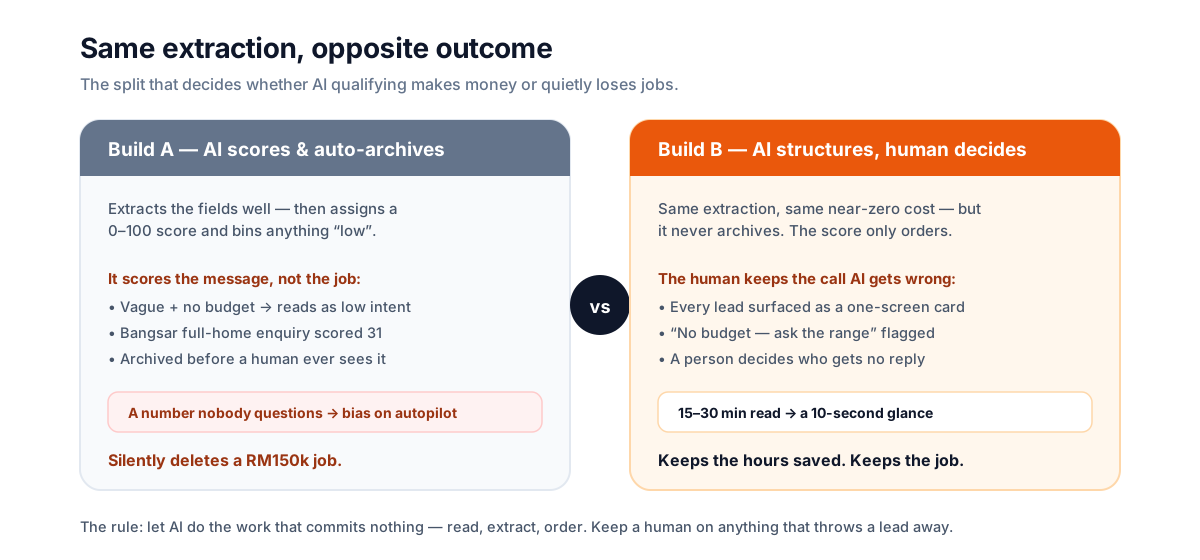
This was Build A: full auto. Enquiry lands, AI extracts the fields, assigns a 0–100 "sales-ready" score, sorts the queue, and auto-archives anything below a threshold so the designers only ever see the "hot" ones. Tidy. It demoed beautifully on the clean enquiries.
Then it did exactly what you would fear on the enquiries that matter. The model scores on what the message contains — and an early Malaysian ID enquiry is deliberately thin. As the qualifying guide lays out, most homeowners here genuinely do not know their budget yet and will go quiet if you ask too soon, so they open vague on purpose. The AI reads "no budget + short message + no specifics" as low intent and drops it to the bottom — or, in Build A, into the archive. The Bangsar condo full-home job that arrived as "need to do up my new place, found you on Qanvast" scored a 31 and got binned. That is not a rounding error. That is a RM150k job your competitor now closes.
There is a second, quieter failure: the score feels objective. "The system gave it a 31" sounds like a fact, so a busy team stops second-guessing it. You have automated your cherry-picking bias and given it the authority of a number. That is worse than the original problem, because now nobody is even feeling guilty about the leads that rot.
What actually worked: AI structures and orders, a human decides who to ignore
Build B kept everything good about Build A and removed the part that deleted jobs. The AI still reads every enquiry and returns the same structured lead card in seconds — same near-zero cost. It still suggests a priority and a one-line reason ("keys collected, full-home, no budget stated — ask range"). But it never archives anything, and the score only orders the queue; it never empties it. The designer sees a one-screen card instead of a wall of WhatsApp, scans the suggested running order, and makes every "skip this one" call themselves.
That distinction — structure and order, never delete — is the whole product. You keep the time saving, because the 15-to-30-minute read collapses into a ten-second glance at a card. You keep the prioritisation, because the queue is sorted sensibly most of the time. And you remove the one thing AI is genuinely bad at here: deciding, on thin early signal, that a human should never see a lead.
| Build A — AI scores and auto-archives | Build B — AI structures, human decides | |
|---|---|---|
| Reads & structures the enquiry | Yes — seconds | Yes — seconds |
| Compute cost | ~0.1 sen / lead | ~0.1 sen / lead |
| Time saved per enquiry | ~15–30 min → seconds | ~15–30 min → seconds |
| Vague-but-real RM150k job | Scored low, binned | Surfaced, flagged "ask budget" |
| Who decides to ignore a lead | The algorithm | A human |
| Failure mode | Silent — jobs vanish | Visible — designer still sees it |
The rule generalises, and it is the same one the first-reply experiment landed on from the other direction: let AI do the work that commits nothing — reading, extracting, ordering — and keep a human on any step that throws something away. Drafting a reply, structuring an enquiry: cheap to get wrong, a human catches it. Deleting a lead, sending a price: expensive to get wrong, the customer never tells you.
Why is this the honest answer for a Malaysian studio right now?
Because the local reality is the exact thing an AI score cannot see. Malaysia's interior-design market is large and growing — sized in the billions of US dollars and projected to keep climbing through 2031 — and a typical condo renovation here runs RM60k to RM150k, with full jobs reaching RM250k. The stakes per lead are high, and the early signal per lead is deliberately low, because homeowners shop quietly and reveal budget late. Any system that ranks leads purely on what the first message says will systematically undervalue your highest-stakes buyers.
That is not an argument against AI in qualifying — it is an argument for using it where it is strong. AI turns thirty messy threads into thirty clean cards faster and cheaper than any human, and that alone claws back most of a working day. What it should not own is the verdict, because the verdict depends on signal the message is built to hide.
What should an owner actually do on Monday?
You do not need to build a scoring pipeline this week to get most of the upside. In order:
- Use AI to structure, not to judge. If you point a model at your enquiries, have it produce a lead card — property, scope, stage, budget signal, what is missing — and stop there. The card saves the hours; the card is the win.
- Let the score sort the queue, never empty it. A suggested running order is useful. An auto-archive bin is how you delete a RM150k job for being badly typed. Keep a human on every "ignore."
- Make "what's missing" the output you care about. The most valuable thing AI gives you on a thin enquiry is not a score — it is "no budget stated, ask range" — because that tells your designer the one question to lead with.
- Get every structured lead to one owner, fast. A perfect lead card is useless if it sits in a shared inbox. Each enquiry still needs one person responsible and a next action, or the busy-season leak swallows it anyway.
How HotLead fits — and what it deliberately does not do
I will be straight, because over-claiming is the hype I keep arguing against. HotLead does not silently score-and-bin your leads, and that is on purpose — this experiment is the reason. What it does is the part the experiment proved is safe and valuable:
- Capture and one structured record per lead — every enquiry from WhatsApp, Qanvast, Atap, IG or a Meta ad lands in one pipeline, source-tagged, instead of scattered across five threads.
- One owner and a next action on every lead, so the structured enquiry actually reaches a person and gets followed up — the fast hand-off the experiment says must stay human.
- An optional AI assistant you can switch on that warms a new enquiry instantly, collects budget and scope, and hands the real buyers to your team — gathering and structuring, not deleting on a guess. You can take over any chat at any time.
- A funnel and per-channel view, so you can see whether you are losing work at qualification or further down the quote-to-deposit window.
In other words, HotLead structures and hands off, and leaves the judgement with your designers — the build that actually pays off. If messy, slow-sorted enquiries are your leak, start with the complete guide to managing renovation leads in Malaysia, see how it fits an interior-design studio, or read the companion piece on qualifying a lead in the first reply.
Sources: monday.com — AI-driven lead qualification (15–30 minute manual research/qualification per lead) and monday.com — sales reps spend ~40% of time selling; structured-extraction accuracy from peer-reviewed work including a System for Name and Address Parsing with LLMs and LLM extraction from pediatric clinical reports (>90% accuracy on clear fields after prompt tuning); AI lead-scoring conversion lift (≈38% higher lead-to-opportunity for mid-size firms) as reported in Brixon — predictive lead scoring ROI and Apollo — AI-driven lead scoring; GPT-4o mini API pricing (USD0.15 / 1M input, USD0.60 / 1M output — used for the illustrative structuring cost); Malaysia interior-design market size from 6Wresearch — Malaysia Interior Design Market and renovation cost bands from Coohom — interior-design pricing in Malaysia. Speed-to-lead and Malaysian qualifying behaviour are as cited in the complete guide and the qualifying guide.
Frequently asked questions
Can AI qualify and score interior-design leads automatically?
It can do the structuring half very well — reading a messy WhatsApp enquiry and pulling out property type, scope, size, stage and timeline into a tidy lead card, in seconds, for a fraction of a sen. What it should not do unsupervised is the deciding half — auto-archiving or ignoring "low-score" leads. It scores on what the message says, and Malaysian homeowners routinely give vague briefs and withhold budget early, so an auto-bin throws away real buyers. Use AI to structure and prioritise, and keep a human on the decision to ignore.
How much does it cost to have AI structure a renovation or ID enquiry?
Almost nothing in compute. Feeding a messy enquiry plus a qualifying prompt is roughly 700 input tokens and a structured reply is about 200 out; at published GPT-4o mini list pricing (around USD0.15 per million input tokens and USD0.60 per million output) that is on the order of USD0.0002, or about a tenth of a sen per lead. The cost that matters is never the tokens — it is a wrongly binned RM150k job.
Is AI lead scoring accurate?
For extracting structured fields from messy text, yes — peer-reviewed studies routinely report over 90% accuracy on clear fields once the prompt is tuned. For predicting who will actually buy, it is only as good as the signal in the message, and early renovation enquiries are deliberately thin on that signal. That is why the safe pattern is to trust the extraction and treat the score as a suggested running order, not a verdict.
Should an ID studio auto-archive low-scoring leads?
No. The whole reason qualifying is hard for a Malaysian studio is that the biggest jobs often arrive as the vaguest messages — "found you on Qanvast, need to do up my condo" with no budget and no scope. An AI score reads that as low intent and bins it, when it might be a full-home fit-out. Order your queue by the score if you like, but a human, not an algorithm, decides who gets no reply.
Does HotLead use AI to qualify my leads?
HotLead captures every enquiry, gives it one structured record and one owner, and keeps a next action on it. If you want, you can switch on an optional AI assistant that warms a new lead instantly, collects budget and scope, and hands the real buyers to your team — and you can take over any chat at any time. It gathers and structures so your designers spend their hours selling, not sorting; it does not silently delete leads on a guessed score. That split is exactly what this experiment landed on.
Keep reading
- The Only Three Ways to Grow a Renovation Firm — and Which Lever to Pull FirstEvery renovation firm's revenue comes down to three levers — how many leads you get, how many you close, and how big each job is. They multiply, so a modest lift on each compounds. But they cost wildly different amounts to pull, and most owners reach first for the one they should reach for last. Here's the ranking, with Malaysian numbers.
- Sight Unseen: Winning the Overseas Malaysian Who Renovates a Unit They Can't VisitA Malaysian working in Singapore collects the keys to a KL condo and messages you to fit it out — but they can't come to a site visit, can't walk your showroom, and will wire a deposit to a firm they've never met. Most firms treat this lead like a walk-in, go quiet when the buyer can't pop by, and lose the highest-budget job in the inbox. Here's why the remote buyer is your hardest-trust but best-paying lead, and how to build a remote lane that actually closes it.
- "Ok, Proceed" Isn't Money in the Bank — I Built an AI to Ask for the Deposit the Moment a Renovation Buyer Says YesA Cheras contractor closes a RM62k job on WhatsApp, the buyer says "ok proceed lah", and then the owner — mid-site, phone in a dusty hand — has to stop, pull the bank details, the agreed deposit and the scope, and type a careful money message. In that gap a hot yes quietly cools back to "let me think." The 2026 reflex is to ask AI to detect the yes and auto-fire the invoice. I built it, and it asked a half-committed buyer for 40% to a personal account two seconds after a soft "ok ok". Here's the version that kills the typing delay without asking for money off a misread.