

A renovation firm in Kota Damansara wins a condo job — a RM80k full unit refit for a young couple, the Lims. On day one, the client does the friendly, organised thing every Malaysian family does: she makes a WhatsApp group, calls it "Reno Rumah Kami 🏡," and adds her husband, her mother, the firm's owner and the firm's designer. Five people. One room.
For the first week it's lovely. Tile photos, a mood board, a lot of 👍. By message sixty it's a different animal. The mother-in-law sends six voice notes about the kitchen. The wife asks for a revised quote on the wardrobes, somewhere around message eighty, and it scrolls away under a flurry of countertop photos. The husband writes "ok" twice and "up to you lah" once. Someone types "I think the island better in marble, more grand" — the owner isn't even sure who, the chat moved too fast.
So the owner does the reasonable thing: he answers the person who's clearly most engaged — the mother-in-law — orders the marble island she kept talking about, and keeps the job moving.
At handover, the husband looks at the invoice. "Marble? I never agreed to marble. Who said marble? That's six thousand extra." And now the firm is standing in the middle of a family argument, holding a RM6k variation nobody will own, with the wife's wardrobe revision still sitting unanswered from three weeks ago.
So the 2026 reflex writes itself: "Can't AI just read the group for me — tell me who decides, what we agreed, and what's still open?"
I built it. The first thing it did was reply to the wrong person, and the second thing it did was log "marble nicer" as an agreed change. Here's why "read the group and handle it" is the wrong instruction — and the version that maps the room without ever opening its mouth.
Why is the family group chat the hardest lead to read, not the easiest?
Because it feels transparent while hiding the one fact you most need — who actually decides. Everyone's in one place, nothing's behind your back, so it reads like clarity. But a hundred and fifty messages of tile photos, voice notes and "up to you lah" don't tell you who holds the budget, whose preference is a decision versus thinking-aloud, or which asks are still open. The group doesn't remove the ambiguity about authority; it buries it under volume.
And in a Malaysian reno, the authority is almost never where the noise is. The pattern repeats across jobs:
- The loudest voice isn't the payer. The mother-in-law with the strongest kitchen opinions is frequently not writing the cheque. The wife running the shortlist may hold design final-say but defer the big number to her husband. The husband who writes "ok" twice may be the one whose loan is funding the whole thing. The person who messages most is the most available, not the most decisive — and those are different people.
- A preference is not a decision. "I think marble nicer" is a wish floated into a group. In a family, half the wishes are thinking-aloud that someone else quietly overrules later. Treating a floated preference as a signed change is how you end up ordering a RM6k island nobody agreed to.
- Open asks drown. The wife's "can you revise the wardrobe quote?" is real money and a real next step, but it arrives mid-stream and gets buried under forty countertop photos within the hour. Nobody re-reads a group chat from the top. The ask doesn't get refused — it just evaporates.
This is a close cousin of two problems my colleague Sarah and I have each written about — the lead where the decider isn't in the chat at all, and whether the single person messaging you is the decider or a messenger. But the family group is its own beast: the decider is in the chat, they're just invisible among five voices, and the risk isn't missing them — it's answering the wrong one and acting on an unsigned wish.
Isn't "who decides" obvious once you actually read the chat?
No — because who decides is a structural fact about the relationships, not a textual one you can read off the words. That's precisely the dimension AI is measurably worst at. You can read every message in "Reno Rumah Kami" and still not know that the quiet husband holds the veto, because nobody ever types "I hold the veto." It's a fact about who pays and who defers to whom — and it lives outside the text entirely.
The research on multi-party conversation is unusually blunt about this. In a 2025 benchmark built specifically to test it, Koji Inoue and colleagues at Kyoto University measured GPT-4o on addressee recognition — just working out who a given utterance is aimed at in a group. It scored 80.9% against a chance level of 80.1%, which the authors describe flatly as "only marginally above chance." The model's favourite move was to assume no-one in particular was being addressed, so it "often fails to recognize when an utterance is directed at a specific participant." On the related task of predicting who speaks next, it managed 46.0% — below the 50% chance line — which the authors say shows it "struggles to effectively capture the dynamics of turn-taking." And tellingly, only about 20% of turns in their data explicitly named their addressee — the other 80% leave "who is this for" implicit, to be inferred from the structure of the conversation.
The deeper diagnosis comes from an EMNLP 2024 paper with the excellent title "Do LLMs suffer from Multi-Party Hangover?" (Penzo, Sajedinia, Lepri, Tonelli and Guerini). Their finding, in one line: picking the right response leans mostly on the text of the conversation, but working out the addressee "requires capturing their structural dimension" — the shape of the conversation graph, who's replying to whom — and standard evaluations miss how badly models wobble as that structure gets more complex. A family group with five people, interleaved sub-threads and a parent dropping in and out is about as structurally complex as a short chat gets.
There's a Malaysian wrinkle that makes the stakes concrete rather than academic. When a home is co-owned — and it often is, because parents help with the deposit or the unit is the family home — Malaysian co-proprietorship runs as tenancy in common, and under Section 343(1) of the National Land Code each co-proprietor is entitled to possess and enjoy the whole property. So that mother-in-law in the group isn't necessarily background noise: if she co-owns or co-paid, her sign-off genuinely carries weight. Which cuts both ways — you can't dismiss her, and you can't treat her offhand "marble nicer" as the firm's green light. Knowing which of the five actually holds authority isn't optional politeness; it's the difference between a signed change and a dispute.
So what did the auto-reply build do? (Build A)
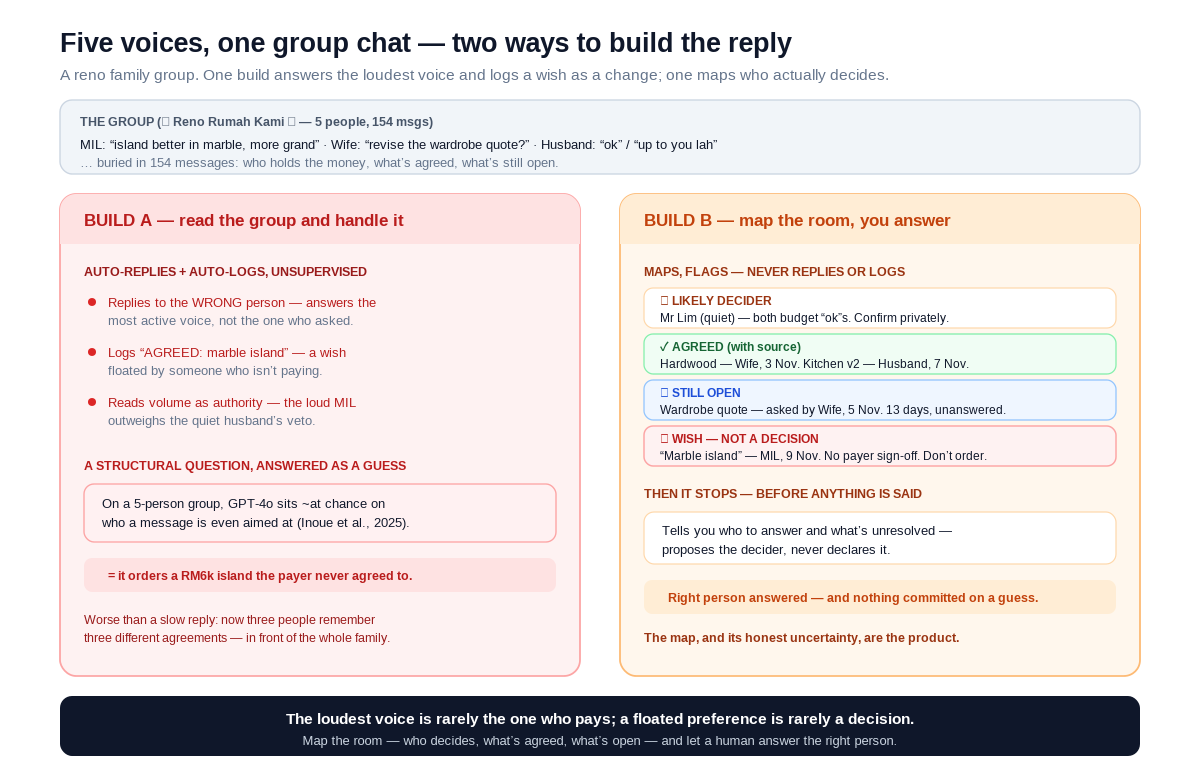
It read the group, picked who to answer, replied on its own, and logged every stated preference as a decision — and it answered the wrong person off a wish nobody committed to. Build A is the one the pitch sells: "AI, watch my project groups and keep them moving." Hands-off, the group runs itself.
It failed in exactly the ways the benchmarks predict:
- It answered the wrong person. Asked to reply to the latest live question, it addressed its answer to the most recent or most frequent writer — the mother-in-law — on a point the wife had actually raised. In a two-person chat "reply to the other person" is trivial; in a five-person family group, where the model sits at chance on who an utterance is even aimed at, "reply to the right person" is a coin-flip it loses often enough to matter. Addressing the wrong family member isn't just clumsy — it signals you're not really tracking the project.
- It logged a wish as a decision. Told to keep a running record of agreed scope, it read "I think the island better in marble" and wrote AGREED: marble island into the job notes. No-one who holds the money said it. It was a preference floated by one voice, the kind a family routinely overrules — and now it's sitting in the record as a commitment, which is exactly how the RM6k variation got ordered. This is scope creep arriving not as a sneaky add-on but as a misread of casual chat.
- It flattened the room into the loudest voice. With everyone talking, the model's reading gravitated to whoever produced the most text, treating volume as authority. The quiet "ok" from the husband — the actual veto-holder — carried less weight in its read than six enthusiastic voice notes from someone who wasn't paying. That's the precise inversion of how the decision really works.
Build A doesn't fail by being unable to read the messages — it reads them fine. It fails by turning a structural question (who decides, what's committed) into a textual guess (who talked most, what words appeared) and then acting on the guess. A slow human reply is recoverable. A confident auto-reply to the wrong family member, plus a logged "agreement" nobody made, is a mess you apologise your way out of in front of the whole family.
Why can't AI just tell you who decides?
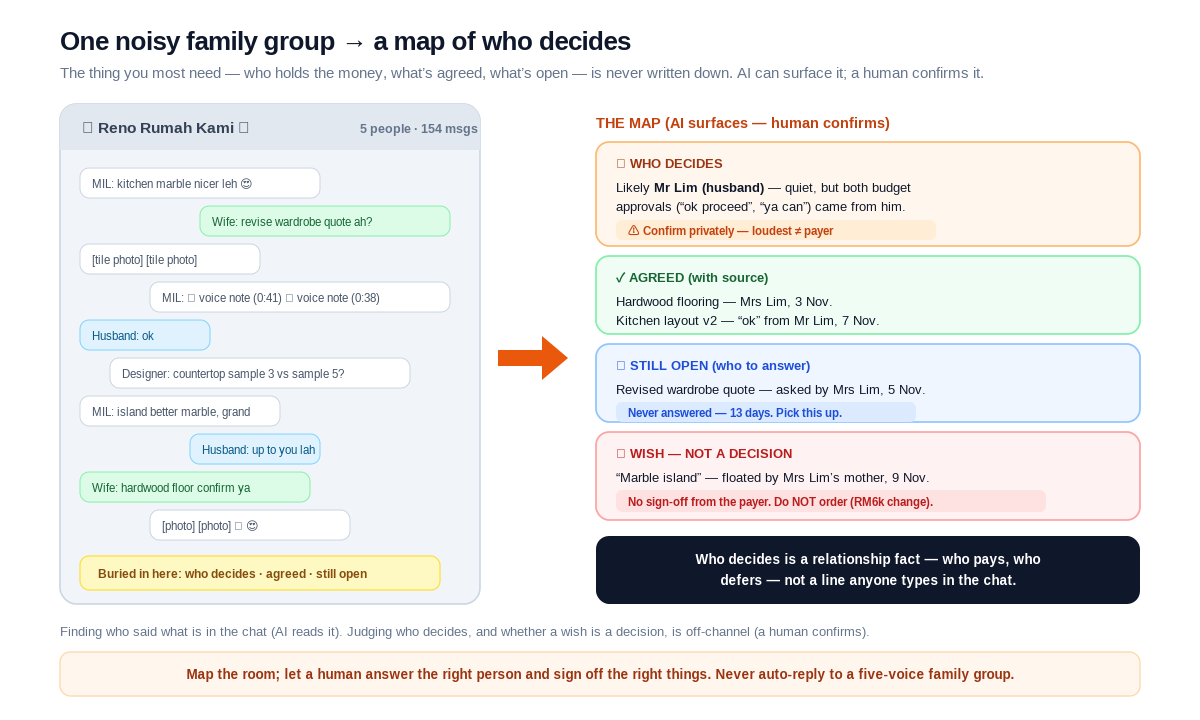
Because finding who said what is in the chat, but judging who actually decides — and whether a preference is a commitment — is not. Those facts live in the relationships and the bank account, off the channel entirely. Run the family group through the one-question test — is the answer written in the messages? — and the line between what AI can safely do and what it can't draws itself:
| In the chat (AI can surface it) | Off-channel (only a human can judge) |
|---|---|
| Who sent each message, and roughly who it seems aimed at | Who actually decides — who pays, who holds the veto |
| What words were used: "marble nicer," "revise the quote" | Whether "marble nicer" is a committed change or a floated wish |
| Which asks got a reply and which didn't | Whether the quiet "ok" was real agreement or just politeness |
| The sequence and timing of the messages | Who defers to whom when the family disagrees |
Everything in the left column is a reading task AI genuinely helps with — it can pull a tangle of 150 messages into "here are the five people, here's what each raised, here's what got answered." Everything in the right column needs a fact nobody typed. The moment you let AI act on the left column as if it knew the right column, it commits your firm on a guess. The useful output isn't a handled group — it's an honest map of the room, so the person who can see who pays answers the right voice and signs off the right things.
What did the build that actually paid look like? (Build B)
It never replies and never logs an agreement. It maps the room — the parties, a best-guess decider with its evidence, what's actually been agreed and in which message, and what's still open and who must confirm it — then stops. Same shape as every build in this series that's earned its keep: AI reads and organises; the human decides and speaks.
Pointed at "Reno Rumah Kami," Build B returns this, in a second or two:
Group: Reno Rumah Kami — 5 people, 154 messages
👥 Likely decider: Mr Lim (husband) — low message count, but the two budget approvals ("ok proceed," "ya can") came from him. ⚠️ Confirm privately — don't assume. 🗣️ Most active: Mrs Lim's mother — 41 messages, mostly kitchen preferences. High input, no evidence of budget authority.
✅ Agreed (with source): hardwood flooring — confirmed by Mrs Lim, 3 Nov. Kitchen layout v2 — "ok" from Mr Lim, 7 Nov. ❓ Still open: revised wardrobe quote — requested by Mrs Lim, 5 Nov, never answered (13 days). 🟡 Wish, not a decision: "marble island" — floated by Mrs Lim's mother, 9 Nov. No sign-off from the payer. Do not order.
Then it stops. It doesn't reply to anyone — it tells you the wardrobe quote is the open thread to pick up, and who raised it. It doesn't log the marble as agreed — it flags it explicitly as a wish from someone who isn't the payer. It doesn't declare Mr Lim the decider — it proposes him with the evidence and tells you to confirm. The map, and the honest uncertainty in it, are the product. The difference between the two builds is small on the page and the whole game in practice:
| Build A — "read it and handle the group" | Build B — "map the room, you answer" | |
|---|---|---|
| Who it replies to | Picks a person and sends — often the wrong one | Nobody. It tells you who to answer and why |
| A floated preference | Logged as AGREED | Flagged "wish — not signed off, don't order" |
| The decider | Inferred from who talks most (the loud one) | Proposed with evidence, marked "confirm privately" |
| The buried open ask | Lost under the noise, same as before | Surfaced: "wardrobe quote, 13 days unanswered" |
| Worst-case output | A wrong reply + a logged agreement nobody made | A map with one line you double-check |
| Where it stops | After it has spoken and recorded | Before anything is said or committed |
| Cost per map | — | ~0.1 sen, illustrative |
Why does the mapping version pay? Because it fixes the real leaks — answering the wrong person, acting on an unsigned wish, losing the buried ask — without opening the far worse one, a firm publicly committing to work in front of a family that never agreed to it. The downside of Build B is that you still have to read the map and type your own reply. The downside of Build A is that one busy week it orders a marble island off a mother-in-law's daydream and bills the husband for it.
What should an owner actually do with a family group chat?
Find the payer early and quietly, speak into the group with one voice, and treat every preference as a wish until the money-holder signs off in writing. Most of the win here is a handful of habits backed by thin, honest software — the AI maps, it doesn't manage.
- Identify the decider in the first week, privately. Early on, a light touch does it: "So I send the formal quote and any changes to confirm — is that best to you directly, Mr Lim, or to the group?" You're not being rude to anyone; you're finding out whose "yes" is the real yes. The payer is usually the quiet one, so don't read silence as disinterest.
- Answer the group with one voice. Your firm should speak into the family group as one person — one owner on the lead, not your designer and your PM contradicting each other in front of the client. A family that sees two of your staff disagree stops trusting both.
- Treat preferences as wishes until signed off. When "marble nicer" appears, the warm, safe reply is: "Love it — marble island is about RM6k more, want me to add it to the quote for sign-off?" That turns a daydream into a priced, confirmed decision — or a polite no — before you order anything. Never let a preference become a purchase order.
- Keep a running "agreed / open" list — and put it back in the group. Once a week, post it: "Confirmed: hardwood, kitchen layout v2. Still open: wardrobe quote (sending today). Anything I've got wrong?" It forces the family to converge, surfaces the buried ask, and gives you a paper trail when someone's memory drifts at handover.
- If you use AI, make it map — never send. Point it at the group to get the room mapped and the open thread surfaced; keep your hand on every reply and every sign-off. "Tell me who to answer and what's unresolved" is a job AI genuinely helps with. "Answer them for me" is the one that orders the marble.
How HotLead fits — honestly
I'll be straight, the way I try to be in all of these, because over-claiming is the exact hype I keep arguing against. HotLead does not read your WhatsApp groups, it does not map the family, and it does not tell you who decides — mapping a multi-party group is the experiment in this piece, and the piece is the argument for keeping that judgement human. What it ships is the plumbing that stops a family group from turning into chaos you can't reconstruct:
- The whole conversation on one lead record. So the agreed items, the open asks and the stray wishes live in one place tied to the job — not scattered across the owner's phone, the designer's phone and a group nobody re-reads from the top. You can't hold a family to an agreement you can't find.
- One owner per lead, by rule. So your firm speaks into the group with a single voice, and one person is accountable for the whole relationship — no two staff contradicting each other in front of the client, which is its own group-chat leak.
- A next-action and overdue flag. So "send the revised wardrobe quote" becomes a dated task that resurfaces if it's not done, instead of scrolling away under forty tile photos. The buried ask that cooled the Lim job can't silently die when it's written down as a next action.
- A funnel and team view. So if family-group jobs are stalling — lots of talk, slow sign-off — you can see it as a pattern and change how you run them, rather than feeling vaguely that "these family jobs always drag."
The judgement — who pays, whose word is final, whether "marble nicer" is a decision — stays with you, because that's a fact the chat never actually states, and the model will just reach for the most confident guess. If the real problem underneath this is reno decisions getting lost among too many voices, start with the complete guide to managing renovation leads in Malaysia, see how it fits a renovation firm or an interior design studio, and read the companion pieces on whether the person messaging you is the decider or a messenger, selling when the decider isn't in the chat, and the honest ledger of which AI builds in this series actually paid.
Sources: That language models are only marginally better than chance at recognising who an utterance is addressed to in multi-party dialogue — GPT-4o at 80.9% against an 80.1% chance level, defaulting to "no specific addressee," and scoring 46.0% (below the 50% chance line) on next-speaker prediction, with only about 20% of turns explicitly naming their addressee — is from Koji Inoue, Divesh Lala, Mikey Elmers, Keiko Ochi and Tatsuya Kawahara, "An LLM Benchmark for Addressee Recognition in Multi-modal Multi-party Dialogue" (arXiv:2501.16643, 2025); the paper notes some of its own table counts don't fully reconcile, so these are reported as the authors state them. That addressee recognition "requires capturing the structural dimension" of a conversation (the shape of the conversation graph), while response selection leans more on text, and that standard evaluations miss how models degrade as conversational structure gets more complex, is from Nicolò Penzo, Maryam Sajedinia, Bruno Lepri, Sara Tonelli and Marco Guerini, "Do LLMs suffer from Multi-Party Hangover? A Diagnostic Approach to Addressee Recognition and Response Selection in Conversations" (Proceedings of EMNLP 2024). That roughly 90%+ of Malaysian internet users are on WhatsApp is from Statista's 2024 social-media reach data for Malaysia (about 92%), consistent with the ~90% penetration reported in Infobip's messaging-app country overview. That Malaysian co-ownership runs as tenancy in common, with each co-proprietor entitled under Section 343(1) of the National Land Code to possess and enjoy the whole property, is from Chia, Lee & Associates on co-proprietorship in Malaysia; whether a renovation specifically requires every co-owner's consent is not settled by that source and is not claimed here. Operating figures — a ~RM80k Kota Damansara condo job, a ~RM6k unsigned "marble island" variation, ~RM1,280 expected gross profit per lead, 40–60 enquiries a month, ~0.1 sen per AI map — are typical numbers reused across this series and labelled illustrative; the Lim family, the group chat and the AI experiments are described from practice and labelled illustrative, not a controlled trial. No addressee-recognition, decision-accuracy or conversion percentage of my own is invented here — the "AI can't tell who decides a multi-party chat" failure mode is argued from the multi-party-dialogue benchmarks above, not a number I made up.
Frequently asked questions
Why is a family WhatsApp group so hard to manage as a renovation lead?
Because it hides the one fact you most need. A family group feels organised — everyone’s in one place, nothing’s behind your back — but across a hundred-plus messages of tile photos, voice notes and “up to you lah,” you can’t tell who actually holds the budget, whose preference is a decision and whose is just thinking aloud, or which asks are still open. In a Malaysian reno the real decider is often the quietest person in the chat: the husband who writes “ok” twice while his wife runs the shortlist and her mother sends six voice notes about the kitchen. Answer the most active voice and you can pour your whole pitch into someone who can’t say yes; treat a stray “I like marble” as agreed and you order a change nobody signed off. The group doesn’t remove the ambiguity about who decides — it buries it under noise.
Can AI read my client’s family group chat and just handle it?
It can help you read the room; it should not reply for you, because the two hardest judgements aren’t in the text. Working out who an utterance is addressed to, and who really decides, is a structural read of the relationships — and that’s measurably where language models are weakest: on a 2025 multi-party benchmark GPT-4o sat essentially at chance on recognising the addressee of a turn and below chance on predicting the next speaker, and it defaulted to assuming no-one in particular was being addressed. So an AI told to auto-reply in a five-person family group will, often enough, answer the wrong person; and told to auto-log preferences, it will record a mother-in-law’s “marble nicer” as a decision the person paying never made. A wrong reply or a wrongly-logged change in a family group is worse than a slow one, because now three people remember three different agreements. The safe design has AI map the parties, the agreed items and the open ones — and stops before it speaks.
Who actually decides a renovation in a Malaysian family?
Often not the person messaging you, and often more than one person. The common pattern is a split: a spouse or an adult child runs the sourcing and the chat while the budget-holder — frequently a quieter husband, or parents who helped pay — holds the real veto and barely types. It matters legally too: when a home is co-owned, Malaysian co-proprietorship runs as tenancy in common, and under Section 343(1) of the National Land Code each co-proprietor is entitled to possess and enjoy the whole property — so a parent who co-owns or co-paid isn’t background noise, their sign-off genuinely counts. The practical move is to find the payer early and quietly, keep answering the group politely, but treat nothing as agreed until the person who holds the money says so in writing.
Isn’t this the same as spotting the decision-maker, or catching up on a long thread?
No — it’s a different shape of problem. Spotting the decision-maker asks whether the one person messaging you is the decider or a messenger. Catching up on a thread compresses one long history for a colleague taking it over cold. Splitting a multi-topic message pulls several asks out of one person’s single rambly message. This is the multi-party case none of those cover: many people talking at once in one group, where you have to map the room — who decides, what’s agreed, what’s open, who must confirm — before you can safely answer anyone. (All three companion pieces are linked in the article above.)
Does HotLead read group chats and tell me who decides?
No, and I won’t pretend it does — mapping a family group and guessing the decider is the experiment in this article, and the article is the argument for keeping a human doing the deciding. What HotLead ships is the plumbing that stops a family group from becoming chaos: the whole conversation sits on one lead record, so the agreed items and open asks aren’t scattered across three phones; one owner on your side holds the lead by rule, so your firm speaks into the group with a single voice instead of two staff contradicting each other; and a next-action with an overdue flag turns “send the revised wardrobe quote” into a tracked task that can’t scroll away under forty tile photos. The judgement — who pays, whose word is final, whether a preference is a decision — stays with you, because that’s a fact the chat never actually states.
Keep reading
- Can AI Reply to Your Renovation Firm's 1-Star Review? I Built It — and the Risk Is How Fast It ApologisesA 2-star review on Google or Qanvast is the first thing your next renovation lead reads — and most firms either ignore it or fire back and make it worse. The 2026 reflex is to let AI write the reply. I built it, and drafting a calm response costs a fraction of a sen. But an AI tuned to be helpful apologises too fast — it will concede a fault in writing, promise a refund that never happened, and grovel to a fake review from a competitor. Here's the build that protects your rank instead of torching it.
- Which Lead Signals Actually Predict a Sale? Reverse-Audit Your Own Won JobsMost firms grade a renovation lead on signals that feel predictive — enthusiasm, a long message, a fast reply — and never check whether those signals actually separate won jobs from lost ones. Here is how to run a reverse-audit on your own closed deals, which signals usually survive it, and why your pipeline is too small to pretend the score is more than directional.
- The "I Only Deal With the Boss" Lead: When the Buyer Refuses Your TeamYou finally hired someone to share the load — then the buyer messages "can I deal with you direct ah, boss?" and refuses to engage your staff. Every big lead quietly re-centralises onto the one person already maxed out, and your firm can never grow past the owner. Here's why caving caps you, why a flat "my staff will assist" loses a nervous buyer, and the move that keeps both.