

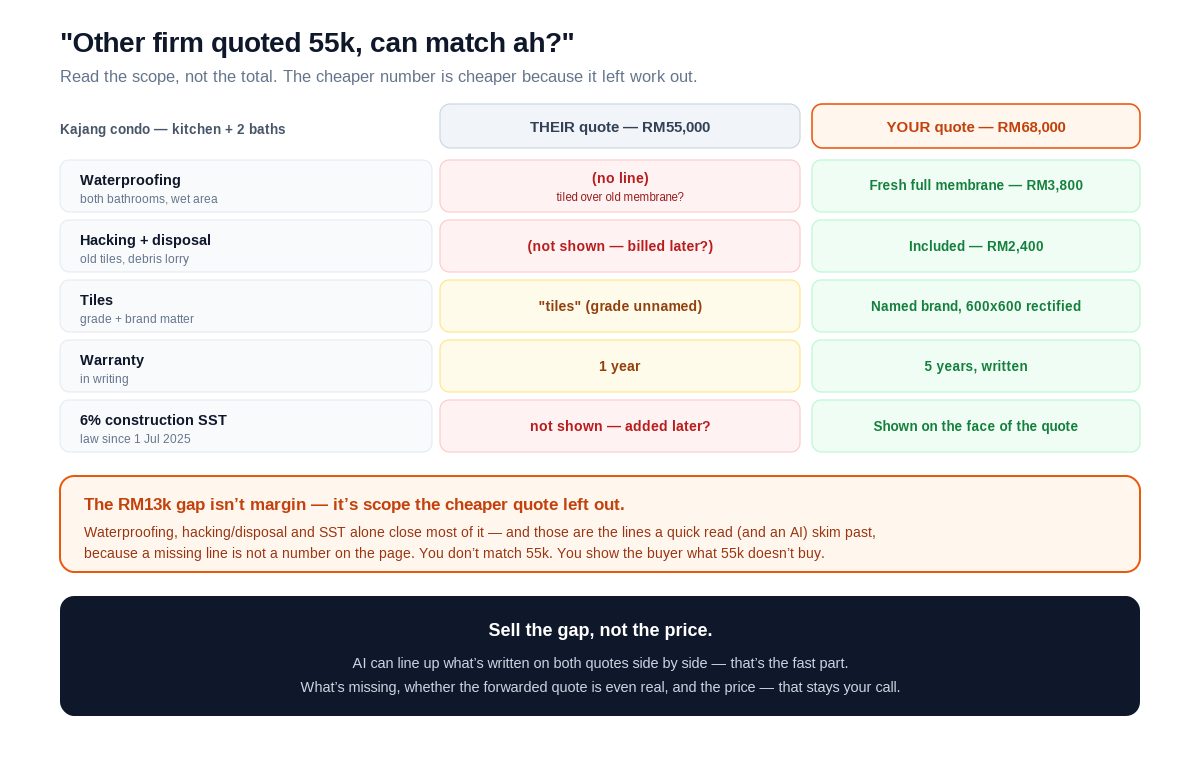
A buyer in Kajang is deep in talks with a renovation firm — call them the firm you run. Full condo kitchen, two bathrooms, a decent double-storey job. You’ve done the site visit, scoped it properly, and sent a careful RM68,000 quote. Then, on a Thursday night, a screenshot lands on WhatsApp: another firm’s quote for the same job, bottom line RM55,000, followed by four words that make every reno owner’s stomach drop — “other firm quote 55k, can match ah?”
Here’s the reflex, and it’s expensive: panic a little, then either drop your price to RM55k to save the deal, or fire back a defensive “our quality is better lah” that convinces no one. The first bleeds RM13,000 of margin on a number you didn’t set. The second loses the job to the cheaper quote anyway.
So the 2026 question this column exists for: now that AI can read a document in seconds, can it read the rival’s forwarded quote, compare it to mine, and tell me how to win? I built it. Within a few threads it had confidently advised me to discount to match — against a quote that, read properly, was cheaper for one simple reason: it had quietly left out the waterproofing. Here’s what broke, why “what did they leave out?” is the exact question AI is worst at, and the build that sells the gap instead of chasing the number.
Why does a buyer forward a competitor’s quote at all?
Because it’s half a buying signal and half a price-test — and almost never a genuine request to match. A buyer who’d already decided on the cheaper firm wouldn’t be showing you their quote; they’re showing you because they’d rather use you and want a reason to. Read it as what it is: a door held open, not a gun to your head.
In a Malaysian reno negotiation, “can match ah?” is ambient — the same reflex as “best price boss” and “got discount or not.” It’s a move, and the forwarded quote is the prop. That means two things. First, the buyer is still talking to you, which is the whole game — a cold lead doesn’t bother. Second, they’re handing you a document that tells you exactly how the competitor positioned the job: their scope, their grades, their assumptions. That’s free reconnaissance. The losing response treats it as a number to beat; the winning one treats it as a scope to read.
And the scope is where the real story is. A quote that comes in RM13,000 under yours on the same flat, same rooms, same work is not usually RM13,000 more generous. It’s RM13,000 lighter — and the weight it’s missing is invisible on the bottom line.
What did the flashy build do? (Build A)
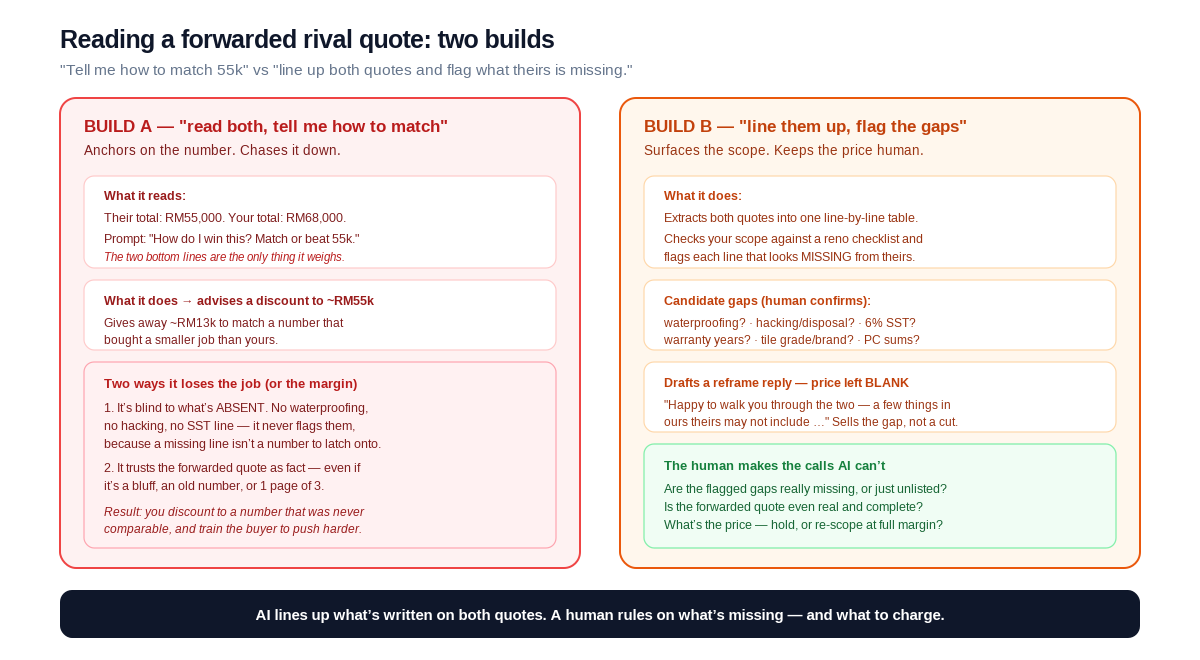
I told it: “Here’s their quote and mine — read both and tell me how to match or beat 55k.” It anchored on the two bottom lines, advised me to discount to around RM55k, and said nothing about the three lines that explained the whole gap. Build A is the one everyone pictures: feed the AI both documents, ask it to win the deal. In practice it made the two mistakes a price-compare specifically invites.
Failure one: it chased the number down. Given two totals — RM55k and RM68k — and a goal of “win,” the model did the arithmetic any calculator would: close the RM13k gap. It drafted a reply offering a “special price” near RM56k and suggested I “trim some scope to get there.” That’s a RM13,000 give-away on a number the other firm set, and in a business where margins are thin, it’s brutal: a 1% price gain lifts operating profit by roughly 11% in the classic McKinsey analysis, so a cut of this size runs the lever hard in reverse. It’s the same reflex I warned about in when to discount to close and when not to — a machine told to “win on price” trains your buyers to push, every time.
Failure two — the fatal one: it was blind to what the cheaper quote left out. The RM55k quote had no waterproofing line. None. For two bathrooms, that’s not a saving — it means either they’re tiling over the old membrane (a leak into the unit below waiting to happen) or they’ll bill it later as a “variation.” It also didn’t show the 6% construction SST, and its hacking-and-disposal line was missing. Those three absences account for most of the RM13k. Build A never mentioned them — not because it was lazy, but because a line that isn’t there is not something a language model reliably notices. It read what was printed, compared the printed totals, and advised me to match a job that wasn’t the same job.
Why can’t AI just tell me what the cheaper quote left out?
Because detecting absence — “there is no waterproofing line in this quote” — is the single capability language models are weakest at. They’re built to extract what’s present; a missing item isn’t a word or a number on the page for them to catch. This isn’t caution, it’s measured. On AbstentionBench, a 20-dataset benchmark for whether models know when a question can’t be answered from what they’ve been given, reasoning-tuned models actually got worse at holding back — abstention dropped by about 24% on average. Models are rewarded for producing an answer, not for noticing that the thing you need isn’t in front of them. And negation specifically is a long-documented blind spot: across a roughly 400,000-sentence negation benchmark, models were found to be largely insensitive to negation, leaning on surface cues instead.
Map that onto a quote compare. “What’s in their quote?” is an extraction question — AI is good at it. “What’s missing from their quote that’s in mine?” is an absence question — AI is bad at it, and worse, it’ll answer confidently anyway. To know the waterproofing is missing, the model has to hold a mental model of what a complete bathroom scope contains and notice a hole in the rival’s — and the thing that should be there isn’t written on either document. That knowledge lives in your head and your standard scope, not in the two PDFs.
Then stack the second problem: the forwarded quote may not even be real. It could be a bluff (“another firm quoted 55k” with a screenshot that’s actually a different flat), an old number, or one page of a three-page quote. Build A trusts whatever it’s handed as ground truth. A human knows to ask whether the document is the whole document.
What signal does the forwarded quote honestly give you?
Not “how to beat them” — but a clean, line-by-line extraction of what’s written on both quotes, lined up so a human can see the shape of the gap fast. That’s a real, automatable job, and it’s a different one from judging what’s missing and what to charge. Split it in two: lining up versus reading the gap. The first is extraction over two documents, which AI does well. The second needs your standard scope, your margin, and your read of whether the rival quote can be trusted — all yours.
| On the two quotes — safe for AI to line up | Off the quotes — stays a human call |
|---|---|
| Every line item written on each quote, side by side | Which lines are missing from theirs vs a full scope |
| Where the two totals differ by line, not just at the bottom | Whether a missing line is truly excluded or just unlisted |
| Flagging your scope lines that have no match in theirs (candidates) | Whether the forwarded quote is real, current and complete |
| Drafting a reframe reply with the price left blank | The price — hold, re-scope at full margin, or walk |
Everything on the left is “here’s what both documents say, aligned.” Everything on the right needs knowledge that isn’t on either page — a complete reno scope, your cost base, and a bit of streetwise judgement about the buyer and the screenshot. So the honest design writes itself: let AI line the quotes up and propose the gaps; let a human confirm them and set the number.
What did the build that actually paid look like? (Build B)
It extracts both quotes into one line-by-line table, checks my scope against a standard renovation checklist and flags the lines that appear to be missing from theirs, then drafts a reframe reply with the price left blank — and it never advises a discount. Same shape as every build in this series that’s earned its keep: AI reads and organises; the person who knows the scope and the margin decides.
Pointed at the Kajang pair, Build B doesn’t touch my price. It lays the two quotes side by side and raises flags against a reno checklist: “Lines in your scope with no match in theirs — waterproofing (both baths), hacking + disposal, 6% SST shown on face. Also differs — warranty 5yr vs 1yr, tiles named grade vs unspecified. These may be excluded or just unlisted — confirm before you use them.” Then it drafts a reply with a blank where the number goes: “Happy to walk you through both side by side — a few things ours includes that theirs may not, want to make sure you’re comparing the same job …”
Then it stops. I read it in a minute, confirm from their actual document that yes, there’s genuinely no waterproofing line and no SST, and do the thing the machine can’t: I don’t discount. I send the buyer a two-column comparison that shows RM55k buys a job without fresh waterproofing, without disposal, with a one-year warranty and a tax bill likely to arrive later — and RM68k buys the complete, warrantied, tax-inclusive version. Nine times out of ten the conversation stops being about RM13k and starts being about a leak into the neighbour’s ceiling. (It’s the mirror of the price-shopping signal build: that one spots that they’re comparing you with no document in hand; this one reads the document once they hand it over.)
| Build A — “read both, beat 55k” | Build B — “line them up, flag the gaps” | |
|---|---|---|
| What it optimises for | Closing the price gap | Showing the scope gap |
| On the missing waterproofing line | Silent — can’t see an absence | Flags it as a candidate gap to confirm |
| On the forwarded quote itself | Trusts it as fact | Prompts you to check it’s real and complete |
| What it does with price | Advises a discount to match | Leaves the number blank — you set it |
| On the 6% SST | Ignores it | Flags it’s not shown on their face |
| When it’s wrong | You’ve already offered the discount | You see the flags and rule on each |
| What it costs per compare | — | ~0.2 sen, illustrative |
The value you actually wanted is still there — a fast, clear read of how the two quotes stack up — minus the one judgement the machine is statistically worst at (what’s missing) and the one it has no business making (your price).
What should an owner actually do when a buyer forwards a rival’s quote?
Don’t match the number. Read what it left out, show the buyer the gap, and quote your own scope with the tax and the warranty on the face of it. The AI is a line-up tool, not a pricer. Most of the win is a habit plus a thin layer of software.
- Treat “can match?” as a buying signal, not an ultimatum. They’re still talking to you because they’d rather use you. Give them the reason, not a discount.
- Read the scope, never just the total. A RM13k-cheaper quote on the same job is almost always RM13k lighter on scope. Find the lighter lines — they’re the whole conversation.
- Know the usual omissions cold. Fresh waterproofing membrane, hacking and disposal, the 6% construction SST, tile and material grade (not just “tiles”), electrical rewiring, condo permits and MC deposits, and the warranty in writing. These are what vanish from a cheap quote.
- Don’t discount against a quote you haven’t seen. “Another firm quoted 55k” with no document is a price-test. Ask, politely, to see it — framed as “so we’re pricing the same scope.” Half the time it doesn’t come.
- Put your tax and warranty on the face of the quote. If yours shows the 6% SST and a written 5-year warranty and theirs doesn’t, that’s not a weakness to hide — it’s the proof you’re quoting the real, legal, complete job. Make it visible.
How HotLead fits — honestly
I’ll be straight, the way I try to be in all of these, because over-claiming is the exact hype I keep arguing against. HotLead does not read competitor quotes, compare documents, or tell you what a rival left out — that’s the experiment in this piece, and the piece is the argument for why the money calls stay yours. What it ships is the plumbing around the “can match?” moment:
- The forwarded quote lands on one lead record, with the whole thread. The screenshot or PDF the buyer sent and the “can match ah?” message sit together on the lead — not lost in a scroll — so when you sit down to compare, everything’s in one place. It’s the same capture discipline behind the supplier-and-subcon quote read; there it’s your cost inputs, here it’s the rival’s document.
- One owner per lead, by rule. So the price-compare reply is consistent and comes from the person who scoped the job — not a second rep who doesn’t know what’s in your RM68k and might just offer a discount to make the awkward question go away.
- A next action and an overdue flag on every lead. A “can match?” is time-sensitive — the buyer is deciding now. The flag means it never sits unanswered for two days and loses by default to the firm that replied in ten minutes.
- A funnel and per-channel view. So you can see how many deals stall right at the price-compare step — the signature of a firm matching numbers instead of selling scope — and fix the pattern, not just this one deal.
The read of what the cheaper quote left out, whether the forwarded quote can even be trusted, and the price itself — all stay with you, because you’re the one who knows a complete scope and your own margin. If the real problem underneath this is losing jobs at the price-compare moment, start with the complete guide to managing renovation leads in Malaysia, see how it fits a renovation firm, and read the companion pieces on spotting the price-shopping signal before the quote even lands, the true cost of giving work away to close, why a free detailed quote isn’t free, what AI still can’t do in a contractor’s lead process, and the honest ledger of which AI builds in this series actually paid.
Sources: The 6% service tax on construction and renovation work, effective 1 July 2025 under Malaysia’s expanded SST, with a residential-only exemption and an RM1.5 million annual registration threshold, is reported by RinggitPlus, Wolters Kluwer and EdgeProp; confirm specifics against the Royal Malaysian Customs Department guidance. That a 1% price increase lifts average operating profit by roughly 11% (demand held constant) comes from a McKinsey study of the Global 1200, as reported in the widely-cited “10 Tips to Better Pricing” (IndustryWeek) — a cross-industry average, so it varies by firm. Malaysian renovation cost bands (condo full interior work RM50–150 per sq ft, bathroom renovations RM6,000–20,000+, and a fresh waterproofing line adding roughly RM5–15 per sq ft) are from budgeting guides by Loanstreet and contractor guides, treated as indicative bands, not quotes; that cheap quotes commonly omit fresh waterproofing (tiling over the old membrane), hacking and disposal, permits, electrical rewiring and clear material grades is drawn from Malaysian contractor and portal guides including PropertyGuru. That language models are weakest at recognising when the needed information is absent is from AbstentionBench (Kirichenko et al., 2025) — 20 datasets, with reasoning fine-tuning degrading abstention by about 24% on average — and the long-documented insensitivity of models to negation is from the large-scale negation benchmarks surveyed in that literature (García-Ferrero et al., 2023; Truong et al., 2023). The one-question test and the off-the-page-fact principle are reused from the honest-limits piece in this series. Lead economics (a ~RM68,000 quote vs a forwarded ~RM55,000 rival quote, the ~RM13k gap attributed to omitted scope, ~0.2 sen per AI compare) are typical operating numbers reused across this series and labelled illustrative; the AI experiment and the Kajang scenario are described from practice and labelled illustrative, not a controlled trial. No tax rate, cost band, profit figure or model score here is invented — the SST, pricing, renovation-cost and AbstentionBench numbers are quoted from the cited sources, and the ringgit figures in the worked example are marked illustrative.
Frequently asked questions
A customer sent me a competitor’s cheaper quote and asked me to match it — should I?
Almost never match the number straight. In renovation a cheaper quote is usually cheaper because it covers less — it tiles over the old waterproofing instead of laying a fresh membrane, leaves hacking and disposal to be billed later, uses an unnamed tile grade, gives a one-year warranty instead of five, or doesn’t show the 6% construction service tax on the face of the quote. If you drop your price to match, you either eat the gap or quietly cut the same corners the cheaper firm did. The better move is to line the two quotes up and show the buyer what RM55k does not buy that your RM68k does. You’re not defending a higher price — you’re explaining that they’re not comparing the same job.
Can AI read a forwarded rival quote and tell me how to beat it?
It can extract what’s written on both quotes and lay them side by side — that part is genuinely useful and fast. What it can’t do reliably is the part that actually wins the job: spot what the cheaper quote left out. Detecting absence — ‘there is no waterproofing line here’ — is the exact task language models are statistically worst at, because a missing item isn’t a number or a word on the page for the model to catch. A naive ‘tell me how to beat 55k’ prompt will faithfully tabulate both totals and stay completely silent on the three lines that explain the gap. Use AI to line the quotes up; keep the read of what’s missing, and the price, human.
What do cheap renovation quotes in Malaysia usually leave out?
The lines that don’t show up in a quick read but cost real money later. The common ones: a fresh, full waterproofing membrane for wet areas (a cheap quote may just tile over the old one); hacking of old finishes and lorry disposal of debris; the 6% construction service tax that has applied since 1 July 2025; the actual tile and material grade or brand (‘tiles’ with no spec lets the firm fit the cheapest); electrical rewiring, often underbudgeted; permits and management-corporation deposits for condo work; and the warranty period in writing. None of these are visible on the bottom line, which is exactly why a buyer comparing two totals thinks they’re comparing the same job when they’re not.
The buyer says another firm quoted 55k but won’t show me the quote — is that real?
Treat it as unverified until you see it. ‘Another firm quoted 55k’ with no document is one of the most common price-tests in a Malaysian reno negotiation — sometimes it’s a real quote, sometimes it’s a rounded-down memory, sometimes it’s a number floated to see if you’ll blink. This is the limit of any AI reading job: there’s nothing to read. Don’t discount against a quote you haven’t seen. A calm ‘happy to compare line by line if you can forward it — want to make sure we’re pricing the same scope’ both calls the bluff politely and, if the quote is real, gets you the document you actually need to sell the gap.
Does HotLead read competitor quotes or compare them for me?
No, and I won’t pretend it does — reading a forwarded rival quote and flagging what it left out is the experiment in this article, and the article is the case for keeping the money calls human. What HotLead ships is the plumbing around that moment: the forwarded screenshot or PDF lands on the one lead record with the whole thread, so the ‘can match?’ message and the quote sit together instead of lost in chat; one owner holds the lead so the reply is consistent; and a next action with an overdue flag means a ‘can match ah?’ never sits unanswered for two days and loses to the firm that replied in ten minutes. The read of what’s missing and the price stay with you.
Keep reading
- Can AI Reply to Your Renovation Firm's 1-Star Review? I Built It — and the Risk Is How Fast It ApologisesA 2-star review on Google or Qanvast is the first thing your next renovation lead reads — and most firms either ignore it or fire back and make it worse. The 2026 reflex is to let AI write the reply. I built it, and drafting a calm response costs a fraction of a sen. But an AI tuned to be helpful apologises too fast — it will concede a fault in writing, promise a refund that never happened, and grovel to a fake review from a competitor. Here's the build that protects your rank instead of torching it.
- Which Lead Signals Actually Predict a Sale? Reverse-Audit Your Own Won JobsMost firms grade a renovation lead on signals that feel predictive — enthusiasm, a long message, a fast reply — and never check whether those signals actually separate won jobs from lost ones. Here is how to run a reverse-audit on your own closed deals, which signals usually survive it, and why your pipeline is too small to pretend the score is more than directional.
- The "I Only Deal With the Boss" Lead: When the Buyer Refuses Your TeamYou finally hired someone to share the load — then the buyer messages "can I deal with you direct ah, boss?" and refuses to engage your staff. Every big lead quietly re-centralises onto the one person already maxed out, and your firm can never grow past the owner. Here's why caving caps you, why a flat "my staff will assist" loses a nervous buyer, and the move that keeps both.