

A renovation firm in Setapak has done over a hundred kitchens and bathrooms across the Klang Valley. On a Monday morning a WhatsApp lands from an unsaved number: "hi bro, it's me again — did my kitchen with you last year, the oak one. Now want to do the master bathroom, got budget around RM25k. Free to chat?"
Here's what happens next in most firms, and it's quietly expensive. The number isn't saved, the message goes into the same pile as every cold Facebook enquiry, and whoever's on duty fires back the reflex intake: "Hi! Thanks for reaching out. May I know your name and which area, and what renovation are you looking at?" The client who just said "it's me again" now has to re-introduce themselves to a firm they already paid RM60,000. The warmth evaporates. The thing that made this the easiest, cheapest, highest-trust job in the inbox — the fact that they already trust you — gets thrown away in the first reply.
So the 2026 reflex writes itself: "Can't AI just read the message, recognise it's an old customer, pull up their file, and greet them properly — automatically?"
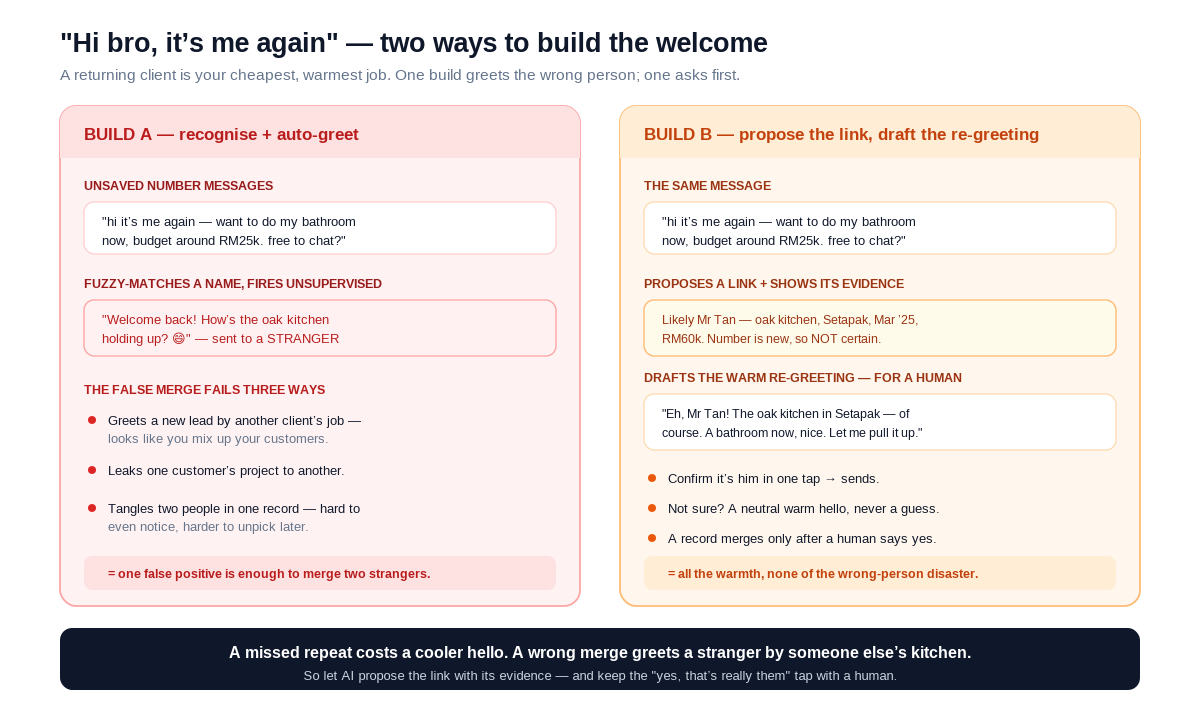
I built it. I pointed a model at the inbox with instructions to match each new opener against past customer records and greet returning clients by name and project. It worked beautifully — right up until it looked at a cold enquiry from a brand-new "Ahmad," fuzzily matched him to a past client also named Ahmad, and cheerfully opened with "Welcome back! How's the oak kitchen holding up? 😄" to a total stranger. Here's why that failure is worse than any cold hello — and the version of the build that catches the real returning client without ever greeting the wrong one.
Why is a returning client the most valuable lead in your inbox — and the worst-handled?
Because the cost to win it is already paid and the trust is already built, so it closes faster and cheaper than anything else — yet it arrives looking exactly like a cold enquiry, so the reflex handles it like one. A repeat or referral is the rare lead where the whole expensive top of your funnel is free. You don't pay for the ad, you don't fight for attention, you don't start from "why should I trust you with my home." That work is done.
The numbers behind that aren't soft. A fresh paid lead off Facebook or Instagram costs a Malaysian reno firm somewhere around RM20–50 just to get the enquiry — before a single reply. A returning client costs effectively nothing to acquire; they walked back in on their own. And referrals aren't just cheap, they're better: the most-cited academic work on referral value — Schmitt, Skiera and Van den Bulte's study in the Journal of Marketing (2011) — found referred customers were worth at least 16% more and churned about 18% less than comparable non-referred ones. Word-of-mouth is also the channel Malaysians trust above all others: Nielsen's trust survey has long put recommendations from people you know at the top, with Malaysians among the most word-of-mouth-driven consumers in the region.
My colleague Sarah has written the ops side of this — why your best customer gets your coldest handling, and the bigger leak of never re-engaging past clients at all. This piece is the narrower engineering question underneath her habit: can software reliably tell a returning client from a stranger in the first place?
The problem is purely one of recognition. A returning client's message doesn't arrive with a badge. It comes from an unsaved number, or a nickname, or a spouse's phone, mixed into the same 40–60 enquiries a month as every cold lead. By the time anyone realises "oh, that was the Setapak kitchen guy," they've already sent the cold-intake reply. The value was never in doubt — the firm just didn't see it in time.
So what did the flashy build do? (Build A)
It auto-matched every new message against past customer records and auto-greeted the ones it thought it recognised — and the first time it was confidently wrong, it greeted a stranger by another customer's kitchen. Build A is the one everyone pictures: "AI, watch my inbox, and whenever an old customer comes back, pull their file and welcome them by name." Hands-off, warm, on paper the perfect use of history.
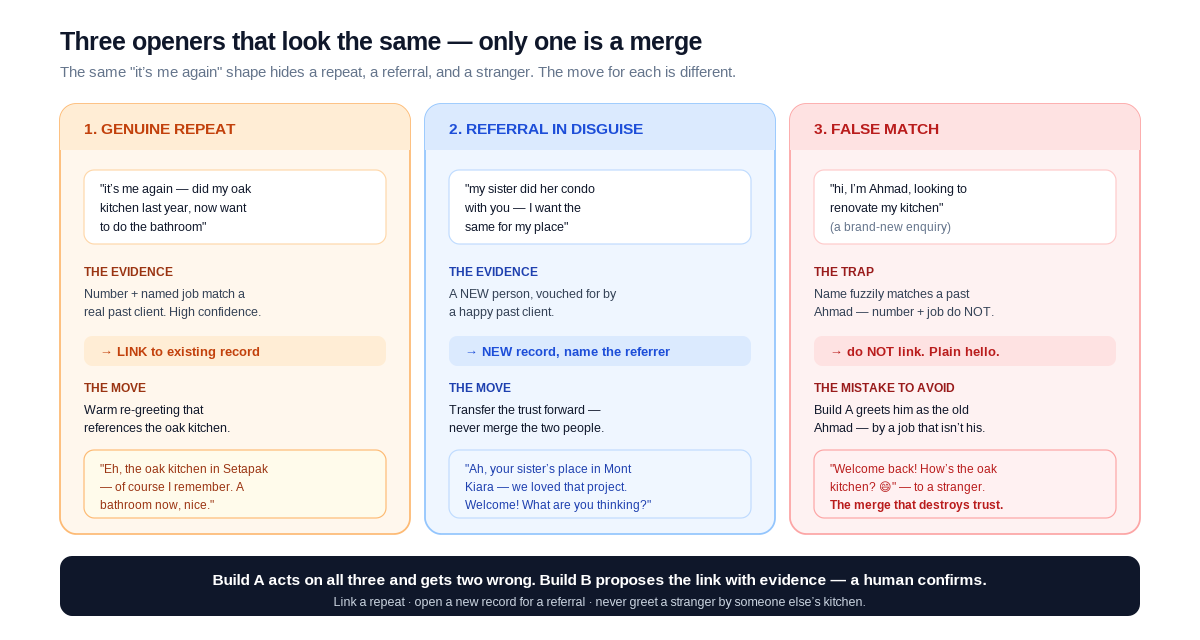
In practice it walked straight into the oldest trap in data matching. Real renovation enquiries are a mess of near-matches: half a dozen past clients named Ahmad or Mei Ling, numbers that changed, a daughter messaging on her father's behalf, "the Mont Kiara job" when you've done three. Told to recognise and greet, the model did exactly that — including on a fresh, never-seen enquiry whose name fuzzily lined up with a past client. It opened with "Welcome back! How's the oak kitchen holding up? 😄" to someone who had never renovated anything with the firm. That one message did three bad things at once: it made the firm look like it mixes up customers (poison for a trust-heavy, high-ticket buy), it leaked a hint of another customer's job to a stranger, and it corrupted the data — two different people now tangled in one record.
Why can't AI just auto-merge the record when it spots a match?
Because matching is asymmetric — a missed repeat costs you a slightly cooler hello, but a wrong merge collapses two different people into one file — and the fact that decides it is often not in the message at all. This is the same wall every build in this series hits: the deciding fact lives off-channel. "Is this unsaved number really the client who did the Setapak kitchen?" isn't answerable from the words "hi bro, it's me again." It depends on whether the number changed, whether it's the client or their spouse, whether "the oak kitchen" is the one you're thinking of or a different one.
The asymmetry is the whole point, and it's well understood in the data world. Record-linkage researchers have a blunt warning about over-eager matching: a single false positive is enough to wrongly merge two distinct entity clusters into one — and once merged, the error is hard to even notice, let alone unpick. The published benchmarks that make AI entity-matching look near-perfect also tend to be unusually clean; on messy, real-world inputs — exactly like a reno inbox — the error rate is higher than the leaderboard suggests. So the two outcomes are not symmetric at all:
- Miss a real repeat → you send a warm-but-generic hello and place them a message later. Mildly wasteful. Recoverable in seconds.
- Falsely merge a stranger into a past client → you greet them by a job that isn't theirs, expose another customer's details, and poison your data. Embarrassing, trust-destroying, and often permanent.
When one error is a shrug and the other is a disaster, you do not let the machine commit the irreversible one on its own. You make it propose and let a human confirm. The one-question test settles it cleanly: is the answer — "is this definitely the same person?" — fully written in the chat? Almost never. So AI surfaces the likely link and its evidence; a person makes the call.
What did the build that actually paid look like? (Build B)
It never merges anything. It proposes the likely past-client link with the evidence it used, drafts a warm history-aware re-greeting, and waits for a one-tap human confirm — and when it isn't sure, it falls back to a genuinely warm plain hello. Same shape as every build in this series that's earned its keep: AI reads and drafts; the person who can tell the client from a stranger decides and sends.
Pointed at the same inbox, Build B doesn't auto-greet. On the "hi bro, it's me again" message it says: "This looks like it could be Mr Tan — oak-finish kitchen, Setapak, Mar 2025, RM60k (matched on 'oak kitchen' + area; the number is new, so not certain). If that's him, here's a re-greeting: 'Eh, Mr Tan! The oak kitchen in Setapak — of course I remember. A master bathroom now, nice. Around RM25k budget, got it — let me pull up your file and I'll come back with some ideas.' Confirm it's him to use this, or send a neutral hello?" Then it stops. On the stranger named Ahmad, it either stays silent or flags a low-confidence possible match the human can dismiss in a tap — it never fires the greeting itself. The difference between the two builds reads small and is the whole game:
| Build A — "recognise and auto-greet" | Build B — "propose the link, draft the re-greeting" | |
|---|---|---|
| What it does with a match | Merges and greets instantly, unsupervised | Proposes the link + its evidence; a human confirms |
| On a fuzzy/uncertain match | Guesses and commits | Flags low-confidence; never auto-sends |
| Worst-case output | Greets a stranger by another client's job | A slightly generic warm hello |
| What it shows you | Nothing — it already acted | The reason it thinks it's them, so you can judge |
| A referral ("my sister's place") | Risks merging two people into one record | Drafts a new lead that names the referrer |
| Data integrity | Corrupts records on every false merge | Records only merge after a human says yes |
| What it costs per draft | — | ~0.1 sen, illustrative |
Why does the proposing version pay? Because it keeps the entire upside — the warm, history-aware welcome that makes a repeat feel remembered — while removing the one failure that actually hurts. The downside of Build B is that a human taps "yes, that's him" once. The downside of Build A is that one morning it tells your newest prospect you've mixed them up with someone else's kitchen. One of those is a rounding error; the other is a story the prospect tells their friends.
What should an owner actually do when an old client messages again?
Catch the repeat on purpose, lead with the history, and treat a referral as the warmest new lead you'll get — not a merge. Most of the win is a habit plus a thin, honest layer of software; the AI is a matching assistant, not an autopilot.
- Make "is this a returning client?" the first question on every unsaved enquiry. Before you fire the cold-intake reply, glance for the tells: "again," "last time," "you did my…," a referral name. The whole cost of a missed repeat is paid in that first generic sentence.
- Lead with the history the moment you've placed them. "The oak kitchen in Setapak — of course" beats "may I know your name" every single time. Being remembered is the product for a repeat customer.
- Never confirm a match you're not sure of — ask instead. A warm "remind me which project was yours so I pull the right file?" is honest and fine. Confidently greeting the wrong person by someone else's job is the one unforced error here. When in doubt, a plain warm hello, never a guessed history.
- Handle a referral as a new, linked record — and name the referrer. "My sister's place in Mont Kiara — we loved that project, welcome" transfers the trust forward. Don't merge the two people; do capture who sent them, because that's your cheapest channel and you should be able to count it.
- Say thank you to the source. A repeat or referral means a past job landed well. That loop is worth closing deliberately — it's the same engine behind asking a happy client for a review. Your best marketing is a finished kitchen someone's proud to show off.
How HotLead fits — honestly
I'll be straight, the way I try to be in all of these, because over-claiming is the exact hype I keep arguing against. HotLead does not auto-recognise your returning customers and does not auto-greet them — auto-matching a message to an old record is the experiment in this piece, and the piece is the argument for keeping a human on that particular call. What it ships is the plumbing that turns catching a repeat from a lucky accident into an easy habit:
- The whole WhatsApp thread on one lead record. So the second you place who's messaging, the past job, the quote, the finishes and the little details are right there to reference — no "remind me what we did for you." It's the same single record that lets you keep a quoted number straight across a long thread; here it's what makes a warm, specific re-greeting possible at all.
- Capture across every channel, into one place. So a returning client who comes back via a new number, Instagram, or a referral's forwarded message doesn't land in a second silo you forget to check — the kind of fragmentation that spawns duplicate records in the first place.
- One owner per lead, by rule. So the person who built the relationship on the first job is the one who sees them come back — not a random duty rep who has no idea this is a repeat.
- A funnel and per-channel view. So "repeat" and "referral" become a source you can actually count, instead of a vague sense that "a lot of our jobs come from word of mouth." When you can see your cheapest, highest-trust channel on a chart, you start feeding it on purpose.
The judgement of whether an unsaved number is really your past client, whether a "referral" is one person or two, and how to welcome them back stays with you — because you're the one who can tell Mr Tan from a stranger who happens to share his name, and the model will just reach for the closest fuzzy match. If the real problem underneath this is warm, valuable leads slipping through unrecognised, start with the complete guide to managing renovation leads in Malaysia, see how it fits a renovation firm or an interior design studio, and read the companion builds on catching duplicate leads across channels, briefing a rep who's picking up a lead cold, and the honest ledger of which AI builds in this series actually paid.
Sources: The value and retention advantage of referred customers — at least 16% higher customer value and roughly 18% lower churn versus comparable non-referred customers — is from Philipp Schmitt, Bernd Skiera and Christophe Van den Bulte, "Referral Programs and Customer Value" (Journal of Marketing, 2011), with the mechanism (better matching plus social enrichment, and referrals churning less only while their referrer stays) elaborated in Van den Bulte, Bayer, Skiera and Schmitt, "Why Customer Referral Can Lead to Sales" (JMR, 2018). That referred/repeat buyers are cheaper to sell to than cold prospects (directionally 60–70% vs 5–20% close probability) is widely attributed to the Marketing Metrics framework and treated here as directional, not a peer-reviewed figure. The standing of word-of-mouth as the most-trusted channel — and Malaysians' high reliance on it — is from Nielsen's Global Trust in Advertising work, including "Malaysians Trust Word-of-Mouth Recommendations Most" (2015) and later waves putting recommendations from people you know at the top (~88% globally). The US data point that nearly two-thirds of consumers use friends', relatives' and neighbours' suggestions to find a remodeling contractor is from a National Association of Home Builders survey and is labelled US, not Malaysian. The record-linkage warning that a single false positive can wrongly merge two distinct entities, and that clean public benchmarks overstate real-world matching accuracy, draws on the entity-matching literature including Peeters et al.'s work on LLM entity matching and critiques of record-linkage benchmarks (e.g. Papadakis et al., ICDE 2024). The Malaysian renovation-market scale (RM47.7bn in 2024, projected RM59.2bn by 2029) is from the New Straits Times quoting Topmix's CEO, "Malaysian home renovation demand rising post-pandemic" (2026); the difficulty of vetting contractors and the role of recommendations is context from Recommend.my. Operating figures (a ~RM60k Setapak kitchen, ~RM20–50 per paid lead, ~RM1,280 expected gross profit per lead, 40–60 enquiries a month, ~0.1 sen per AI draft) are typical numbers reused across this series and labelled illustrative; the Setapak firm, the "Ahmad" false-match and the AI experiments are described from practice and labelled illustrative, not a controlled trial. No recognition-accuracy, repeat-rate or match-rate percentage is invented here — the matching failure mode is argued from the record-linkage literature, not a number of my own.
Frequently asked questions
How should I reply when a past renovation client messages me again for a new job?
Lead with the history, fast, and make them feel remembered — that warmth is the whole advantage of a repeat. Something like: “Eh — the oak-finish kitchen we did in Setapak last year, right? Great to hear from you lah. A bathroom reno, nice — what are you thinking?” The trap is the opposite reflex: treating them as a cold new enquiry and re-asking name, address, and “what do you need?” as if the last job never happened. That re-ask quietly tells your best, pre-sold customer that they’re just another lead in the queue — and it throws away the single biggest reason a repeat closes faster and cheaper than anything a Facebook ad sends you. If you genuinely can’t place them, a warm, honest “hello! Remind me which project was yours so I pull up the right file?” beats confidently guessing the wrong one.
Can AI automatically recognise my returning customers and greet them?
It can flag a likely match in a second; it should not greet on its own, because the cost of a wrong match is worse than the cost of a plain hello. A model that auto-links a new message to an old record and fires “great to see you again, how’s the kitchen?” will, sooner or later, send that to a brand-new stranger whose name or number fuzzily matched someone else — and now your firm looks like it’s mixing up customers, which for a high-ticket, trust-heavy purchase is a terrible first impression. In record-linkage research a single false positive is enough to wrongly merge two distinct people. So the honest split is the one that runs through this whole series: let AI propose the match <em>with its evidence</em> and draft the warm re-greeting; let a human confirm it’s really them in one tap before it sends.
Isn't a referral just a new lead — why treat it differently?
It’s a new lead, but the warmest kind you’ll ever get, so treating it like a random cold enquiry wastes its biggest asset. When someone messages “my sister did her condo with you, I want the same for mine,” the trust is already transferred — they’ve seen your work in person and heard it vouched for by someone they believe. Malaysians trust word-of-mouth recommendations more than any form of advertising (Nielsen), and referred customers tend to be more valuable and stickier than ones you bought with ads. The move is to name the referrer warmly (“ah, your sister’s place in Mont Kiara — we loved that project”), not to merge the two people into one record or re-run a cold intake. It’s a new record, linked to a happy old one — and it should be handled like the gift it is.
What's the risk of letting software auto-link a message to an old customer record?
A false merge — two different people collapsed into one file — which is both embarrassing and hard to unpick later. Matching is asymmetric: missing a real repeat costs you a slightly cooler hello, but wrongly merging a stranger into a past client’s record greets them by a job that isn’t theirs, exposes another customer’s details, and corrupts your data so two histories are now tangled. Renovation enquiries are exactly the messy input that trips auto-matching: new phone numbers, nicknames, a spouse or child messaging on the client’s behalf, “Ahmad” matching four past Ahmads. That’s why the safe design proposes a link for a human to confirm rather than committing the merge itself — the same lesson as <a href="/resources/ai-duplicate-leads-across-channels-renovation-malaysia">catching duplicate leads across channels</a>.
Does HotLead recognise returning clients and greet them for me?
No, and I won’t pretend it does — auto-recognising a returning client is the experiment in this article, and the article is the argument for keeping a human hand on the match. What HotLead ships is the plumbing that makes catching a repeat easy instead of accidental: the entire WhatsApp history sits on one lead record, so the moment you place who it is, the past job, the quote and the finishes are right there to reference; capture pulls enquiries from every channel into one place, so a repeat doesn’t land in a second silo you forget to check; one owner holds each lead by rule, so the person who built the relationship is the one who sees them come back; and the funnel shows how many of your jobs come from repeat and referral, so you can finally count your cheapest channel instead of guessing at it.
Keep reading
- Can AI Reply to Your Renovation Firm's 1-Star Review? I Built It — and the Risk Is How Fast It ApologisesA 2-star review on Google or Qanvast is the first thing your next renovation lead reads — and most firms either ignore it or fire back and make it worse. The 2026 reflex is to let AI write the reply. I built it, and drafting a calm response costs a fraction of a sen. But an AI tuned to be helpful apologises too fast — it will concede a fault in writing, promise a refund that never happened, and grovel to a fake review from a competitor. Here's the build that protects your rank instead of torching it.
- Which Lead Signals Actually Predict a Sale? Reverse-Audit Your Own Won JobsMost firms grade a renovation lead on signals that feel predictive — enthusiasm, a long message, a fast reply — and never check whether those signals actually separate won jobs from lost ones. Here is how to run a reverse-audit on your own closed deals, which signals usually survive it, and why your pipeline is too small to pretend the score is more than directional.
- The "I Only Deal With the Boss" Lead: When the Buyer Refuses Your TeamYou finally hired someone to share the load — then the buyer messages "can I deal with you direct ah, boss?" and refuses to engage your staff. Every big lead quietly re-centralises onto the one person already maxed out, and your firm can never grow past the owner. Here's why caving caps you, why a flat "my staff will assist" loses a nervous buyer, and the move that keeps both.