

It's a Wednesday evening in Kajang and a small renovation firm just booked a good one: a semi-D owner in Setia Alam wants a full kitchen and wet-area redo, and agreed over WhatsApp to a Saturday 11am site visit. Deposit energy in the air. The owner pencils it in and moves on.
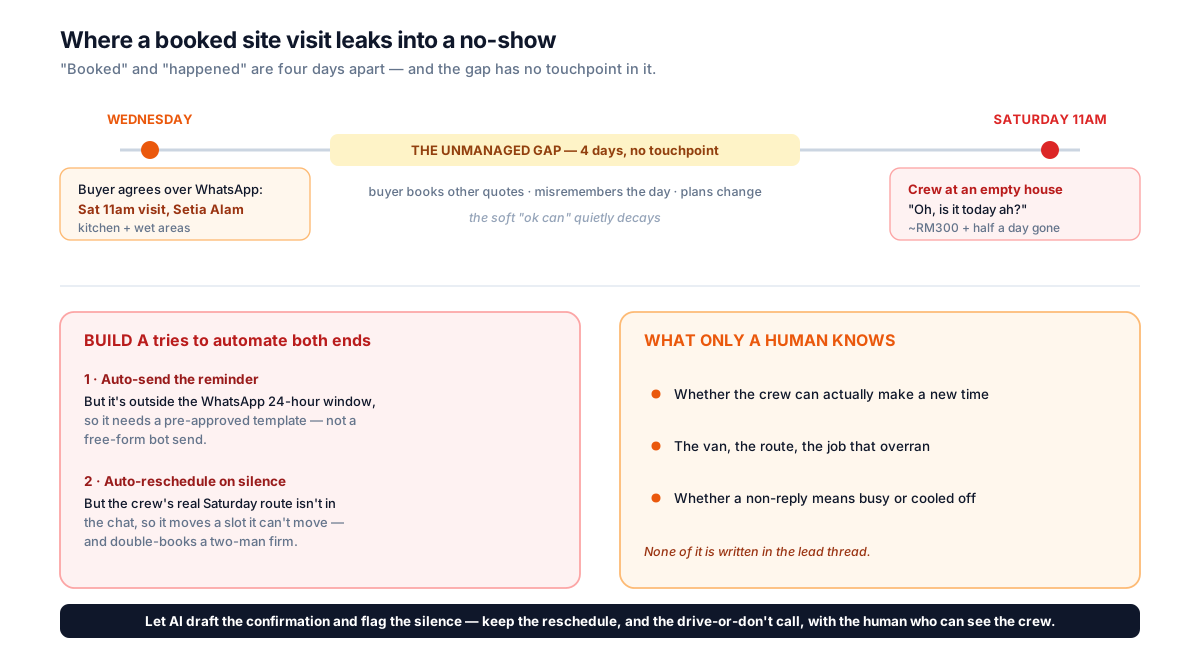
Saturday, 10:40am. The two-man crew is parked outside the house in Setia Alam with the laser measure and the clipboard. They knock. Nothing. A call goes to voicemail. At 11:15 a WhatsApp finally comes back: "Oh, is it today ah? Aiya I thought next week lah, I'm in Melaka now."
That's it. The visit is gone. The toll and fuel out and back, the measuring gear, two people's Saturday morning — call it ~RM300 in hard cost — plus the thing that actually hurts: a Saturday site-visit slot, the firm's scarcest thing in busy season, spent driving to an empty house. So the 2026 reflex writes itself: "Can't AI just remind the buyer the day before, and if they go quiet, auto-reschedule them to the next open slot?"
I built it. The reminder half worked beautifully. The auto-reschedule half tried to move a Saturday slot my crew was already committed to, because it had no idea where the crew actually was. Here's what the no-show really costs, why the flashy "auto-everything" version is the dangerous one, and the build that cuts the no-show without touching a calendar it can't see.
Why does a confirmed site visit still turn into a no-show?
Because "booked" and "happened" are two different events with days of gap between them — and in Malaysian reno the visit is free, set over WhatsApp, and held loosely by the buyer. A clinic appointment has a card, a cost, a sense of obligation. A free Saturday site visit agreed to in a chat on Wednesday has none of that. The buyer said yes in the moment and then life moved on.
The gap is where everything leaks. Between Wednesday's "ok Saturday 11 can" and Saturday morning, the buyer books three other quotes, a kid gets sick, they drive to the in-laws in Melaka, or they simply misremember which weekend it was. Nothing dramatic — just a soft commitment decaying over four days with no touchpoint in between. The firm, meanwhile, treats the slot as locked and plans the week around it.
This matters more in renovation than almost anywhere, because the free site visit is the norm. When the buyer hasn't paid anything to be there, the no-show carries no cost to them — the entire cost lands on the firm that drove out. That asymmetry is exactly what the free-site-visit trap is about: the visit that feels like progress is also the visit most likely to evaporate. And it's a different problem from getting the visit booked in the first place — that's the calendar step; this is the seam after the slot is locked, where a booked visit quietly becomes a no-show.
What does a no-show actually cost a small reno firm?
Around RM300 in hard cost, and a half-day of site-visit capacity you can't get back — which is the part that really bites. The visible loss is easy to tally: fuel and toll out to Setia Alam or Semenyih and back, the wear on the van, an hour or two of a two-person crew that you're paying either way. For a Klang Valley firm, ~RM300 is a fair round number for one wasted roll (illustrative, but ask any busy-season crew and they'll nod).
The invisible loss is bigger. A small firm has maybe four or five good site-visit slots on a Saturday. The one the crew spent driving to an empty house in Setia Alam is a slot it didn't spend on a buyer who'd have been home, measured, and quoted — a buyer who converts. Lose one or two of those a week and you haven't just lost RM600 in diesel; you've lost a real slice of the week's capacity to turn warm leads into priced jobs. The no-show tax is paid twice: once at the pump, once in the pipeline.
And it's the same crew-time problem as deciding who even answers and drives out on a lead. A two-person firm's time is its inventory. Burning it on a locked door is the most expensive kind of lost lead, because you were so close — the buyer was interested enough to book.
So what did the flashy build do? (Build A)
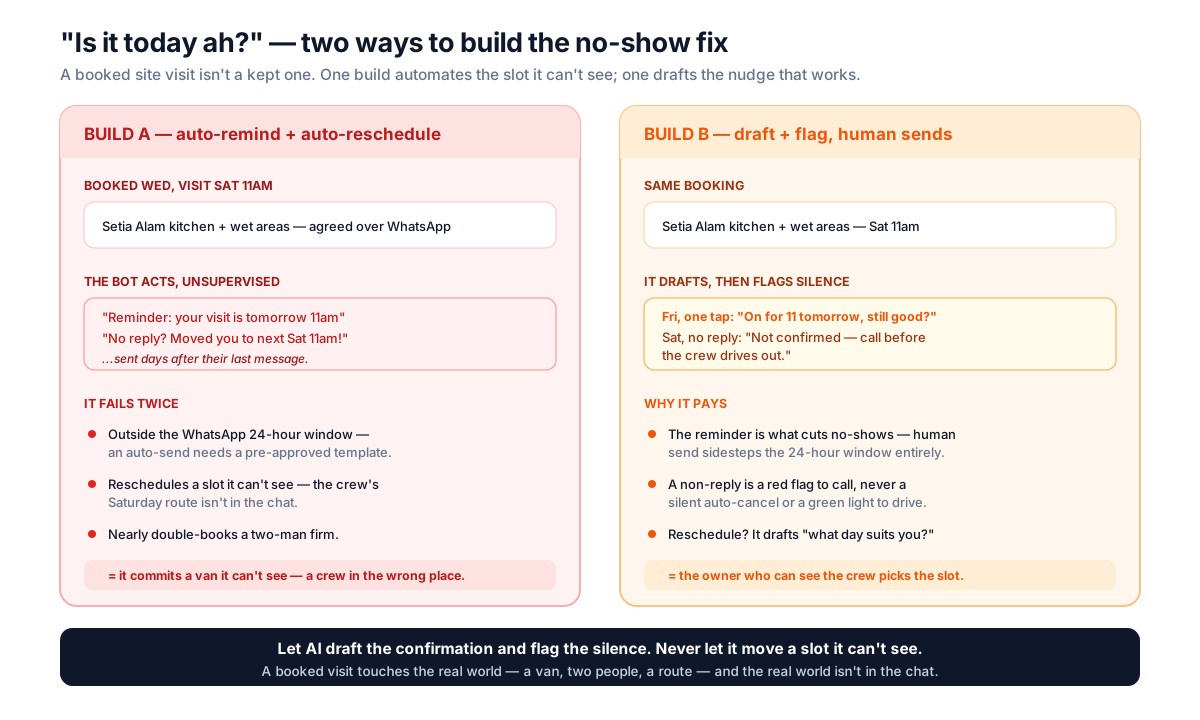
It auto-sent the reminder and, on silence, auto-rescheduled the buyer to the next open slot — and in doing so it tripped over two things that don't live in the chat. Build A is the dream: hands-off, the bot reminds, the bot re-books, the owner never thinks about it. It failed in two specific, instructive ways.
Failure one: the WhatsApp 24-hour window. This is the mechanic nobody mentions until it bites. On the WhatsApp Business Platform (the API you'd use to automate sends), a business can only send free-form messages to a user inside a 24-hour window that resets on the user's last inbound message. Once that lapses, the only thing you can push is a pre-approved template message — and Meta reviews and categorises those (utility, authentication, marketing). A reminder for a Saturday visit the buyer last messaged about on Wednesday is comfortably outside the window. So "just auto-send a reminder" isn't a free-form bot message at all; it's a templated send that has to be pre-approved and correctly categorised, and a bot firing unprompted templates at buyers is exactly the behaviour that gets a sender's quality rating dinged. The human sending the same reminder by hand from their own phone? Not bound by any of this. The automation hits the wall the human walks around.
Failure two: the auto-reschedule moved a slot it couldn't see. When a buyer went quiet, Build A cheerfully offered "No worries, I've moved you to next Saturday 11am instead!" — except the crew was already booked solid next Saturday on a job in Puchong. The AI had no idea, because the crew's real availability, route and van live in the owner's head and a contractor WhatsApp group, not in the lead thread. The model rescheduled something it had no power to reschedule, and nearly double-booked a two-man firm into being in two places at once.
Why can't AI just reschedule the visit itself?
Because rescheduling is an off-channel, irreversible commitment, and the facts that decide whether a new time is even possible aren't written anywhere the model can read. This is the same wall every honest build in this series hits — the one laid out in what AI still can't do in a contractor's lead process: the deciding information lives off the page.
Run the one-question test on it. Is the answer in the chat? For "draft a friendly confirmation" — yes, everything needed is right there. For "move this visit to a slot the crew can actually make" — no. Whether next Saturday works depends on the Puchong job that overran, whether the second installer is on leave, how the route stacks up if you're already in Klang that morning, and whether the van's in for service. None of that is in the lead thread. An AI that reschedules is guessing at a physical-world commitment, and unlike a wrong word in a draft, a wrong reschedule is a crew standing in the wrong place on a Saturday — you can't un-send a van.
So the division of labour is clean and it's the same one that's worked in every build that earned its keep: AI reads and drafts and flags; the human who can see the crew decides and sends.
What did the build that actually paid look like? (Build B)
It drafts the day-before confirmation and the morning-of "still on?" check for a human to send in one tap, and it turns a non-reply into a flag — never a silent auto-cancel, never an auto-reschedule. Same shape as every build in this series that's worked: AI does the reading and the drafting, the human keeps the one decision that needs eyes on the real world.
Pointed at the Setia Alam booking, Build B does three small things:
- Friday afternoon, it drafts the confirmation for the owner to fire off in one tap: "Hi Mr Tan, confirming our site visit this Saturday 11am at your Setia Alam place for the kitchen and wet areas — just reply OK and we'll see you then!" A question-shaped nudge, not a statement, so the buyer has to actually respond.
- Saturday morning, if it's been confirmed, it drafts the on-the-way message; if it hasn't been confirmed, it does the opposite of auto-proceeding — it flags the lead: "Not confirmed — Mr Tan didn't reply to Friday's message. Call before the crew drives out." The crew doesn't roll on silence.
- If the buyer wants to move it, Build B drafts a warm "no problem, what day suits you?" and hands the actual slot-picking to the owner, who can see the crew's week. It never names a new time itself.
The difference between the two builds looks small on the page and is the whole game:
| Build A — "auto-remind + auto-reschedule" | Build B — "draft + flag, human sends" | |
|---|---|---|
| The reminder | Bot sends unprompted — hits the 24-hr window / template rule | Drafted for a human to send in one tap from their own WhatsApp |
| On a non-reply | Silently cancels, or silently assumes it's on | Flags it: "not confirmed — call before you drive" |
| Rescheduling | Picks a new slot it can't see the crew's week for | Drafts "what day suits you?" — the owner picks the slot |
| Who commits the crew | The bot, blindly | The person who knows the route and the van |
| Worst case | Crew double-booked, or sent to an empty house | Thirty seconds of a human reading a flag |
| What it costs per draft | — | ~0.1 sen, illustrative |
Why does the modest version pay? Because it captures the real win — the reminder that demonstrably cuts no-shows — without creating a worse problem. The BMJ Open meta-analysis is clear that the reminder itself is where the no-show reduction comes from (21% down to 15%, and more than one nudge beats a single one). Build B delivers exactly that and nothing riskier: it writes the nudge, leaves the send one tap away, and refuses to pretend it knows where the crew is.
What should an owner actually do about site-visit no-shows?
Confirm twice, make the buyer reply, and treat silence as a reason to call — not a reason to cancel or to assume. Most of the win is a habit; the AI is just a drafting assistant that makes the habit frictionless.
- Confirm the day before, and again on the morning. One nudge helps; the meta-analysis found multiple reminders help more. The Friday "still on?" and the Saturday "on our way once you confirm" are the two cheapest insurance payments you'll make all week.
- Make it a question, not a statement. "See you Saturday 11am" lets the buyer stay silent. "We're on for 11 tomorrow, still good?" forces a yes, a no, or a reschedule — all three of which are better than a surprise at the door.
- A non-reply is a red flag, not a green light. This is the contrarian bit most reminder tools get wrong. Don't auto-cancel on silence (you'll kill visits that would've happened) and don't auto-assume (you'll drive to empty houses). Silence means phone them before anyone starts the van.
- Keep the reschedule human. The AI can draft "what day suits you?" all day long. The actual new slot has to be picked by someone who can see the crew's route and the van — not guessed by a bot. The same way the pre-visit brief hands the estimator the context but not the judgement, the reschedule gets the draft but not the decision.
- Make the confirmation a task you can see. The no-show's root cause is that "confirm tomorrow's visit" lives only in your head on a busy Friday. Put it somewhere it surfaces itself.
How HotLead fits — honestly
I'll be straight, the way I try to be in all of these, because over-claiming is the exact hype I keep arguing against. HotLead does not ship a reminder bot, an appointment scheduler, or a calendar — auto-reminding is the experiment in this piece, and the piece is the argument for keeping the send (and the reschedule) in your own hand anyway, since the 24-hour window makes the human send the one that actually works. What HotLead ships is the plumbing that stops a booked visit from being forgotten:
- A next action and an overdue flag on every lead. So "confirm Saturday's Setia Alam visit" is a dated step in plain sight — it surfaces itself on Friday instead of depending on your memory in the middle of a busy week. The confirmation becomes a task, not a good intention.
- One owner per lead, by rule. So the confirmation isn't everyone's job (and therefore no one's). The person running the lead holds the "did we confirm?" question, and the Saturday drive-or-don't-drive call lands on someone.
- The whole WhatsApp thread on one record. So whoever rolls out on Saturday has the address, the scope and the last message in front of them — and if the buyer did reply "push to next week," it's right there, not buried three chats back.
- Team performance in view. So if one salesperson's visits no-show far more than the rest, you can see it — usually it's the one who books and never confirms.
The judgement — whether a silence means "busy" or "cooled off," and whether the crew can really make next Saturday — stays with you, because you're the one who can see the van and the route, and the model will just reach for a plausible slot. If the deeper problem is leads and crew-time slipping out the side doors of your business, start with the complete guide to managing renovation leads in Malaysia, see how it fits a renovation firm or an interior-design studio, and read the companion builds on booking the site visit from the chat and the honest limits of AI in a contractor's lead process.
Sources: The reminder effect on no-shows is from R. Robotham et al., "Using digital notifications to improve attendance in clinic: systematic review and meta-analysis," BMJ Open (2016), which pooled 21 studies (8,345 patients notified vs 7,731 not) and found electronic notifications cut the no-show rate from 21% to ~15% (risk ratio 0.75), with multiple notifications more effective than a single one and voice notifications more effective than text. This is a healthcare setting, not renovation site visits, so it is cited as directional evidence for the mechanism, not a reno-specific figure. The WhatsApp Business Platform 24-hour customer service window — a free-form messaging window that resets on each inbound user message, outside which only pre-approved template messages (utility, authentication, marketing categories) may be sent — is per Meta's WhatsApp Business Platform documentation (with utility templates sent inside an open window carrying no Meta fee since 1 July 2025). WhatsApp's dominance as the first-contact channel for Malaysian buyers (90%+ of internet users) is a house figure reused across this series. The ~RM300 hard cost of a wasted Klang Valley site visit, the half-day two-crew capacity loss, the ~0.1 sen per AI draft, and the Setia Alam / Kajang scenario are typical operating numbers and a described-from-practice experiment reused across this series and labelled illustrative, not a controlled trial. No no-show rate, cost figure or conversion number is invented here: the clinic reduction is the cited BMJ Open figure labelled directional, and the reno costs are labelled illustrative.
Frequently asked questions
Can AI automatically remind a renovation client about a site visit and reschedule if they don't reply?
It can draft the reminder reliably; it should not send it unsupervised, and it definitely should not reschedule on its own. Two walls get in the way. First, the WhatsApp Business Platform only lets a business message a user freely inside a 24-hour window that resets on the user’s last inbound message — a reminder for a Saturday visit booked on Wednesday is almost always outside that window, so an automated send needs a pre-approved utility template, not a free-form bot message. Second, rescheduling is an off-channel, irreversible act: whether the crew can actually make a new time depends on their route, their other jobs and the van, none of which is in the chat. So AI’s safe job is to draft the confirmation and the morning-of check for a human to send in one tap, and to flag a non-reply — not to move a slot it can’t see.
How much does a renovation site-visit no-show actually cost?
For a small Klang Valley firm, a wasted site visit runs around RM300 once you count the fuel and toll out to somewhere like Setia Alam or Semenyih, the measuring gear, and an hour or two of a two-person crew’s time — and that’s before the real cost, which is the slot itself. A Saturday morning a small firm spends driving to an empty house is a Saturday morning it didn’t spend on a visit that converts. One or two no-shows a week quietly eats a chunk of the week’s site-visit capacity. The RM300 is the visible loss; the burnt half-day you can’t re-sell is the expensive one. (Figures illustrative, typical for a KV two-crew firm.)
Do reminders really reduce no-shows, or is that just a vendor claim?
They really do, and the best evidence is from healthcare, not software marketing. A 2016 systematic review and meta-analysis in BMJ Open (Robotham et al.) pooled 21 studies and found electronic notifications cut the no-show rate from about 21% to about 15% — a risk ratio of 0.75, roughly a quarter fewer misses — and that multiple reminders worked better than a single one. That’s clinics, not renovation site visits, so treat the exact number as directional rather than a promise. But the mechanism carries across: a person who gets a nudge the day before and a quick check on the morning is far more likely to show up than one left to remember a slot they agreed to days ago.
Should I cancel a site visit if the client doesn't reply to my confirmation?
No — treat a non-reply as a reason to phone, not a reason to cancel or to assume it’s on. Silence is ambiguous: the buyer might be busy, might have the wrong day, might have cooled off. Auto-cancelling on silence kills visits that would have happened; auto-assuming it’s on sends your crew to an empty house. The move that actually works is to make the confirmation a question the buyer has to answer (“we’re on for 11 tomorrow, still good?”), and if there’s no reply by the morning, call before anyone drives. A non-reply is a red flag to check, never a green light to roll the van.
Does HotLead send appointment reminders or manage a calendar for me?
No, and I won’t dress it up — HotLead doesn’t ship a reminder bot, an appointment scheduler or a calendar, and auto-reminding is the experiment this article is about, not a feature. What it ships is the plumbing that stops a booked visit from being forgotten: “confirm tomorrow’s site visit” lives as a dated next action with an overdue flag, so it surfaces as a due task instead of relying on your memory on a busy Friday; one owner holds the lead, so the confirmation isn’t everyone’s job and therefore no one’s; and the whole WhatsApp thread sits on one record, so whoever drives out on Saturday has the address, the scope and the last message in front of them. The reminder you still send yourself — which, given the 24-hour window, is the version that actually works anyway.
Keep reading
- How to Raise Your Average Renovation Job Value — Without Scaring the BuyerAverage job value is the quiet middle growth lever — nearly free to pull, but only if you do it right. Most owners try to raise it by padding the quote, which just loses the job to a cheaper bid. Here are the four honest ways to move your average up, where the extra ringgit actually sits in a Malaysian reno, and the ones that add real value versus the ones that feel like padding.
- The Condo Reno Lead Where the Building Decides, Not Just the OwnerA condo owner WhatsApps you to renovate their unit, you quote fast and win — then the building's management rejects the hacking, caps your hours and holds a RM5,000 deposit. In a high-rise reno there are two approvers, not one. Here's how to stop losing these leads at the management office.
- "Can Also Do The Balcony Ah?" — I Built an AI to Catch Mid-Job Scope Creep Before It Ate the MarginThree weeks into a RM80k condo job, the client messages "while you're already here, can also do the balcony ah?" The reflex is "boleh boleh, later settle" — and you've just agreed to build it for free. The 2026 reflex is to ask AI to watch your job chats, spot the extra work, price it and add it to the invoice. I built it. It invented a number. Here's the version that catches the scope creep without guessing a price it can't know.