

In the three-growth-levers piece, we ranked the only three ways to grow a renovation firm — more leads, a higher close rate, and bigger average jobs — and put average job value in the middle: cheap to pull, but capped. This is the deep-dive on that middle lever. It's the one owners most often pull the wrong way.
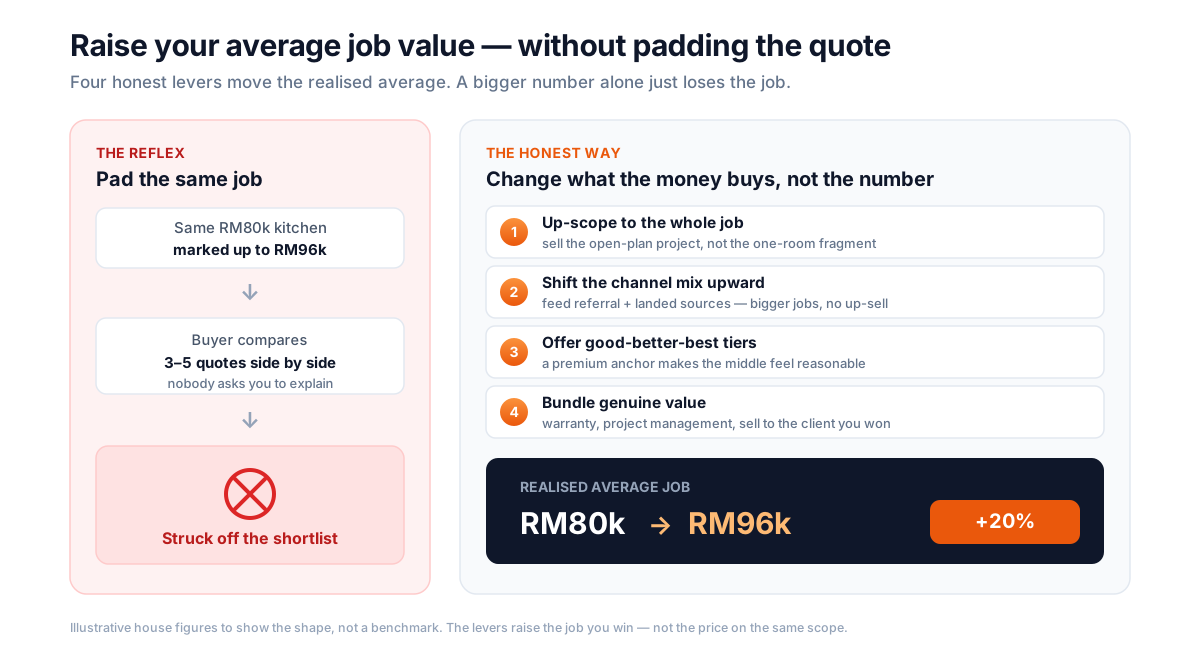
The wrong way is to raise your average job by quoting higher on the same work. In a market where every buyer holds three to five quotes side by side, that number just gets struck off. The right way is to change what the money buys — sell the whole job instead of the fragment they asked about, shift your mix toward channels that send bigger projects, tier your quote, and bundle genuine value. Do that and the average rises because the scope or the mix moved, not because you padded a markup. Here's where the extra ringgit actually comes from in a Malaysian reno, and which moves add value versus which ones feel like a rip-off.
What does "raising your average job value" actually mean?
It means lifting the average ringgit value of the jobs you win — total revenue divided by jobs closed — not the price you quote. It's one of three levers on your revenue, and because they multiply, a 20% lift on average job value is a 20% lift on the top line on its own.
Revenue = leads × close rate × average job value. Nudge the average job from RM80,000 to RM96,000 and, holding leads and close rate steady, revenue climbs the same 20% — and if you've also tightened the other two levers, it compounds. The whole appeal of this lever is that it costs almost nothing to pull: you're not buying more leads or hiring a closer, you're winning bigger out of the same pipeline.
But "realised" is the load-bearing word. Your average job value is set by the jobs you actually sign, so there are only two honest ways to move it:
- Win a bigger share of the big jobs — change the mix of what you close.
- Make each job genuinely bigger — sell the whole scope, not a slice of it.
Everything that works lives in one of those two buckets. Everything that doesn't work — padding the number, inventing line items, marking up the same job — lives in a third bucket labelled "you'll lose the quote." Let's deal with that one first, because it's the instinct.
Why does padding the quote backfire?
Because the Malaysian renovation buyer is a comparison shopper by default, and a higher number with no bigger scope behind it is the easiest thing in the world to strike off a shortlist. Qanvast shortlists up to five firms; buyers on Recommend.my compare three or more. Your padded quote sits in a WhatsApp chat next to two leaner ones, and nobody's asking you to justify the gap — they just stop replying.
This is the same mistake as its mirror image, the reflex discount. We've written about why cutting your price to win a stalled deal is usually negative-EV; padding is the same error pointed the other way. Both treat the number as the lever, when the number is just a readout of the scope. Marking up the same RM80k kitchen to RM96k doesn't raise your average job value — it raises your quoted value and lowers your close rate, and those cancel out (or worse). Raising the realised average means the RM96k job has RM16k more job in it.
Where does the extra ringgit actually come from?
From four honest moves, and it helps to know where the money physically sits in a Malaysian reno before you reach for any of them. The answer surprises most owners: it's not the marble, it's the carpentry.
In a Malaysian condo fit-out, custom carpentry runs 30–50% of the whole budget — full-height wardrobes, a feature TV wall, built-in cabinetry, a timber-wrapped console. It's the single biggest and most underestimated line. Surfaces and stone — the island the client fixates on — are a much smaller slice. A full mid-range kitchen cabinet run alone is RM15,000–35,000, and that's before wardrobes and feature walls. (We unpack this fully in the expensive-look, small-budget ID lead.)
That matters here because it tells you the biggest lever on job size is scope of carpentry and finishes, not price per item. Now the four moves:
1. Up-scope honestly — sell the whole job, not the fragment
Most enquiries arrive as a fragment. "How much to redo my kitchen?" is often really a kitchen-plus-dining-plus-the-wall-between-them, because the buyer hasn't thought past the one room that annoys them. Quote only the fragment and you win a RM25k kitchen; understand the whole intent and you win a RM70k open-plan job — same client, same close, nearly double the value, and a better result for them.
Up-scoping honestly means asking what the project is really for and showing the version that does the job properly, not bolting on line items nobody wanted. It's the designer's craft — the thing the client can't do themselves — and it's where the carpentry share pays off: the fuller scope is mostly more cabinetry and built-ins, the highest-value work you do.
2. Shift the channel mix upward — the free lever
This is the easiest and most overlooked move, because it raises your average with no selling at all. Different lead sources send jobs of wildly different sizes. A cold boosted-post lead is often a price-shopping small job; a warm referral or a landed-property enquiry is typically a much bigger, higher-intent project.
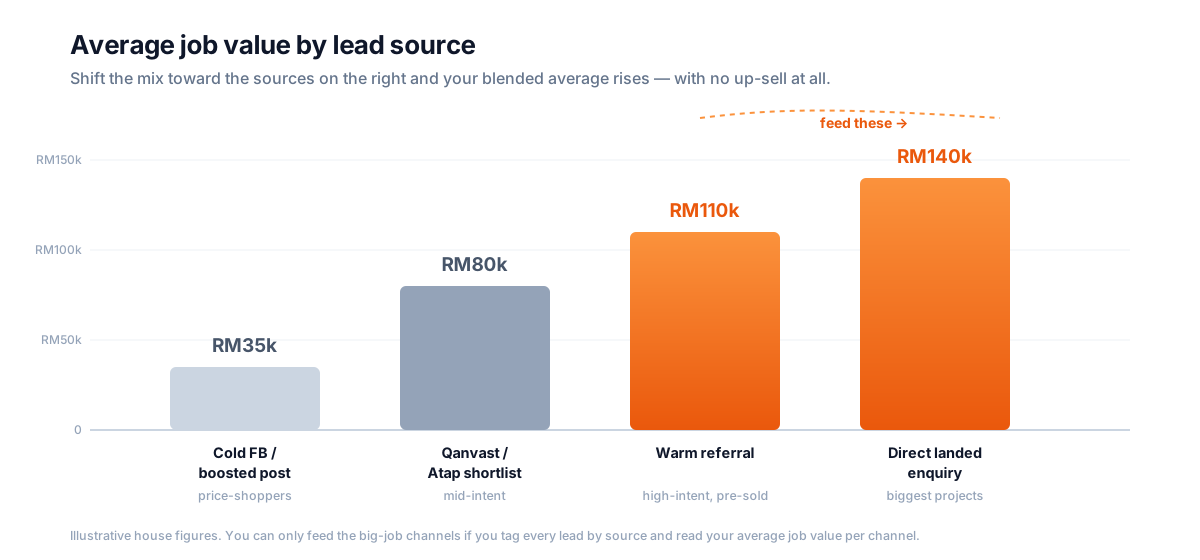
So the same hours spent earning more referrals, ranking for higher-intent searches, and nurturing landed-property leads quietly lift the average size of what lands in your inbox. You're not up-selling anyone — you're changing the kind of lead that arrives. The prerequisite is measurement: you can only feed the big-job channels if you know which ones they are, which means tagging every lead by source and reading your average job value per channel.
3. Anchor and tier — the good-better-best quote
Instead of one flat number, present the quote as three tiers: an essential version, a recommended version, and a premium version. The top tier anchors the buyer's sense of what the project is worth and makes the middle feel reasonable, so more buyers choose up than they would against a single number — with no pressure from you.
This isn't a sales trick dressed up; it's one of the most robust findings in behavioural pricing. In Dan Ariely's well-known Economist subscription experiment, students chose a web-only plan 68% of the time over a pricier print bundle — until a third, obviously inferior option (print-only at the same price as the bundle) was added, at which point 84% chose the premium bundle. The decoy changed nothing about the bundle; it changed the reference point. The same logic shows up in the classic anchoring work — estimators pulled their valuations toward whatever number they saw first, even experts.
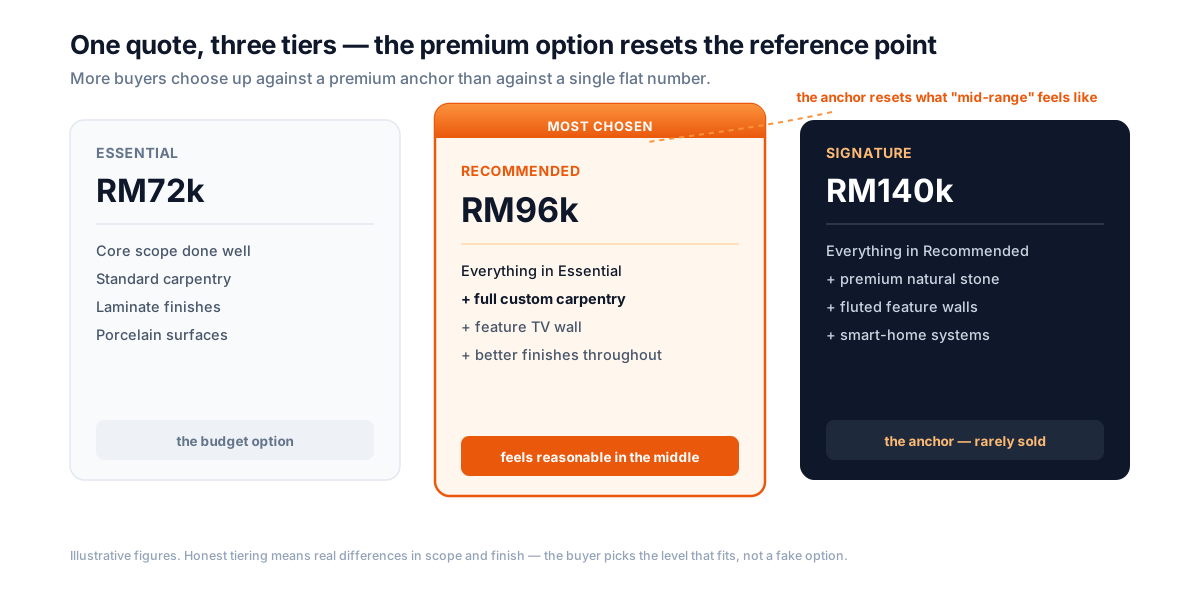
The honest version for a reno firm has real tiers — genuine differences in finish, carpentry and scope — so the buyer picks the level that fits, rather than a fake option designed to mislead. Done right, the Signature tier you rarely sell still earns its place by resetting what "mid-range" feels like.
4. Bundle genuine value — and sell it to the client you already have
The fourth move is to add value the buyer actually wants rather than cut price: a longer written workmanship warranty, proper project management, a phased plan that lets them live through the works. These raise the perceived value of the job — and often the scope — without reading as padding.
And the richest place to do it is the client you've already won. Marketing Metrics' widely-cited benchmark puts the probability of selling to an existing customer at 60–70%, versus 5–20% for a new prospect. For a reno firm that shows up as the second bathroom, the office the client just bought, the repeat and referral work that is your highest-value, lowest-cost pipeline. A happy past client taking on a bigger second project is average job value and close rate rising at once.
Which moves add value, and which just feel like padding?
The line between a bigger job and a rip-off is whether the extra ringgit buys the client something they actually get. Here's the honest sort:
| Move | Where the ringgit comes from | Adds value or padding? | The catch |
|---|---|---|---|
| Up-scope to the whole job | More carpentry and scope the buyer genuinely needs | Value — a better result | Only if it's the real project, not invented rooms |
| Shift channel mix upward | Bigger-job sources (referral, landed) | Value — no up-sell at all | Needs per-channel measurement to know which to feed |
| Good-better-best tiers | Buyer chooses up against a premium anchor | Value — if the tiers are real | A fake decoy erodes trust; make the top tier genuine |
| Bundle warranty / PM / phasing | Higher perceived value, often more scope | Value — things they want | Don't bundle costs you can't deliver |
| Mark up the same scope | Nowhere — just a bigger number | Padding | Loses the quote to a leaner bid |
| Invent line items | A padded breakdown | Padding | MY buyers read breakdowns; it reads as hiding |
How much can this actually move the average — and what's the catch?
On the series' worked figures, nudging the average job from RM80,000 to RM96,000 is a 20% lift — and because the three levers multiply, that 20% doesn't just raise revenue, it raises the expected value of every lead you later buy by the same 20%. That's why the growth-levers piece tells you to tune this lever before you open the ad tap: it makes the leads you pay for worth more.
But this lever is capped, and the ceiling is real. Bigger jobs strain two things a small firm runs out of fastest:
- Cash. A larger job ties up more of your own money between milestones. Push job size without sizing your working-capital buffer and you hit the profitable-but-broke wall.
- Crew-weeks. Bigger jobs occupy your crews longer, and crew-weeks are usually the binding constraint in a labour-short market. A firm that wins only big jobs can starve on throughput.
And there's a softer, more expensive catch: over-scoping the wrong client. Sell a nervous first-timer more than they wanted, and you manufacture a disappointed handover on work that's actually fine — a lukewarm review, no referral, and a dent in the cheapest channel you have. Bigger isn't always better; better-fit is.
How HotLead fits in
HotLead doesn't price your jobs or design your scope — that's your sales craft and your estimator's. What it does is make the mix lever visible and keep the up-scope-and-tier conversation from leaking. Its per-channel and funnel view shows your average job value by source, so you can see which channels send the bigger jobs and feed them instead of guessing. Every enquiry is captured and tagged by source, so "referral" and "repeat" become countable, comparable channels rather than a vague sense that word-of-mouth is good.
Just as important, it routes each lead to one owner and keeps it on a clear next action with overdue nudges — so the bigger-job conversation (understanding the real scope, sending the tiered quote, following up the warm referral) actually happens instead of dying in a group chat. You still decide the scope and the tiers; HotLead makes sure you're deciding with the numbers in front of you and that the high-value leads don't slip.
Start with the complete guide to managing renovation leads in Malaysia, see the renovation lead playbook or the interior-design playbook, or read the lever that ranks this one — the only three ways to grow a renovation firm — and its sibling, how many leads your firm actually needs a month.
Sources: The decoy effect — adding a higher-priced, obviously-inferior option swung choice toward the premium bundle (68% web-only without the decoy → 84% choosing the print-and-web bundle with it) in Dan Ariely's Economist-subscription experiment — SmartCompany, "The decoy effect". Anchoring pulls buyers' willingness-to-pay toward the first number they see, even for experts — Stanford GSB working paper, "Anchoring Effects on Consumers' Willingness-to-Pay and Willingness-to-Accept". Probability of selling to an existing customer ~60–70% vs ~5–20% for a new prospect — the Marketing Metrics (Farris, Bendle, Pfeifer & Reibstein) benchmark, as cited by Qualified. Custom carpentry ~30–50% of a Malaysian fit-out budget and a full mid-range kitchen cabinet run RM15,000–35,000 — FindContractor.my, Kitchen renovation cost Malaysia 2026 and FindContractor.my, Interior design cost Malaysia 2026. Shortlisting norm (Qanvast up to five firms, Recommend.my compare three-plus) as cited in where renovation leads come from in Malaysia. The RM80k average job / ~20% margin / ~7–8% close / referral-vs-cold close figures and the condo RM40–150k / landed RM60–250k job ranges are the illustrative house figures used across this series — see the three growth levers and funnel-stage benchmark pieces. The worked job-value, per-channel and tier figures are illustrative — plug in your own numbers to see which move raises your average cheapest.
Frequently asked questions
What does "average job value" mean for a renovation firm?
It's the average ringgit value of the jobs you actually win, over a period — total revenue divided by number of jobs closed. It's one of the three levers on your revenue (Revenue = leads × close rate × average job value), and because the three multiply, lifting your average by 20% flows straight to the top line. The key word is realised — it's the value of jobs you won, not the price you quoted. You raise it by winning more of the bigger, better-fit work and by selling the whole job rather than the fragment a buyer first asks about, not by inflating every quote.
Isn't raising my average job value just charging more?
No, and that's the trap. Charging more on the same scope is padding, and in a market where buyers hold three to five quotes side by side, a number that's simply higher than the next firm's gets struck off before you can explain it. Raising job value means changing what the money buys — up-scoping to the real job, shifting your mix toward channels that send bigger projects, offering a tiered quote, or bundling genuine value. The price moves because the scope or the mix moved, not because you marked up the same work.
What's the easiest way to raise my average renovation job value?
Shift your channel mix upward — it moves your average with no extra selling at all. Referral and landed-property enquiries are typically much bigger jobs than cold boosted-post leads, so the same effort spent earning more referrals and ranking for higher-intent searches quietly raises the average size of what lands in your inbox. You're not up-selling anyone; you're changing the kind of lead that arrives. Measure your average job value by source and you'll usually find one or two channels are carrying your average — feed those.
Does offering a premium option actually make people spend more?
Often, yes — and without pressure. When you present a quote as three tiers (an essential version, a recommended version, and a premium version), the top tier anchors the buyer's sense of what the project is worth and makes the middle option feel reasonable, so more buyers choose up than if you'd shown one flat number. It's a well-documented behavioural effect — in Dan Ariely's famous Economist subscription test, simply adding a higher-priced decoy option swung the majority toward the premium bundle. The honest version for a reno firm is real tiers with real differences in finish and scope, so the buyer chooses the level that fits — not a fake option designed to trick them.
What's the risk of chasing bigger renovation jobs?
Two real ones. First, bigger jobs tie up more of your own cash between payment milestones and occupy your crews longer, so growing job size without watching your working-capital buffer and crew-weeks is how a firm ends up profitable on paper but short on payroll. Second, over-scoping the wrong client — selling a nervous first-timer more than they wanted or can afford — produces a disappointed handover, a lukewarm review, and no referral, which poisons the cheapest channel you have. Raise job value by winning better-fit work and selling the whole genuine scope, not by pushing people into projects they'll regret.
Keep reading
- The Condo Reno Lead Where the Building Decides, Not Just the OwnerA condo owner WhatsApps you to renovate their unit, you quote fast and win — then the building's management rejects the hacking, caps your hours and holds a RM5,000 deposit. In a high-rise reno there are two approvers, not one. Here's how to stop losing these leads at the management office.
- "Can Also Do The Balcony Ah?" — I Built an AI to Catch Mid-Job Scope Creep Before It Ate the MarginThree weeks into a RM80k condo job, the client messages "while you're already here, can also do the balcony ah?" The reflex is "boleh boleh, later settle" — and you've just agreed to build it for free. The 2026 reflex is to ask AI to watch your job chats, spot the extra work, price it and add it to the invoice. I built it. It invented a number. Here's the version that catches the scope creep without guessing a price it can't know.
- Quote Turnaround Time — The Renovation Benchmark (and What Each Day Costs)You measure how fast you reply in minutes. You never measure how fast you quote in days — yet that's where the money actually moves. Here's the quote-turnaround benchmark for a Malaysian renovation firm, and the ringgit value of every day you shave off it.