

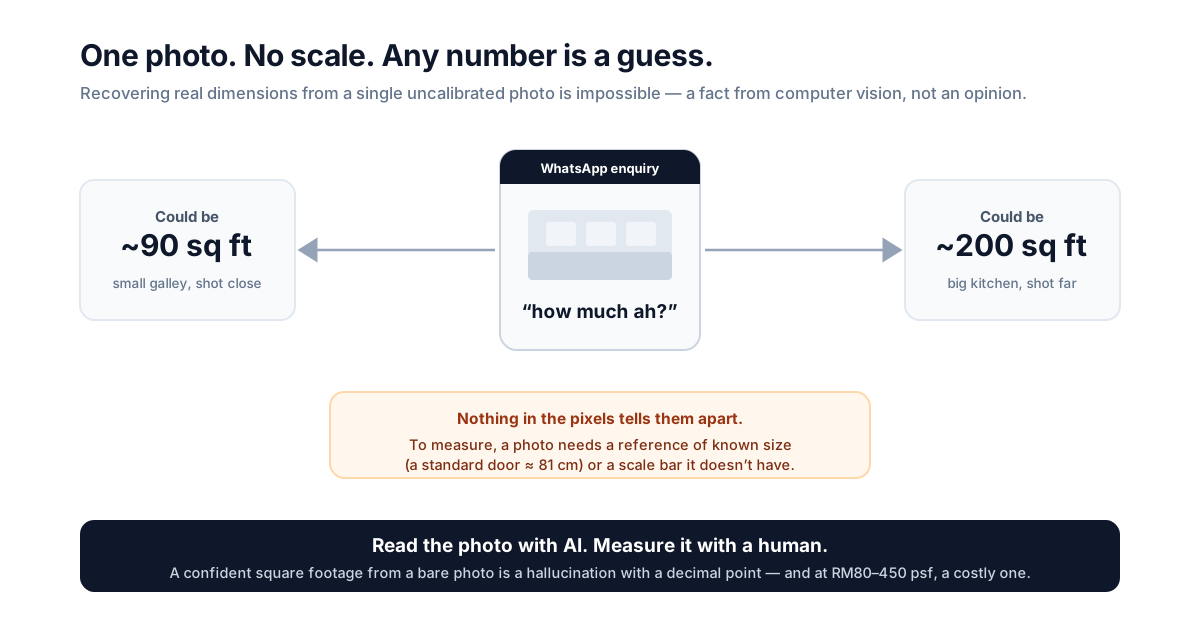
Here is an enquiry that lands on a renovation firm's WhatsApp several times a week, and it breaks every tidy system you have built. There is no message. There is just a photo — a slightly blurry shot of a tired wet kitchen, melamine doors peeling at the corners, taken at arm's length — and three words under it: "how much ah?" Or it is a screenshot of a developer's floor plan, lifted straight from the VP pack, captioned "renovate this whole unit, can quote?" Or it is a bare, echoing handover unit, cement floor and stub pipes, from someone who collected keys in Mont Kiara last week.
We have already covered reading a messy text enquiry with AI — the voice notes, the one-liners, the "do up my condo" messages. But images were the blind spot in that build. A model reading text cannot see a photo. And in Malaysian reno and ID, a huge share of first contact is a picture, because it is genuinely easier for a homeowner to snap their kitchen than to describe it.
So the obvious 2026 question, now that every model can "see": can AI just look at the photo and hand me a size and a rough price? And the Kai follow-up — can it do that profitably, or does the magic trick quietly cost me jobs? I pointed vision AI at it. Here is the problem, what it cost before, what the two builds actually did, and what you should do on Monday.
What does a photo-only enquiry cost you before any AI?
Before AI, a photo enquiry costs you the worst kind of time: the guessing kind. Someone on the team opens the picture, squints, and tries to reverse-engineer a job out of it. Is that a 3x3 galley or a big open kitchen? Are those existing cabinets staying or going? Is the floor tiled or screed? None of it is answerable from one photo, so you do one of two things — and both leak money.
Either you interrogate: you fire back five questions — size, scope, materials, budget, timeline — and a homeowner who just wanted a ballpark feels examined and goes quiet. Or you guess: you eyeball the photo, decide it "looks like a RM18k kitchen," and say so. If you guessed low, you have just anchored the buyer to a number you cannot honour, and the awkward correction later reads as a bait-and-switch. If you guessed high, they have already messaged the next firm.
And these are not junk leads. A photo enquiry is often a serious one — the homeowner is standing in the actual room, motivated enough to snap it and send it. As the qualifying guide keeps finding, the vaguest opener in Malaysian reno is frequently the biggest job. So "just look at the photo and quote it" is a tempting shortcut precisely because these leads matter. Which is why I wanted to know if a vision model could do it.
So can AI look at the photo and give me the size and price? (Build A)
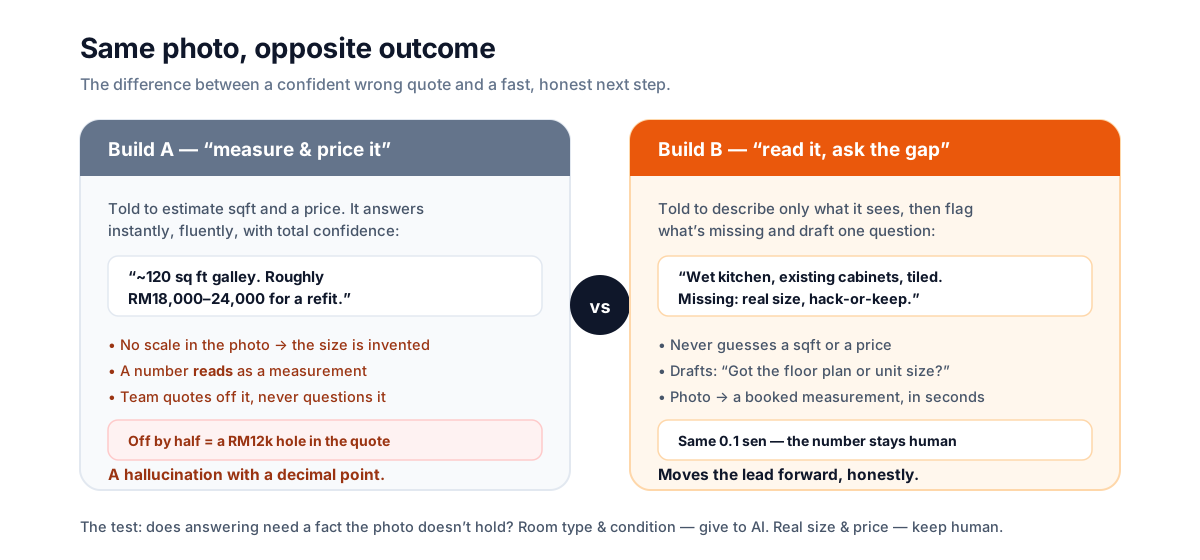
This was the demo everyone wants. Build A: a photo lands, the model is told "you are a renovation estimator, look at this photo, estimate the square footage and give a rough price range." And it answers. Instantly, fluently, with total confidence: "This looks like an approximately 120 sq ft galley kitchen. For a mid-range refit expect roughly RM18,000 to RM24,000."
It is genuinely impressive to watch. It is also the single most dangerous thing in this whole experiment, because the number is invented and it does not look invented.
Here is the hard part, and it is not a "models will get better" problem — it is geometry. You cannot recover an object's real size from a single photo. Computer-vision researchers call it scale ambiguity, and it is fundamental: metric scale is inherently unobservable from one viewpoint, because perspective throws away the information during the moment the photo is taken. The same image is consistent with a small kitchen shot close up and a huge kitchen shot from far back — nothing in the pixels tells them apart. To pin down real dimensions you need extra information the photo does not contain: a reference object of known size in frame (this is why people are told to stand a standard 81cm door or a ruler in shot), a legible scale bar, or the camera's own calibration. A homeowner's snap of their kitchen has none of that. So when Build A says "120 sq ft," it is not measuring — it is pattern-matching to kitchens it has seen and dressing the guess as a fact.
Floor-plan screenshots are only marginally better, and they fail the same way. A vision model can read the labels and the layout on a plan — this is the master bedroom, that is the yard — but the moment it tries to turn that into dimensions it hits the same wall, because the scale bar is almost always cropped out of the screenshot or too low-res to read, and floor-plan geometry is exactly where these models are documented to slip. The research on running vision models over floor plans has a name for it — geometric hallucination — because the models reason well about what a room is and badly about how big it is.
And put the ringgit on it, because that is the whole point of this column. Malaysian reno runs roughly RM80 to RM450 per square foot depending on scope. If Build A eyeballs a kitchen at "120 sq ft" and it is really 180, that fifty-percent miss, at a mid-range RM200 psf, is a RM12,000 hole dropped straight into the quote before anyone has measured a wall. The compute to generate that error cost about a tenth of a sen.
What actually worked: AI reads what the photo shows, and what's missing (Build B)
Build B kept the useful half and cut the part that invents numbers. Same photo, but the prompt changed from "estimate the size and price" to "tell me only what you can actually see in this image, then tell me what is still missing before anyone could quote it, then draft one friendly question to get that." No measurement. No price. Just triage.
And that it does well. For the tired wet-kitchen photo it returns something like: "Wet kitchen, existing melamine cabinets (look original, likely to be replaced), tiled floor and walls, single window. Scope reads as a refit, not a layout change. Missing to quote: actual dimensions or the unit's floor plan, whether the cabinets are being replaced or refaced, and material preference." Then it drafts the message: "Thanks for the photo! Looks like a galley kitchen we can definitely help with. Quick one so I can get you an accurate range — do you have the unit's floor plan or roughly the square footage? That's all I need to send you a proper quote."
That is the entire product. AI turned a three-word photo enquiry into a structured read and the exact one question that unblocks a real quote — in seconds, for a tenth of a sen. It never guessed a size. It never anchored a price. It converted an un-actionable image into an actionable next step, which is precisely what a buried owner cannot do fast at 10pm. The measurement still comes from a floor plan or a site visit; the number still comes from a human. AI just made sure the conversation moved forward instead of stalling on a squint.
| Build A — AI measures & prices the photo | Build B — AI reads the photo, human measures | |
|---|---|---|
| Reads room type, scope, condition | Yes | Yes |
| Returns a square footage | Yes — invented, no scale to measure from | No — asks for the plan or size |
| Returns a price | Yes — anchors a number you may not honour | No — quote stays human |
| Flags what's missing to quote | No — it "already knows" | Yes — the most useful output |
| Compute cost | ~0.1 sen / photo | ~0.1 sen / photo |
| Failure mode | Silent — a wrong number reads as a fact | Visible — a human still sets the size |
The rule is the same one every honest AI-in-lead-process build lands on, and it has a clean test: does answering this need a fact the image doesn't contain? Room type, visible condition, what's missing — all in the photo, so give them to AI. The real dimensions and the price — not in the photo, they live in a plan, a tape measure, and your costing — so keep them human. Build A crossed that line and paid for it; Build B respects it and keeps every bit of the speed.
Why is this the honest answer for a Malaysian firm right now?
Because the picture is genuinely where a lot of your leads start, and pretending AI can measure it just moves the leak downstream into your quotes. Homeowners here lean on images — they screenshot the developer's layout from the PropertyGuru or iProperty listing, they forward the floor plan from the VP pack, they snap the actual room because typing out a scope is hard. That behaviour is not going away; it is growing. So the winning move is not to wish the photos were text — it is to read them for what they safely give you (what the space is, what's missing) and to be disciplined about what they cannot give you (how big it is, what it costs).
This is also why the flashy "AI auto-quotes from a photo" pitch you will start seeing should make you reach for your wallet and hold it shut. It demos beautifully and it is wrong in the one place that costs a renovation firm real money — the number. A slightly slower right quote beats an instant confident wrong one every single time on a job this size.
What should an owner actually do on Monday?
You do not need to build anything to get the upside — you need one rule and one habit:
- Never let AI put a size or a price on a photo. If you use a model on enquiry images at all, prompt it to describe what it sees and list what's missing — full stop. Treat any square footage it volunteers as a red flag, not a feature.
- Auto-acknowledge the photo instantly, then ask the one question. The buyer should never be left on read while someone squints. An instant "got it, looks like a galley kitchen — do you have the floor plan or sqft?" holds the lead and moves it forward. Speed on the acknowledgement, patience on the number.
- Get the real size from a plan or a visit before you quote. A floor plan with a legible scale, or a measured site visit, is the only honest input to a number. Build that into the flow so the photo becomes a booked measurement, not a guessed price.
- Get every photo enquiry to one owner with a next action. A picture in a shared inbox rots as fast as any other lead — faster, because "someone will look at it" is even easier to think about a photo. One owner, one next action, or the busy-season leak swallows it.
How HotLead fits — and what it deliberately does not do
I will be straight, because over-claiming is the exact hype I keep arguing against. HotLead does not look at a photo and fire back a square footage or a price, and that is on purpose — this experiment is the reason. What it does is the part the experiment proved is safe and valuable:
- Captures every enquiry, including the images — the kitchen photos, the floor-plan screenshots, the VP-pack PDFs — into one lead record, source-tagged, instead of scattered across five WhatsApp threads.
- Acknowledges instantly and structures in text — the optional AI assistant can warm a new enquiry the moment it lands and collect scope and budget in words, so a photo-only lead is not left on read while you find a free minute.
- One owner and a next action on every lead, so a photo becomes a booked measurement instead of a thread nobody reopens — the human hand-off the experiment says must stay human.
- A funnel and per-channel view, so you can see whether image enquiries are stalling at first contact or later at the slow-quote step.
In other words, HotLead captures and structures the picture and hands it to a person to measure and price — the build that actually pays off. If photo and floor-plan enquiries are quietly stalling your inbox, start with the complete guide to managing renovation leads in Malaysia, see how it fits a renovation firm or an interior-design studio, or read the companion piece on turning a messy text enquiry into a structured lead.
Sources: the impossibility of recovering absolute scale from a single view is established computer vision — see RSA: Resolving Scale Ambiguities in Monocular Depth Estimators (arXiv 2410.02924) and Language as Prior, Vision as Calibration: Metric Scale Recovery for Monocular Depth Estimation (arXiv 2601.01457), which describe metric scale as inherently unobservable from one image without a reference of known size or camera calibration; the floor-plan failure mode ("geometric hallucination") is documented in FloorplanVLM (arXiv 2602.06507) and SVG Decomposition for Multimodal Floor-Plan Comprehension (arXiv 2511.03478); the reference-object requirement and AR-app accuracy bands (a standard 81cm door, errors of 1–5cm even for purpose-built tools) from Coohom — AR vs laser room measurement and Alibaba LifeTips — measuring rooms with a phone camera; vision-model image tokenisation and cost from Roboflow — what it costs to process an image with a vision model; Malaysian reno cost bands (RM80–450 psf; kitchens RM15k–50k) from iHome.my — renovation cost per sq ft and LoanStreet — home renovation costs Malaysia; property portals from iProperty Malaysia. Illustrative compute costs use published vision-model pricing and are labelled illustrative. Speed-to-lead and Malaysian qualifying behaviour are as cited in the complete guide and the qualifying guide.
Frequently asked questions
Can AI estimate a room's size or renovation cost from a photo?
Not reliably, and you should not let it. Recovering real dimensions from a single uncalibrated photo is a known-impossible problem in computer vision — scale is unobservable from one viewpoint unless there is a reference object of known size (a standard door is about 81cm wide) or a legible scale bar in the frame. A general vision model handed a random WhatsApp photo has neither, so any square footage or price it returns is a confident guess, not a measurement. Even purpose-built AR measuring apps, which use camera motion and sometimes LiDAR, only land within a few centimetres and degrade in poor light. Use AI to read what the photo shows, and get the real size from a floor plan or a site visit.
What can AI actually do with a photo or floor-plan renovation enquiry?
The genuinely useful half — triage. Given a kitchen photo it can tell you it is a wet kitchen with existing melamine cabinets and tiled floors, that the scope looks like a refit rather than a move-the-walls job, and — the valuable bit — what is still missing before anyone can quote (real dimensions, hack-or-keep, materials). Given a floor-plan screenshot it can read the room labels and layout. What it should not do is convert any of that into a measurement or a price. Structure and flag the gaps; leave the number to a human.
How much does it cost to have AI look at an enquiry photo?
Almost nothing in compute. Vision models bill an image as a few hundred to around a thousand tokens depending on its size — GPT-4o-class models tile the image at roughly 170 tokens per 512-pixel tile plus a base, Claude bills about width times height over 750. A typical WhatsApp photo plus a short prompt and reply runs on the order of a tenth of a sen. As always, the tokens were never the cost — the cost is a wrong number in a quote.
Should I let an AI assistant auto-quote from photos to reply faster?
No. Speed is worth a lot on a renovation lead, but a fast wrong quote is worse than a slightly slower right one — it anchors the buyer on a number you cannot honour and either kills the deal or forces an awkward climbdown. The fast, safe move is to auto-acknowledge the photo instantly (so the buyer is not left on read while you squint at it) and have AI draft the one question that gets you a real size. Instant acknowledgement plus the right question beats an instant guess.
Does HotLead read photos and quote them for me?
No — and that is deliberate, because this experiment is the reason. HotLead captures every WhatsApp enquiry including the photos, PDFs and floor plans into one lead record with one owner and a next action, and its optional AI assistant can acknowledge a new enquiry instantly and collect scope and budget in text. It does not eyeball a photo and fire back a square footage or a price, because a single photo cannot be measured and a wrong number costs you the job. Capture and structure the image; keep the measurement and the quote human.
Keep reading
- Quote Turnaround Time — The Renovation Benchmark (and What Each Day Costs)You measure how fast you reply in minutes. You never measure how fast you quote in days — yet that's where the money actually moves. Here's the quote-turnaround benchmark for a Malaysian renovation firm, and the ringgit value of every day you shave off it.
- "Boss, Berapa?" The Renovation Lead That Lands on the Wrong ChannelYour hottest organic leads often arrive where they found you — a comment under a project post, or a DM to your personal account — not the business WhatsApp you actually watch. Here's why those leads leak at the capture step, why an ignored public comment costs more than a missed message, and how to catch a lead no matter which door it walks in.
- "We Went With Another Contractor" — I Built an AI to Win Back a Lost Renovation Lead Instead of Slamming the DoorA Shah Alam firm quotes a RM70k job, chases it for three weeks, and finally gets the message every owner dreads — "thanks, we've decided to go with another contractor." The reflex is a terse "ok, all the best 🙏" and a closed chat. The 2026 reflex is to ask AI to detect the rejection and auto-fire a win-back discount. I built it, and it begged. Here's the version that keeps a near-free option on a re-win without ever chasing a no.