

Here is a scene every Malaysian renovation-firm owner recognises: the order book is full, the phone won't stop, the crews are on three sites, and revenue for the year will clear a million ringgit — and yet at the end of the month there's barely enough in the account to cover payroll. Busy, respected, apparently successful, and quietly broke.
That gap has a precise cause, and it lives in the difference between two numbers most owners use interchangeably: gross margin and net margin. Gross margin is the margin on the job. Net margin is the margin on the business. They are not the same number, they are not close, and the space between them — your overhead — is exactly why a healthy-looking 20 percent can leave you keeping 5.
This piece does the arithmetic with Malaysian renovation numbers. It shows why a 20 percent gross margin routinely nets around 5 percent, how to work out the one figure that actually explains "busy but broke" — your break-even job count — and why, once you know it, a single extra job past the line can triple your profit while one slow month can tip you into a loss.
What's the difference between gross margin and net margin?
Gross margin is your profit after the direct costs of the job — materials, subcontracted labour, site costs — as a percentage of the price. Net margin is what's left after you also pay everything the firm spends whether or not any single job runs. One measures the work; the other measures the whole business.
Walk it through on the mid-band condo job used across this series. You quote RM80,000. Your direct cost — materials plus subcontracted trades — is RM64,000. That leaves RM16,000 of gross profit, a 20 percent gross margin. So far, so healthy: it sits right inside the 18–25 percent band Malaysian residential renovation runs on, and near the 20–30 percent international remodelers report (BuildBook, Projul).
But that RM16,000 isn't yours yet. Before it becomes profit it has to help carry every cost that shows up whether you win two jobs this month or five: the office rent, the coordinator's salary, your own pay, the van, the software, the accountant. Those are your overhead, and they don't appear on any single job's costing. Once they're paid, what remains is your net margin — and for a residential renovation firm that's typically only 5 to 12 percent, against the 20–30 percent gross (Bridgit, Foundation Software). The average net margin across construction sits around 5 to 6 percent.
As Foundation Software puts it bluntly: a contractor with 15 percent gross margins but heavy overhead can easily end up at 3 percent net, while another with the same gross but leaner operations hits 8. Same pricing, different survival. The gross margin is set at the quote; the net margin is set by how much overhead you carry and how many jobs you run it across.
Why does a healthy 20 percent gross margin leave almost nothing?
Because overhead is a fixed monthly cost, and it eats the gross profit before it reaches you — roughly three-quarters of it, in a typical small firm. The gross margin looks healthy on paper precisely because it hasn't yet met the office, the salaries and your own pay.
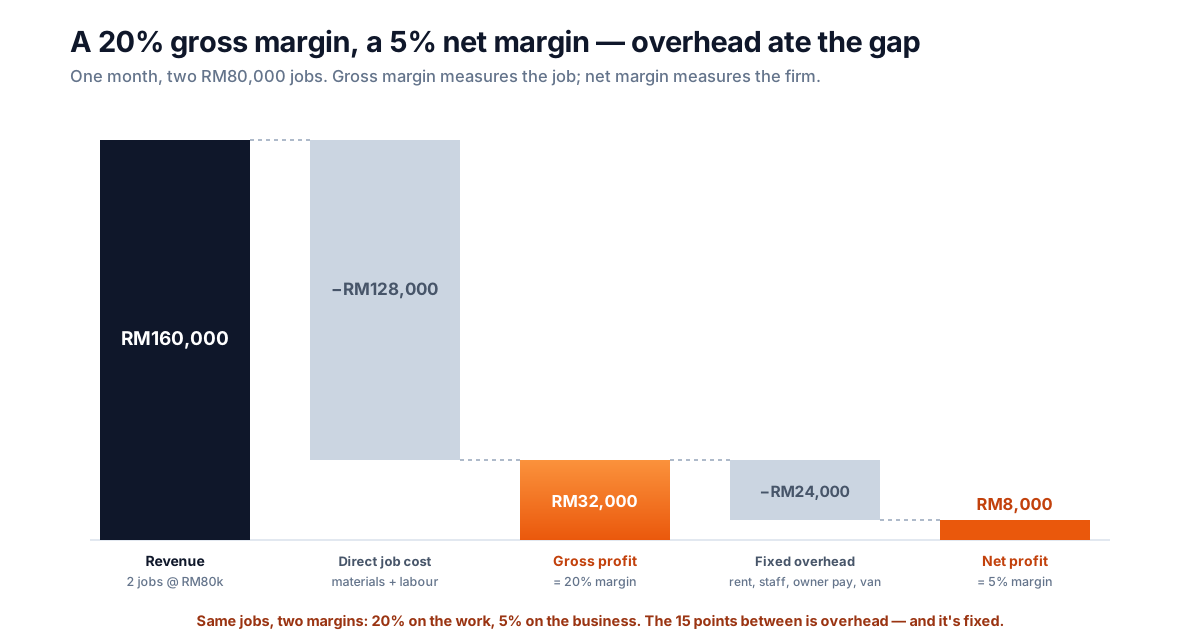
Here's the same job at firm level. Say a modest Klang Valley firm completes two of these RM80,000 jobs in a month:
- Revenue: RM160,000
- Direct job costs: RM128,000
- Gross profit (20%): RM32,000
- Fixed overhead: RM24,000
- Net profit: RM8,000 — a 5 percent net margin
Fifteen of the twenty gross-margin points vanished into overhead. That's not waste or mismanagement — it's the normal shape of the business. The RM32,000 of gross profit felt like a good month; the RM8,000 of net profit is what actually feeds the owner.
This is the number that undoes owners who plan off the gross figure. You price for 20 percent, you feel like a 20 percent business, and you spend and hire as if one in five ringgit is yours. In reality one in twenty is — and the other error compounds it, because the markup-versus-margin habit quietly under-builds even that gross figure before overhead ever touches it.
What's your break-even number — how many jobs before profit starts?
Divide your fixed monthly overhead by your gross profit per job. The answer is the number of jobs you must complete each month before a single ringgit of profit appears — the most useful number a renovation owner can know, and the one almost none track.
The formula the whole of finance uses is break-even = fixed costs ÷ contribution per unit (Wall Street Prep, AccountingCoach). For a renovation firm, your "unit" is a job and your "contribution" is its gross profit. So first you need your real fixed overhead. Here's an illustrative — but realistic — small Klang firm running a couple of jobs a month:
| Monthly fixed overhead (illustrative Klang firm) | Amount |
|---|---|
| Office / small showroom rent + utilities | RM3,500 |
| Two office staff (coordinator + estimator), loaded with EPF / SOCSO / EIS | RM8,000 |
| Owner's own pay — a real cost, not "whatever's left" | RM8,000 |
| Company van — fuel, maintenance, insurance, road tax | RM1,500 |
| Software, phones, tools, accounting, baseline marketing | RM3,000 |
| Total fixed monthly overhead | RM24,000 |
Two things worth naming. First, those staff figures include the loaded cost, not the sticker salary: on top of a gross wage an employer pays roughly 15–16 percent in statutory contributions — EPF at 13 percent, SOCSO at about 1.75 percent, EIS at 0.2 percent (PayrollPanda, Talenox). A "RM3,500 coordinator" costs the firm about RM4,050. Second, the owner's own pay is overhead — if you don't count what your own time is worth, your net margin is a fiction that quietly borrows from your salary.
Now the break-even:
Suddenly "busy but broke" isn't a mystery. A firm doing one-and-a-half jobs a month is flat out, turning over roughly RM1.4 million a year, and netting nothing. Every kitchen, every site visit, every late-night WhatsApp reply is going to keep the lights on, not to build a buffer. And this is before tax — a Malaysian SME still owes 15 percent on its first RM150,000 of chargeable profit and 17 percent above that (Acclime, Curlec), which takes another bite out of whatever net remains.
Why does one extra job triple your profit — and one slow month create a loss?
Because your overhead is fixed, the maths above break-even is wildly different from the maths below it. Once the fixed costs are paid, the next job's gross profit falls almost entirely to net profit — a lever that swings your bottom line far harder than your revenue.
Watch what happens as the same firm does one, two or three jobs in a month. Revenue rises in a straight line. Net profit does not:
| Jobs this month | Revenue | Gross profit (20%) | − Overhead | Net profit | Net margin |
|---|---|---|---|---|---|
| 1 | RM80,000 | RM16,000 | RM24,000 | −RM8,000 | −10% |
| 1.5 (break-even) | RM120,000 | RM24,000 | RM24,000 | RM0 | 0% |
| 2 | RM160,000 | RM32,000 | RM24,000 | RM8,000 | 5% |
| 3 | RM240,000 | RM48,000 | RM24,000 | RM24,000 | 10% |
Read the two ends of that table. Going from two jobs to three — a 50 percent rise in revenue — moves net profit from RM8,000 to RM24,000. That's three times the profit from one extra job, because the overhead was already covered by the first two. And going the other way, from two jobs to one — a 50 percent fall in revenue — swings you from an RM8,000 profit to an RM8,000 loss. Not "a bit less profit." A loss.
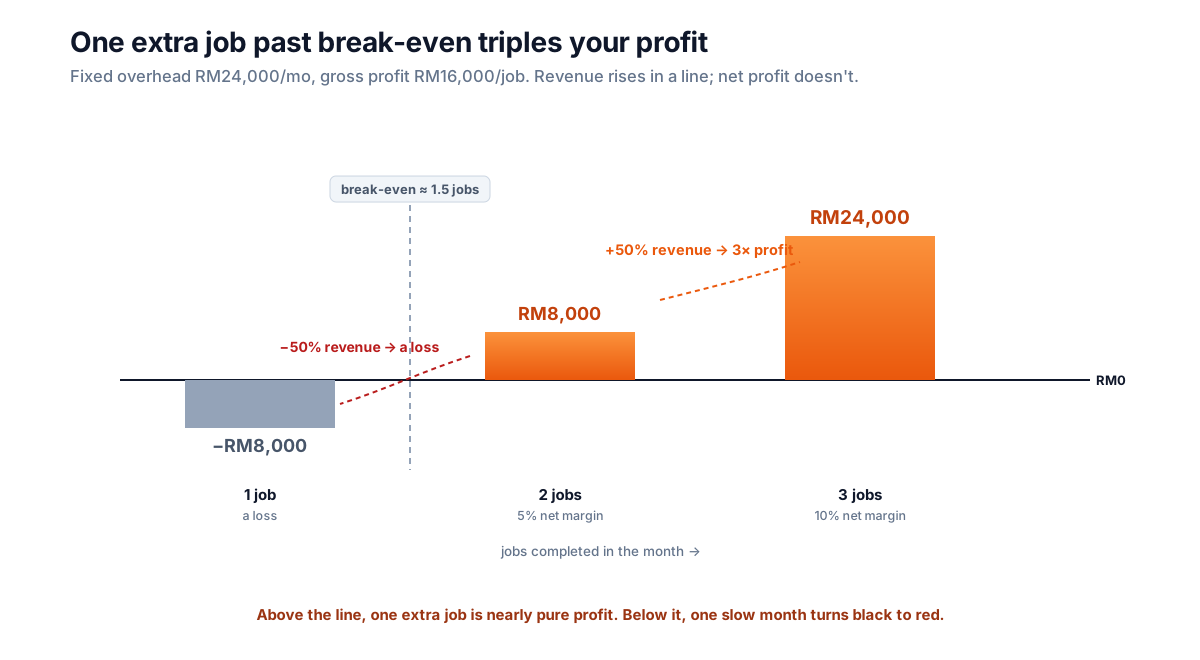
This is operating leverage, and it's the single most important thing a fixed-overhead reno firm can understand about its own economics. It means your worst month and your best month are not a little apart — they're on opposite sides of zero. It means the third job in a good month is worth roughly three times the net profit of an "average" job, because it's nearly pure profit. And it means a run of slow lead weeks isn't just disappointing; it can flip the whole month red.
Why "just grow revenue" often makes it worse
Because growth usually means adding overhead, and every ringgit of new fixed cost raises your break-even bar — so you need more jobs each month just to stand still than you did before. Chase the top line without watching the break-even line and you can genuinely out-grow your own profit.
The reflex when a firm feels stretched is to scale up: a bigger showroom to look established, a permanent salesperson, a second coordinator, a heavier monthly ad spend. Each is defensible. But each is fixed overhead, so each pushes your break-even count up. Add RM8,000 a month of new salary and rent to our firm and its break-even moves from 1.5 jobs to about 2 jobs a month — you've raised the number of jobs you must win before profit starts by a third, on the promise that the extra capacity will bring the jobs in. If it doesn't arrive fast enough, you're now a larger firm making less money, working harder for a thinner net margin.
There's a reason this matters right now. Construction was the fastest-growing MSME segment in Malaysia in 2024, up 17.3 percent — the strongest in a decade (DOSM MSME Performance 2024, Business Today). More firms are scaling up into more overhead at once. And roughly 60 percent of Malaysian SMEs don't survive their first five years (HRMARS study on SME performance in Malaysia) — rarely because they couldn't win work, and often because they grew the business faster than they grew the gap between what they earned and what they'd committed to spend every month.
Why this is a lead-management problem, not just an accounting one
Here's the turn that makes break-even more than a bookkeeping exercise: your break-even count is, quite literally, the number of leads you must convert every month before you make a cent — and operating leverage means the jobs you win past that line are the most valuable ringgit in your business. The number that decides your profit is set in your inbox, not your ledger.
Translate the maths back into leads. If you need 1.5 jobs a month to break even and you close roughly 7–8 percent of enquiries (our funnel-stage benchmarks), then you need to be working around 20 real enquiries a month just to reach zero — and every enquiry above that, if you convert it, is worth about three times its face value in net profit, because your overhead is already paid. That completely reframes a "slow lead month." It isn't a mild dip in revenue; it can be the difference between the black and the red, because you're operating on the steep part of the leverage curve.
It also changes which leads you fight for. Late in a good month, once you've cleared break-even, the next lead you convert is nearly pure net profit — so the enquiry you might have let slide because "we're already busy" is the one worth chasing hardest. This is the same lesson as not out-spending a leaky funnel and why the cheapest lead can be your most expensive job, seen from the profit side: the goal isn't more revenue, it's more converted jobs above your break-even line.
That's where a system earns its keep — with an honest boundary. HotLead is not accounting software. It won't calculate your margin, run your P&L, or tell you your break-even number; that's your accountant's job and this article's arithmetic. What it does is protect the thing your break-even depends on — winning enough jobs each month. It captures and tags every enquiry by source so no lead is lost in the WhatsApp scroll, keeps one owner and a next-action on every lead so the jobs that push you above break-even actually close, and its funnel and per-channel views show you which sources bring the jobs that make money, not just the enquiries that make noise. Know your break-even count, hold your gross margin on every job, and convert the leads that carry you past the line — that's how a "busy" firm stops feeling broke.
The renovation firms that quietly build wealth aren't the ones with the biggest revenue or even the fattest gross margin. They're the ones who know exactly how many jobs a month they need before profit starts, keep their overhead below what their real lead flow can feed, and treat every enquiry past the break-even line for what it is — the most profitable ringgit they'll earn all month.
Pricing the job is one number; running the firm is another. Start with the complete guide to managing renovation leads in Malaysia, then read markup vs margin on building the price right, and deposit vs revenue vs cash on why a booked-out order book can still miss payroll.
Sources: Bridgit, Foundation Software, BuildBook and Projul on gross-margin (18–30%) and net-margin (5–12%) benchmarks for residential remodelers and the overhead-absorption gap between them; Wall Street Prep and AccountingCoach on the break-even formula (fixed costs ÷ contribution per unit); PayrollPanda and Talenox on Malaysian loaded employer cost (EPF 13% / SOCSO ~1.75% / EIS 0.2%, ~15–16% above gross); Acclime and Curlec on Malaysian SME corporate tax bands (15% / 17% / 24%); DOSM MSME Performance 2024 and Business Today on construction MSMEs growing 17.3% in 2024; HRMARS on the ~60% five-year SME failure rate. House figures (RM80k condo job, RM64k cost, RM16k gross profit, ~7–8% conversion, ~RM1,280 expected gross profit per enquiry) are consistent across this series; the RM24,000/month overhead and 1.5-job break-even are illustrative and labelled as such.
Frequently asked questions
What is the difference between gross margin and net margin for a renovation firm?
Gross margin is your profit after the direct costs of doing the job — materials, subcontracted labour, site costs — as a percentage of the price. Net margin is what's left after you also pay everything the firm spends whether or not a specific job runs — rent, office and admin salaries, your own pay, the van, software, accounting, and tax. Gross margin measures the job; net margin measures the business. In Malaysian residential renovation a firm commonly runs a gross margin of about 18 to 25 percent but a net margin of only around 5 percent, because fixed overhead absorbs most of the gross profit before it reaches the owner.
Why does a 20 percent gross margin only leave a 5 percent net margin?
Because overhead sits between them. A 20 percent gross margin on an RM80,000 job leaves RM16,000 after direct costs — but that RM16,000 still has to help pay the firm's fixed monthly overhead, which does not change with how many jobs you run. Once rent, office salaries, the owner's pay, the van and software are shared across the jobs you actually completed that month, only a thin slice reaches the bottom line. Residential remodelers typically report net margins of 5 to 12 percent against 20 to 30 percent gross, and the difference is almost entirely overhead absorption.
How do I calculate my renovation firm's break-even point?
Divide your total fixed monthly overhead by your average gross profit per job. If your overhead is RM24,000 a month and a typical job earns RM16,000 in gross profit, your break-even is RM24,000 divided by RM16,000, or about 1.5 jobs a month — the number you must complete just to reach zero before any profit. Every job beyond that contributes almost its whole gross profit straight to net profit, because the overhead is already paid. Knowing this single number tells you how many leads you must convert each month before you start making money.
Why does one extra job increase my profit so much?
It's operating leverage. Your overhead is fixed, so once you have cleared break-even the fixed costs are already covered and the next job's gross profit falls almost entirely to net profit. Take a firm with RM24,000 overhead and RM16,000 gross profit per job — two jobs gives RM32,000 gross less RM24,000 overhead, so RM8,000 net; three jobs gives RM48,000 less RM24,000, so RM24,000 net. One extra job, a 50 percent rise in revenue, tripled the net profit. The same maths in reverse is why dropping from two jobs to one turns an RM8,000 profit into an RM8,000 loss.
Does growing revenue fix a "busy but broke" renovation firm?
Not on its own, and often it makes things worse. If you add overhead to chase growth — a bigger showroom, more permanent staff, a heavier ad budget — you raise your break-even bar, so you now need more jobs each month just to reach zero than you did before. If the extra jobs don't arrive fast enough to clear the higher bar, a firm with more revenue can make less profit than a leaner one. The fix is to know your break-even count, protect the gross margin on every job, and win enough jobs above the line — not simply to grow the top number.
Keep reading
- The Lead Who Can't Say Yes: Selling a Renovation When the Decider Isn't in the ChatThe person messaging you about the renovation often isn't the one who signs off the job — it's a wife gathering quotes while the husband holds the budget veto, an adult child sourcing for aging parents, one sibling of a jointly-owned unit. So you pour your whole pitch, quote and follow-up into someone who can't actually say yes, and the deal dies in a family discussion you were never invited to. Here's how to spot the messenger early and get the real decider into the room — without insulting the one who chose you.
- "Can Discount Ah?" Can AI Spot a Price-Shopping Renovation Lead — and Should It Decide the Next Move?A Puchong contractor gets "another firm quoted me RM55k, can match or not?" at 10pm and does what a tired owner does — he knocks RM6k off to not lose it. He's trained that buyer, and the ten after her, to push. So the 2026 reflex is to ask AI to read the thread, flag the price-shoppers, and either auto-discount to win them or bin them as tyre-kickers. I built it. It mislabels your best buyer as a time-waster and your margin as negotiable — because the signal is in the chat but the right move never is. Here's the build that earns its keep, and why "can discount ah?" is the start of a conversation, not a verdict.
- What a Referred Lead Is Actually Worth — and Why Your Best Ringgit Protects ItA referral isn't just a "free" lead — it wins on cost, close rate and lifetime value at the same time, and those three advantages multiply. Here's what a referred renovation lead is really worth against a paid one, why owners under-fund their single best channel, and why the highest-return marketing ringgit protects the referral engine instead of buying more cold strangers.