

Every renovation owner wants more five-star reviews, and almost none can tell you what the next review is actually worth. Is it worth chasing your clients for a 4.9 when you already sit at 4.7? Does your fortieth review pull in more enquiries than your tenth did? Is a perfect 5.0 the goal — or a liability? These aren't soft questions. Reviews are the cheapest lead channel you own, and like any channel they have a cost curve, a point of peak return, and a point where spending more effort is simply waste.
Here's the short answer: your star rating and review count move your lead volume, but the relationship is a threshold followed by a plateau, not a straight line. Below a certain point you're invisible and win almost nothing. Cross it and each review buys real leads. Past the knee, the hundredth review barely moves the needle — and a "perfect" score can quietly repel the exact buyer you want. Let's put numbers on all three.
Do reviews actually bring in more renovation leads?
Yes — and the effect is large, measured, and concentrated on firms exactly like yours. The cleanest evidence comes from Harvard Business School economist Michael Luca, whose 2011 study Reviews, Reputation, and Revenue matched Yelp ratings to tax-office revenue data for Seattle businesses and found that a one-star increase in rating was associated with a 5 to 9% increase in revenue. The crucial detail for you is that the effect showed up almost entirely among independent businesses, not chains — because a chain already has a known brand, while an independent lives or dies on reputation. A Malaysian renovation or interior-design firm is the independent in that study.
Why does a rating move revenue at all? Because reviews are the real top of your funnel, not a decoration bolted on at the end. Roughly three in four consumers read reviews before choosing a local business (BrightLocal), and the lead you lose to a thin profile never shows up in your pipeline — it shows up as an enquiry that never arrives. You can't see that leak, which is exactly why owners under-rate it.
And the lever is strongest precisely where the stakes are highest. Northwestern University's Spiegel Research Center, working with PowerReviews, found that displaying reviews lifted conversion by about 190% for a lower-priced product but about 380% for a higher-priced one — the riskier the purchase, the more the buyer leans on other people's experience before committing. A renovation is the most expensive, most irreversible, most anxiety-laden purchase most Malaysian families make outside their home loan itself. Reviews don't matter less on a RM80,000 fit-out than on a RM50 gadget. They matter far more.
How many reviews do you actually need?
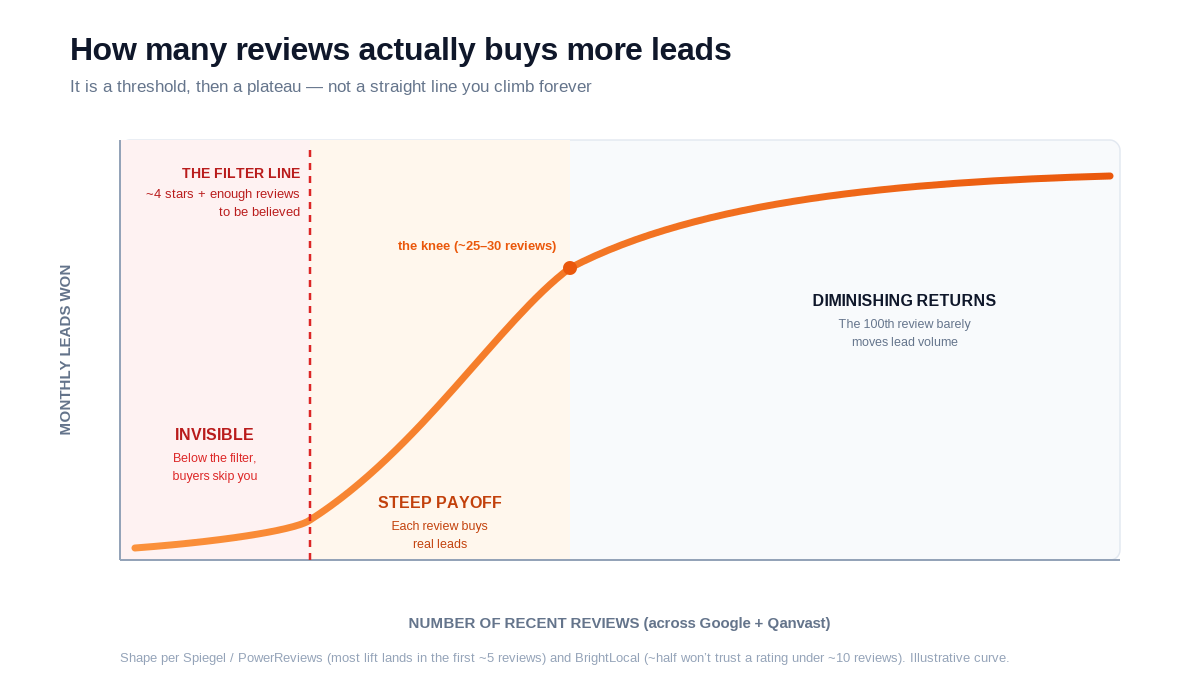
Enough to clear the filter — then far fewer than you think. This is the part owners get wrong in both directions, so it helps to picture the curve.
The first zone is invisible. Buyers don't read every profile — they filter, then read the survivors. A rating propped up by only a handful of reviews fails that filter: BrightLocal's consumer research has found that around half of consumers won't believe a business's average rating if it rests on 10 or fewer reviews, and a growing share screen out anything below four stars outright. Below the line, it almost doesn't matter how good your 4.9 looks — you're not in the shortlist to be compared.
The second zone is the steep payoff, and it's shorter than most owners expect. Spiegel's data found that the conversion benefit of adding reviews climbs quickly and then "diminishes quickly once a base number is reached" — for higher-priced items, most of the lift was already captured by around the first five reviews. Crossing from zero into a credible double-digit count is where the real lead volume is bought.
The third zone is diminishing returns. Once you're comfortably over the filter — call it roughly 20 to 30 recent reviews at a solid rating — the next review adds very little. Going from 5 reviews to 25 can transform your lead flow; going from 150 to 170 is invisible to a buyer who already saw "4.8, 150 reviews" and moved on to reading the words. The marginal lead per review falls off a cliff past the knee, which is the single most useful fact in this whole piece: your review-chasing effort has a point of sharply diminishing value, and most firms keep pushing well past it while under-investing in the stages that still pay.
Why a perfect 5.0 can lose you leads
Because an unbroken wall of five stars reads as fake — and the buyer most likely to smell it is a Malaysian one. This is the finding that surprises every owner, and it comes straight from the Spiegel data: purchase likelihood peaks when the average rating sits between about 4.2 and 4.5 stars, and then declines as the rating approaches a perfect 5.0. Spiegel's research director Edward Malthouse put the reason plainly — when shoppers see nothing but five-star reviews, they get suspicious that it's too good to be true.
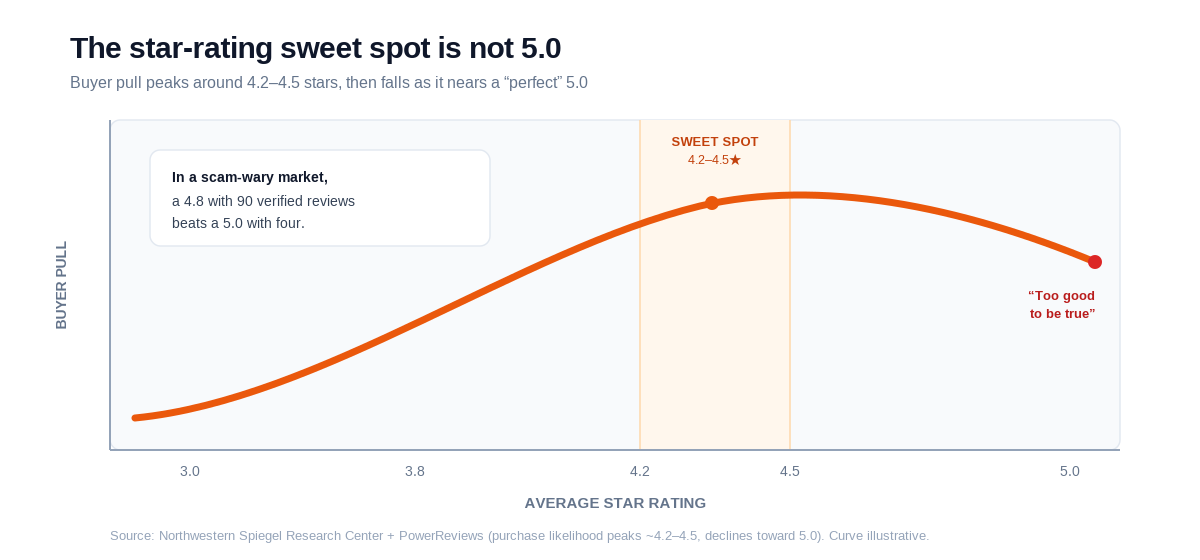
Now layer on the Malaysian context, because it sharpens the effect. Renovation-deposit scams here are common enough to be their own recurring news genre, and buyers arrive pre-trained to look for the con. A flawless 5.0 backed by four reviews, all posted the same week, all glowing, all vague — that's not reassuring to a KL homeowner who has read a dozen "contractor ran off with my deposit" threads. It's a red flag. A few honest three- and four-star reviews, with a measured owner reply underneath each, do more to build trust than a suspiciously perfect record, because they prove the reviews are real.
That's why review count and a believable rating beat a chase for the last decimal. Consider two Klang Valley interior-design studios bidding for the same Mont Kiara condo fit-out:
| Studio A | Studio B | |
|---|---|---|
| Rating | 5.0★ | 4.8★ |
| Review count | 4 reviews, all last month | 90+ reviews over 3 years |
| Platform | Google only | Google + verified Qanvast |
| How the buyer reads it | "Too new, too perfect — could be planted" | "Lots of real jobs, a few honest gripes, firm replies" |
| Lead outcome | Often skipped despite the higher number | Makes the shortlist, gets the enquiry |
Studio A has the higher rating and loses. The buyer isn't optimising a spreadsheet — they're managing risk on the biggest cheque they'll write this year, and depth of evidence beats a shiny score.
The Malaysian twist — why review count is a real moat here
On the platform that matters most for high-intent reno buyers, reviews can't simply be farmed. Qanvast verifies reviews by cross-checking them against the homeowner's actual renovation contract, and runs a RM50,000 Qanvast Guarantee plus firm vetting on top. That changes the economics of review count entirely. A verified Qanvast review represents a real, documented job — so a thick verified profile isn't a number you can buy or fake your way to overnight. It's hard-won proof, and that makes it a durable lead-generation asset a competitor can't match in a weekend.
Google is easier to pad, which cuts both ways: it's where most buyers start their search and apply the first filter, but it's also where a scam-wary buyer is quickest to discount a too-clean profile. The practical read is to be present and credible on both — Google for discovery and the filter, Qanvast for the verified depth that closes the trust gap — and to value the review you can prove over the review you merely display. It's the same logic as every other channel in this series: a referred lead and a cold boosted-post lead are not worth the same, and a verified review and an anonymous one aren't either.
So what should an owner actually do?
Treat reviews as a lead channel with a target and a stopping point, not an ego project with no ceiling. Four moves, in order:
- Get over the filter first. If you're under roughly 10 to 20 recent reviews or below four stars, this is your highest-return review work by far — you're buying your way from invisible into the shortlist. Make the ask a tracked step at handover, after snags are cleared and the client is genuinely happy, never a generic blast the moment a job is marked done.
- Keep the count fresh, don't chase a perfect score. Once you're credibly over the line, a steady trickle of new reviews maintains recency and depth. Stop trying to scrub your way to a 5.0 — a believable 4.7 to 4.8 with honest spread and owner replies out-pulls a suspicious perfect record.
- Spread across the platforms buyers filter on. Google for discovery, Qanvast for verified depth. Prize the verified count where you can earn it, because that's the number a rival can't fake.
- Reallocate the effort past the knee. This is the real payoff of understanding the curve. The hour you'd spend wringing your 150th review out of a reluctant client is worth more spent on replying faster to the next enquiry or turning a quote around in two days instead of eight — stages where the marginal ringgit is still large. Reviews get you onto the shortlist; speed and follow-up decide whether you win off it.
The firms that win here read reviews like Izzat reads any number: not "more is always better," but "where is the next unit of effort actually worth the most?" For reviews, that answer is sharply front-loaded — then it's somewhere else.
How HotLead fits in
HotLead doesn't collect reviews, write them, or manufacture a rating — those come from the work you do and the ask you make at the right moment, and we're deliberate about never faking either. What it does is make sure the leads your reviews win don't leak after they arrive, and give you the data to treat reviews as the channel they are, for Malaysian renovation, interior-design and construction firms, on the WhatsApp you already use. It:
- Captures and tags every enquiry by source, so you can see how many leads are actually arriving from your Google and Qanvast presence versus paid channels — and tell whether your review investment is still paying or past its knee.
- Keeps every won job on one record with one owner, so the review ask at handover becomes a tracked next action, not a forgotten intention — the single habit that decides your review count.
- Shows the funnel and per-channel ROI over time, so "reviews get me onto the shortlist" and "speed and follow-up win me the job" become two numbers you can see and balance, not a feeling.
Start with the complete guide to managing renovation leads in Malaysia, see the three numbers that predict your next quarter of leads, or read the renovation lead playbook and the interior-design playbook.
Sources: Michael Luca, "Reviews, Reputation, and Revenue: The Case of Yelp.com," Harvard Business School working paper (2011) — a one-star rating increase associated with a 5–9% revenue increase, concentrated among independent businesses, via a regression-discontinuity design on Seattle revenue data; Northwestern University Spiegel Research Center + PowerReviews, "How Online Reviews Influence Sales" — purchase likelihood peaks between ~4.2 and 4.5 stars and declines toward 5.0 ("too good to be true"); conversion lift of ~190% (lower-priced) vs ~380% (higher-priced) when reviews are displayed, with benefits diminishing quickly after roughly the first five reviews (study of 111,460 SKUs across 22 categories; higher-priced data from Hammacher Schlemmer); BrightLocal, Local Consumer Review Survey (roughly three in four consumers read reviews before choosing a local business; about half won't trust an average rating built on 10 or fewer reviews; a rising share only use businesses rated four stars or higher) — figures drawn from BrightLocal's reporting; Qanvast (Malaysia) — verified reviews cross-checked against the homeowner's renovation contract, firm vetting, and a RM50,000 Qanvast Guarantee, per Qanvast's own listings. House figures — a ~RM80,000 condo fit-out, ~RM40,000–150,000 condo renovation range, referral close ~15–25% vs ~1% cold — are used for consistency across this series and labelled as typical, not firm-specific. The Luca and BrightLocal figures are drawn from widely cited secondary reporting and flagged as such.
Frequently asked questions
How many Google reviews does a renovation or interior-design firm need?
There is no magic number, but the useful target is a threshold, not a maximum. About half of consumers won't trust an average rating built on 10 or fewer reviews (BrightLocal), and research by Northwestern's Spiegel Research Center found most of the conversion lift arrives within roughly the first five reviews and then diminishes quickly. So the first job is clearing the visibility filter — get past about 10 to 20 recent reviews at 4 stars or higher — after which each extra review buys you steadily fewer leads. Keep a steady trickle so the profile stays fresh rather than chasing a round number.
Does a 5.0 star rating get more leads than a 4.7?
Usually not. Spiegel and PowerReviews found purchase likelihood peaks between about 4.2 and 4.5 stars and then drops as the rating approaches a perfect 5.0, because an unbroken wall of five-star reviews reads as too good to be true. In Malaysia, where renovation-deposit scams are common enough to be their own news genre, buyers are even more primed to distrust a flawless profile backed by only a handful of reviews. A 4.7 or 4.8 with real volume and a few honest lower ratings converts better than a suspicious 5.0.
Do online reviews actually bring in more renovation leads, or just look nice?
They bring leads, and the effect is measurable. A Harvard Business School study of independent businesses found a one-star increase in rating was associated with a 5 to 9% rise in revenue, with the effect concentrated among independents rather than chains — which describes most Malaysian reno firms. The mechanism is the shortlist — roughly three in four consumers read reviews before choosing a local business, so a thin or low-rated profile loses you enquiries that simply never arrive.
Are Qanvast reviews worth more than Google reviews for a Malaysian reno firm?
They carry a different kind of weight. Qanvast verifies reviews by cross-checking them against the homeowner's actual renovation contract, so they are far harder to fabricate than an open Google review — which makes a thick verified Qanvast profile a real moat a competitor can't build overnight. Google still matters because it is where most buyers start and filter. The practical answer is to be present and credible on both, and to prize verified review count where you can earn it.
Should I worry more about my star rating or my number of reviews?
Get both over the line, then stop optimising the rating and keep the count fresh. A high rating on too few reviews isn't believed, and a big count at a poor rating is a different problem. Once you are above about 4 stars with enough recent reviews to be credible, the rating is doing its job and extra decimal points barely move leads. Your effort is better spent keeping reviews flowing and recent — and better still spent on reply speed and quote turnaround, where the marginal ringgit is larger.
Keep reading
- Can AI Reply to Your Renovation Firm's 1-Star Review? I Built It — and the Risk Is How Fast It ApologisesA 2-star review on Google or Qanvast is the first thing your next renovation lead reads — and most firms either ignore it or fire back and make it worse. The 2026 reflex is to let AI write the reply. I built it, and drafting a calm response costs a fraction of a sen. But an AI tuned to be helpful apologises too fast — it will concede a fault in writing, promise a refund that never happened, and grovel to a fake review from a competitor. Here's the build that protects your rank instead of torching it.
- Which Lead Signals Actually Predict a Sale? Reverse-Audit Your Own Won JobsMost firms grade a renovation lead on signals that feel predictive — enthusiasm, a long message, a fast reply — and never check whether those signals actually separate won jobs from lost ones. Here is how to run a reverse-audit on your own closed deals, which signals usually survive it, and why your pipeline is too small to pretend the score is more than directional.
- The "I Only Deal With the Boss" Lead: When the Buyer Refuses Your TeamYou finally hired someone to share the load — then the buyer messages "can I deal with you direct ah, boss?" and refuses to engage your staff. Every big lead quietly re-centralises onto the one person already maxed out, and your firm can never grow past the owner. Here's why caving caps you, why a flat "my staff will assist" loses a nervous buyer, and the move that keeps both.