

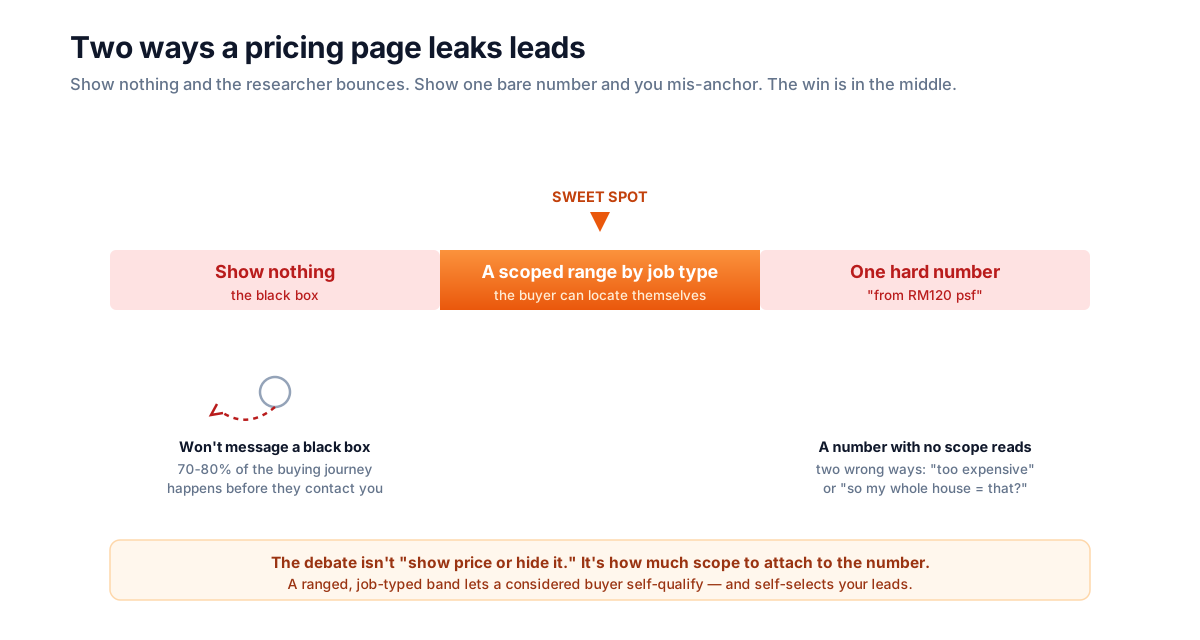
Ask ten Malaysian renovation or interior-design firm owners whether they put prices on their website and you'll get the same nervous split you'd get asking about a horror movie: half swear by showing nothing ("let them message first, then I can sell"), half slap a "from RM X psf" on the homepage and hope it does the filtering. Both camps are answering the wrong question — and both are quietly leaking leads at the top of the funnel, before a single WhatsApp message is ever sent.
Here's the framing that actually matters: the decision isn't "show your price or hide it." It's how much scope you attach to the number you show. A price with no context repels buyers at both extremes — the black-box page the researcher won't enter, and the bare headline figure that mis-anchors everyone who reads it. The firms that get this right treat their published price not as a billboard but as a filter — the first, cheapest qualification step in the whole lead process.
Should you put prices on your renovation website at all?
Yes — but publish a scoped range, not a single number and not nothing. The "show or hide" debate is a false binary. Both pure answers fail a high-ticket, heavily-researched purchase like a renovation, and they fail it for opposite reasons: silence repels the buyer who needs a number to justify reaching out, while a bare figure hands every reader the wrong number. The useful move sits in the middle — a band tied to job types that lets a buyer place themselves before they message.
That middle ground is where this piece lives. First, why each extreme leaks. Then, what a scoped band looks like with real Malaysian figures, how the right amount changes by channel, and why — for lead management specifically — the price you publish is really the top of your qualification funnel, not a marketing afterthought.
Why does hiding your price entirely leak leads?
Because a renovation is researched to death before anyone messages you, and a page with no pricing gives the researcher nowhere to go except a competitor who did give them a number. For a considered, five-figure purchase, most of the decision is made before contact. Forrester's widely-cited finding puts buyers at 70 to 80 percent of the journey complete before they talk to sales; Master B2B's research finds around 74 percent research at least half their decision online first, and 87 percent are told to check prices before they buy.
The mechanism is simple and unkind. When your page shows no price, the buyer has two choices: fill in a "request a quote" form and wait, or open the next tab. Most open the next tab. As Nielsen Norman Group's work on pricing transparency has long argued, for every buyer willing to raise their hand and ask, several more quietly find a number elsewhere and never come back. On a renovation that instinct is stronger, not weaker, because the buyer is trying to sort a shortlist of firms down, and the fastest way to eliminate one is that it made them work just to learn if it's even in their league.
Now, the hide-it camp isn't entirely wrong about one thing: a wall does filter. Put your price behind a form and you'll get fewer, more-qualified enquiries — the casual browser won't bother. But that trade only pays when you have too many leads and want to thin them. Most renovation SMEs have the opposite problem: not enough good enquiries, and a slow follow-up process that already loses the ones they get. Filtering harder at the very top, before you've earned any trust, throws out serious researchers along with the tyre-kickers.
Then why does a bare "from RM X psf" also leak leads?
Because a number with no scope attached gives the buyer nowhere to stand — so they stand in the wrong place. The moment you publish "from RM120 psf" and nothing else, you've handed every reader a figure they'll interpret against their own situation, and two very different buyers will both read it wrong.
- The buyer it would have suited reads "too expensive." Renovation cost per square foot in Malaysia runs anywhere from RM50 to RM120 for light work up to RM250 to RM450-plus for a major overhaul (Houz, Loanstreet). Seen cold, out of context, a "from RM120" headline looks like a premium number to someone whose cosmetic refresh would actually have landed lower — so they self-eliminate from a job you'd have happily done.
- The buyer with a bigger job under-anchors. They take "from RM120 psf," multiply it across their 1,000 sq ft house, and conclude a full renovation costs them RM120,000. When your real quote for their scope, finish and custom joinery comes back higher, it doesn't read as "different scope" — it reads as bait-and-switch, and you've lost trust you can't rebuild. Smaller units make this worse: a 600 sq ft unit costs more per square foot because the fixed cost of a kitchen and bathrooms spreads over less area, so a headline "from" rate is often furthest from the truth for exactly the compact condo jobs that message you most.
A "from" price feels like transparency. But a number the buyer can't attach to a scope isn't information — it's a Rorschach test. Here's what each of the three choices actually does to your top-of-funnel:
| What you publish | Who it attracts | Who it repels | What the enquiry is worth |
|---|---|---|---|
| Nothing (black box) | Buyers already sold on you; the impatient | The researcher who needs a number to justify reaching out | Mixed — includes no-budget browsers who message because there's no filter |
| One hard "from RM X" | Buyers who happen to match that anchor | The suited buyer who reads it as "too expensive"; sets up a bait-and-switch feeling for bigger jobs | Skewed by mis-anchoring — some arrive expecting a whole job at the "from" rate |
| Scoped range by job type | Buyers who can place themselves in a band | Genuinely out-of-budget buyers (which is the point) | Warmer — they've pre-qualified their own scope before messaging |
What should you actually publish? A scoped band, by job type
Publish a range tied to the kind of job, so the buyer can locate themselves — and reserve a real "from" price only for a genuinely packageable offer. The reason a scoped band beats both extremes is that it gives the buyer a place to stand and tells the truth about a purchase whose price legitimately varies five-fold. You're not committing to a number; you're giving them enough to self-qualify.
The market already hands you the shape of it. Presented as bands, Malaysian renovation and interior-design pricing sorts cleanly into three tiers a homeowner can recognise:
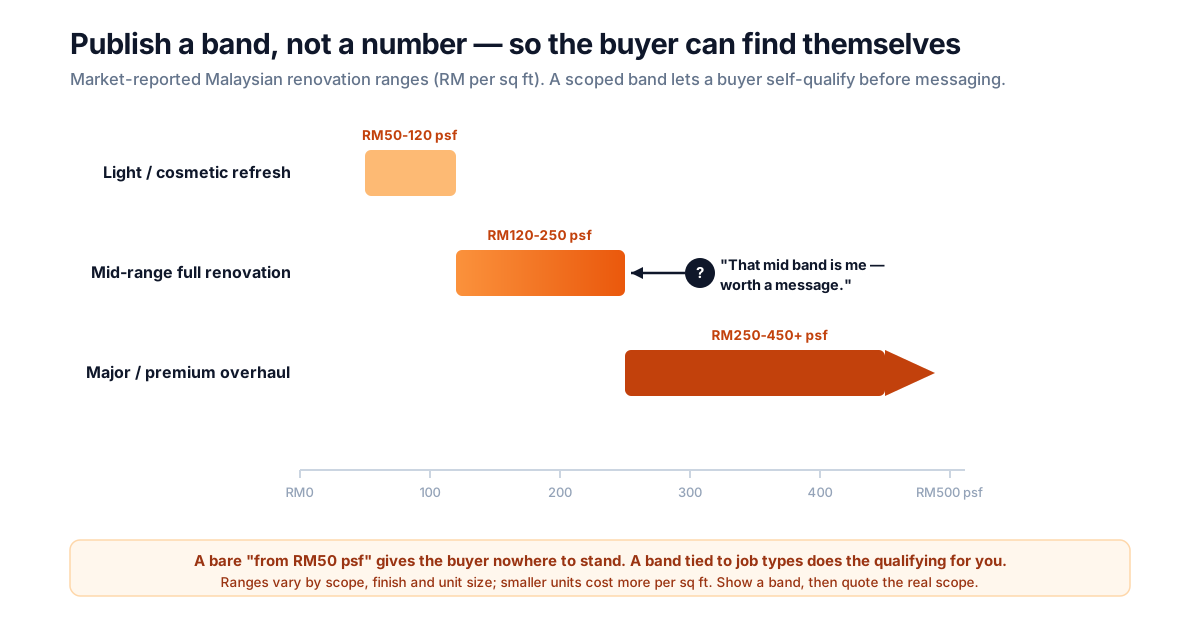
Two rules make a band work instead of confuse:
- Attach the range to a job type, never to a bare rate. "A light cosmetic refresh typically runs RM50–120 psf; a full mid-range renovation RM120–250; a major or premium overhaul RM250–450+" tells a buyer far more than "from RM120 psf," because it lets them match their job to a band. The interior-design equivalent — cosmetic work around RM100–130 psf, mid-range full renovation RM150–220, premium with custom joinery RM180–280 — works the same way.
- Show a real "from" only where the offer is genuinely packageable. If you sell a fixed-scope product — a standard 3-room condo painting package, a kitchen-cabinet-only fit-out — a firm "from RM X" is honest and converts, because the scope is fixed. The danger is only in putting a "from" on bespoke work that isn't. Know which you're publishing.
How much to publish changes by channel
The right amount of price isn't one setting — it's per surface, because the buyer arrives at each channel with a different amount of context already in their head. Publishing the same thing everywhere ignores that a Qanvast enquirer is pre-anchored while a cold Facebook browser isn't.
| Channel | Buyer's starting context | What to publish |
|---|---|---|
| Your own website | Actively researching, on your turf, willing to read | The fullest version — scoped bands by job type, a worked example, what pushes the number up or down. This is where you educate. |
| Qanvast / Atap | Already budget-matched and pre-anchored by the platform's calculator | A typical-project figure plus a range; stay consistent with the platform's own numbers so you don't read as the outlier. |
| Cold Facebook / Instagram | Browsing without intent, no context, fast-scrolling | A clear range that lets them self-qualify — a bare "from" stops the scroll for the wrong reasons and pulls in mis-anchored enquiries. |
The through-line: on every surface the published price is doing the same job — deciding who messages and how qualified they are — but the amount of scope you need to attach changes with how much the buyer already knows. Match the context, and the same buyer who'd have bounced off a black box or a bare number instead arrives in your inbox having already placed themselves in your range.
Why your published price is really a lead filter
Whatever you publish is the first qualification step in your funnel — it decides who messages you at all, and how pre-qualified they are when they do. That reframes the whole question. You're not choosing a marketing headline; you're setting the mesh size on the net at the very top of your pipeline, before you've spent a minute of sales time or a single free site visit.
Set it too loose — show nothing — and you attract everyone, including no-budget browsers who message precisely because there's no filter, while the serious researcher who needed a number quietly went elsewhere. The enquiries that land are a mixed bag you then have to qualify one by one on the first reply, burning the hours a small team doesn't have. Set it as a scoped band and buyers self-select — the ones who message have already matched their job to your range, so you spend fewer of those expensive free site-visit hours on people who were never in budget.
This is the same logic as the cost-per-won-job math: the cheapest enquiry to generate is often the most expensive to serve, and a price filter is your earliest, cheapest lever on lead quality rather than lead volume. It sits one step before the pricing arithmetic that decides whether a won job is profitable — first you shape who asks, then you price what you quote them.
Where does a system fit — and where doesn't it?
HotLead doesn't build your website or set your prices — the band you publish is your commercial call, and no tool makes it for you. What a lead system does is tell you whether the price you published is working, which is the one thing you can't see from the page itself. Because your published price is a top-of-funnel experiment, the only honest way to judge it is by what lands in your inbox and what converts.
That's the measurable part. When you capture and tag every enquiry by source, you can see whether the scoped band on your website is bringing budget-fit leads while the bare "from" you left on an old Facebook post is still pulling mis-anchored ones. Qualifying on the first reply confirms fast whether a buyer who messaged actually sits in the band they think they do, and the funnel and per-channel views show which surfaces send enquiries that become jobs, not just messages. Change what you publish, watch the conversion by source move — that's how you tune the filter instead of guessing.
The renovation firms that fill their pipeline with the right buyers aren't the ones who reveal the most or hide the most. They're the ones who publish just enough scope for a buyer to know whether to knock — and then measure who does.
Your published price sets who asks; the rest of the funnel decides who signs. Start with the complete guide to managing renovation leads in Malaysia, then read how fast a scoped enquiry needs a first reply and which channel actually pays per won job.
Sources: eMarketer / TrustRadius on pricing transparency as the No. 1 change buyers want and the 70–80% pre-contact journey; Master B2B on buyers researching online before contact; Nielsen Norman Group on pricing information as a competitive advantage and buyers who price-check elsewhere rather than ask; Store Owner Tips on the fewer-but-qualified trade-off of hidden pricing. Malaysian renovation and interior-design cost-per-sq-ft ranges from iHome.my, Houz, Loanstreet and Calculator Malaysia (smaller units cost more per sq ft); Qanvast renovation calculator backed by RM20m+ of contract data and budget-matching. The PJ studio scenario is illustrative, built from patterns described across these sources; house figures are consistent across this series.
Frequently asked questions
Should a renovation or interior design firm show prices on its website?
Yes, but not as a single number and not as nothing. The evidence on considered purchases is consistent — most of the buying decision happens before a buyer contacts you, and a page with no pricing at all makes the researching buyer bounce rather than fill in a "request a quote" form. The mistake people make is reading this as "so I should post a price." A bare "from RM120 psf" mis-anchors as badly as silence. The right answer is a scoped range tied to job types — a light cosmetic refresh runs one band, a mid-range full renovation another, a major overhaul another — so a buyer can place themselves before they message you. That is enough to earn the enquiry without pretending a bespoke job has a fixed price.
Why does hiding my renovation prices lose leads?
Because a high-ticket, considered purchase is researched heavily before anyone talks to sales — commonly cited figures put it at 70 to 80 percent of the journey completed pre-contact (Forrester). A page with no pricing forces the buyer to either message a black box or, far more often, price-check a competitor who did give them a number. In Malaysia the gap is sharper because platforms have moved the baseline — Qanvast's renovation calculator, backed by more than RM20 million of contract data, already hands buyers a ballpark before they reach your page, so a firm showing nothing reads as evasive rather than exclusive.
Is it better to put a fixed "from RM X per sq ft" price or a range?
A range, in almost every case, because a bare "from" number gives the buyer nowhere to stand. Renovation cost per square foot in Malaysia spans roughly RM50 to RM450-plus depending on scope and finish, and smaller units cost more per square foot because fixed items like the kitchen and bathrooms spread over less area. A single "from RM120 psf" therefore mis-anchors two ways — it looks expensive to the buyer whose job would have landed lower, and it under-anchors the buyer who multiplies it across their whole house and expects a full renovation at that rate. A scoped band by job type, or a real "from" price only on a genuinely packageable offer, avoids both.
Does publishing a price help qualify leads?
That is its most useful job. Whatever you publish is a filter at the very top of the funnel — it decides who messages you at all and how pre-qualified they are when they do. Show nothing and you attract everyone, including no-budget browsers, while repelling serious researchers who need a number to justify reaching out. Publish a scoped band and buyers self-select — the ones who message have already placed themselves in your range, so you burn fewer free site-visit hours on people who were never in budget. The only way to know if the price you publish is working is to tag every enquiry by source and watch which sources convert.
How much of my pricing should I show on Qanvast versus my own website versus Facebook?
Match the amount of context to the channel. On your own website you have room for the fullest guide — a scoped band by job type, worked examples, what drives the number up or down. On Qanvast or Atap the buyer is already budget-matched and pre-anchored by the platform's calculator, so a typical-project figure plus a range is enough and consistency with the platform matters. On a cold Facebook or Instagram audience, people are browsing without intent, so a clear range that lets them self-qualify does more than a bare "from" number that stops the scroll for the wrong reasons. In every case the published price is doing the same job — filtering who messages — so measure it by conversion, not by clicks.
Keep reading
- Did We Already Say RM68k? Using AI to Stop Quote Drift Across a Long Renovation ThreadOver a weeks-long WhatsApp thread with two or three quote revisions, a rep re-states a number that contradicts an earlier promise — and re-opening a settled price quietly invites a discount that eats a whole job's profit. So I pointed AI at the drift. It works beautifully as a flag, and dangerously as an auto-corrector.
- The Warranty as a Closing Lever: Why a Longer Guarantee Beats a Discount on a Renovation DealA quote is stalling and the buyer wants a reason to say yes. Before you drop the price, look at the other lever in your hand — a longer workmanship warranty. It is the same expected-value decision as a discount, but the math runs the opposite way — a price cut costs you thousands with certainty, while extending the defects cover costs you a couple of hundred ringgit in expectation, for arguably more trust with a scam-wary buyer. Here is the EV case for the non-price concession, the trap that turns it into a hidden liability, and which leads it actually moves.
- "Can You Just Build It, My Neighbour Also Did" — Handling the Renovation Lead That Needs Council Approval FirstSome renovation enquiries can't legally start next month, no matter how ready the buyer is — a kitchen extension, a hacked-through wall, a roofed-over air well all need the council's written approval first. Quote a fast build price to win the job and you either lose it to a "boss, can start" cowboy, or win it and inherit the stop-work order, the RM50,000 fine and a client who later can't sell the house. Here's how to spot the permit-first lead and sell the approval as protection.