

Ask a Malaysian renovation or interior-design owner how detailed their quotes should be and you'll hear the tension in real time. One half has been burned by a customer who took their carefully broken-down quote straight to a cheaper contractor and said "build this for less." The other half has watched a buyer go cold on a clean one-line price because — in a market thick with renovation-scam warnings — a lump sum looks like something to hide. Both instincts are right. That's the problem.
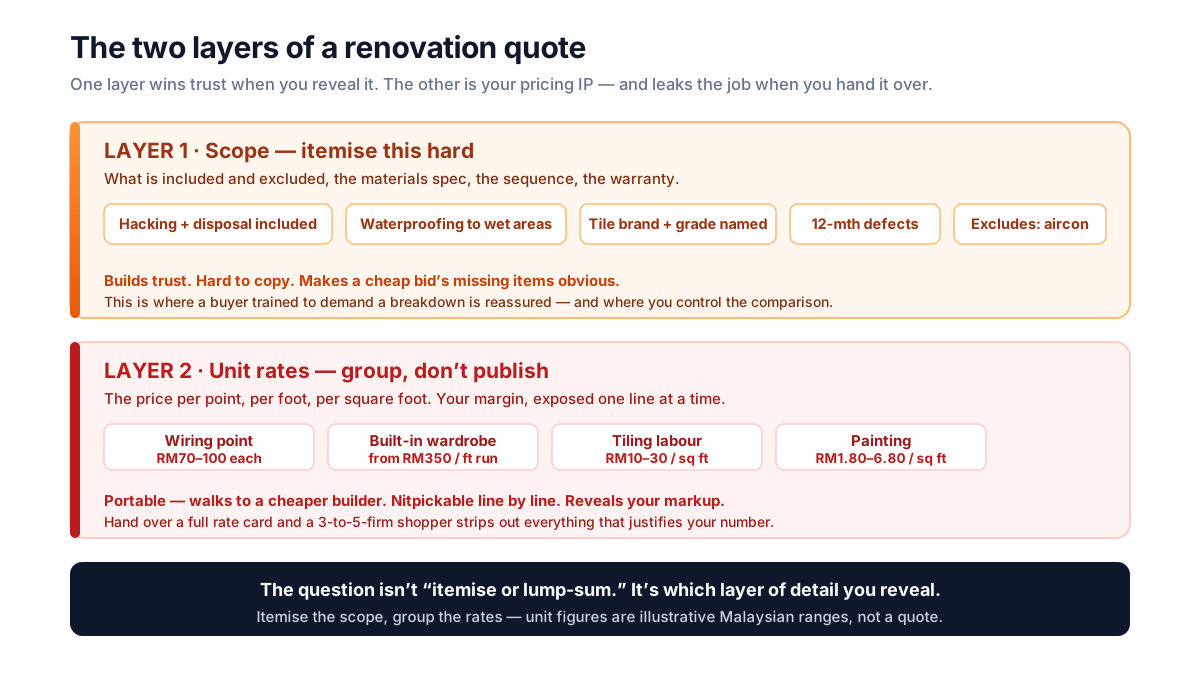
Here's the framing that resolves it: the decision was never "itemise or lump-sum." It's which layer of detail you reveal. A renovation quote carries two very different kinds of information, and they behave in opposite ways. Reveal one and you win trust. Reveal the other and you leak the job. Get them the wrong way round — which is the default — and you manage to do both at once: expose the pricing a shopper uses against you, while under-showing the scope that would have justified your number.
Itemise or lump-sum — which should a renovation quote be?
Neither extreme. Itemise your scope generously and group your rates — because the two layers of a quote pull in opposite directions. A lump sum protects your pricing but reads as hiding something to a primed Malaysian buyer. A full unit-rate breakdown looks transparent but hands a price-shopper a shopping list. The move that works is to split the difference by type of detail, not by amount.
This piece is one step deeper than how much of your price to publish at the top of the funnel. That decision is about the ballpark a researching buyer sees before they message you. This one is about the structure of the actual quote you send a specific buyer — how much of the quote's internals to reveal once they're a live lead. First, why a lump sum is a trap in Malaysia specifically. Then why the opposite — full itemisation — quietly loses you the job. Then the level that wins, and why it's really a lead-management decision, not a formatting one.
Why is a lump-sum quote risky in Malaysia?
Because the local buyer has been coached to distrust it — a single opaque number reads as the scam pattern they were warned about, not as clean simplicity. This is the part that firms who "just quote one price to keep it simple" miss. Malaysian renovation buyers don't arrive neutral; they arrive pre-loaded with advice to demand a breakdown.
Read almost any Malaysian renovation cost guide or consumer-protection article and the instruction to the homeowner is identical. My Reno Service tells buyers a quote "shouldn't just say Bathroom – RM15,000" but should list tiles, waterproofing, plumbing, fixtures and labour separately. FindContractor.my and iHome.my tell them to get itemised quotations from three to five contractors, specifying exact materials and scope, and to check whether hacking, disposal, protection, plumbing, electrical points, waterproofing, ceiling, flooring, painting and clean-up are included or listed separately. The consistent warning: a cheap headline figure often hides a thin material spec, vague "to be confirmed" allowances, or excluded items that reappear later as variation orders.
So the reflex to hide everything behind a lump sum backfires here worse than it would elsewhere. Some transparency isn't optional; it's the price of being taken seriously. Which is exactly why the opposite reflex — "fine, I'll itemise everything" — feels safe. It isn't.
Why does a fully itemised quote lose the job?
Because a quote where every line carries a unit rate commoditises you — it hands a three-to-five-firm shopper the exact list they need to strip out everything that justifies your price. The moment your quote reads "wiring point RM90 × 20, built-in wardrobe RM380/ft × 18, tiling RM22/sqft × 400," you've stopped selling a renovation and started publishing a rate card. And a rate card does three things to you, all bad.
- It's portable. A built-in wardrobe at RM350+ a foot run, tiling labour at RM10–30 a square foot, a wiring point at RM70–100 — those are your rates, and once they're in a WhatsApp they can be forwarded to a cheaper contractor or a handyman to build off. This is the same leak as giving away a free 3D render: you've handed over the portable version of your own work.
- It invites nickel-and-diming on every line. As contractors on the trades forums put it bluntly, an itemised estimate opens you to negotiation on every line instead of a conversation about the whole project — and some report losing jobs entirely because the line-by-line haggling dragged on until the buyer lost momentum.
- It exposes your markup. When materials sit at cost and labour is listed separately, a savvy buyer can back-calculate the markup — and people react badly to a visible markup figure even when it legitimately covers overhead, supervision and risk they never see.
But the deepest cost is subtler, and it's about which comparison the buyer runs. A buyer holding three to five quotes will compare something. Give them a full unit-rate breakdown and you've picked the fight for them: rate against rate. And a line-by-line rate comparison silently deletes everything that doesn't have a line — the supervision, the licensed wireman instead of a cousin, the site protection, the finish quality, the warranty you'll actually honour. None of it appears on a per-unit line, so in a line-by-line contest, none of it counts.
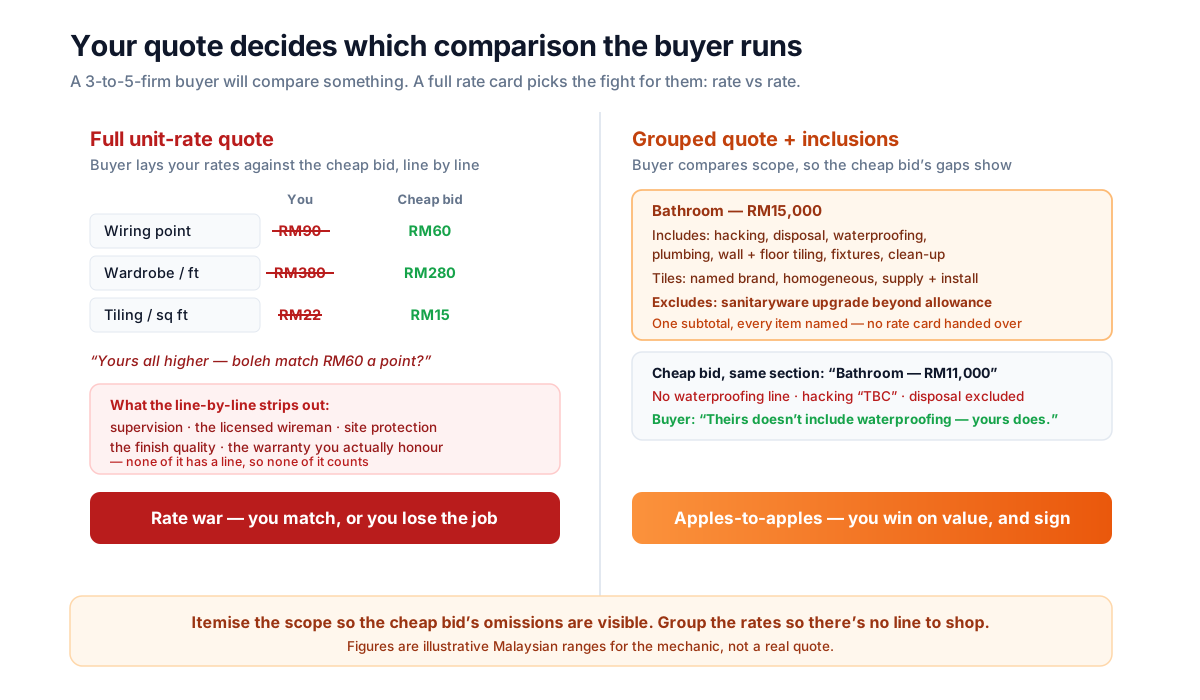
This is why the lowest bid is a warning, not an advantage: the cheap quote is usually cheap because it left things out. But a buyer can only see that if your quote is structured to make the omission visible. A rate card doesn't do that. It just makes you the expensive column.
What level of detail actually wins? The sectional quote
Group the quote by area or trade, give each section a subtotal and an explicit list of what's included and excluded — detailed enough to show you're not hiding, structured so there's no unit rate to shop. This is the level the trades call a "hybrid" or category estimate, and it exists precisely to solve this trade-off: it gives the buyer category-level breakdowns without exposing exact material costs and per-line labour rates.
For a Malaysian residential job it reads like this:
Bathroom — RM15,000. Includes hacking of existing tiles, debris disposal, full waterproofing to floor and walls, plumbing rework, wall and floor tiling (homogeneous, named brand, supply and install), fixture installation and final clean-up. Excludes: sanitaryware upgrades beyond the RM2,000 allowance; any concealed pipe repair found after hacking (quoted separately if needed).
Notice what that does. It names hacking, disposal, waterproofing, plumbing and the tile grade — every item the buyer was coached to check — so it clears the "is this firm hiding something?" test that a lump sum fails. It states the exclusions honestly, which is where the cheap bid quietly differs. But it doesn't publish "waterproofing labour RM8/sqft" or "tiling RM22/sqft," so there's no line for a competitor to undercut or a shopper to forward. The buyer gets the reassurance of transparency; you keep the pricing that a rate war needs.
Here's what each of the three levels actually does to your position:
| Quote level | How the buyer reads it | What it does to you |
|---|---|---|
| Lump sum ("Bathroom — RM15,000") | "What's in this? What's left out? Are they hiding something?" — trips the scam-warning reflex | Protects your rates, but reads as evasive; loses trust before price is even discussed |
| Full unit-rate list ("point RM90, tiling RM22/sqft…") | "Line them up against the cheap bid and negotiate each one" | Commoditises you; portable; nitpickable; reveals markup; picks a rate war you lose |
| Sectional + inclusions/exclusions ("RM15,000, includes…, excludes…") | "I can see what I'm buying, and what the cheap quote left out" | Shows transparency without a rate card; frames the comparison on scope, where you win |
When full itemisation is the right call
Reveal fuller line-item detail when the scope is genuinely standard, or when the buyer has already committed — not before, and not on bespoke work. The rule above isn't "never show a unit rate." It's "don't lead with a rate card to an uncommitted, comparison-shopping lead." A few situations flip it:
- Packageable, fixed-scope work. A standard 3-room painting package or a cabinet-only fit-out has a genuinely standard scope, so a clear per-unit or per-package price converts — the buyer isn't going to re-engineer a fixed package, and the number is the product. This is the quoting equivalent of a real "from" price on a packageable offer.
- After the buyer has chosen you. Once there's a signed intent and a deposit conversation, fuller detail builds confidence for the build ahead and keeps the job's changes clear — an itemised contract keeps communication open as variations arise. The danger was only in handing the rate card to a shopper still deciding.
- Commercial or tendered work. Government and commercial bids often require line-item pricing by law, and a business client comparing on documented rates is a different animal from a homeowner. If you want tender work, you itemise — that's the game.
For everything else — the bespoke residential renovation quoted to a buyer still comparing five firms — the sectional level is the sweet spot.
Why this is really a lead-management decision
How itemised a buyer demands the quote be is a qualification signal — and how you structure the quote decides whether you win the comparison or get shopped. That reframes the whole thing from a formatting choice into a lead-management one, which is where a system actually helps.
Start with the signal. The genuine shortlist buyer — the one who'll sign — is reassured by a clear sectional quote and moves toward booking. The buyer who, before committing anything, pushes hard for every unit rate is often doing something else: harvesting numbers to build the job cheaper elsewhere, or assembling a comparison spreadsheet. That's the same tell as the mass-blast quote-shopper — and it's worth catching early, because a full itemised quote is expensive to produce and you don't want to spend that cost on a lead that was never going to close.
Then the structure. Whether you win a three-to-five-firm comparison isn't only about your number — it's about whether the buyer compares scope or rate, and your quote decides that. This is the same logic as why the cheapest lead is often the most expensive job: the bottom-line number hides what actually matters, and your job is to make the real comparison visible. A sectional quote with honest exclusions does that; a rate card does the opposite.
Where a lead system fits — and where it doesn't
HotLead doesn't write your quote, set your rates or build your quote template — the level of detail is your commercial call, and no tool makes it for you. What a system does is manage the quote as what it actually is: a lead-management touch that has to reach the right buyer, get chased, and be measured.
That's the honest boundary. Once you've decided how to structure the quote, capturing and tagging every enquiry by source shows you which leads accept a clean sectional quote and which keep pushing for a rate card before committing — so you can see whether a channel is sending buyers or number-harvesters. Making the sent quote a tracked next-action with an overdue flag stops the finished-in-your-head quote from sitting for days while a competitor's lands first. And the funnel and per-channel views show quote-to-deposit by source, and your team view shows who's winning on well-structured quotes versus who's quietly caving to a rate war on every job. The quote is your commercial craft; the system's job is to make sure it lands, gets followed up, and tells you what's working.
The firms that hold their margin in a market this comparison-hungry aren't the ones who reveal everything, and they aren't the ones who hide behind a lump sum. They're the ones who itemise the one layer that earns trust — and group the one that starts a rate war.
How you structure the quote shapes who signs; the rest of the funnel decides whether it lands. Start with the complete guide to managing renovation leads in Malaysia, then read how much of your price to publish before a buyer messages you, what a "free" quote really costs to produce, and the markup-versus-margin math a line-item quote exposes.
Sources: Malaysian itemised-quote norms and the "demand a breakdown, compare three to five, check line by line" buyer advice from My Reno Service, FindContractor.my and iHome.my; real Malaysian unit rates (wiring points RM70–100, built-in wardrobe from RM350/ft run, tiling labour RM10–30/sqft, painting RM1.80–6.80/sqft). Itemised-versus-lump-sum trade-offs, the price-shopping and nickel-and-diming risk, back-calculated markup and the category/hybrid middle ground from Projul, Shawn Van Dyke, DCarson Construction, Truitt & White and the Contractor Talk trades forum; apples-to-apples comparison and the lowest-bid warning from Terrapin CG. The PJ studio scenario is illustrative, built from patterns across these sources; house figures (RM40–150k condo jobs, three-to-five-firm shortlist, expected gross profit per lead) are consistent across this series.
Frequently asked questions
Should a renovation firm give customers an itemised quote or a lump sum?
Neither extreme, in Malaysia. A pure lump sum ("Bathroom — RM15,000") reads as hiding something to a buyer trained to demand a breakdown and compare three to five firms line by line, so it costs you trust. But a fully itemised quote that lists every unit rate — RM90 a wiring point, RM380 a foot of carpentry, RM20 a square foot of tiling — hands a price-shopper a shopping list they can walk to a cheaper builder. The answer sits between the two — itemise the scope generously (what is included and excluded, the materials spec, the warranty) because that builds trust and is hard to copy, but group your rates into sectional subtotals rather than publishing a rate card. That way you look transparent without giving away the pricing that a line-by-line comparison uses against you.
Why is a lump-sum renovation quote risky in Malaysia specifically?
Because the local buyer has been coached to distrust it. Malaysian renovation portals, cost guides and consumer-protection advice consistently tell homeowners to demand an itemised quotation that names hacking, disposal, waterproofing, electrical and plumbing separately, to get three to five quotes, and to compare them item by item rather than on the bottom number. That advice exists because renovation scams are common enough to warrant it. So when your quote is a single opaque figure, it doesn't read as "clean and simple" — it reads as the pattern the buyer was warned about. In a market this primed, refusing to itemise anything is a conversion problem, not a way to protect your margin.
What is the danger of a fully itemised renovation quote?
It commoditises you. When every line carries a unit rate, a buyer comparing three to five firms lays your quote next to a cheaper one and negotiates line by line — "yours is RM90 a point, theirs is RM60, boleh match?" — which quietly deletes everything that isn't on a line — your supervision, a licensed wireman, site protection, the finish, the warranty you actually honour. A savvy buyer can also back-calculate your markup from listed material and labour costs, and react badly to a number that in fact covers real overhead and risk. And your rate card is portable — it can be handed to a cheaper contractor or a handyman to build off. Full itemisation wins the transparency and loses the job.
What level of detail should a renovation quote actually show?
A sectional quote — grouped by area or trade, with a subtotal per section and an explicit list of what each section includes and excludes — is the level that works for most residential jobs. "Bathroom — RM15,000, includes hacking, disposal, waterproofing, plumbing, wall and floor tiling in a named tile, fixtures and clean-up; excludes sanitaryware upgrades beyond the allowance" tells the buyer far more than a lump sum, reassures them you are not hiding anything, and makes a cheaper bid's missing items obvious — without publishing the per-unit rates that let a shopper nitpick or copy you. Reserve fuller line-item detail for the buyer who has committed, or for genuinely packageable fixed-scope work where the scope really is standard.
Should I publish a sample price list or line-item rates on my website?
Publish scope-level education, not a public rate card. An indicative guide — typical bands by job type, what drives a number up or down, what a quote should include — helps a researching buyer place themselves and pre-qualifies your enquiries, the same way a scoped price range does. But a public unit-rate list (wiring point RM90, wardrobe RM400 a foot) commoditises you into a rate comparison, goes stale as costs move, and is trivially undercut by any firm that sees it. Keep unit rates for the private, specific quote — and even there, group them rather than list every one.
Keep reading
- The 'Quick Question Ah?' Lead: When a Buyer Uses You as a Free Second Opinion for Someone Else's RenoSome of your busiest WhatsApp threads are with buyers who already have a builder — a cousin, a part-time reno friend — and are messaging you only to sanity-check his price, his tile, his scope. Every question you answer in full is a free consult that de-risks the other guy's job. Here's how to spot the sanity-check lead, why answering everything loses you the work, and how to convert a real doubt without becoming the unpaid QA department.
- Did We Already Say RM68k? Using AI to Stop Quote Drift Across a Long Renovation ThreadOver a weeks-long WhatsApp thread with two or three quote revisions, a rep re-states a number that contradicts an earlier promise — and re-opening a settled price quietly invites a discount that eats a whole job's profit. So I pointed AI at the drift. It works beautifully as a flag, and dangerously as an auto-corrector.
- The Warranty as a Closing Lever: Why a Longer Guarantee Beats a Discount on a Renovation DealA quote is stalling and the buyer wants a reason to say yes. Before you drop the price, look at the other lever in your hand — a longer workmanship warranty. It is the same expected-value decision as a discount, but the math runs the opposite way — a price cut costs you thousands with certainty, while extending the defects cover costs you a couple of hundred ringgit in expectation, for arguably more trust with a scam-wary buyer. Here is the EV case for the non-price concession, the trap that turns it into a hidden liability, and which leads it actually moves.