

Ask a renovation-firm owner what a customer is worth and you'll get the job in front of them: "RM80k job, maybe RM16k profit — that's the customer." It's an honest answer, and it's the reason so many firms stop trying the second the deposit clears. If the customer is one job, then once the job is signed there's nothing left to invest in.
But a renovation client isn't one job. Their real lifetime value is the profit on this job plus the probability-weighted value of their future own work plus the value of the referral chain they feed — and in Malaysia that last part is unusually large, because word of mouth is the single biggest way reno buyers find a firm. Get the full number and it changes which leads you fight for, how hard you protect a happy client, and why the warm lead you're tempted to leave till tomorrow is the most valuable one in your inbox. This is the worth side of the ledger — the counterpart to what it costs to win a customer. Let's put ringgit on it.
Why does a renovation firm value a client at one job?
Because the second job is far away and invisible, so the mind quietly rounds it to zero. Renovation has none of the cues that force other businesses to think in lifetime value. There's no subscription renewing every month, no reorder, no obvious "next purchase" date. A homeowner does a kitchen, pays, and disappears from your pipeline — and the repurchase cycle is genuinely long: full-home renovations are typically a 15–20 year event, kitchens every 10–15 years, with smaller updates every few years in between (US remodeling-cycle guides; directional, but the shape holds in Malaysia too).
So the accounting instinct is reasonable but wrong: this customer bought once, therefore they are a one-off. The error is confusing a long, lumpy, dated value stream for no value stream. A landlord doesn't value a tenant at one month's rent just because rent arrives one month at a time. A reno client is the same — a series of future events (the bathrooms after the kitchen, the second property, the parents' house, the office when the business grows) plus something a tenant doesn't have: a voice in the market that sends you other buyers.
What is a renovation client's lifetime value actually made of?
Three parts, and most firms bank only the first. Lifetime value here isn't a mystical number — it's a sum you can build:
- This job's gross profit. The RM16,000 on a mid condo job. Real, immediate, and the only part firms count.
- Future own work, probability-weighted. Not every client comes back, and the ones who do come back years later — so you weight it. If there's, say, a 40% chance a happy client brings you one more mid-size job over the horizon, that future job's profit counts at 40% of its value today, not zero and not 100%.
- The referral chain. A satisfied client tells people, and in a market where half of all buyers arrive by word of mouth, some of those become warm enquiries to you. Each warm enquiry has an expected value (its close rate times the profit if you win it), and referred customers tend to refer again — so this part compounds.
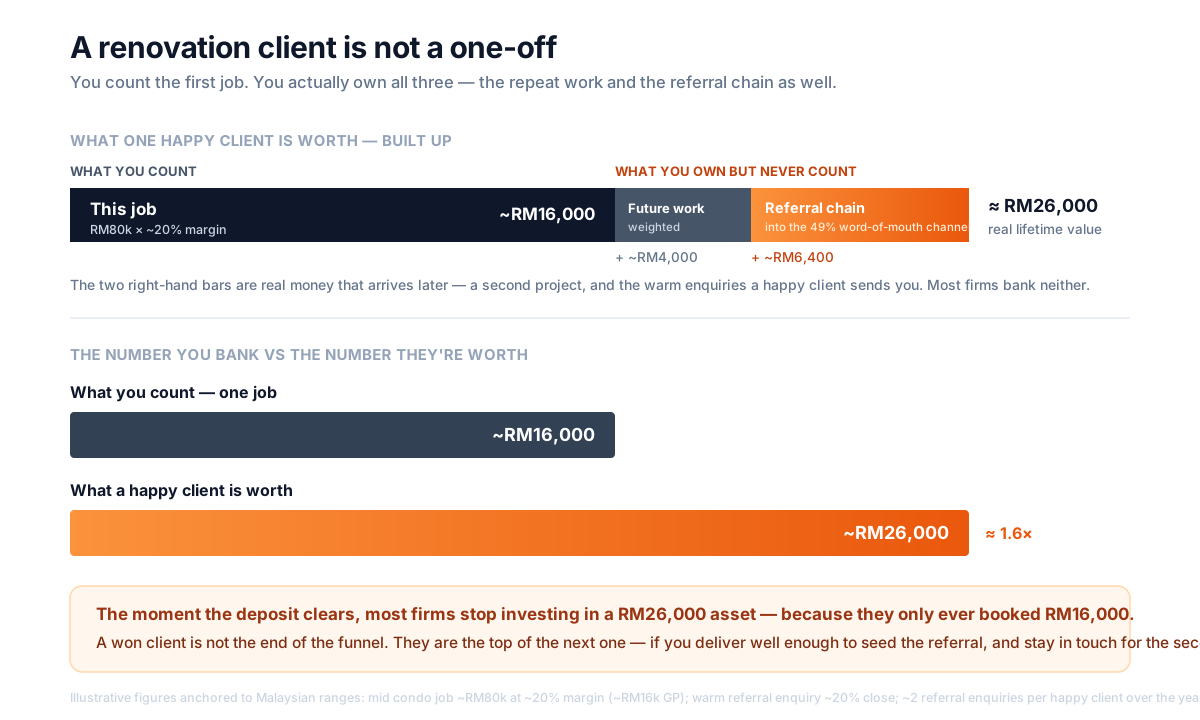
The cover diagram above stacks the three. The first bar is what you book; the two on the right are real money that simply arrives later. The point of separating them is that each responds to a different lever — the first to how you price and deliver, the second to whether you stay in contact, the third to how well you delivered and whether you can even see who referred whom.
How big is the referral half — and why is it bigger in Malaysia?
Big enough to change the answer, because in Malaysia word of mouth isn't a nice bonus — it's the primary channel. A Malaysian buyer-discovery survey (ZenWeb) puts the channels at roughly 58% Google, 53% Facebook/Instagram, 49% word of mouth or referral from a friend, 36% Google Maps, 21% AI chatbots, with most buyers using three to four in parallel. Word of mouth is effectively neck-and-neck for first — and it has two properties no paid channel can match:
- It's nearly free. No ad spend, no per-lead fee. The fully-loaded cost to acquire a referral is close to zero, where a paid customer costs you ~RM2,000 all-in.
- It converts far better. A warm referral arrives pre-sold by a friend's finished kitchen and closes in the 15–25% band, versus roughly 1% for a cold boosted-post lead.
That combination is why a happy client is quietly a lead-generation asset, not just a completed job. The US remodeling data says the same thing from the other direction: nearly half of the projects a remodeling contractor signs come from client referrals, with roughly another fifth from word of mouth, and about 68% of remodeling firms rely on word of mouth as a core channel (gFour Marketing; RenoLeadz). Put plainly — your happiest past clients are running your cheapest and most effective marketing department, whether or not you've noticed.
So what is one happy client worth, in ringgit?
Around RM26,000 on our house figures — about 1.6 times the RM16,000 you actually booked. Here's the build, using the same mid condo job (RM80,000 at a ~20% gross margin) we use across this playbook, with every future figure weighted and labelled illustrative:
| Component | How it's valued | Value |
|---|---|---|
| This job | RM80,000 × ~20% margin | ~RM16,000 |
| Future own work | ~RM4,000 | |
| Referral chain | ~2 warm enquiries over the years × ~20% close × ~RM16k GP | ~RM6,400 |
| Real lifetime value | ~RM26,400 |
The two added rows are deliberately conservative. The referral figure assumes only two warm enquiries and ignores second-order referrals entirely — yet referred customers are documented to bring in 30–57% more new customers than customers acquired other ways, because being referred and referring are contagious (referral-marketing research). Push the referral count to three or four, or add the second-order tail, and the client is worth two to three times the single job. Even at the conservative end, the conclusion holds: the client you booked at RM16,000 is worth ~RM26,000, and you stopped selling to them at the deposit.
What is an unhappy client worth? The number nobody puts a minus sign on
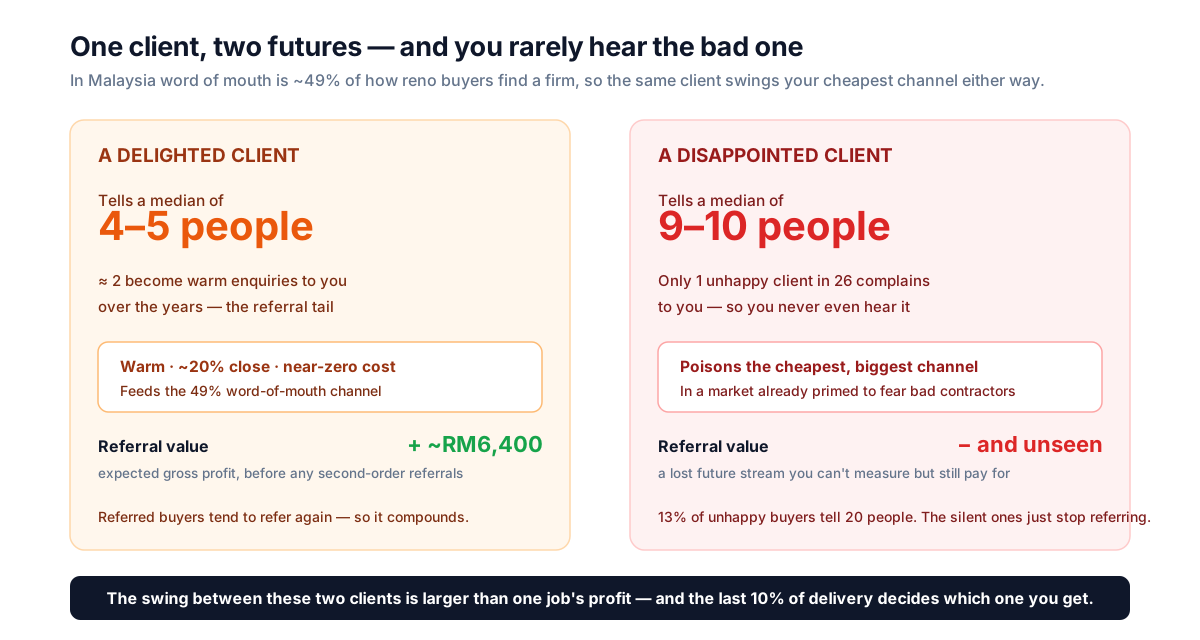
Negative — and worse, invisible. Lifetime value has a downside that reno firms almost never price, because the whole referral engine runs in reverse when a job goes badly. The word-of-mouth research is blunt: unhappy customers tell a median of about nine to ten people about a bad experience, versus three to five for a happy one, and about 13% of unhappy customers tell twenty people (customer-experience studies via Beyond Philosophy, Customer Thermometer). The killer statistic is the one about silence: only about one dissatisfied customer in twenty-six ever complains to the business — the other twenty-five just leave, and tell their friends on the way out.
Stack that on a market where buyers are already primed to fear renovation scams and demand referrals before they trust anyone, and a soured job doesn't just cost you that client — it turns your biggest, cheapest channel against you, silently. You don't get a complaint you can fix. You get a slow erosion of the 49% channel you can't even see.
Why the SaaS lifetime-value playbook misleads a reno firm
Because renovation value is lumpy, dated and partly external — none of which a retention curve models. In a subscription business, lifetime value is a smooth recurring tail, and you manage it by reducing churn month over month. Borrow that mental model for a reno firm and you'll look for the wrong things — a monthly relationship that isn't there, a churn number that doesn't apply. This is the same trap as the SaaS 3:1 CAC rule that can't discipline a reno firm: the shapes don't match.
Renovation lifetime value has three features that change how you manage it:
- It's lumpy, not recurring. One big lump now, maybe another lump years later — there's no smooth tail to protect, so "retention" isn't the lever. Delivery and staying-in-contact are.
- It's dated. The future job is pinned to a real-world event — the second property, the kids' rooms when they're older, the parents' downsizing. You can't accelerate it; you can only make sure you're still the firm they message when the date arrives, which means not going silent for three years.
- Most of it is external. The referral value isn't your customer's spending at all — it's other people's, unlocked by your customer's satisfaction. No churn model captures "how many strangers will my happy client send me." That's a delivery-and-reputation number, not a retention number.
The practical read: for a reno firm, most of the "lifetime" in lifetime value lives outside the customer — in the people they tell. You grow it by being worth talking about and by being reachable when the next dated job lands.
What does lifetime value change about how you handle leads?
It re-ranks your inbox and redefines where the funnel ends. If a happy referral/repeat client is worth well over a single job — near-zero to acquire, higher-converting, with a compounding tail — then three things follow for how you run leads day to day:
| If you believe... | ...then this changes |
|---|---|
| The warm referral can wait, "they already trust us" | It's your highest-lifetime-value lead getting your slowest reply — the exact warm-lead complacency leak that poisons the 49% channel |
| A won job is the end of the funnel | It's the top of the next funnel — a source of dated future work and referrals you'll lose to a faster competitor if you go dark |
| Referrals are lucky walk-ins | They're a measurable channel you're currently flying blind on, because the referral arrives as an anonymous "my friend used you" with no source tag |
The disciplining moves are unglamorous and cheap:
- Tag lead source at arrival, so you can actually see which past clients generate referrals — and therefore who to look after. You can't grow a channel you can't measure, and a shared WhatsApp number and a spreadsheet don't capture source reliably.
- Keep past-client records so a second project isn't a cold start — you already know their unit, their taste, their budget band.
- Protect the referral tail deliberately — the clean handover, the follow-up months later, the "how's the kitchen holding up?" message. That's not admin; it's the cheapest lead generation you have.
This is why the four numbers every reno firm should track include where your leads come from: the day you can see that referrals convert at 20% while cold social converts at 1%, you stop treating your happy clients as finished business.
How HotLead fits in
HotLead is built so Malaysian renovation, interior-design and construction firms can treat a won client as an asset, not a closed ticket — on top of the WhatsApp they already use. It captures every enquiry with its source attached, so a referral doesn't arrive as an anonymous "my friend used you" — you can finally see which past clients are sending you warm, high-converting leads and which channel is actually your biggest. It keeps first replies fast and every lead owned with a next action and overdue flags, so the warm referral and the returning past client — your highest-lifetime-value leads — don't leak into a slow reply while you chase colder ones. And its funnel and per-channel ROI view shows, over time, that word of mouth converts several times better than paid social — the evidence that your happy clients are worth far more than the one job you booked.
To be clear about the boundary: HotLead is a lead-management tool, not a loyalty or referral-program platform — it won't run a rewards scheme or automate a referral payout. What it does is make sure the referrals and repeat enquiries you already earn are seen, owned and followed up instead of lost in a busy inbox.
Start with the complete guide to managing renovation leads in Malaysia, see the renovation lead playbook, or read the cost side of this coin in what it really costs to win a customer and what a lost renovation lead is worth.
Sources: Referred-customer value — Schmitt, Skiera & Van den Bulte, "Referral Programs and Customer Value" (Wharton/Goethe University; a German bank study of 10,000 customers finding referred customers ~16–25% more valuable over six years and ~18% less likely to churn, via better matching and social enrichment). Referral contagion / referred customers refer more (30–57% more new customers) — referral-marketing research via Viral Loops and Referral Rock. Home-improvement referral and word-of-mouth share (nearly half of remodeling projects from client referrals, ~22% more from word of mouth, ~68% of firms rely on it; ~92% trust friend/family recommendations; ~91% check online reviews) — gFour Marketing, RenoLeadz and improveit360 2026 homeowner-behaviour data. Renovation repurchase cycle (full-home ~15–20 years, kitchens ~10–15 years, smaller updates every few years; 61% of long-term owners renovate rather than move) — US remodeling-cycle guides (Zippia and contractor sources), applied directionally. Negative word of mouth (unhappy customers tell a median of ~9–10 vs ~3–5 for happy; ~13% tell 20; only ~1 in 26 dissatisfied customers complain; 91% won't return after a bad experience) — customer-experience research via Beyond Philosophy, Customer Thermometer and WiserNotify. Malaysian buyer-discovery channels (58% Google, ~53% FB/IG, ~49% word of mouth, ~36% Google Maps, ~21% AI chatbots; 3–4 channels in parallel) — ZenWeb Malaysian renovation buyer discovery-channel survey, Q1 2026. Job-value, margin, close-rate and CAC figures (mid condo ~RM80k at ~18–25% margin, ~RM16k gross profit, warm referral 15–25% close vs ~1% cold, ~RM2,025 fully-loaded CAC, ~RM1,280 expected gross profit per enquiry) reuse the house figures established across this playbook. All ringgit lifetime-value figures in this article are illustrative worked examples anchored to these ranges — plug in your own job values, margin, close rate and referral counts for your real number.
Frequently asked questions
What is the lifetime value of a renovation customer?
It's the total gross profit a customer generates for your firm over the whole relationship, not just the single job in front of you. For a renovation client it has three parts — the gross profit on the current job, the probability-weighted value of their future own work (a bathroom in a few years, a second property, the parents' house), and the value of the referrals they send you. Because renovation has a long repurchase cycle and no subscription, firms tend to see only the first part and treat the customer as a one-off, which materially undercounts their best clients.
How much is a happy renovation client actually worth in Malaysia?
On the house figures we use across this playbook — a mid condo job of about RM80,000 at a roughly 20% gross margin — the job itself carries about RM16,000 of gross profit. Add a probability-weighted allowance for future own work (say ~RM4,000) and the expected value of the referral chain a happy client feeds (roughly two warm enquiries over the years at a ~20% close on ~RM16,000 of profit each, ~RM6,400), and the real lifetime value is closer to RM26,000 — about 1.6 times the single job most firms book. These are illustrative figures; plug in your own job values, margin, close rate and referral counts.
Why are referrals so valuable for a Malaysian renovation firm specifically?
Because word of mouth is roughly 49% of how Malaysian reno buyers find a contractor — effectively the number-one discovery channel, ahead of Google and social (ZenWeb buyer-discovery survey). It's also the cheapest (near-zero acquisition cost) and the highest-converting (warm referrals close in the 15–25% band versus roughly 1% for cold paid social). So a happy client isn't just a finished job — they're a low-cost, high-intent source of future leads. A firm that delivers well and stays in touch is compounding its cheapest channel; a firm that doesn't is starving it.
What does an unhappy renovation client cost?
More than one job's profit, and usually invisibly. Research on word of mouth finds unhappy customers tell a median of about nine to ten people versus three to five for satisfied ones, and only about one dissatisfied customer in twenty-six ever complains to the business — the rest leave quietly and tell their friends instead. In a market where buyers are already primed to fear bad contractors, that turns your biggest, cheapest channel against you without you ever hearing it. The lifetime value swing between a delighted and a disappointed client is larger than the profit on the job you did.
How is renovation lifetime value different from a SaaS or subscription business?
A subscription business earns lifetime value as a smooth recurring tail and manages it with retention curves. Renovation lifetime value is lumpy and dated — one big lump now, maybe another lump years later, plus a referral stream that isn't even your customer's own spending. You can't manage it like churn. You manage it by delivering the current job well enough to seed referrals, and by staying in contact so the dated future job (after the next property, after the kids move out) isn't lost to a competitor who replied faster. For a reno firm, most of the "lifetime" in lifetime value lives outside the customer — in the people they tell.
Keep reading
- The Only Three Ways to Grow a Renovation Firm — and Which Lever to Pull FirstEvery renovation firm's revenue comes down to three levers — how many leads you get, how many you close, and how big each job is. They multiply, so a modest lift on each compounds. But they cost wildly different amounts to pull, and most owners reach first for the one they should reach for last. Here's the ranking, with Malaysian numbers.
- Sight Unseen: Winning the Overseas Malaysian Who Renovates a Unit They Can't VisitA Malaysian working in Singapore collects the keys to a KL condo and messages you to fit it out — but they can't come to a site visit, can't walk your showroom, and will wire a deposit to a firm they've never met. Most firms treat this lead like a walk-in, go quiet when the buyer can't pop by, and lose the highest-budget job in the inbox. Here's why the remote buyer is your hardest-trust but best-paying lead, and how to build a remote lane that actually closes it.
- "Ok, Proceed" Isn't Money in the Bank — I Built an AI to Ask for the Deposit the Moment a Renovation Buyer Says YesA Cheras contractor closes a RM62k job on WhatsApp, the buyer says "ok proceed lah", and then the owner — mid-site, phone in a dusty hand — has to stop, pull the bank details, the agreed deposit and the scope, and type a careful money message. In that gap a hot yes quietly cools back to "let me think." The 2026 reflex is to ask AI to detect the yes and auto-fire the invoice. I built it, and it asked a half-committed buyer for 40% to a personal account two seconds after a soft "ok ok". Here's the version that kills the typing delay without asking for money off a misread.