

There's a certain kind of WhatsApp that feels like a gift when it lands. Not a vague "how much to renovate ah?" — the opposite. A full, detailed brief: "Hi, looking to renovate my condo in Old Klang Road. Hacking to open up the kitchen, full wet works both bathrooms, kitchen and TV cabinet carpentry, rewiring, whole-unit painting, aircon points x3. Please provide itemised quotation." Specific. Thorough. Ready. The dream lead.
So you do what a good firm does. You block out Sunday evening, you build a proper itemised quotation, you price the carpentry runs and guess sensibly at the wet works, you send a clean PDF Monday morning — and then nothing. No reply. No visit. A week later a friend in the trade mentions he got the exact same message, word for word, same unit, same day. Turns out it went to about ten of you. And the buyer? He'd already picked his cousin's contractor. He just wanted a stack of itemised quotes to beat that fellow down on price.
That's the mass-blast quote request, and it's a leak most owners never name because it doesn't look like one. It's not a tyre-kicker — the brief is detailed. It's not a no-show — there was no visit to miss. It's not a free 3D walking out the door. What it quietly eats is the most finite thing you own after your crew: your estimating hours. And the reason it keeps eating them is that it's disguised as the best lead in your inbox.
Why is a detailed brief not the same as a serious buyer?
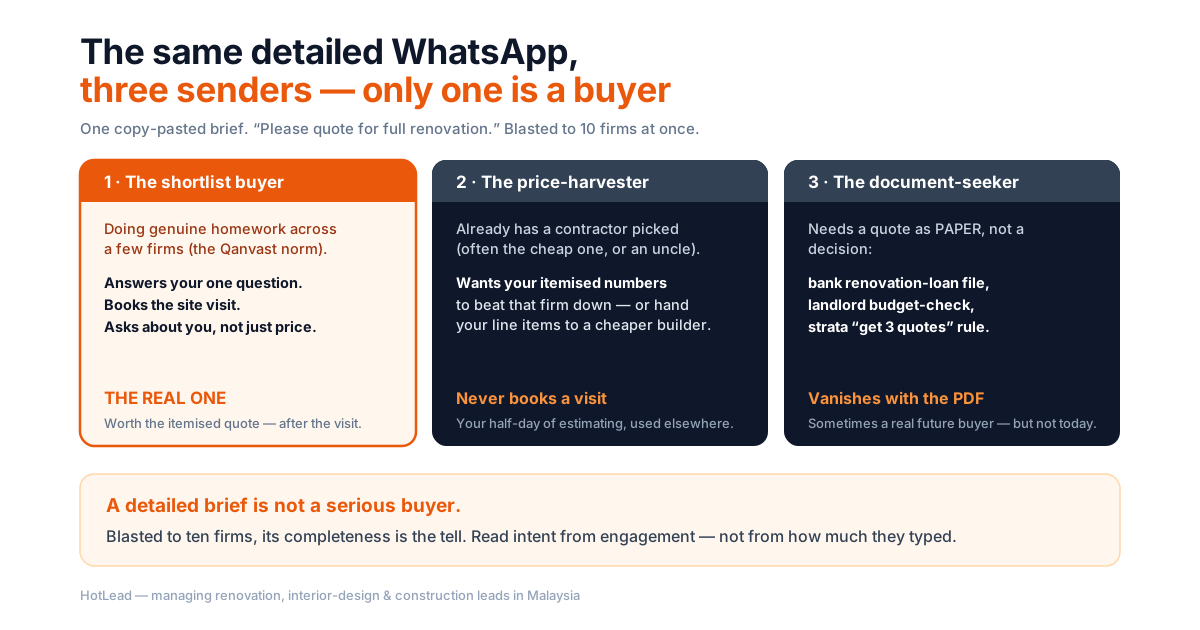
A detailed brief tells you how much someone typed, not how much they intend to build — and the two come apart completely once the same message is sent to ten firms. The completeness that makes a mass-blast look serious is actually the tell that the buyer has done none of the narrowing work a real shortlist buyer does.
Think about how a genuine buyer behaves. They shortlist a few firms — Malaysian homeowners are told everywhere to get three to five quotes, and platforms like Qanvast will connect them to up to five firms for free — but they narrow. They look at your past work. They ask about you: how long you've been doing condos, whether you did the block next door, when you could start. The brief may even be a little rough, because they're still figuring out what they want and they expect the site visit to sharpen it.
The mass-blaster does the reverse. The brief is polished precisely because it's a template, fired at everyone unchanged. There's no question about your firm, because you're interchangeable — a row in a spreadsheet, not a firm they're choosing. This is the distinction that matters, and it's the opposite of the one in the vague one-line enquiry: there, too little information hides a winnable early-stage buyer. Here, a lot of information hides someone who may not be buying from you at all.
Who actually sends these? Three senders, one is a buyer
The same detailed message arrives from three very different people, and telling them apart is the whole game — because you'd handle each one differently if you knew which was which. The trouble is they're indistinguishable on arrival. Here's who's behind the blast.
- The shortlist buyer — the real one. A genuine homeowner doing proper due diligence across a few firms. They will engage back: answer your question, book the visit, react to your past work. This is the lead you want, and the good news is the same reply that filters the other two also serves this one perfectly. You don't lose them by not itemising up front — you lose them by going silent, or by burying them under a wall of numbers before they've met you.
- The price-harvester. Has already chosen a contractor — often the cheap one, or a relative — and is collecting itemised quotes as ammunition. Your careful line items get used two ways: to beat their chosen firm down ("but this other contractor quoted the carpentry at RM12k only"), or, worse, to hand your scope and pricing to a cheaper builder to execute. It's the cousin of the free-3D trap — except what walks out the door isn't a render, it's your estimating work. They never book a visit, because a visit isn't what they came for.
- The document-seeker. Needs a quote as a document, not a decision. And in Malaysia this category is bigger than most owners realise, because our own systems manufacture it — more on that next. They'll take your PDF politely and vanish, because the moment they have the paper, their actual task is done.
The point of naming the three isn't to get cynical about every detailed enquiry. Most firms swing between two bad reflexes — treat every blast as a real buyer and bleed estimating hours, or dismiss every detailed-but-generic message as spam and occasionally ghost a genuine shortlist buyer. Both are wrong because you genuinely can't tell on arrival. The fix isn't better mind-reading; it's a reply that makes the sender reveal which one they are.
The Malaysian twist: our own systems manufacture quote-requests
Here's the un-Googleable part, the bit a generic "how to handle tyre-kickers" article will never tell you: a large share of Malaysian mass-blast quote-requests come from people who are required to collect quotes, by a bank or a committee, and who may not be ready — or able — to build at all yet.
Start with renovation loans. Malaysian banks that offer renovation financing typically require an itemised contractor quotation and will lend only up to the quoted amount, disbursed in stages against progress (Maybank, PropCashflow). So a homeowner who wants to borrow must get quotes on paper before the money exists — and they'll gather several, because they're shopping the loan and the reno at once. That person is a real future buyer, but today they need a document, and they can't sign anything until the loan clears (the weeks-long approval clock I walk through in how long it takes to close a reno lead).
Then there's the committee quote. If the enquiry is for a condo's common-area works — a repaint, waterproofing, the lift lobby — the sender is often a JMB or MC committee whose own by-laws require them to obtain three quotes before they can vote on spending from the maintenance fund. They're not harvesting to cheat you; they're ticking a governance box. But the effect on your inbox is identical: a detailed request, sent to several firms, from someone who can't decide alone or quickly.
And there's the budget-checker — the landlord or investor pricing a renovation to see whether the numbers work before they commit, or to put in a business case. They may never proceed at all.
None of this means you should treat every detailed enquiry as a non-buyer. It means the right response to a mass-blast isn't a rushed itemised quote — because the itemised quote is exactly what the harvester wants to steal, what the document-seeker doesn't need yet, and what the real buyer would rather get after meeting you anyway.
Why answering it "as written" is the trap
Here's the mistake that costs the most: taking the copy-pasted brief at face value and building the full itemised quote it asks for. It feels responsive and professional. It's actually the one move that guarantees you lose — and it does so through a mechanic peculiar to how Malaysian reno quotes work.
A real reno quote isn't a lookup. It turns on assumptions, and every firm fills them differently. How much hacking is really involved? Are the wet works — waterproofing, re-screeding, re-tiling — in or out? How many electrical points, and at what spec? What grade of tile, what carpentry finish? Is protection work and waste disposal costed in or left out? Malaysian quotation guides make this point directly: the same home can draw wildly different quotes because contractors bake in different assumptions, which is why the standard advice is that you can only compare quotes when the scope is genuinely the same — otherwise you're not comparing apples to apples. That's also why two honest quotes for one job can sit 30–50% apart.
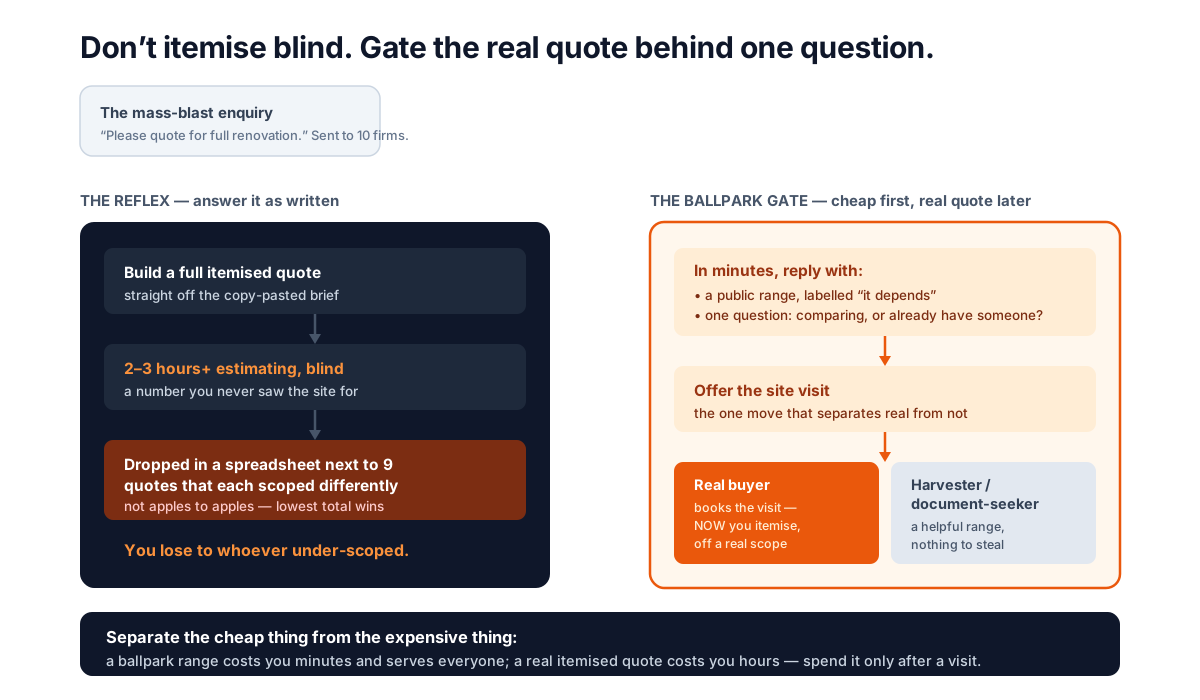
Now put that together with a mass-blast. Ten firms quote a template brief that specifies none of those assumptions clearly. So ten of you fill the gaps ten different ways, and the buyer ends up with ten non-comparable numbers laid out as if they were. What happens next is predictable: the lowest total tends to win, and the lowest total belongs to whoever assumed the least work — the firm that left out the protection, the waste, the honest wet-works allowance. You either match that by under-scoping too, or you lose the job to it. And the firm that won by under-scoping doesn't lose money; it recovers the gap in variation orders once the buyer is committed and it's too late to shop again.
So when you itemise blind off a template, the only way to win is to be the cheapest under-scoper. That's a race whose prize is a job priced below what it costs to build honestly. You do not want to win it.
What's the fix? The ballpark gate
Separate the cheap thing from the expensive thing. A ballpark range costs you minutes and can go to anyone; a real itemised quote costs you hours and should be spent only on a real, scoped job. The mistake is doing the expensive thing first, for everyone. The fix is a fast reply that does the cheap thing first and makes the sender earn the expensive one. Four moves:
- Lead with a public range, labelled "it depends." Not a firm number — a band tied to the unit and scope. "For a condo kitchen refit we're usually in the RM18k–38k range depending on carpentry and finishes; a full unit is a different conversation." A range serves the genuine buyer and the loan applicant instantly, avoids anchoring a harvester with an exact figure to beat you down with, and commits you to nothing before you've seen the site.
- Ask one question that reveals intent. "Are you comparing a few firms, or do you already have someone in mind?" It's friendly, it's normal, and it flushes out the harvester who's already chosen — and it tells the genuine shortlist buyer you're paying attention, not copy-pasting back.
- Offer the site visit — the one move that separates real from not. A genuine buyer will take a visit; a harvester and a paper-seeker generally won't, because a visit isn't what they came for. The visit is your qualifier here, the same way it is in the free site-visit trap — just aimed at a different leak.
- Gate the itemised quote behind the visit, and say why. "I can give you a proper itemised quote once I've seen the unit — quoting off a floor plan, I'd be guessing, and I'd rather not hand you a number I can't stand behind." This is the reframe that matters: not itemising up front is professionalism, not unhelpfulness. You come across as the firm that quotes accurately, against the ones flinging blind numbers into the spreadsheet.
| Answering it "as written" | The ballpark gate | |
|---|---|---|
| Your first move | full itemised quote off the template | a range + one question + a visit offer |
| Time it costs you | 2–3 hours+ of estimating, blind | a few minutes |
| The harvester gets | your line items, as a weapon | nothing worth stealing |
| The loan/committee-seeker gets | a blind number they can't rely on | a clear range that serves the file |
| The real buyer gets | a wall of numbers before meeting you | a fast, useful reply and a visit |
| How you win the good ones | by being the cheapest under-scoper | by quoting accurately, off a real scope |
When is the full quote worth building?
The point isn't never quote in detail — it's never itemise blind for a benchmark. Build the full itemised quote when the lead has earned it, which usually means one of these:
- They engaged back. They answered your question, booked the visit, referenced your work — they're behaving like a shortlist buyer, not a spreadsheet. Now the hours are an investment, not a donation.
- It's a warm or referred source. A referral or repeat client who happens to open with a detailed brief isn't mass-blasting you — they came to you. Treat that completely differently.
- The loan applicant who's real, parked correctly. Give them a clear range or a lighter quote now, and set a follow-up for when their financing should clear. They're a genuine future buyer on a bank's timeline, not a dead lead — just don't spend whole-home estimating hours on a job that can't start yet.
- A segment you're deliberately chasing. If you want the committee and common-area work, a documented, procurement-grade proposal is the price of entry — but you go in eyes open, pricing the relationship and the decision cycle, not racing a template.
Everywhere else, the discipline is the same one that runs through the whole wrong-fit lead idea: your estimating hours are fixed capacity. Every one spent building a blind quote for a benchmark is an hour not spent quoting a job you could actually win.
The bottom line
The mass-blast quote request is the leak that hides behind a compliment. A detailed, copy-pasted brief blasted to ten firms looks like the most serious lead you'll get all week, and that's exactly why it costs you — you rush to build the full itemised quote it asks for, and hand a half-day of estimating to a price-harvester using it as leverage, a document-seeker who needed paper for a bank or a committee, or a spreadsheet that rewards whoever under-scoped. The completeness of the brief measures typing, not intent. Read intent from what the sender does after you reply: whether they answer your one question, and whether they book the visit. And protect your hours with the ballpark gate — a fast public range and a visit offer for everyone, a real itemised quote only for the real buyer, off a real scope. Not itemising blind isn't unhelpful. It's the mark of a firm that quotes numbers it can stand behind.
For the whole system this sits inside — capture, qualify, decide, quote, follow up and measure — start with the complete guide to managing renovation leads in Malaysia, and see how it connects to the vague one-line enquiry, the free-3D trap, and the slow-quote leak.
How HotLead helps you spend estimating hours on real buyers
HotLead sits on top of your existing WhatsApp. It can't build the quote for you — the estimate is your craft, and the ballpark and the itemisation are yours to price — but it makes the ballpark gate easy to run and hard to skip:
- Auto-greeting and capture on every enquiry, so even a mass-blast gets an instant, professional acknowledgement and a fast range — no lead is ghosted, and none jumps the queue just because the brief looked thorough.
- One owner per lead, with tags and a next action, so you can tag how a lead behaves — comparing, already-has-someone, loan-application — and the site-visit-then-quote path becomes a tracked task instead of a Sunday spent estimating into the void.
- Overdue-follow-up flags, so the genuine loan applicant you correctly parked gets followed up when their financing clears — and the blasts you didn't itemise for don't quietly leak back onto your to-do list.
- A funnel and per-channel view, so you can see which sources send you bookers versus quote-shoppers, and which enquiries actually convert to a paid deposit — the data that tells you where your estimating hours pay off.
If your evenings keep disappearing into itemised quotes that never come back, the fix isn't quoting faster — it's quoting the right people, after a visit, off a real scope. See how HotLead works, or how it fits a renovation firm or a construction firm specifically.
Sources: PropertyGuru — how to budget for a home renovation in Malaysia and Malaysian renovation-quotation guides (get 3–5 quotes; compare only on the same scope; 30–50% price variance from differing assumptions on hacking, wet works, electrical, carpentry, finishes, protection and waste); One Click Contractor — estimating a remodeling job and FreshBooks — are estimates free (a detailed quote takes hours; charging or gating filters price-shoppers); Build-folio — construction bid win-rate benchmarks 2026 (25–35% healthy residential win rate; below ~15% means chasing bad leads); Maybank — financing your home renovation and PropCashflow — renovation loans in Malaysia (banks require itemised contractor quotations and lend up to the quoted amount, disbursed in stages); Qanvast — free reno quotes from up to 5 firms (multi-quoting norm; no commission; Qanvast Guarantee up to RM50,000). Job-value, visit-cost and expected-gross-profit figures as cited across the free site-visit trap, the vague enquiry and the complete guide to managing renovation leads in Malaysia.
Frequently asked questions
What is a "mass-blast" or copy-paste renovation quote request?
It's a detailed, often fully-specified enquiry — "please quote for full renovation of my condo, hacking, wet works, kitchen carpentry, wiring, painting" — sent identically to many firms at once, frequently copy-pasted word for word. It's different from a vague one-line enquiry, which has too little information to quote. The mass-blast has plenty of detail; the problem is that the detail is generic, the sender is talking to ten firms, and building the itemised quote they've asked for can cost you hours of estimating on a lead that may never have intended to buy from you at all.
How do I tell a serious shortlist buyer from a price-harvester?
You can't tell from the message — both send the same detailed brief. You tell from what happens next. Reply fast with a ballpark range and one question ("are you comparing a few firms, or do you already have someone in mind?"), and offer a site visit. A genuine shortlist buyer engages back — answers the question, books the visit, asks about your work, not just your number. A price-harvester who already has a contractor and just wants your figures to negotiate, or to hand to a cheaper builder, won't book the visit and won't answer straight. Intent shows in engagement, never in how much they typed.
Why shouldn't I just send the full itemised quote they asked for?
Because a copy-pasted brief is unquotable as written. A real Malaysian reno quote depends on assumptions every firm fills differently — how much hacking, whether wet works are included, the electrical points, the grade of tile and carpentry, protection work, waste disposal — so ten firms quoting the "same" brief produce ten non-comparable numbers. Yours lands in the buyer's spreadsheet next to firms that assumed less work, the lowest total tends to win, and the winner is usually whoever under-scoped — who then recovers it in variation orders later. Quoting blind off a template, you can only win by being the cheapest under-scoper, which is a race you don't want to win.
Someone said they need the quote for a bank renovation loan — is that a waste of time?
Not necessarily — it's a different kind of lead. Malaysian banks that offer renovation financing typically require an itemised contractor quotation and will lend up to the quoted amount, disbursed in stages, so a buyer genuinely needs a quote on paper before they can borrow. That person is often a real future buyer who simply isn't ready to build until the loan clears. Give them a clear range or a simpler quote cheaply, don't burn a half-day on a blind itemised estimate, and park them on a follow-up date tied to when their loan should be approved rather than treating them as a dead lead or a full-priority job today.
How do I give a ballpark without under-pricing myself?
Give a range, not a single number, and label it clearly as "depends on the unit and the scope" — for example, a condo kitchen refit commonly runs roughly RM18,000 to RM38,000 depending on carpentry and finishes. A range does three things a firm price can't — it serves the genuine buyer and the loan applicant immediately, it avoids anchoring a harvester with an exact number to beat you down with, and it protects you from committing to a figure before you've seen the site. Then gate the precise, itemised quote behind a site visit, where you can scope the real job and give a number you can stand behind.
Keep reading
- The Only Three Ways to Grow a Renovation Firm — and Which Lever to Pull FirstEvery renovation firm's revenue comes down to three levers — how many leads you get, how many you close, and how big each job is. They multiply, so a modest lift on each compounds. But they cost wildly different amounts to pull, and most owners reach first for the one they should reach for last. Here's the ranking, with Malaysian numbers.
- Sight Unseen: Winning the Overseas Malaysian Who Renovates a Unit They Can't VisitA Malaysian working in Singapore collects the keys to a KL condo and messages you to fit it out — but they can't come to a site visit, can't walk your showroom, and will wire a deposit to a firm they've never met. Most firms treat this lead like a walk-in, go quiet when the buyer can't pop by, and lose the highest-budget job in the inbox. Here's why the remote buyer is your hardest-trust but best-paying lead, and how to build a remote lane that actually closes it.
- "Ok, Proceed" Isn't Money in the Bank — I Built an AI to Ask for the Deposit the Moment a Renovation Buyer Says YesA Cheras contractor closes a RM62k job on WhatsApp, the buyer says "ok proceed lah", and then the owner — mid-site, phone in a dusty hand — has to stop, pull the bank details, the agreed deposit and the scope, and type a careful money message. In that gap a hot yes quietly cools back to "let me think." The 2026 reflex is to ask AI to detect the yes and auto-fire the invoice. I built it, and it asked a half-committed buyer for 40% to a personal account two seconds after a soft "ok ok". Here's the version that kills the typing delay without asking for money off a misread.