

There's a contractor in Cheras I talked to who was quietly furious with himself, and it took him a while to work out why.
He'd started buying leads — some from Recommend.my, some from ServisHero, a few from paying to boost his posts in the "any contractor recommend?" Facebook groups. And it worked, sort of. He won some jobs. But at the end of the quarter he did the sums, and the picture stung: for every paid lead he'd turned into a job, there were three or four he'd paid for and never really worked. Replied the next afternoon. Sent a one-line "hi, interested" and waited. Opened the notification on-site, thought "later", and never came back. Each of those was money he'd already spent, gone — not a free enquiry that slipped away, but a lead he'd bought and then thrown in the bin.
That's the thing nobody tells you about paid leads. A lead you paid for is not the same animal as an organic WhatsApp enquiry, and working it the same way is exactly how you bleed money. Let me walk through why, because once you see it you can't un-see it.
What actually makes a paid marketplace lead different?
Three things, and all three change the reply calculus. On your own WhatsApp — from your signboard, your Instagram, a referral — a lead is yours alone, it arrived free, and no one is watching how you handle it. A paid marketplace lead is the opposite on every count: you paid to receive it, several firms received it at the same second, and the platform is scoring how you respond.
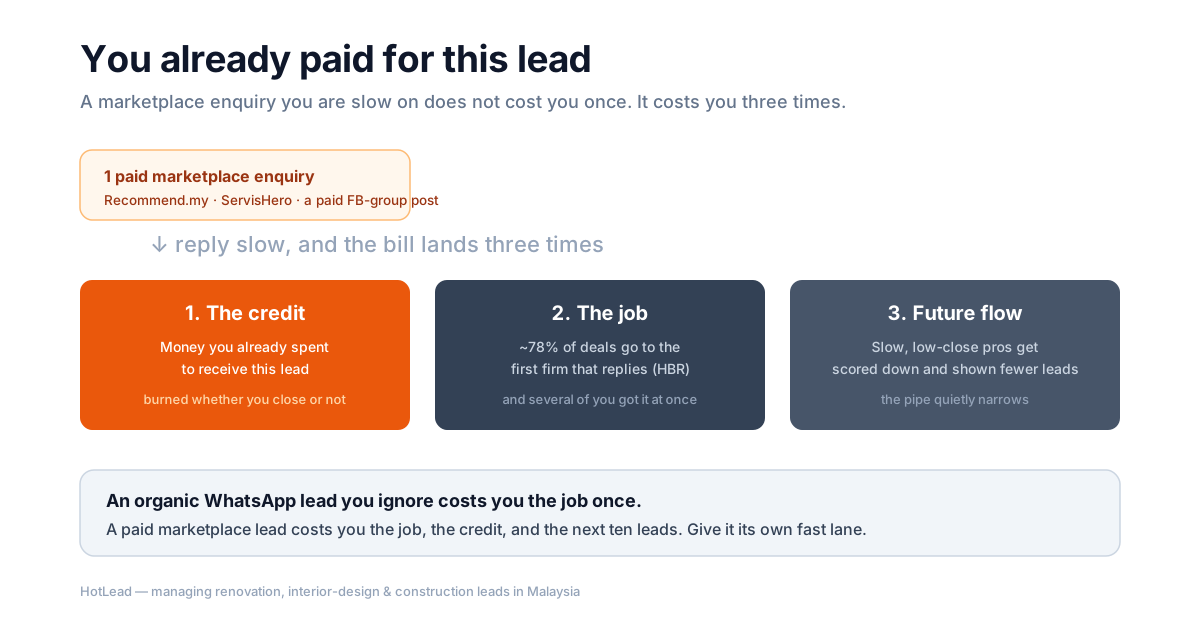
That's not a small difference in degree. It flips the whole economics. When an organic lead goes cold, you've lost a possible job — painful, but the lead cost you nothing to get. When a paid lead goes cold, you've lost the possible job and the money you spent to receive it and, on a scored platform, a slice of your future lead flow. Same cold lead, very different bill.
Why does treating it like any other WhatsApp lead leak money?
Because the reflex — "a lead's a lead, I'll get to it" — quietly turns paid money into sunk money. The paid lead lands in the same inbox as your organic ones, sits in the same slow queue, and gets the same eventual reply. On an organic lead that's a leak. On a paid lead it's a leak you pre-paid for.
Think about how these platforms charge. ServisHero has pros buy prepaid credits just to bid on a job (Digital News Asia) — so before you've said a single word to the buyer, you've spent money. Recommend.my, running since 2015, positions itself as Malaysia's home-improvement marketplace and vets the pros it sends work to. The exact mechanics differ platform to platform, but the shape is the same: you spend to receive the lead. Which means the moment a paid lead sits unworked, you're not "losing a maybe" — you're watching money you already spent evaporate.
And it compounds. Most platforms track your response rate and speed, and use it to decide how many leads you see. A firm that replies fast and closes gets shown more; a firm that's slow and ghosts gets shown fewer. So a slow habit on paid leads doesn't just lose today's job — it slowly narrows the pipe. You end up paying the same subscription or credit cost for a thinner and thinner stream, and blaming the platform, when the platform is just doing what you trained it to do.
The race you didn't agree to
Here's the part that catches out even fast firms: on a marketplace, you're not in a conversation, you're in a race — and you didn't get to set the rules.
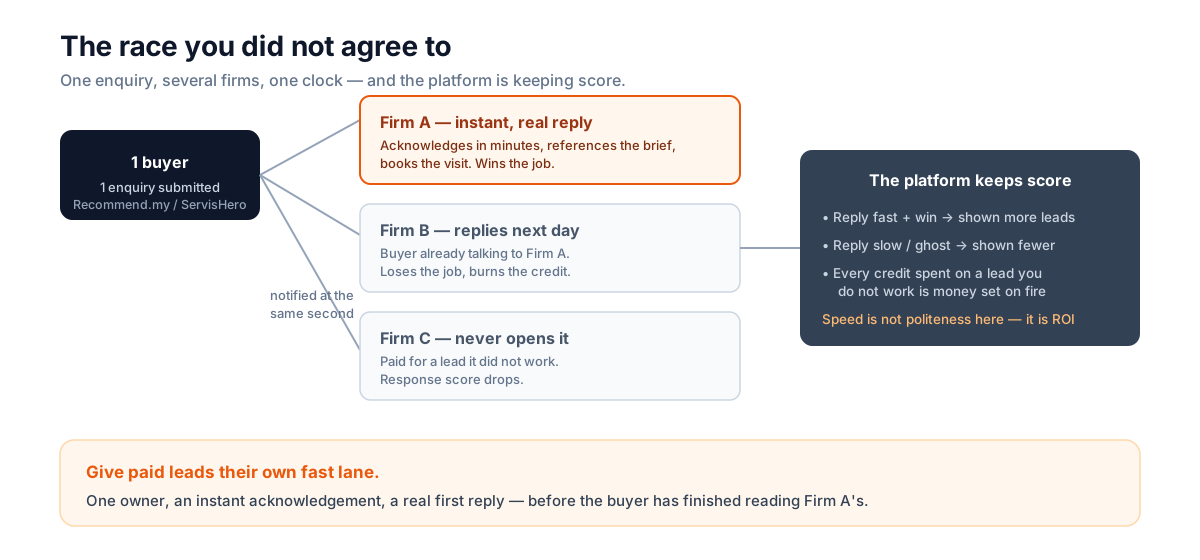
The buyer submits one request. The platform fans it out to several firms — ServisHero tells buyers to expect "a handful of quotes" — all notified at the same instant. Now the speed-to-lead rule you already know bites twice as hard, because on your own WhatsApp being first is nice; here it's the whole game. Around 78% of deals go to the firm that responds first (the much-cited InsideSales.com/MIT lead-response study, Dr James Oldroyd), and businesses that reply within a day get roughly 4× more quote requests over time (Yelp for Business). When five firms get the same enquiry together, "I'll reply after this site visit" isn't caution — it's forfeiting.
The organic-lead comparison makes it stark:
| Organic WhatsApp lead | Paid marketplace lead | |
|---|---|---|
| What it cost to get | free (your signboard, IG, referral) | a credit or fee, paid before you reply |
| Who else has it | just you | several firms, notified the same second |
| The clock | your own pace | shared — first useful reply usually wins |
| Cost of ignoring it | a possible job | the job plus the credit plus future flow |
| Who's watching | no one | the platform, scoring your reply rate |
| What wins it | a good reply, eventually | a real reply, almost instantly |
Read that last column top to bottom and the message is simple: a paid lead is a faster, more expensive, more watched version of every lead rule you already follow. It punishes slowness harder because slowness now costs real ringgit and shrinks tomorrow's flow.
The bigger trap: "just buy more leads"
When paid leads aren't converting, the instinct is to buy more of them. It feels like the growth move. It's usually the expensive mistake.
If your firm replies late and follows up loosely, buying more credits is pouring water into a leaking bucket — you're spending more to lose more, at the same conversion rate, on leads that were never the problem. Worse, on a scored platform, more volume through a slow firm can actively hurt you: your reply rate and close rate stay low across a bigger denominator, and the algorithm reads that as "this pro doesn't work its leads" and shows you fewer. You can spend your way into less flow.
This is where knowing your cost per won job, not cost per lead decides everything. A platform with an RM40 cost-per-lead that you close at 15% is cheaper per job than one at RM15 a lead you close at 3% — but you'll only know which is which if you track outcomes by source. Most firms don't, so they scale the cheap-looking lead and starve the profitable one.
You rent the pipe — you don't own it
Even if you win the race and work every credit, there's one more thing a paid marketplace can never give you: ownership. And in this market, that's not theoretical.
The lesson isn't "avoid marketplaces." It's don't let the marketplace own your customer relationship. Every paid lead — name, number, project, the whole thread — should land in your records, not just live inside the platform's app where you can't reach it if the platform disappears, raises its rates, or throttles you. Marketplaces are a channel to fill the top of your funnel while you're building your own. They're a bad foundation to build the whole business on.
How do you run a fast paid-lead lane?
You give paid leads their own lane — separate from the organic queue, run tighter, owned clearly. Six moves:
- Put paid leads in their own lane, not the general inbox. Tag them by source the moment they arrive so they're visibly different from an organic WhatsApp enquiry. A paid lead sitting anonymously in the same pile as everything else is a paid lead about to get treated like everything else.
- Give the lane one owner. The lost-in-the-group-chat problem is fatal here — a paid lead with no clear owner is money with no one accountable for it. One person watches the paid-lead lane and answers, every time.
- Acknowledge instantly, automatically. The race is won in minutes. An automatic acknowledgement the second a lead lands — "Thanks for your enquiry, [name] from [firm] here, I'll send you some details shortly" — keeps you in the race and buys the owner time to write the real reply without losing to the fastest firm.
- Make the first real reply real. Not "hi interested, please call." Reference their project, ask one sharp question, give a rough sense of how you'd approach it. On a platform where five firms replied, the personalised one gets the visit — and don't fire a napkin price just to be fast, because a number with no scope invites a race to the bottom you'll lose to whoever's cheapest.
- Follow up tightly — you paid for the right to. Around 80% of sales that close need five or more follow-ups, and 44% of firms quit after one (Invesp). On an organic lead that's a missed maybe. On a paid lead, giving up after one message is throwing away a credit you already bought. Chase it like the money it is.
- Track cost-per-won-job by platform. Log every paid lead's source through to won or lost. After a month you'll know which platform earns back its credits and which is a slow drain — and you can move spend to the one that pays, instead of guessing.
The through-line: paid leads reward the same disciplines as organic ones — speed, ownership, real replies, tight follow-up — but they punish the absence of those disciplines much harder, because every gap has a receipt attached.
The bottom line
A lead from Recommend.my, ServisHero or a boosted Facebook post is not a free WhatsApp enquiry with a price tag. It's a faster, watched, pre-paid race against several other firms, and treating it like any other message is how firms convince themselves that "buying leads doesn't work." It works — for the firm that acknowledges in minutes, replies like a human who read the brief, follows up like the credit cost real money, tracks which platform actually pays back, and captures every lead into records it owns rather than the platform's. The double loss of a ghosted paid lead — the job and the money you spent to get it — is entirely avoidable. You just have to stop letting the thing you paid for sit in the same slow queue as the things that came free.
For the whole system this sits inside — capture, qualify, reply fast, follow up, and track what pays — start with the complete guide to managing renovation leads in Malaysia, and see how it connects to where your renovation leads actually come from, handling Facebook and Instagram ad leads, how fast you really need to reply, and cost per lead versus cost per won job.
How HotLead helps you win the paid-lead race
HotLead sits on top of your existing WhatsApp and is built for exactly this — making sure a lead you paid for gets worked like it cost money:
- Auto-greeting and capture on every enquiry, so a paid lead is acknowledged the instant it lands — keeping you in the race while your owner writes the real reply — and captured into your records with its full history, not stranded inside a platform's app.
- One owner per lead, by rule, with source tagging and custom routing, so paid marketplace leads can run in their own fast lane with a clear person accountable for them — never lost in a group chat.
- A next action on every lead and overdue follow-ups flagged, so a lead you already paid for never sits one message deep and forgotten — the follow-up you paid for the right to make actually happens.
- Funnel and per-channel ROI, so you can see cost-per-won-job by source and tell which platform earns back its credits and which is quietly draining you — the difference between scaling the channel that pays and pouring money into the one that doesn't.
- Team performance, so you can see who's turning paid leads into booked jobs and who's letting bought money go cold.
If you're paying for leads and not sure they're paying you back, the fix is rarely more leads — it's working the ones you have faster and tracking what returns. See how HotLead works, or how it fits a renovation firm, an interior-design studio, or a construction contractor.
Sources: The Star — Malaysian startup Kaodim to shut down on July 1, cites rising costs and Vulcan Post — Kaodim CEO announces the company will shut down (launched 2014, ceased operations 1 July 2022 across Malaysia, Singapore, Indonesia and the Philippines); Digital News Asia — ServisHero introduces ServisHero Direct and e27 — how Malaysia's ServisHero transforms Southeast Asia's home service market (service providers buy prepaid credits to bid on jobs; buyers receive a handful of quotes); Recommend.my (Malaysian home-improvement marketplace since 2015; vetted pros; escrow via Recommend Pay); Yelp for Business — turning job requests into sales (a single request fans out to multiple businesses; reply within a day for 4× more quote requests). First-responder (78%) and speed-to-lead figures as cited in how fast to reply to a renovation lead; follow-up figures from Invesp — the importance of follow-ups (80% of sales need 5+ follow-ups, 44% quit after one).
Frequently asked questions
Are Recommend.my or ServisHero leads worth it for a renovation firm in Malaysia?
They can be, but only if you work them differently from organic WhatsApp leads. On a marketplace you pay per lead or per credit, and the same enquiry is usually sent to several firms at once, so a slow or generic reply loses the job and burns money you already spent. The firms that make marketplaces pay back are the ones that reply almost instantly with a real, personalised message, follow up tightly, and track cost-per-won-job per platform so they can tell which one actually earns back the credits. The firms that lose money are the ones that let paid leads sit in the same slow queue as everything else.
Why is a paid marketplace lead more expensive to ignore than a normal WhatsApp enquiry?
Because you have already spent money to receive it. Ignoring an organic WhatsApp lead costs you a possible job. Ignoring a paid lead costs you that possible job plus the credit or fee you paid to get it — and on platforms that score response rate and speed, a pattern of slow replies quietly shrinks how many leads you are shown next month. That is a triple loss on a lead you were charged for, versus a single loss on one that arrived free.
How fast should I reply to a lead from a lead marketplace?
Faster than you would to an organic enquiry, because the clock is shared. The buyer submitted one request and several firms were notified at the same second, so the first firm to send a real reply usually wins the visit. Aim to acknowledge within minutes and follow with a genuine, brief, personalised message that references their project — not a copy-paste "hi, interested, please call." An automatic acknowledgement the instant the lead lands buys you time to send the proper reply without losing the race.
Should I just buy more leads to grow my renovation business?
Not before you fix how fast you work the ones you already pay for. Buying more credits when your firm replies slowly is pouring water into a leaking bucket — you are spending more to lose more, and on a scored platform your low reply and close rates can get you shown fewer leads regardless. Get your paid-lead lane fast and your follow-up tight first, then scale spend on the platform your numbers prove actually earns back the credits.
Is it safe to rely on a lead marketplace for my renovation leads?
Treat it as one channel, never the whole pipeline. Kaodim, a large Malaysian home-services marketplace, shut down across four countries in July 2022 and took its lead flow with it — so a firm that depended on it lost its pipeline overnight. Use marketplaces for what they are good at, but capture every lead into your own records with their contact details and history, and build referrals and your own channels alongside, so your business does not sit on ground you do not own.
Keep reading
- Did We Already Say RM68k? Using AI to Stop Quote Drift Across a Long Renovation ThreadOver a weeks-long WhatsApp thread with two or three quote revisions, a rep re-states a number that contradicts an earlier promise — and re-opening a settled price quietly invites a discount that eats a whole job's profit. So I pointed AI at the drift. It works beautifully as a flag, and dangerously as an auto-corrector.
- The Warranty as a Closing Lever: Why a Longer Guarantee Beats a Discount on a Renovation DealA quote is stalling and the buyer wants a reason to say yes. Before you drop the price, look at the other lever in your hand — a longer workmanship warranty. It is the same expected-value decision as a discount, but the math runs the opposite way — a price cut costs you thousands with certainty, while extending the defects cover costs you a couple of hundred ringgit in expectation, for arguably more trust with a scam-wary buyer. Here is the EV case for the non-price concession, the trap that turns it into a hidden liability, and which leads it actually moves.
- "Can You Just Build It, My Neighbour Also Did" — Handling the Renovation Lead That Needs Council Approval FirstSome renovation enquiries can't legally start next month, no matter how ready the buyer is — a kitchen extension, a hacked-through wall, a roofed-over air well all need the council's written approval first. Quote a fast build price to win the job and you either lose it to a "boss, can start" cowboy, or win it and inherit the stop-work order, the RM50,000 fine and a client who later can't sell the house. Here's how to spot the permit-first lead and sell the approval as protection.