

Every renovation firm owner I have sat with has the same complaint, and it is never "not enough leads." It is the opposite: "I get thirty WhatsApp messages a week asking 'how much to renovate my house?' and I spend my evenings quoting people who ghost me."
The problem is not the volume. It is that every enquiry gets treated the same — the genuine buyer who collected their keys last week and the person idly curious about a kitchen they might do in two years both get the same careful, two-hour quote. And a detailed quote really does cost you roughly two hours each. Stack up twenty-odd weak leads in a month and that is forty-plus hours gone — a full working week spent on people who were never going to sign.
Qualifying fixes that. Not by being rude or putting up barriers, but by reading — in the very first reply — who is actually ready. The good news for Malaysian reno and ID firms is that homeowners hand you the signals without realising it. You just have to know what to listen for.
What does it actually mean to qualify a renovation lead?
Qualifying a lead means working out, early and cheaply, how ready and how right a lead is — before you sink hours into a full quote. It is not about filtering people out or being picky. It is about deciding what each lead deserves right now: a full quote and a site visit today, or a quick honest range and a follow-up date.
For a Malaysian reno firm, qualifying is the step that sits between capture and quote. Skip it and you do one of two expensive things — you under-serve a hot buyer by treating them like everyone else, or you over-serve a tyre-kicker with a two-hour quote they were never going to act on. Done in the first reply, qualifying simply tells you which is which.
Why you should not open with "what is your budget?"
Because in Malaysia, most homeowners enquiring about a renovation genuinely do not have a budget number yet — and asking for one too early backfires. It is the single most common qualifying mistake I see, and it is contrarian to say so, because every generic sales guide tells you to "qualify on budget first."
Here is what actually happens when "what's your budget?" is your opening line:
- They do not know, so they either guess low to protect themselves or go silent because they feel put on the spot.
- They have been told to hide it, because half the renovation advice online warns homeowners that contractors will "quote up to your budget."
- It feels like a sales filter, not help — and a first-time renovator is nervous enough already.
The deeper issue is that budget is an output, not an input. A homeowner cannot tell you a sensible figure until they understand what their scope costs. So flip it: read the scope from their message, then offer the band yourself (more on that below). You will qualify on budget far more accurately by never asking the question directly.
What are the four signals to read from the first reply?
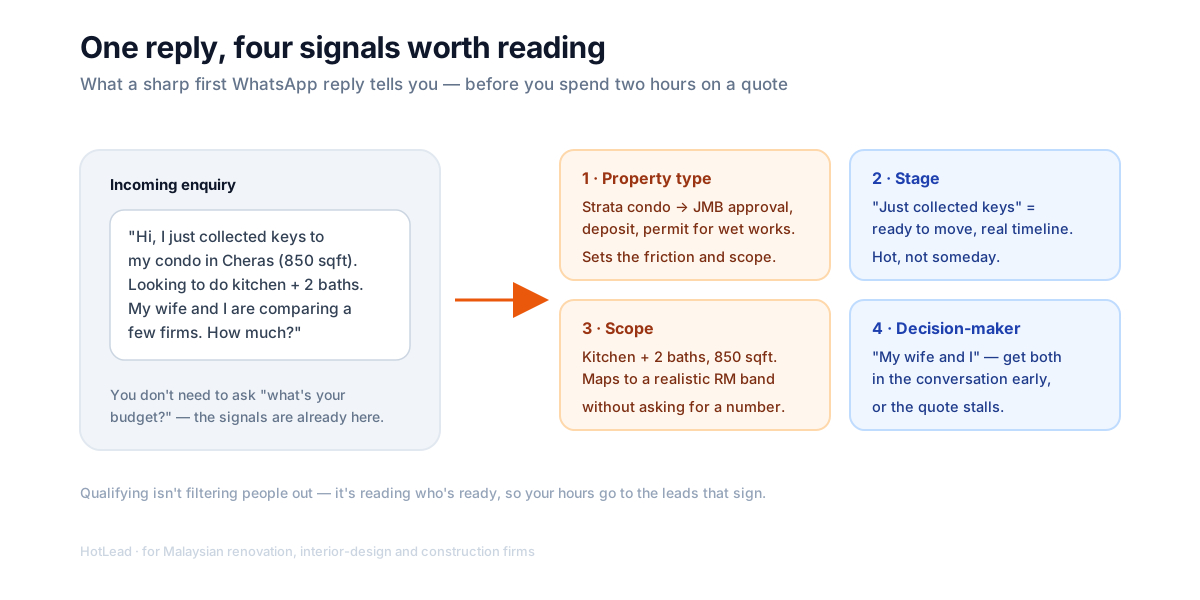
Read four things, and you have qualified the lead — usually without asking more than one or two questions. They are property type, stage, scope, and decision-maker. Most enquiries reveal two or three of these on their own; you ask for the rest.
| Signal | What to listen for | What it tells you |
|---|---|---|
| Property type | "Condo / apartment / serviced residence" vs "terrace / semi-D / landed" | Strata = approval, deposit and permit friction; landed = more scope freedom |
| Stage | "Just collected keys", "VP next month", "still planning", "already getting quotes" | How hot and how real the timeline is |
| Scope | "Whole unit", "just the kitchen", "kitchen + 2 baths", square footage | Maps to a realistic budget band — without asking for a number |
| Decision-maker | "My wife and I", "checking with my parents", "for my own place" | Who needs to be in the chat before a quote can be approved |
Take a real-shaped enquiry: "Hi, I just collected keys to my condo in Cheras (850 sqft). Looking to do kitchen + 2 baths. My wife and I are comparing a few firms. How much?" Without asking a single question, you already know it is a strata unit (permit friction), they just got the keys (hot, real timeline), the scope is mid-sized, and there are two decision-makers. That is a qualified lead in one message. Your only job now is to reply fast and well.
Which single question tells you the most?
If you can only ask one thing, ask "is it a strata unit — condo, apartment, serviced residence — or a landed home?" In the Malaysian market, that one answer unlocks more than any other, because strata renovations carry real, specific friction that shapes the whole job.
Under the Strata Management Act 2013, an owner cannot start renovation works without prior written approval from the management corporation (MC) or joint management body (JMB). On top of that, expect:
- A renovation deposit, commonly RM2,000 to RM5,000, held as a guarantee against damage to common property.
- Restricted working hours and contractor access rules set by the management.
- A council permit (DBKL, MBPJ, MBJB and others) for "wet works" — moving a toilet, hacking a wall, changing plumbing — often needing submission by a registered architect or engineer. DBKL permits typically run one year.
This is why "strata or landed?" out-qualifies "what's your budget?" every time. It tells you the friction, hints at the realistic scope (strata units are usually smaller, with a hard cap on what you can structurally change), and surfaces the timeline — and a homeowner who already understands the deposit-and-approval dance is usually a more serious buyer than one who is surprised by it.
How do you ask about budget without scaring them off?
You do not ask — you offer a band. Once you have read the scope, map it to a realistic range and put that range to them. This reframes the whole conversation from "how much money do you have?" to "here is what your project tends to cost — does that work for you?"
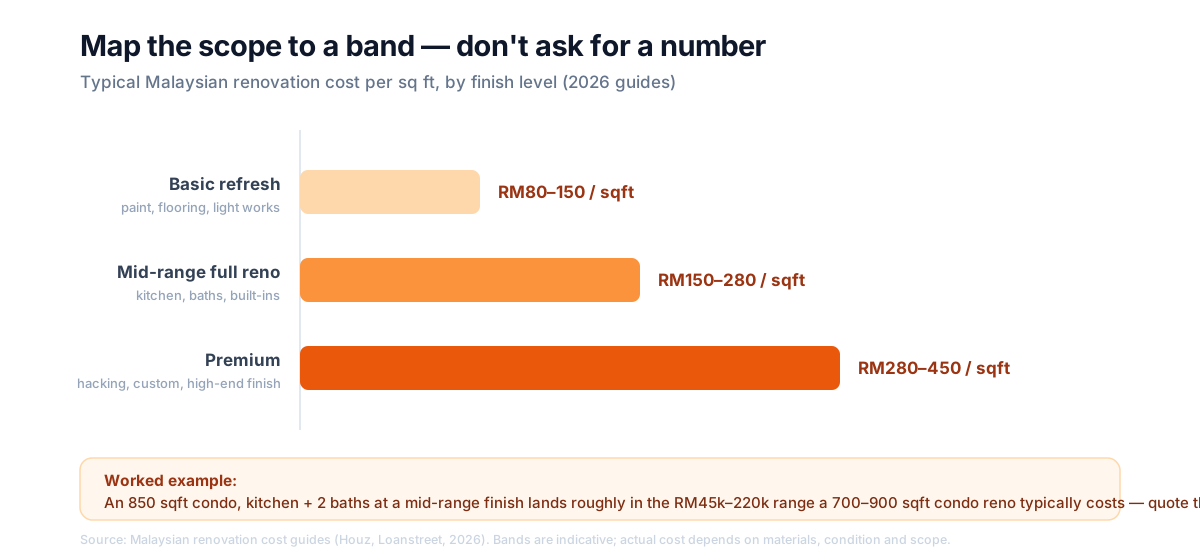
Malaysian renovation cost guides for 2026 put per-square-foot costs in three rough bands: basic refresh RM80–150/sqft, mid-range full renovation RM150–280/sqft, and premium RM280–450/sqft. For a typical 700–900 sqft condo, that works out to roughly RM45,000 to RM220,000 depending on finish and scope.
So instead of "what's your budget?", you reply: "For a kitchen and two baths in an 850 sqft condo at a mid-range finish, most firms land somewhere between RM X and RM Y — I will give you an exact figure after a quick site visit. Does that range work for you?" Their answer qualifies them instantly:
- "Yes, that's roughly what I expected" → qualified, book the site visit.
- "That's higher than I thought" → still workable; you can talk phasing or a lighter scope.
- "I was thinking RM15k for all of it" → expectation mismatch; be honest now and save both of you a wasted visit.
You have qualified on budget without ever asking for a number, and you have positioned yourself as the firm that was straight with them. On a platform like Qanvast — where a homeowner is shortlisted with up to five firms in one working day — being the one who gives a clear, honest range fast is exactly how you stand out from the four others sending "please share your floor plan 🙏".
A first-reply template that qualifies in three questions
You can do all of this in one warm, fast message. Acknowledge, give a little value, ask one or two questions tied to helping them, and signal the next step:
Hi! Thanks for reaching out 🙌 Happy to help with your kitchen and bathrooms. So I can give you an accurate range rather than a random number — (1) is it a condo/strata unit or a landed home, and (2) have you collected the keys yet? For a job like this most firms land between RM X and RM Y, and I'll confirm exactly after a 15-min site visit. Would this weekend suit you and your partner?
That single message reads property type, stage, scope and decision-maker, offers a band, and proposes a next step — all without feeling like an interrogation. Speed matters as much as the wording: replying within 5 minutes makes you dramatically more likely to actually connect, which is why qualifying belongs in the first reply, not a follow-up call three days later. (More on that in how fast you should reply to a renovation lead.)
When should you politely deprioritise a lead?
When the signals say "not now" or "not us" — deprioritise, do not delete. Qualifying gives you permission to spend your two-hour quotes where they will pay off, and to give everyone else a lighter, honest touch instead of ignoring them.
Deprioritise (but keep on a follow-up date) when:
- The timeline is genuinely far off — "maybe end of next year" — so they get a quick range and a diarised nudge, not a full quote today.
- The expectation gap is huge and they will not move — be honest about cost and let it go.
- They cannot or will not name the property, stage or scope after a couple of friendly asks — a sign they are still window-shopping.
The point is not to be cold. It is that a homeowner at "someday" and one at "I have the keys" should not get the same slice of your week. Qualifying is simply how you decide. The ones you deprioritise still go into your follow-up list, because in this business silence usually means "not yet", not "no" — and a "someday" lead nudged at the right time becomes next quarter's job.
How HotLead helps you qualify faster
HotLead is built so the qualifying step actually happens on every lead, instead of only on the ones your busiest salesperson remembers. It sits on top of your WhatsApp and:
- Captures every enquiry from your FB/IG ads, Qanvast and Recommend.my, so none sits unseen while it is still hot enough to qualify.
- Routes each lead to one owner in seconds — so the right person asks the qualifying questions, and nobody assumes "someone else replied".
- Keeps the next action and overdue follow-ups in front of your team, so the leads you deprioritise today still get nudged on the right date.
- Shows your funnel — enquiries, quoted, won — so you can see whether you are losing leads at the qualifying stage or further down.
If your team is drowning in "how much?" messages and quoting the wrong people, that is the leak qualifying fixes. See how HotLead works, read the complete guide to managing renovation leads in Malaysia, or see how it fits a renovation firm specifically.
Tempted to hand the first reply to AI? Read the two companion experiments before you do: can AI write the first WhatsApp reply on a renovation lead, and where AI lead-qualification helps an interior-design studio — and where it quietly bins your best job.
Sources: Houz — Condo interior design & renovation cost Malaysia 2026 and Loanstreet — Home renovation costs Malaysia (per-sqft cost bands); AskLegal.my — What condo owners should know before renovating and Houz — Condo renovation JMB & MC regulations (Strata Management Act 2013 approval, deposits, permits); Qanvast Malaysia (shortlist of up to five firms); Association of Professional Builders (time spent on unqualified leads). Speed-to-lead and follow-up figures as cited in the complete guide.
Frequently asked questions
What questions should I ask to qualify a renovation lead?
In the first reply, learn four things without interrogating — property type (strata condo or landed), stage (just collected keys, still planning, already comparing quotes), scope (whole unit or one or two rooms), and who decides (often a couple or the wider family). Those four answers tell you urgency and realistic budget without you having to ask for a number.
Should I ask for the budget in the first WhatsApp message?
Usually not as your opening question. Most Malaysian homeowners have not settled on a figure yet, so "what is your budget?" either gets a vague answer or makes them go quiet. Instead, read the scope, then offer a realistic band — "for a kitchen and two baths in an 850 sqft condo, most firms land between RM X and RM Y" — and let them react to it.
How do I qualify without sounding like an interrogation?
Ask one or two questions per message, lead with something useful, and tie questions to helping them. "So I can give you an accurate range, is it a condo or a landed home, and have you collected the keys yet?" feels like service, not a quiz. Save the rest for the site visit.
How do I know if a condo renovation lead is serious?
Strata renovations carry real friction — written approval from the JMB or management corporation under the Strata Management Act 2013, a renovation deposit usually around RM2,000 to RM5,000, and a council permit for wet works. A serious lead either already knows this or takes it in stride; someone who balks at the deposit and approval steps may not be ready to commit.
Should I quote everyone who asks?
No. A detailed quote can take a couple of hours to prepare, and a stream of unqualified enquiries can quietly eat dozens of hours a month. Quote the qualified leads in full and fast, and give the rest a quick honest range plus a next step — you are deciding where your hours go, not being rude.
Keep reading
- Did We Already Say RM68k? Using AI to Stop Quote Drift Across a Long Renovation ThreadOver a weeks-long WhatsApp thread with two or three quote revisions, a rep re-states a number that contradicts an earlier promise — and re-opening a settled price quietly invites a discount that eats a whole job's profit. So I pointed AI at the drift. It works beautifully as a flag, and dangerously as an auto-corrector.
- The Warranty as a Closing Lever: Why a Longer Guarantee Beats a Discount on a Renovation DealA quote is stalling and the buyer wants a reason to say yes. Before you drop the price, look at the other lever in your hand — a longer workmanship warranty. It is the same expected-value decision as a discount, but the math runs the opposite way — a price cut costs you thousands with certainty, while extending the defects cover costs you a couple of hundred ringgit in expectation, for arguably more trust with a scam-wary buyer. Here is the EV case for the non-price concession, the trap that turns it into a hidden liability, and which leads it actually moves.
- "Can You Just Build It, My Neighbour Also Did" — Handling the Renovation Lead That Needs Council Approval FirstSome renovation enquiries can't legally start next month, no matter how ready the buyer is — a kitchen extension, a hacked-through wall, a roofed-over air well all need the council's written approval first. Quote a fast build price to win the job and you either lose it to a "boss, can start" cowboy, or win it and inherit the stop-work order, the RM50,000 fine and a client who later can't sell the house. Here's how to spot the permit-first lead and sell the approval as protection.