

There's a message that lands in almost every renovation and interior-design firm's WhatsApp eventually, and it always arrives dressed up as a favour.
"Hi! Love your work. I'm renovating my condo and I'd love to feature the whole process — I have 20k followers and my content does really well with the home-reno crowd. If you can do mine at a special rate, I'll post you properly, tag you, the works. Honestly it's free marketing for you!"
Or the other flavour, the one from a buyer mid-negotiation: "Boss, my whole condo block pun tengah renovate. You give me good price, I bring you ten more jobs easy." Or the barter: "Do my unit as your show unit lah, I'll give you a 5-star review and let you bring clients to see." Or the straight contra — "I'll do your branding / supply your tiles, you do my reno, we settle like that."
Every one of these is the same move wearing a different hat. The buyer is offering you something other than clean payment — exposure, referrals, a testimonial, a trade — to move your price down today, against a return that is vague, unguaranteed, and lands (if it lands at all) somewhere in the future. And because Malaysian reno runs so heavily on word-of-mouth, the offer is genuinely tempting. Turning it down feels like turning down free marketing and risking the goodwill of someone who might actually be connected.
But here's the trap: the discount you give is real, immediate and certain. The value you're promised is none of those things. The firm that says yes to the promise keeps paying a known cost to collect an unknown — and usually uncollected — benefit. The way out isn't a blunt "no." It's to stop pricing the job and the promise as one deal.
Why does this lead feel so hard to say no to?
Because it presses on two real nerves at once — your biggest free channel, and your fear of insulting someone important. A reno firm's best, cheapest work comes through word-of-mouth and referral, so an offer framed as "I'll send everyone to you" or "free marketing" taps the exact channel you most want to grow. ZenWeb's Malaysian discovery data puts word-of-mouth among the largest sources of renovation and construction leads — for construction it's cited around 36% — which makes "I'll tell everyone about you" sound like it's offering the one thing money can't easily buy.
The second nerve is social. In KL's reno and ID scene, where influencers, home accounts and "show unit" content are everywhere, you genuinely can't tell at a glance whether the person messaging you is a well-connected buyer who could open real doors — or just someone who's learned that waving a follower count gets a discount. Say a flat "no" and you might have just insulted a client who really would have sent you ten jobs. That uncertainty is exactly what the tactic runs on.
So the pull is real. The problem is that the reflex it produces — "say yes, the exposure is worth it, don't risk the relationship" — answers a social worry by quietly spending your margin. And the thing you're spending it on is usually worth far less than it sounds.
Do the promised followers and referrals actually convert to renovation buyers?
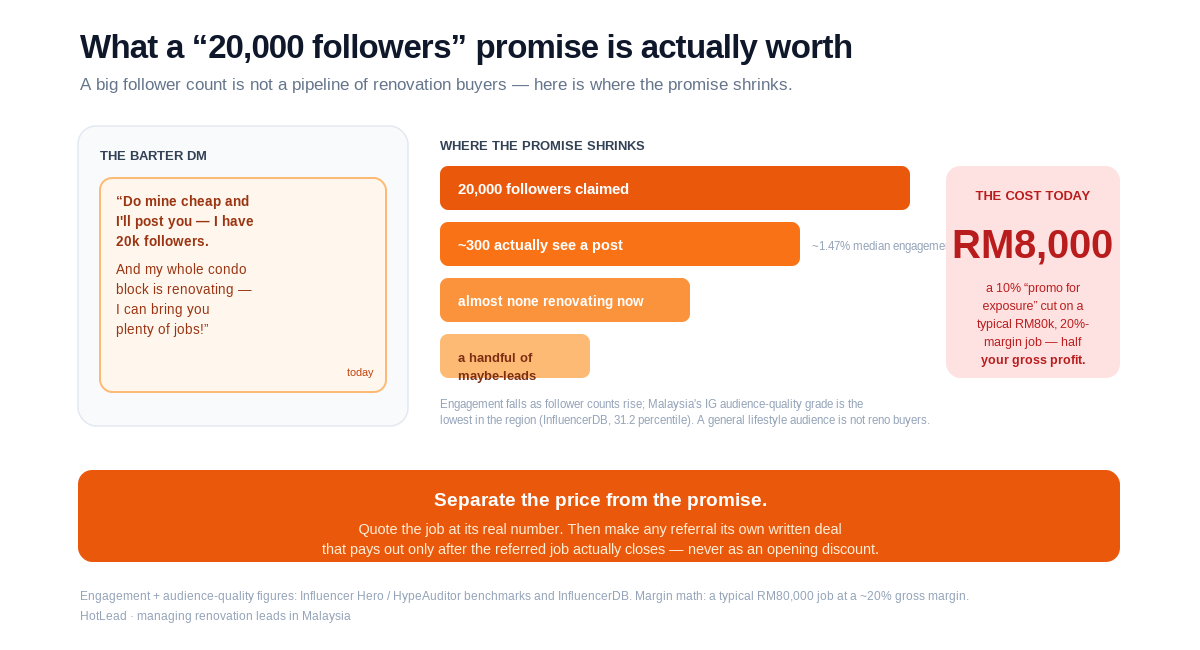
Usually, no — not in anything like the quantity implied. A follower count is a vanity number, not a pipeline. Two things gut it. First, almost nobody who follows a general lifestyle or home account is a homeowner about to renovate this quarter — they're scrolling, not buying, and a renovation is a once-in-several-years, high-consideration purchase. Second, the reach itself is a fraction of the headline number.
The benchmark data is blunt about that gap. Engagement rate falls as follower counts rise: nano accounts under 10,000 followers see the highest engagement (one 2024 analysis puts the top tier around 6.23%), while the median Instagram account engages only about 1.47% of its followers, per Influencer Hero's January 2024 figure. On a 20,000-follower account, that's roughly 300 people who actually see and react to a given post — and a general audience at that, not a filtered list of people hunting for a renovator. Worse for Malaysia specifically: an InfluencerDB benchmark graded Malaysian Instagram audiences at the 31.2 percentile — the lowest audience quality in the region, well below Indonesia and Thailand — meaning a meaningful share of those followers may be inactive or fake to begin with. As one Malaysian agency founder put it to Malay Mail, plenty of accounts have "hundreds of thousands of followers but only a handful of people engage."
None of this means influencer or referral marketing is worthless — it means the raw promise is. A real, measured partnership with a creator whose audience is genuinely Malaysian homeowners can pay. A follower count thrown onto the table to move your quote cannot be valued at all, because you have no idea how much of it is real, how much is relevant, or whether the post will ever happen. You're being asked to price something nobody can price — which is precisely why it should never be folded into the discount.
What does a "promo for exposure" actually cost you?
More than owners feel in the moment, because the cost is certain and the margin is thin. Take the house example we use across this series: a typical RM80,000 job at a ~20% gross margin earns you RM16,000 before overheads. Knock "just 10%" off for exposure and you've given away RM8,000 — half your gross profit on that job — on day one, in exchange for a post that reaches a few hundred strangers and may never go up. As we show in the margin math behind "boleh kurang?", a discount bites far harder than the percentage suggests, because it comes straight off profit, not off the top line.
Barter and contra carry a second, sneakier cost. The moment you agree to "I'll do your branding, you do my reno," you've created an unpriced, undated, two-sided obligation with no scope on either leg. Which half gets delivered first? What exactly is "branding"? What happens when their side quietly stalls after your crew has already hacked their kitchen? And if the trade pushes you into work outside your trade — you touch wiring or gas as a favour to sweeten the deal — you now warranty work you did for free, with the CIDB and liability exposure that comes with it. A verbal "we settle like that" is also the kind of undocumented arrangement that Malaysian authorities keep warning homeowners and contractors against: the New Straits Times flagged in 2026 that works done without a written contract leave both sides exposed to disputes and fraud.
Which promises are real, and which are just leverage?
Here's the uncomfortable pattern: the buyers who loudest promise future value are usually the least likely to deliver it. A genuinely well-connected person — the one who really does send three neighbours a year — rarely leads with it as a bargaining chip, because they're not trying to extract a discount; they just quietly refer people because they liked your work. The person who opens with "I have 20k followers" or "I'll bring you ten jobs, trust me" before you've even quoted is telling you, plainly, that the leverage is the negotiation.
You don't have to guess. You can read it with one specific question, because real plans survive detail and bluffs don't:
- To the influencer: "Love that — what would the post actually look like, and when would it go up?" A real partner answers with specifics. A chancer gets vague ("I'll see, when I have time lah").
- To the "ten jobs" buyer: "That's great — are any of your neighbours ready to message me now? Happy to look after anyone you send." A real connector names someone. A bluffer stays in the hypothetical future.
- To the barter/contra: "Sounds good — can we each write down what we're doing and what it's worth, and sort out who delivers first?" A genuine trade welcomes the structure. A free-ride flinches at it.
The question isn't rude. It just moves the promise from "something I'll be impressed by" to "something we can both define" — and that move, by itself, filters most of the leverage out.
| The promise, as pitched | The same thing, done properly | |
|---|---|---|
| Shape | Vague future value, traded for a discount today | A specific deal that pays out on delivery |
| When you pay | Now, up front, for certain | After the referred job closes, or the post goes live |
| What secures it | Their word | Written scope, dates, and a defined reward |
| If they don't deliver | You're already out the margin | You've lost nothing — the reward was never earned |
| Who it suits | The chancer using leverage | The genuinely connected partner |
How do you handle it without losing the margin or the goodwill?
You separate the price from the promise, and you make the promise earn its reward on delivery. The job gets quoted at its real, profitable number — the same one a paying client would get — because that number reflects your actual cost, crew-weeks and risk, none of which a follower count reduces. Then, if there's a genuine relationship worth building, you structure it as its own small, written, delivered-first arrangement:
- For referrals: reward the result, not the promise. Offer a referral credit or thank-you that pays out after each referred neighbour's job actually signs — a voucher, a small credit on their next job, a genuine gesture. Never a discount on their job on day one for referrals that haven't happened. This way you only ever pay for referrals that materialise, and a real connector is delighted (they know the jobs are coming). It's the same logic as treating your referral channel as a fundable asset rather than a vague hope.
- For exposure: a paid or clearly-scoped collaboration, separate from the quote. If their audience genuinely matters, agree exactly what they'll post, when, and what you give once it's live and performing — as a marketing decision with its own budget, not a hole in your margin.
- For contra: written scope on both legs, their side first. Define what each party delivers and what it's worth, date it, and don't let your crew start before their obligation is specified — ideally delivered. And never trade yourself into work outside your registered trade.
- Keep it with one owner, and track it to payout. A promise-based deal falls apart when it's agreed in a side-chat nobody logged. One person owns the negotiation, the terms live on the lead's record, and a dated next action chases the promised post or referral through — so "I'll bring you jobs" either turns into real jobs you can see, or quietly expires without having cost you anything.
This is the same discipline that protects you from the wrong-fit lead you should say no to early and from giving your warmest leads your slowest, softest handling: a reno firm's margin and attention are finite, and the leads that feel like favours are often where both quietly leak. A promise is not payment. Price accordingly.
The bottom line
The lead that offers you exposure, referrals or a trade instead of a clean payment is asking you to do something no business can afford to do without thinking: hand over real, certain margin today for a vague, unenforceable benefit tomorrow. The reflex to say yes — because the exposure sounds free and refusing feels rude — is exactly backwards. The follower count buys a fraction of the reach it implies, the "ten jobs" usually becomes one or none, and the discount is gone the moment you agree to it.
So don't price the job and the promise together. Quote the renovation at its real number, warmly and without apology, and offer any referral or exposure deal as its own small, written arrangement that pays out on delivery. A genuinely connected buyer will happily take the cleaner structure, because they're not bluffing. The one who walks away was never going to bring you those jobs anyway — they just wanted your margin, and you got to keep it.
For the whole system this sits inside — capture, qualify, quote, price and follow up — start with the complete guide to managing renovation leads in Malaysia. Read this alongside whether to discount a stalled deal at all, what a referral is actually worth, and the margin math behind every "boleh kurang?".
How HotLead helps you hold the line on a promise
HotLead is a lead-management tool, not a marketing platform — it can't value an influencer's real pull, score a follower count, or police a barter deal for you. Those judgements stay yours. What it does is make a promise-based lead visible and trackable instead of agreed in a side-chat and forgotten:
- Capture and tag the lead as its own type, so an "exposure / referral-promise" enquiry is handled consistently every time, not improvised differently by whoever picks up the phone.
- One named owner per lead, so the negotiation is consistent and nobody quietly agrees to a discount or a contra in a conversation no one logged.
- A next action with a wake-date, so a promised post or a "ten jobs" referral is actually chased through to payout — and either turns into real work or expires without costing you margin.
- Per-channel and team views, so over time you can see whether the buyers who promise to bring you jobs ever really do — and price the next one against data instead of a feeling.
If "do mine cheap and I'll promote you" keeps costing you margin for exposure that never arrives, the problem isn't the buyer — it's that the promise was never priced separately or tracked. See how HotLead works, or how it fits a renovation firm or an interior-design studio.
Sources: Influencer Hero — Instagram engagement benchmark (median engagement ~1.47% across accounts, January 2024) and vendor benchmarks showing engagement rate falling as follower counts rise (nano under 10k highest, around 6.23%); InfluencerDB audience-quality benchmark, as reported by Options/The Edge and SAYS — Malaysian Instagram audiences graded at the 31.2 percentile, the lowest audience quality in the region (vs Indonesia 51.0, Thailand 37.9), with engagement declining across verticals; Malay Mail, "Fakefluencers alert" (2024) — a Malaysian agency founder on accounts with huge follower counts but negligible engagement; New Straits Times (2026) — building or renovating without a written contract leaves homeowners (and contractors) exposed to disputes and fraud; Recommend.my — guidance on renovation deposits and avoiding contractor scams. ZenWeb Malaysian discovery-channel data (word-of-mouth among the largest renovation/construction lead sources, ~36% for construction) and the house figures — a typical RM80,000 job at a ~20% gross margin (RM16,000 gross profit) and the ~RM1,280 expected gross profit per winnable enquiry — are as cited across this series in the referral channel's real worth and the renovation discount margin math. Engagement and audience figures are general-industry benchmarks from vendor tools, used directionally rather than as precise Malaysian measurements.
Frequently asked questions
A lead says they'll promote us to their followers if we do their job cheap. Should we take it?
Treat it as two separate things, not one deal. Quote the renovation at its real, profitable number — the price a paying client would get. Then, if their audience genuinely matters to you, offer a small, specific, written promotion arrangement on its own terms: what exactly they'll post, when, and what you'll give in return once they've actually delivered it. The mistake is folding a vague 'I'll post you' into an immediate price cut, because you pay the discount now with certainty and collect the exposure later with none. On the numbers, a general follower count rarely converts to renovation buyers — engagement falls as follower counts rise, the median Instagram account reaches around 1.47% of its followers, and almost none of a lifestyle audience are homeowners renovating this quarter.
A buyer promises 'my whole condo block is renovating, I'll bring you ten jobs' for a discount. Is that worth it?
Rarely, in the form it's offered. A promise of ten future jobs is unguaranteed, usually unquantified, and most often delivers one job or none — while the discount you give is real and immediate. Price the job in front of you properly, then structure the referral as its own reward that pays out after each referred job actually signs — for example a referral credit or thank-you once their neighbour's deposit is in, not a discount on their own job on day one. That way you only ever pay for referrals that materialise. A genuinely connected buyer who really will send you work is usually happy with that, because they know the jobs are coming; the one who pushes back hard was trading leverage, not referrals.
How do I say no to a barter or 'contra' deal without insulting a well-connected client?
You don't say no to the person — you say yes to a cleaner structure. Be warm and specific: 'I'd love to work with you, and I keep my pricing the same for everyone so it stays fair — but I'm genuinely open to a referral arrangement. If you send me a neighbour and their job closes, here's what I'll do for you.' That respects a real connector (they get a better, earned deal) and politely filters a chancer (who wanted the discount, not the partnership). If it's a contra — you do their reno, they do your branding or supply something — put it in writing with scope, value and dates on both sides, and never let your work start before their side is defined and ideally delivered first.
Why is discounting against a promise worse than just giving a straight discount?
Because at least a straight discount buys you the job in your hand. A promise-based discount gives away the same margin but ties the 'return' to something you can't control or enforce — a post that may never happen, referrals that may never come, a 'show unit' nobody sees. You're certain to pay and unlikely to collect. If a deal genuinely needs a price cut to close, our piece on whether to discount a stalled deal shows how to run that number. This is different — here you're being asked to cut price for a future favour, and the honest move is to value the job and the favour separately so each stands on its own.
Does HotLead decide whether an influencer or a referral promise is worth it?
No — that judgement stays yours, and no tool can value an influencer's real pull or police a barter deal for you. What HotLead does is make the promise trackable instead of forgotten. You can capture and tag the lead as its own type, keep it with one owner so the negotiation is consistent and nobody quietly agrees to a side-deal in a chat no one logged, and set a next action with a wake-date to actually follow a promised post or referral through to payout. The per-channel and team views then show you, over time, whether the 'I'll bring you jobs' buyers ever actually do — so next time you're pricing against data, not a feeling.
Keep reading
- Can AI Reply to Your Renovation Firm's 1-Star Review? I Built It — and the Risk Is How Fast It ApologisesA 2-star review on Google or Qanvast is the first thing your next renovation lead reads — and most firms either ignore it or fire back and make it worse. The 2026 reflex is to let AI write the reply. I built it, and drafting a calm response costs a fraction of a sen. But an AI tuned to be helpful apologises too fast — it will concede a fault in writing, promise a refund that never happened, and grovel to a fake review from a competitor. Here's the build that protects your rank instead of torching it.
- Which Lead Signals Actually Predict a Sale? Reverse-Audit Your Own Won JobsMost firms grade a renovation lead on signals that feel predictive — enthusiasm, a long message, a fast reply — and never check whether those signals actually separate won jobs from lost ones. Here is how to run a reverse-audit on your own closed deals, which signals usually survive it, and why your pipeline is too small to pretend the score is more than directional.
- The "I Only Deal With the Boss" Lead: When the Buyer Refuses Your TeamYou finally hired someone to share the load — then the buyer messages "can I deal with you direct ah, boss?" and refuses to engage your staff. Every big lead quietly re-centralises onto the one person already maxed out, and your firm can never grow past the owner. Here's why caving caps you, why a flat "my staff will assist" loses a nervous buyer, and the move that keeps both.