

Here is a decision every busy Malaysian renovation firm makes without noticing it. Two enquiries land in the same week. One is a RM80,000 condo kitchen in a nearly-new Cheras unit — clean, well-defined, four weeks of work. The other is a RM110,000 full renovation of a 1980s terrace in Klang — bigger, more prestigious, the kind of job you put on your Instagram. Your crews are already stretched. You can properly serve one. Which do you chase hardest?
Almost every owner reaches for the bigger number. It's worth more, the gross profit on its own costing is larger, and it feels like the firm is levelling up. And almost every owner is, in a full month, choosing wrong — because they're ranking the job by the one thing that doesn't decide their profit when they're busy: its ringgit value.
The number that actually decides it is gross profit per crew-week — how much a job earns for each week it occupies the resource a small firm truly runs out of. By that measure, your biggest job is often your worst. This piece does the arithmetic with Malaysian numbers, and turns it into a rule for which leads deserve your fastest reply and your firmest price.
What is your real scarce resource — cash, leads, or crew time?
For a small renovation firm that's winning enough work, the binding constraint is almost never leads and rarely cash — it's crew-weeks: the number of weeks your teams can actually be on a job in a month. That's the resource you should be squeezing the most profit out of, and the one owners least often measure.
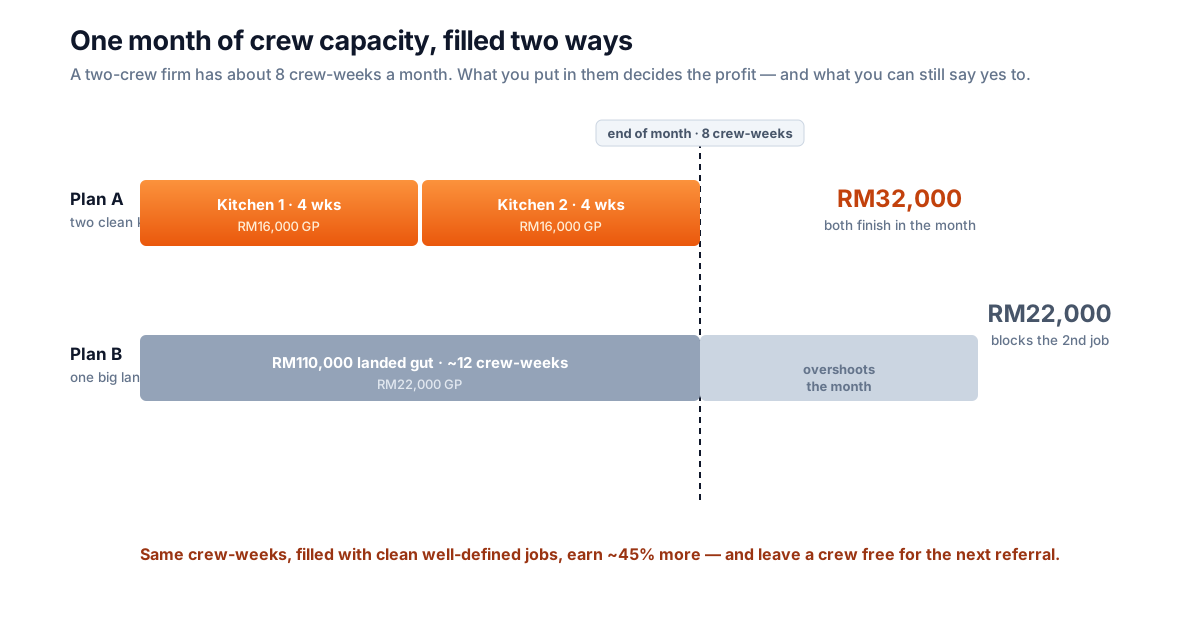
A firm's growth is capped by whatever it runs out of first. Point ad spend at a leaky funnel and you run out of close rate — the problem the marketing-budget piece takes apart. Win jobs on back-loaded terms and you run out of cash, the working-capital buffer that funds jobs between milestones. But once the leads are flowing and the cash is managed, a busy reno firm hits a harder wall: it simply cannot put more crews on more sites. Two teams working four-week months give you roughly eight crew-weeks to sell — and no amount of extra enquiries or deposit money conjures a ninth out of thin air.
That ceiling is unusually hard in Malaysia right now, which is what makes crew-weeks a genuine constraint rather than a theoretical one. The construction sector runs on a workforce it can't easily expand: a January 2024 policy that let foreign workers switch sectors is reported to have cut the construction workforce by around 40 percent (FTI Consulting), the skilled-labour shortage has been pushing trade wages up, and industry associations have gone as far as urging the Prime Minister to intervene in the prolonged shortage (The Edge, Focus Malaysia). You cannot hire a reliable tiling team for next Tuesday because you feel like it. So your trusted crews are exactly the resource you can't scale on demand — the textbook definition of a bottleneck.
Why should I rank jobs by profit per crew-week instead of price?
Because when a resource is scarce, the right way to rank what competes for it is the profit each option earns per unit of that resource — not the profit per job. This isn't a renovation trick; it's the standard answer to a bottleneck, and it routinely reorders a list that looked obvious.
Managerial accounting has a settled rule for this. When one resource is the limiting factor, you rank the work by contribution per unit of the constrained resource, not by contribution per job or by price, and you fill the scarce capacity from the top down (cost-accounting limiting-factor analysis). It's the heart of the Theory of Constraints — identify the bottleneck, then maximise throughput per unit of the bottleneck resource (ACCA on throughput accounting, Theory of Constraints Institute). A factory ranks products by profit per machine-hour on the one machine everything queues for. A renovation firm's "machine" is its crews, and its unit is the crew-week.
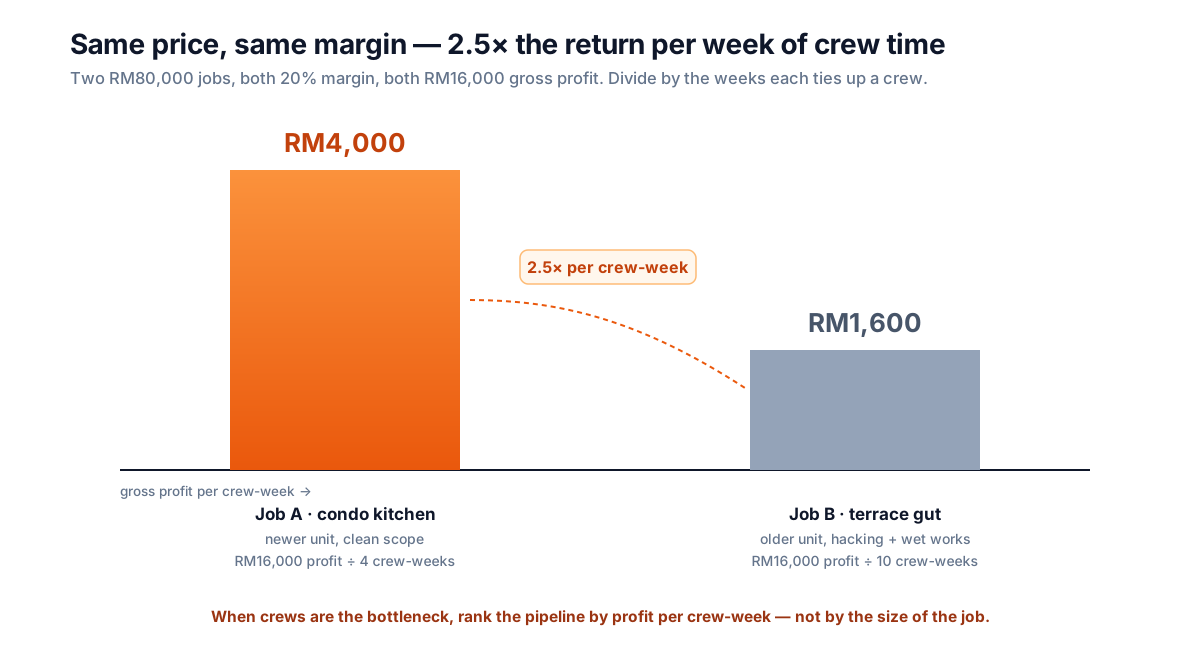
Watch what that does to the two jobs from the top. Both are RM80,000. Both run the 20 percent gross margin used across this series — RM64,000 of direct cost, RM16,000 of gross profit each. On price and on margin they are identical twins. The only difference is time on a crew:
| Same-price jobs | Price | Gross margin | Gross profit | Crew-weeks | Profit / crew-week |
|---|---|---|---|---|---|
| Job A — clean condo kitchen + living, newer unit | RM80,000 | 20% | RM16,000 | 4 | RM4,000 |
| Job B — older terrace partial gut, hacking + wet works | RM80,000 | 20% | RM16,000 | 10 | RM1,600 |
Same money, same margin, and yet Job A earns two-and-a-half times as much for every week of the capacity you actually run short of. Spread RM16,000 over four crew-weeks and each week earns RM4,000; spread the same RM16,000 over ten and each week earns RM1,600. Nothing about the price or the margin told you that. Only dividing by crew-weeks did.
Why can my biggest job be my worst?
Because a bigger ringgit total and a bigger gross profit can still spread thin over enough crew-weeks to fall below a smaller, faster job. The size that impresses you on the quote is the size that quietly starves your capacity — and it drags in a second cost that never shows on the job's own costing.
Add the trophy job — the RM110,000 Klang terrace — to the table. It carries a bigger gross profit than either RM80,000 job. It also ties up a crew for about 12 weeks:
| Ranked two ways | Gross profit | Crew-weeks | Profit / crew-week | Rank by ringgit | Rank by crew-week |
|---|---|---|---|---|---|
| Job A — condo kitchen | RM16,000 | 4 | RM4,000 | 3rd (smallest) | 1st |
| Job C — RM110k landed gut | RM22,000 | 12 | RM1,833 | 1st (biggest) | 2nd |
| Job B — terrace partial gut | RM16,000 | 10 | RM1,600 | 3rd | 3rd |
The ranking flips. By ringgit, the RM110,000 job is the obvious winner and the little kitchen is the runt. By profit per crew-week — the only ranking that matters when you can't do all three — the little kitchen wins decisively and the trophy job drops to the middle. Chase the big one in a full month and you're spending your scarcest weeks at RM1,833 each when you could have spent them at RM4,000.
And that understates it, because the long job carries an opportunity cost its own costing never shows. While your best crew is buried in the 12-week gut, you are saying no — or replying slowly, which is the same thing — to the fast, clean kitchens that would have earned more per week. Older homes also overrun more than newer units: hidden defects behind tiles and screed, the exact risk the contingency piece prices, push the real crew-week count up and the real profit-per-crew-week down. The trophy on your Instagram can be the job that, month after month, keeps you at break-even.
When does this rule NOT apply?
When your crews are idle. Profit per crew-week only decides priority when crew-weeks are genuinely scarce — when you have more good work than teams. If a crew is sitting empty, an empty week earns nothing, so any job with positive contribution beats it, however low its return per week.
This is the guardrail that keeps the rule from turning into "only take small jobs," which would be wrong. The whole logic rests on the resource being constrained. The moment it isn't — a slow month, a gap between projects, a crew between jobs — the maths inverts: the cost of an idle crew-week is the entire profit it could have earned, so a RM1,600-a-crew-week job you'd have declined in a busy month is pure upside in a quiet one. In the Theory of Constraints this is the same insight from the other side: a resource's value depends entirely on whether it's the bottleneck.
So the big slow job isn't bad. It's a trough-filler — exactly the work you want lined up for the quiet weeks after a busy run, when it keeps good crews paid and busy rather than drifting off to another firm. The error is only ever taking it instead of higher-return work you could have had at the same time. Which turns profit per crew-week into a scheduling question, not a moral one: do I have the capacity to say yes to this without turning away something better? When you're fully booked and overflowing, the answer decides which leads win your weeks.
How does this change which leads I chase?
It turns a costing metric into a lead-selection rule. In a full month, the enquiry worth your fastest reply, your site visit and your firmest price is the one with the higher expected profit per crew-week — usually the clean, well-defined, newer-unit job, not the big-ringgit gut. That reverses the instinct to chase the biggest number in the inbox.
Translate the arithmetic back to the inbox. Every enquiry is a claim on future crew-weeks, and you can read its rough weight from the first WhatsApp — unit type, age and scope place a job in a band before you've spent an hour on it. Malaysian durations cluster predictably: a cabinet-only or light kitchen runs about 3 to 5 weeks, a full condo renovation 8 to 14, a terrace gut 12 to 18 (StudioD3, EverKitchen), with older units and heavy wet works at the long, overrun-prone end. So the moment a lead lands you can tag it fast-clean or long-heavy — and in a busy month, weight your fastest reply and your best price toward the fast-clean jobs that earn the most per crew-week.
That flips a habit worth naming. It's the same trap as why the cheapest lead can be your most expensive job: the headline number misleads. There, a cheap lead hides an expensive job; here, a big job hides a poor use of capacity. And it dovetails with operating leverage — because your overhead is fixed, the fast job that clears your crews sooner gets you to the next job, and the profit above break-even, quicker. Profit per crew-week is how you decide which jobs get you there fastest.
Where a lead system helps — and where it doesn't
Be honest about the boundary. HotLead is not project-scheduling or resource-planning software. It won't build you a Gantt chart, count your crew-weeks, or estimate how long a job will run — that's your project manager's judgment and your site experience. What it does is make the crew-week weight of your pipeline visible at the point you can still act on it: the enquiry stage.
It captures and tags every enquiry by scope and source the moment it lands, so you can see whether your pipeline is filling with fast-clean kitchens or long-heavy guts before you've committed a single site visit. It keeps one owner and a next-action on every lead, so the high-return jobs get chased hardest instead of whoever shouts loudest. And its funnel and per-channel views show you which sources actually bring the jobs that make the best use of your crews — not just the ones with the biggest quote attached. You still decide which jobs to run and how to price them; the system makes sure the fast, well-defined, high-return enquiry never dies in the WhatsApp scroll while you're heads-down on the trophy.
The renovation firms that quietly compound aren't the ones with the biggest jobs on the wall. They're the ones who know their scarcest resource is crew-weeks, who rank their pipeline by what each job earns per week of it, and who spend their busiest weeks on the work that pays the most for them — and keep the big, slow, proud jobs for the troughs, where an idle crew would otherwise earn nothing at all.
This is a capacity question sitting underneath a lead question. Start with the complete guide to managing renovation leads in Malaysia, then read gross margin vs net margin on the break-even count and operating leverage behind it, and how much cash a renovation firm needs on the other ceiling — the cash that funds the jobs your crews are running.
Sources: ACCA and the Theory of Constraints Institute on maximising throughput per unit of the bottleneck resource; cost-accounting limiting-factor analysis on ranking work by contribution per unit of the constrained resource rather than by contribution per unit or price; FTI Consulting on the ~40% reduction in Malaysia's construction workforce after the January 2024 foreign-worker policy and the skilled-labour shortage lifting trade wages, The Edge and Focus Malaysia on the prolonged labour crunch and its pressure on contractor margins; StudioD3 and EverKitchen on Malaysian renovation durations (cabinet/light kitchen ~3–5 weeks, full condo ~8–14, terrace gut ~12–18). House figures — RM80,000 condo job, RM64,000 direct cost, RM16,000 gross profit, ~20% gross margin, ~7–8% conversion — are consistent across this series; the crew-week counts and the RM4,000 / RM1,600 / RM1,833 per-crew-week figures are illustrative and labelled as such.
Frequently asked questions
What is profit per crew-week for a renovation firm?
It's the gross profit a job earns divided by the number of weeks it occupies one of your crews. A crew-week is one crew (your own team or a regular subcontractor team) working for one week. If a job earns RM16,000 gross profit and ties up a crew for four weeks, it returns RM4,000 per crew-week. The measure matters because a small firm has a fixed number of crews, so crew-weeks — not ringgit or leads — is usually the real ceiling on how much it can earn in a month. Ranking your pipeline by profit per crew-week tells you which jobs make the best use of that ceiling.
Why not just rank renovation jobs by their ringgit value or margin?
Because both ignore time, and time on a crew is your scarcest resource when you're busy. A RM110,000 job looks bigger than an RM80,000 one and a 25 percent margin looks better than 18 percent, but if the big job ties up a crew for three months while the smaller one is done in four weeks, the smaller job can earn far more per week of the capacity you actually run out of. Ringgit value and margin percentage tell you if a single job is worth doing in isolation; profit per crew-week tells you which jobs to prioritise when you can't do them all — which is exactly the decision a busy firm faces every week.
Does this mean I should turn down big renovation jobs?
No. Profit per crew-week only decides priority when crews are the binding constraint — when you have more good work than teams and you're choosing which jobs to chase. When you have idle crew-weeks, a big slow job with a lower return per week still beats an empty crew earning nothing, so take it. The rule is a busy-season and fully-booked tool. Its real use is telling you which enquiries deserve your fastest reply and firmest price in a full month, and which "trophy" job is quietly blocking two better ones — not a blanket ban on large projects.
How do I estimate crew-weeks for a job before I've quoted it?
You don't need a precise figure at the enquiry stage — a rough band is enough to prioritise. Malaysian renovation durations cluster by scope — a cabinet-only or light kitchen runs roughly 3 to 5 weeks, a full condo renovation 8 to 14, a terrace-house gut 12 to 18, and a bungalow far longer. Older units with hacking and wet works run longer and overrun more often. From the first WhatsApp — unit type, age, and scope — you can usually place a job in a rough crew-week band and flag the long, messy ones before they eat a site visit. The precise number is your project manager's call once you've seen it.
What counts as a crew-week if I use subcontractors?
Count the teams you can't easily multiply. If you run two of your own crews plus one regular tiling subcontractor you always use, your practical capacity is those three teams — and a job that occupies any of them for a week is a crew-week. The point of the measure is your real bottleneck, so count the resource you genuinely run short of. If you can hire an extra reliable team overnight for any job, that resource isn't your constraint; in a Malaysian market with a chronic skilled-labour shortage, most firms find their trusted crews are exactly the thing they can't scale on demand.
Keep reading
- "Boss, Berapa?" The Renovation Lead That Lands on the Wrong ChannelYour hottest organic leads often arrive where they found you — a comment under a project post, or a DM to your personal account — not the business WhatsApp you actually watch. Here's why those leads leak at the capture step, why an ignored public comment costs more than a missed message, and how to catch a lead no matter which door it walks in.
- "We Went With Another Contractor" — I Built an AI to Win Back a Lost Renovation Lead Instead of Slamming the DoorA Shah Alam firm quotes a RM70k job, chases it for three weeks, and finally gets the message every owner dreads — "thanks, we've decided to go with another contractor." The reflex is a terse "ok, all the best 🙏" and a closed chat. The 2026 reflex is to ask AI to detect the rejection and auto-fire a win-back discount. I built it, and it begged. Here's the version that keeps a near-free option on a re-win without ever chasing a no.
- The Only Three Ways to Grow a Renovation Firm — and Which Lever to Pull FirstEvery renovation firm's revenue comes down to three levers — how many leads you get, how many you close, and how big each job is. They multiply, so a modest lift on each compounds. But they cost wildly different amounts to pull, and most owners reach first for the one they should reach for last. Here's the ranking, with Malaysian numbers.