

Two renovation firms in Klang Valley can quote the same jobs, win the same work, run the same 20 percent margin — and one of them quietly runs out of money while the other doesn't. The difference isn't sales, and it isn't pricing. It's how much of their own cash they need to have sitting inside their live jobs at any one moment, and whether they knew that number before the order book filled up.
This is the question almost no reno owner can answer off the top of their head: how much cash does my firm actually need just to run? Not to grow, not to buy a van — just to keep three or four jobs moving without the account going dry the week before payday. It's a different question from "am I profitable?" and a different question from "what did I make?" A firm can be profitable, be owed a fortune, and still have nothing in the bank on the 28th.
This piece puts a real number on it. It shows what working capital actually is for a renovation firm, how to size the buffer you need with Malaysian figures, why every job you win makes that buffer bigger — the reason "busy" and "broke" so often arrive together — and why the size of your cushion quietly decides how many leads you can afford to say yes to.
Why can a profitable renovation firm run out of cash?
Because the cash to run a job goes out well before the cash from the job comes back — and profit sits inside unfinished, uncollected work, not in your account. You are, in effect, lending your clients the cost of their renovation and getting paid back in instalments after you've already spent it.
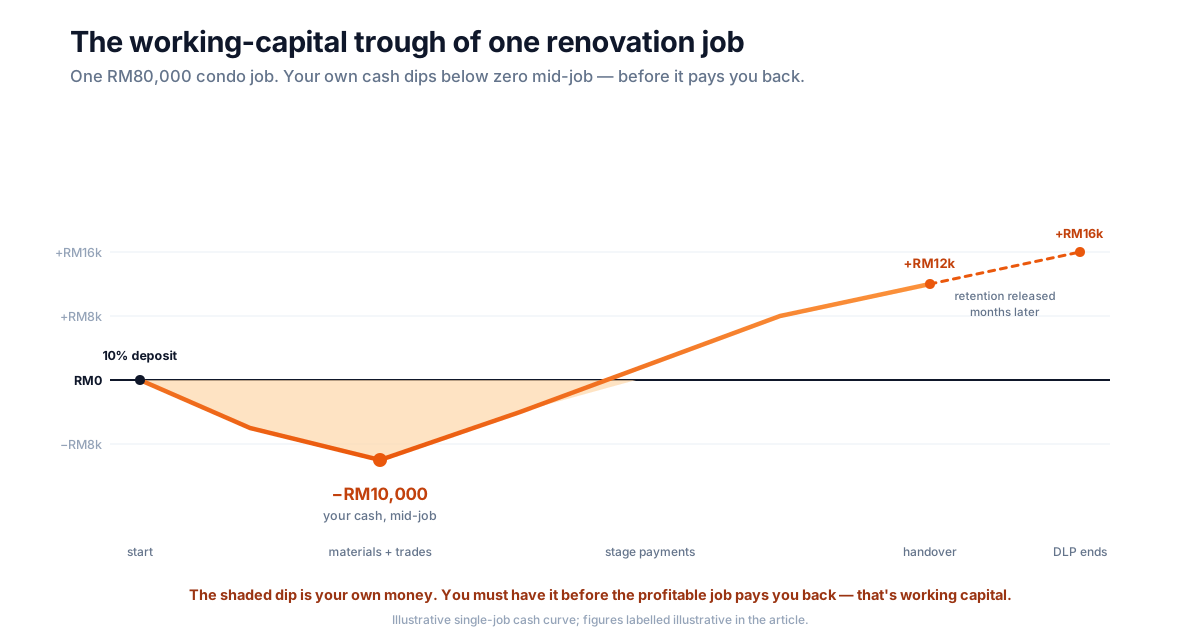
Walk the money through one job on the mid-band condo used across this series. You quote RM80,000, your direct cost is RM64,000, leaving RM16,000 of gross profit. The client pays a 10 percent deposit — RM8,000 — up front, which sounds like a cushion until you order materials and pay your first subcontractor and it's gone in the first fortnight. From there the job runs on progressive payments: you complete a stage, you claim it, and — after the client inspects, agrees, and gets around to transferring — you collect. Meanwhile the trades want paying weekly and the supplier wants paying on delivery.
So your own cash dips into the negative in the middle of the job. You've paid for hacking, wiring and half the carpentry before the matching progress payment lands. At the low point of a single RM80,000 job you might be out of pocket by roughly RM10,000 of your own money — money you will get back, but not today. That dip is working capital: the cash a job demands from you between spending and collecting.
The finance term for this is the cash conversion cycle — the number of days your money is tied up in a job before it turns back into cash you can use. For a renovation firm that cycle can run weeks to months per job, stretched by every slow-paying client and every stage that waits on an inspection. The longer the cycle, the more cash each job locks up while it runs.
What exactly is the working-capital buffer — and why doesn't it show on any job costing?
Your buffer is the total of your own cash locked inside every live job at the same time, plus the earned money held back after jobs finish. It never appears on a single job's costing because it's a firm-level number — the sum of gaps, not the cost of any one job.
There are two parts to it, and both are invisible on a per-job P&L:
- The work-in-progress float. Every live job has a trough like the one above. Running several at once, the troughs stack. They don't perfectly line up, but a firm juggling four jobs will routinely have several of them in their cash-hungry middle phase together.
- The retention float. When a job finishes, you often don't collect the last of it. In Malaysian construction it's standard for the payer to hold a retention sum of 5 to 10 percent of the contract value as security against defects, released only after a defects-liability period (Mondaq, Sato Kogyo). On homeowner jobs the same thing appears as a held final payment collected only once snagging is cleared. Either way, a slice of every finished job stays out of your account for months — earned, but unspendable.
Add the WIP float across your live jobs to the retention float across your recently finished ones, and you have the amount of your own money that must be permanently in play just to operate. That's the buffer. It's not a cost you can cut and it's not profit you can spend — it's the working float the business runs on, and until you've sized it you're managing your cash by looking at the bank balance and hoping.
How much cash do you actually need? The arithmetic
Size it bottom-up: the deepest cash dip per live job, multiplied by the jobs you run at once, plus the retention held on finished jobs, plus a cushion for a slow month's overhead. Here's the calculation on illustrative but realistic figures.
Take our RM80,000 condo job. Assume, illustratively:
- WIP trough per live job: ~RM10,000 — your own cash at the job's lowest point, after a 10 percent deposit and before stage payments catch up.
- Retention / held final per finished job: ~RM4,000 — roughly 5 percent of RM80,000, locked until the defects period ends.
Now scale it by how many jobs you run in parallel — because the buffer isn't set by job size, it's set by concurrency:
| Jobs running at once | Recently finished, retention held | WIP float | Retention float | Working-capital buffer |
|---|---|---|---|---|
| 2 | 1 | RM20,000 | RM4,000 | RM24,000 |
| 4 | 2 | RM40,000 | RM8,000 | RM48,000 |
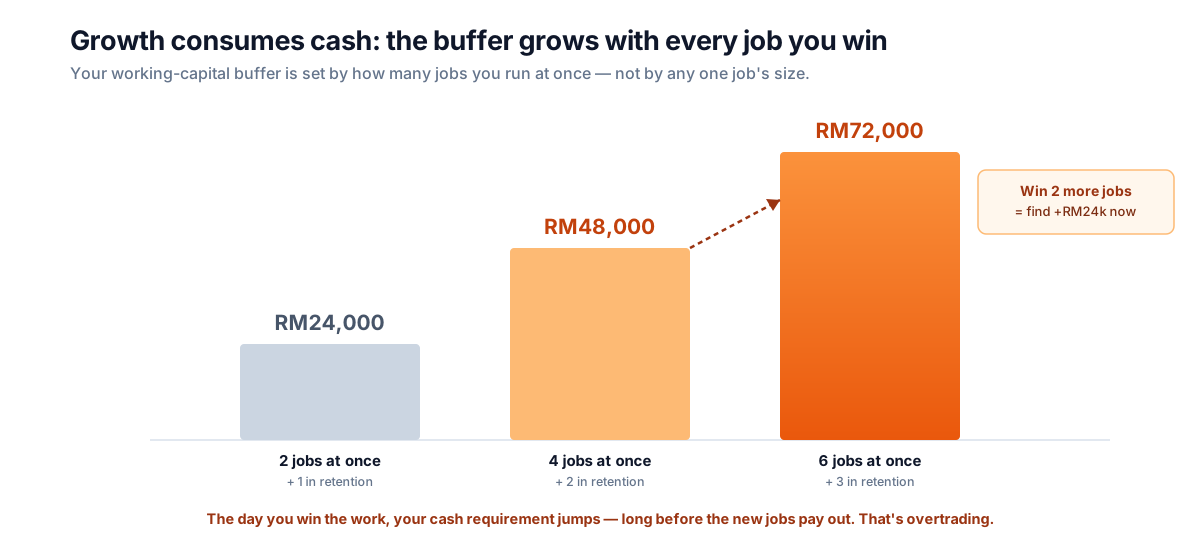
| 6 | 3 | RM60,000 | RM12,000 | RM72,000 |
A firm running four jobs at once needs, on these figures, around RM48,000 of its own cash permanently working inside the business — none of it profit, all of it just to keep the lights of live jobs on. Set that against the firm-level overhead of a similar small firm — roughly RM24,000 a month — and a prudent cushion of a month or so of overhead on top, and the honest answer to "how much cash do I need to run?" is closer to RM70,000 than to zero. That is the number a busy four-job firm should have banked and untouchable, and almost none do — which is why one late progress payment or one slow month tips them straight into borrowing.
Why does winning more work make the problem worse, not better?
Because growth consumes cash before it generates it. The day you win two more jobs, your buffer requirement jumps — and that extra cash is needed now, weeks before the new jobs pay out. This is the single most dangerous blind spot for a growing reno firm, and it has a name.
Look at the table again as a growth story, not a snapshot. Go from four jobs to six — a great fortnight of selling — and your buffer requirement climbs from RM48,000 to RM72,000. You need to find RM24,000 more of your own cash immediately, to front materials and pay trades on the two new jobs, while their deposits (RM8,000 each) barely dent the gap and their progress payments are weeks away. You are, at the moment of your biggest sales success, at your most cash-stretched. Win a third and fourth new job on top and a genuinely thriving firm can hit a wall it never saw coming.
Economists call the general version overtrading — expanding faster than your working capital can fund, so a profitable business runs out of cash and can fail anyway (nibusinessinfo, tutor2u). The sharpest treatment of it for owners is Harvard's Neil Churchill and John Mullins in How Fast Can Your Company Afford to Grow? — their "self-financeable growth rate" is exactly the rate at which a firm can grow on the cash it throws off before it has to go to a bank. Their blunt line: a profitable company that tries to grow too fast can run out of cash even if its products are great successes. For a renovation firm, "growing too fast" means taking on more concurrent jobs than your buffer can float.
Why does Malaysia make the gap worse?
Because the two things that would shorten your cash cycle — fast payment and legal recourse when it's late — are weakest exactly where reno firms operate. The buffer you need is bigger here than the textbook implies.
On the homeowner side, you have almost no legal lever to force prompt payment. The Construction Industry Payment and Adjudication Act (CIPAA) 2012, which gives contractors a fast statutory route to chase unpaid claims, specifically excludes construction work a natural person contracts for on a building of less than four storeys wholly intended for their own occupation — which is most landed residential renovation. So when a homeowner drags a progress payment, you can't reach for quick adjudication; your milestone schedule and deposit terms are your only cashflow defence. That's why the structure of your payment stages isn't just admin — it's the wall holding your working capital up.
On the commercial and subcontract side, the problem is chronic and documented. Late payment is described in Malaysian construction research as a habit of the industry, with knock-on effects that include cash-flow paralysis and outright bankruptcy for smaller players (Late Payment Practices in the Malaysian Construction Industry). Stack the standard 5–10 percent retention on top, and a subcontractor can finish a job and wait many months for the last of the money — a gap that has been serious enough to trigger a national conversation about protecting retention sums after small builders went bust (Malaysia SME). SMEs are estimated to make up around 70 percent of Malaysia's construction sector, so this isn't an edge case — it's the base case.
And the timing is pointed: construction was the fastest-growing MSME segment in Malaysia in 2024, up 17.3 percent (DOSM MSME Performance 2024). More small firms are scaling into bigger order books at once — precisely the move that inflates the working-capital buffer fastest.
How do you size and defend your buffer?
Calculate the number, then pull the levers that shrink it — deposit percentage, milestone tightness, and job selection — before you reach for a bank. You can't eliminate working capital, but you can manage how much your firm needs.
- Work out your real buffer using the bottom-up method above: WIP trough per live job × jobs run at once, plus retention held, plus a month of overhead. Recalculate it whenever your concurrency changes. This is the cash target you bank toward and don't spend.
- Use the deposit and milestones as cashflow tools, not afterthoughts. A slightly higher deposit and payment stages tied to when you spend (a materials draw before a big supply order, not after) shorten your cash cycle and shrink the trough. But stay inside the Malaysian deposit trust band — buyers are trained to read a demand above about 25 percent as a scam signal, so the fix is smarter staging, not a scarier number.
- Re-rank your pipeline by cash freed, not just ringgit. A RM90,000 job on clean, front-loaded milestones can be worth more to a capacity-limited firm than a RM110,000 job that pays mostly at the end — the same logic as weighing your pipeline by more than face value. The biggest job is not always the one to chase when cash, not profit, is your constraint.
- Know your ceiling and hold it. If your buffer safely funds four concurrent jobs, the fifth simultaneous job is a financing decision, not just a sales win. Sometimes the right answer is to stagger the start, not to say no — but you can only make that call if you know the number.
Why this is a lead-management problem, not just a treasury one
Here's the turn: your working-capital buffer sets a hard ceiling on how many jobs you can run at once — and that ceiling limits how many leads you can convert in the same window. The size of your bank cushion quietly decides which enquiries you can afford to win.
Think about what that means for the inbox. When you're well under your concurrency ceiling, every enquiry is worth chasing hard — you have the cash to serve it. When you're near the ceiling, the game changes: taking a fifth simultaneous job you can't fund doesn't grow the firm, it endangers it, and the honest move is to stagger the start or tell a lead "we can begin next month." That's not lost business; it's protecting the firm's ability to deliver the work it already has — and delivering on time is what keeps the referral engine that feeds your cheapest leads alive.
It also changes which leads you fight for and how you read them. A client who resists any deposit, or pushes hard for back-loaded "pay-at-the-end" terms, is a cash-risk signal you want to catch on the first call, not discover at the trough of the job — the same way the cheapest lead can be your most expensive job. And when two good leads land and you can only fund one right now, the one on cleaner terms is the one to prioritise.
That's where a lead system earns its place — with an honest boundary. HotLead is not accounting or treasury software. It won't calculate your working capital, model your cash cycle, or tell you your buffer number; that's this article's arithmetic and your accountant's job. What it does is govern the thing your buffer depends on — how much work you take on and when. It captures and tags every enquiry by source so you can see your true incoming demand and pace it against your capacity, keeps one owner and a next-action on every lead so the deposit-and-terms conversation that protects your cash actually happens on the first call, and its funnel and per-channel views show which sources bring jobs you can serve profitably now versus enquiries that just fill the pipe. Know your buffer, price and stage your jobs to shrink it, and let it — not optimism — decide how fast you say yes.
The renovation firms that survive their own success aren't the ones with the fullest order books. They're the ones who know, to the ringgit, how much cash their business needs just to run — and who never let the order book grow faster than the cash to fund it.
Cash is the last thing a reno firm learns to manage and the first thing that kills it. Start with the complete guide to managing renovation leads in Malaysia, then read deposit vs revenue vs cash on why a full order book still misses payroll, and gross margin vs net margin on why busy firms feel broke.
Sources: Corporate Finance Institute on the working-capital / cash-conversion cycle (the days cash is tied up before it returns); nibusinessinfo and tutor2u on overtrading (a profitable business failing for lack of working capital while growing); Neil Churchill and John Mullins, How Fast Can Your Company Afford to Grow? (Harvard Business Review, 2001) on the self-financeable growth rate and growth consuming cash; Mondaq and Sato Kogyo on Malaysian retention sums (commonly 5–10% of contract value, released after the defects-liability period); Malaysia SME on the retention-sum crisis and SMEs being ~70% of the construction sector; Late Payment Practices in the Malaysian Construction Industry on chronic late payment and its cash-flow consequences; the CIPAA 2012 residential exemption (Section 3 — a natural person's construction contract on a building of less than four storeys wholly intended for their own occupation) on why homeowner reno has no fast-payment recourse; DOSM MSME Performance 2024 on construction MSMEs growing 17.3% in 2024. The widely-cited "82% of business failures trace to cash flow" figure is attributed to a U.S. Bank study. House figures (RM80k condo job, RM64k cost, RM16k gross profit, ~10% deposit, ~RM24k/month overhead, ~7–8% conversion) are consistent across this series; the RM10,000 per-job WIP trough, RM4,000 retention float, and the RM24k/RM48k/RM72k buffer figures are illustrative and labelled as such.
Frequently asked questions
What is working capital for a renovation firm?
Working capital is the cash a firm needs to keep its day-to-day operations running — the money tied up in work that has been started and paid for but not yet fully collected. For a renovation firm it is mostly the materials you've bought and the subcontractors you've paid for a job before the client's progress payment for that stage lands in your account. Because a deposit is usually only about 10 percent and the rest arrives in stages after the work is done, you are constantly funding the gap between what you've spent on a live job and what you've been paid for it. That gap, across all your live jobs at once, is the working-capital buffer you must be able to cover.
How much cash does a small renovation firm need to keep in reserve?
Enough to cover the deepest point of the cash tied up across all your live jobs at the same time, plus a cushion for fixed overhead during a slow month. Illustratively, if one job ties up about RM10,000 of your own cash at its lowest and you run four jobs at once while carrying retention on two finished ones, that's roughly RM48,000 locked up before any profit — and you'd want a further month or so of overhead on top. The exact number depends on your deposit percentage, how fast your clients pay each stage, how much you front in materials, and how many jobs you run in parallel. The key point is that the figure scales with your order book, so it must be recalculated as you grow.
Why does a profitable renovation firm run out of cash?
Because profit and cash are on different clocks, and growth widens the gap. A job can be genuinely profitable on paper while the cash to run it goes out weeks before it comes back — you pay suppliers and subcontractors now and collect the matching progress payment later. When you win more work, you take on more of these gaps at once, so your cash requirement rises the moment you sign the new jobs, before any of them pay out. This is why a firm can have a full order book, real profit on every job, and still not have the money to make payroll — the profit is real but it is still sitting inside unfinished and uncollected jobs.
What is a retention sum and how does it affect my cash flow?
A retention sum is a percentage of a job's value — commonly 5 to 10 percent in Malaysian construction contracts — that the client or main contractor holds back after the work is done, released only after a defects-liability period passes with no problems. It is money you have earned but cannot spend, sometimes for six to twelve months. On homeowner renovations the same effect shows up as a held final payment collected only after snagging is cleared. Retention protects the payer against defects, but for a small firm it means a slice of every completed job stays locked away, so the more jobs you finish, the more of your earned cash is parked in retention at any one time.
How does my cash buffer affect which renovation leads I should take?
Directly. Your buffer sets a hard ceiling on how many jobs you can run at once without running out of cash, and that ceiling limits how many leads you can convert in the same window. So the buffer turns lead selection into a cash decision — chase the enquiries you can serve profitably now, treat a client who resists any deposit or pushes for back-loaded, pay-at-the-end terms as a cash-risk signal to catch on the first call, and re-rank your pipeline by how quickly a job frees cash, not just by its ringgit value. When you're at your safe limit, "we're full until next month" protects the firm better than a fifth job you can't fund.
Keep reading
- The Only Three Ways to Grow a Renovation Firm — and Which Lever to Pull FirstEvery renovation firm's revenue comes down to three levers — how many leads you get, how many you close, and how big each job is. They multiply, so a modest lift on each compounds. But they cost wildly different amounts to pull, and most owners reach first for the one they should reach for last. Here's the ranking, with Malaysian numbers.
- Sight Unseen: Winning the Overseas Malaysian Who Renovates a Unit They Can't VisitA Malaysian working in Singapore collects the keys to a KL condo and messages you to fit it out — but they can't come to a site visit, can't walk your showroom, and will wire a deposit to a firm they've never met. Most firms treat this lead like a walk-in, go quiet when the buyer can't pop by, and lose the highest-budget job in the inbox. Here's why the remote buyer is your hardest-trust but best-paying lead, and how to build a remote lane that actually closes it.
- "Ok, Proceed" Isn't Money in the Bank — I Built an AI to Ask for the Deposit the Moment a Renovation Buyer Says YesA Cheras contractor closes a RM62k job on WhatsApp, the buyer says "ok proceed lah", and then the owner — mid-site, phone in a dusty hand — has to stop, pull the bank details, the agreed deposit and the scope, and type a careful money message. In that gap a hot yes quietly cools back to "let me think." The 2026 reflex is to ask AI to detect the yes and auto-fire the invoice. I built it, and it asked a half-committed buyer for 40% to a personal account two seconds after a soft "ok ok". Here's the version that kills the typing delay without asking for money off a misread.