

A Johor Bahru interior-design firm nearly lost a RM45k condo job in the eight minutes it took to find someone who could read the message.
The enquiry came in on a Saturday morning, in Mandarin: a Bukit Indah condo owner asking about a kitchen and TV-wall package, with a photo of the empty unit. The designer who handled the firm's Mandarin-speaking clients was on a site in Skudai with his phone in his pocket. The only person at the desk that morning read Malay and English fluently and almost no Mandarin. She could see it was a real enquiry — there was a photo, a unit, an obvious intent — and she could see the little "typing…" stop, and start, and stop. She couldn't answer a word of it. By the time the Skudai designer surfaced and replied, the buyer had already messaged two other firms off the same Qanvast shortlist.
That gap — a hot lead in a language the free person can't read, the matched person unreachable, the first-response clock running — is a very Malaysian leak, and a very fixable-looking one. Because the obvious 2026 move is right there: just let AI translate the whole thing both ways. So I built exactly that, ran it, and watched it fail in a way that's worth understanding — because it fails differently from every other AI build in this series, and the difference is the whole point.
Why does a language mismatch cost you the lead in the first few minutes?
Because language is one of the few things that genuinely changes the outcome of a renovation enquiry, not just its tidiness — and the damage happens in the exact window where you can least afford a stall.
Start with who's messaging. About 22% of Malaysians are ethnic Chinese and 6.5% Indian (DOSM, 2024), and plenty of buyers open in Mandarin, a dialect or Tamil on purpose — not because they can't manage English, but to check, at hello, that they'll be understood by the firm they're about to trust with RM45k and three months in their home. In the assignment experiment I argued that language is one of only two specialty routing rules worth having (the other is region), precisely because a lead who writes "boleh cakap Mandarin?" and reaches someone who can't is a lead you've half-lost before you've said anything.
Now layer on the clock. Roughly 78% of deals go to the firm that responds first, per the much-cited InsideSales/MIT lead-response work, and on a Qanvast or Atap shortlist the buyer is messaging several firms in parallel. The first few minutes decide it. So the language-mismatch problem isn't "we'll get to it when the right person is free" — the cost is booked in the minutes while you're still finding that person. That's the gap a bridge is meant to fill: not to close the deal, but to keep it warm and answered until the matched rep can take over.
So what happened when I let AI auto-translate the conversation both ways?
The translation read fluent — which, as with every dangerous build in this series, is exactly what makes the reflex version risky.
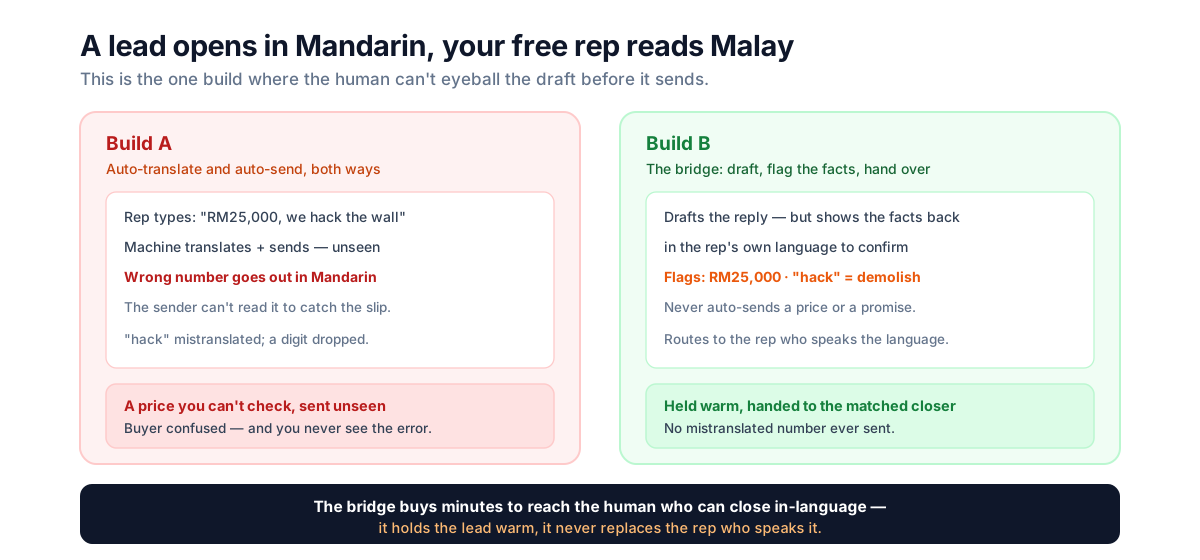
I wired up the obvious thing: incoming Mandarin message → auto-translate to English for the free rep → she types a reply in English → auto-translate to Mandarin → auto-send. On the happy-path bits it looked great. "请问厨房翻新大概多少钱" came through as "May I ask roughly how much for a kitchen renovation," she replied naturally, and it went back out in perfectly readable Mandarin. For thirty seconds it felt like the language barrier had just… dissolved.
Then the buyer asked a specific question about hacking the wet-kitchen wall and a rough budget, the rep answered with a number and a scope, and the wheels came off — quietly, which is the dangerous kind.
Why is "auto-translate and send" the dangerous build?
Because the payload of a renovation chat is numbers, scope words and tone — and those are the three things machine translation is documented to get wrong, especially on messy Malaysian text.
Take them in order:
- Numbers and named entities. Research on neural machine translation treats mistranslation of named entities — names, dates, numbers — as a known, distinct failure mode, separate from fluent "hallucination," and catalogues hallucination errors that include wrong units, numbers and dates (Guerreiro et al., "A Comprehensive Study of Hallucinations in NMT," EACL 2023; Raunak et al., "The Curious Case of Hallucinations in NMT," NAACL 2021). A reno chat is almost entirely named entities — "3 kaki setengah," "25k," "RM180 per square foot," "the 8-foot run" — so when translation slips, it slips on the price or the dimension. A quote is the one message where a single wrong digit is the whole message.
- Trade slang in a mixed language. A KL or JB reno chat is Malay-English code-switching — Manglish — laced with trade slang: "hack" (demolish, not chop up or cut a price), "wet and dry kitchen," "kaki" (foot), "bomba" (the fire department's approval), "kabinet dapur." Manglish is a genuinely low-resource case for translation (the code-switching MT literature notes it's under-studied and that quality drops on exactly this kind of input), and a general engine will happily render "hack the wall" into something that means the opposite of demolition. A wrong scope word changes what you're quoting for.
- Tone and politeness. A documented category of MT error is the pragmatic one — flattening a soft, hedged request into a blunt statement, or losing the honorific and register (Sennrich et al. on controlling politeness in NMT; broader work on pragmatic and honorific errors). In a reno sale this is not cosmetic. "我考虑一下先" ("let me think about it first") is a soft-no you'd nurture gently; flattened into a flat "I will consider it," or worse an over-eager "I want to proceed," it changes how you'd handle the buyer entirely — the same soft-no misread that corrupts an AI-updated CRM stage.
Each of these on its own is a manageable risk when a human checks the output. Which brings us to why this build is special.
The un-Googleable catch: you can't eyeball a draft in a language you can't read
Here's what makes the translation bridge different from every other build in this series — and it's the reason the reflex version is genuinely unsafe, not just imperfect.
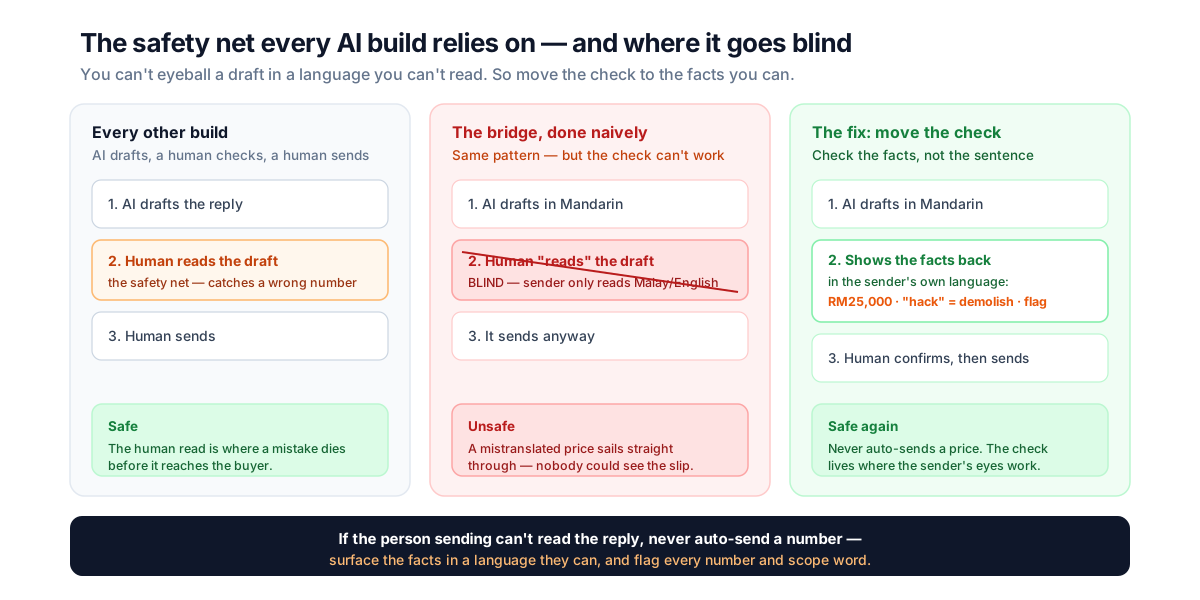
Every AI build I've written up works on the same safety pattern: AI drafts, a human eyeballs the draft, a human sends. The first reply, the quote follow-up, the CRM note — all of them are safe because the last thing before anything irreversible is a person reading the output and catching the mistake. That human check is the whole safety net.
Now look at the bridge. AI drafts a reply in Mandarin, and the person about to send it only reads Malay and English. The eyeball check is blind. You cannot verify a draft in a language you cannot read. The one mechanism that makes "AI drafts, human sends" safe everywhere else is precisely the mechanism that's missing here — the sender is staring at a fluent-looking Mandarin sentence with a mistranslated price in it and has no way to know. That's not a smaller version of the usual risk; it's the usual risk with the airbag removed.
This is the one-question test that runs through the whole series, sharpened for language: can the person hitting send actually read what they're sending? If the answer is no, then auto-sending is out — full stop — and the build has to move the human's check somewhere the human can see. That's the entire design problem, and it has a clean answer.
The second trap: translation doesn't replace the matched closer — it buys time to reach them
The other reason auto-translate feels like a full solution is that it seems to make language routing obsolete: why keep a Mandarin-speaking designer on the bench if the machine can translate everything? That logic is wrong for the same reason language routing is a real edge in the first place.
A renovation or interior-design job is a high-trust, high-ticket, months-long relationship. The buyer who opens in Mandarin isn't just transacting a price — they're deciding whether this firm gets them, whether they can explain the awkward family situation about the mother-in-law's room, whether the soft-no will be respected or steamrolled. That's rapport, and rapport in someone's own language is exactly what a machine bridge can't build. It can answer "roughly how much" and "can we visit Saturday." It cannot be the person who closes a RM45k job over three careful conversations.
So the honest role of the bridge is narrow and useful: hold the lead warm and answered for the few minutes it takes to reach the human who can actually close it in-language. It's the same shape as not auto-booking a site visit and not auto-pricing a photo — AI does the fast, reversible part (keep the conversation alive), the human owns the part that's slow, relational and irreversible (the actual relationship and the number). Translation is a stopgap for speed. It is not a substitute for the matched closer, and a firm that treats it as one will hold conversations warm all the way to a lukewarm loss.
What did the build that actually paid look like?
The version that works keeps the machine on the fast, reversible parts and moves the human's check to something the human can actually see. Same division of labour as every step in this chain: AI reads and drafts, the human owns anything you can't cleanly undo.
Build B does four things:
- Never auto-sends a price or a commitment in-language. A drafted reply that contains a number, a scope decision, or a "yes" is held for a human, always. Small, safe pleasantries ("thanks, one moment, my colleague who can help will message you shortly") can go; anything that commits you cannot.
- Shows the key facts back in the sender's own language. Alongside the drafted Mandarin reply, it surfaces the load-bearing facts in Malay/English: the number (RM25,000), the scope word and what it means (hack = demolish), the commitment. So the rep checks the facts even though they can't read the sentence — the eyeball check moves to where their eyes work.
- Flags every number and scope word as low-confidence. The digits, the dimensions, the trade slang — the exact things translation gets wrong — are pulled out and marked for confirmation, not buried in fluent prose. The flags are the product, not the tidy translation.
- Routes to the language-matched owner and hands over. The bridge is explicitly a holding action. The lead is assigned by rule to the rep who speaks the language, with a next action to take it over — so the stopgap ends in the right hands, fast.
| Build A — "auto-translate + auto-send" | Build B — "bridge, flag facts, hand over" | |
|---|---|---|
| A price / number | Sent in-language, unseen | Held; shown back in the sender's language to confirm |
| The human check | Blind — sender can't read the reply | Moved to the facts the sender can read |
| Trade slang / scope | Silently mistranslated | Flagged as low-confidence for a human |
| The relationship | Machine holds it to the end | Held warm, then handed to the matched closer |
| What it's for | Replacing a language-matched rep | Buying minutes to reach one |
Reply at machine speed on the safe, reversible things; keep every irreversible number and every real conversation with a human who can see what they're doing. That's the bridge that held the JB lead the second time — an instant in-language "someone who can help is coming," a Skudai designer pinged and taking over inside a few minutes, and no mistranslated price ever sent.
What should an owner actually do?
You don't need a translation engine to fix most of this. The biggest wins are in routing and holding, which carry no translation risk at all — and they make any future bridge safer.
- Auto-greet every inbound instantly, in both languages. A simple bilingual "thanks for your message — someone who can help will be with you shortly" holds the lead the moment it lands, and it translates nothing the buyer said, so nothing can be mistranslated. This alone closes most of the first-response gap.
- Route by language, by rule. Set a custom rule that sends a Mandarin or Tamil opener to the rep who speaks it, with one named owner from the second it lands. This is the real fix — most of the time the matched rep is reachable and no bridge is needed.
- Reserve the bridge for the genuine gap. Only bridge when the lead is hot, the matched rep is unreachable for the next few minutes, and the free rep can't read the message. It's for minutes, not for a segment of your buyers.
- Never let a number or a promise auto-send in a language your sender can't read. If you use a bridge, make it flag the numbers and scope words and show them back in the sender's language. If it can't do that, it drafts pleasantries only.
- Always hand over to the matched closer. The bridge is a holding action with a next action attached — take it over. A reno closes on rapport in the buyer's language, not on a machine round-trip.
How HotLead fits — honestly
I'll be straight, the way I try to be in every one of these. HotLead does not ship a translation engine, and it won't send a translated message for you — the bridge is the experiment in this piece, and the point of the piece is that the risky part is the translation, which I'd keep human. What HotLead ships is the part that does most of the work with none of the translation risk:
- Instant auto-greeting on every inbound, which you can set as a bilingual holding message — so a lead in any language is answered and held warm the second it lands, without translating a word of what the buyer wrote.
- Custom routing rules, including by language or region, so a Mandarin or Tamil opener reaches the rep who speaks it by rule, with one named owner — the language-routing edge built in, not left to whoever happens to see the message.
- A next action and an overdue nudge, so a bridged or handed-over lead is a tracked step that lands with the matched closer instead of sitting in a stopgap while everyone assumes someone else has it.
- A team-performance view, so you can see whether your language-matched leads are actually reaching the right person fast — or leaking in the gap.
The translation, keep human until you can see what you're sending. The routing and the holding are what stop the lead from dying while you find the right person — and those are the boring, reliable mechanics that pay. If that first-response gap is the problem underneath this, start with the complete guide to managing renovation leads in Malaysia, see how it fits a renovation firm or an interior-design studio, and read the companion builds on routing leads to the right salesperson, the auto-greeting first reply, and what AI still can't do in your lead process.
Sources: That mistranslation of named entities — names, dates and numbers — is a known, distinct failure of neural machine translation, and that hallucination errors include wrong units, numbers and dates, from Guerreiro, Voita & Martins, "Looking for a Needle in a Haystack: A Comprehensive Study of Hallucinations in Neural Machine Translation" (EACL 2023) and Raunak, Menezes & Junczys-Dowmunt, "The Curious Case of Hallucinations in Neural Machine Translation" (NAACL 2021). That machine translation of low-resource code-switched (mixed-language) text is under-studied and lower-quality — the Manglish case — from Xu & Yvon, "How effective is machine translation on low-resource code-switching?" (ACL Findings 2023) and the broader survey of code-switched NLP; that Manglish specifically is a low-resource pair with scarce data is noted in a Malay-English code-switching dataset paper. That machine translation makes documented pragmatic errors — flattening politeness, losing honorifics and register, turning a hedged request into a blunt one — from Sennrich, Haddow & Birch, "Controlling Politeness in Neural Machine Translation via Side Constraints" (NAACL 2016) and work on translating politeness across languages. Malaysian ethnic composition (2024: 22.4% Chinese, ~6.5% Indian) from the Department of Statistics Malaysia Current Population Estimates 2024. The first-responder win rate (78% of deals to the firm that responds first) from the InsideSales.com/MIT lead-response study (Dr James Oldroyd), consistent with the benchmarks in our lead-response-time piece; the language-routing edge and the assign-the-tag-not-the-pick model are reused from the assignment experiment. Renovation lead-volume (40–60 enquiries a month) and the ~RM1,280 expected gross profit per enquiry are typical operating figures reused from the cost-of-a-lost-lead and funnel-benchmarks pieces and labelled as typical; the translation-bridge experiment, the JB scenario and the per-message AI cost are described from practice and labelled illustrative, not a controlled trial or a quoted price. HotLead is described only by its real features — capture, auto-greeting, round-robin/manual/custom-rule routing, next-action and overdue follow-ups, funnel and per-channel ROI, and team performance; it does not ship a translation engine.
Frequently asked questions
Can AI translate a WhatsApp renovation enquiry so a rep who doesn't speak the language can reply?
It can draft a translation, and as a stopgap that buys time it can genuinely help. But you should not let it auto-translate and auto-send both ways unattended, and this is the one AI build where the usual safety check is weakened. In every other use, a human reads the AI's draft before sending it — that eyeball is what keeps a wrong number or a mangled scope from going out. Here the person sending only reads their own language, so they can't read the drafted reply to check it. The safe version drafts the reply, flags the numbers and scope words, and shows those key facts back in the sender's own language so they verify the facts even when they can't read the sentence — and it never auto-sends a price or a commitment in-language.
What does machine translation actually get wrong on a Malaysian renovation chat?
The things that cost you money. Research on neural machine translation lists mistranslation of named entities — names, dates, numbers — as a known, distinct failure, and hallucination errors include wrong units, numbers and dates. A renovation chat is almost all named entities — "3 kaki setengah," "25k," "per square foot" — so the error lands on the price or the dimension. On top of that, Malay-English code-switching (Manglish) plus trade slang like "hack," "wet and dry kitchen" or "kaki" is a low-resource, under-studied case where error rates are higher. And politeness gets flattened — a documented pragmatic error is turning a soft, hedged "let me think about it first ah" into a blunt statement, which in a reno sale reads completely differently.
Doesn't AI translation mean I no longer need a rep who speaks the customer's language?
No — and this is the trap. A renovation or interior-design job is a high-trust, high-ticket, months-long relationship, and a buyer who opens in Mandarin or Tamil is often checking they will be understood before they commit. A machine bridge can hold that conversation warm and answer a simple question, but it can't build the rapport, read the family dynamics, or handle the soft-no that actually closes the deal. Language matching changes the outcome — which is exactly why it's one of the few specialty routing rules worth having. The bridge buys you time to reach the matched closer; it doesn't replace them.
When should I use an AI translation bridge at all?
Only in the gap — a hot lead opens in a language your available rep doesn't read, and the matched rep is genuinely unreachable for the next few minutes. That's the first-response window where the lead cools fastest. Most of the time you don't need a bridge at all — you route the lead to the rep who speaks the language and they reply fast. Reserve the bridge for the minutes it takes to reach that person, hold the conversation warm without sending anything irreversible, and hand it over. It's a stopgap for speed, not the default way you talk to a segment of your buyers.
Does HotLead translate my WhatsApp leads?
No, and I won't pretend it does — the translation bridge is the experiment in this piece, not a shipped feature. What HotLead ships is the part that does most of the work without any translation risk. Every inbound gets an instant auto-greeting, which can be a simple bilingual "thanks, someone who can help will be with you shortly" — no translation of the buyer's actual message, so nothing can be mistranslated, and the lead is held warm the second it lands. A custom routing rule can send a lead to the rep who speaks the language, so it reaches the right owner by rule, not by luck. And a next action plus an overdue nudge makes that handover a tracked step, so a bridged lead is handed to the matched closer, not left sitting in a stopgap. The routing and the holding are the real fix; the translation is the risky part I'd keep human.
Keep reading
- "We Went With Another Contractor" — I Built an AI to Win Back a Lost Renovation Lead Instead of Slamming the DoorA Shah Alam firm quotes a RM70k job, chases it for three weeks, and finally gets the message every owner dreads — "thanks, we've decided to go with another contractor." The reflex is a terse "ok, all the best 🙏" and a closed chat. The 2026 reflex is to ask AI to detect the rejection and auto-fire a win-back discount. I built it, and it begged. Here's the version that keeps a near-free option on a re-win without ever chasing a no.
- The Only Three Ways to Grow a Renovation Firm — and Which Lever to Pull FirstEvery renovation firm's revenue comes down to three levers — how many leads you get, how many you close, and how big each job is. They multiply, so a modest lift on each compounds. But they cost wildly different amounts to pull, and most owners reach first for the one they should reach for last. Here's the ranking, with Malaysian numbers.
- Sight Unseen: Winning the Overseas Malaysian Who Renovates a Unit They Can't VisitA Malaysian working in Singapore collects the keys to a KL condo and messages you to fit it out — but they can't come to a site visit, can't walk your showroom, and will wire a deposit to a firm they've never met. Most firms treat this lead like a walk-in, go quiet when the buyer can't pop by, and lose the highest-budget job in the inbox. Here's why the remote buyer is your hardest-trust but best-paying lead, and how to build a remote lane that actually closes it.