

There's a lead I chased for three weeks that I should have turned down in the first ten minutes.
A homeowner messaged wanting a full condo renovation — but the unit was out past Rawang, well beyond where my crew and suppliers sat, and the budget they kept repeating couldn't carry half the scope they described. Every time I sent a number, the brief changed: "actually, can add the store room also?", "my friend say should be cheaper", "can lower the deposit first?" I drove out twice, re-quoted three times, and burned four evenings on takeoffs. They signed with someone else. And here's the thing — that was the good outcome. If I'd won it, I'd have inherited a job that couldn't be built at that budget, for a buyer already primed to feel cheated, two hours from my nearest supplier.
That's a wrong-fit lead: a real, funded project that's simply a bad job for your firm. And it's one of the most expensive leaks in a small reno business, precisely because it doesn't look like a leak. It's a real enquiry. It passes every filter you've built. So you chase it — out of the reflex every contractor I know shares: never turn away work.
What exactly is a "wrong-fit" renovation lead?
A wrong-fit lead is a genuine, ready project that is nonetheless a bad job for your specific firm. Not a scam, not a tyre-kicker, not someone who's months early — a real buyer with a real unit who could sign this month. It's just wrong for you: the budget can't carry the scope, the site is too far, the buyer is set up to fight you, or the brief won't hold still long enough to price.
That's what makes it dangerous. It's easy to spot a lead that isn't a real project — that's what qualifying on the first WhatsApp reply is for. It's easy enough to spot a buyer who's not ready to act, once you've read the silent site visit. But the wrong-fit lead passes both tests. There's a real unit, real keys, a real intent to renovate now. Everything your filters check for is present. What's wrong isn't the project — it's the match between the project and your firm, and no standard qualifier is looking at that.
Why is "never turn away work" the most expensive habit in a small reno firm?
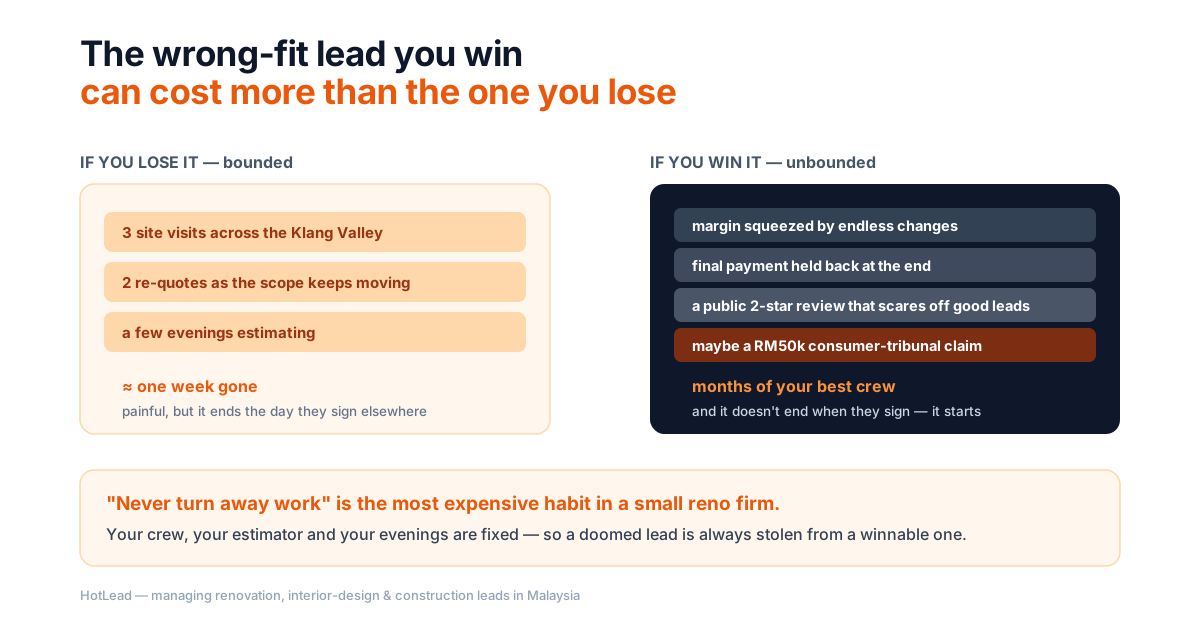
Because your capacity is fixed, and a lead that will never close well is always stolen from one that would. That's the whole argument, and it's worth sitting with, because "never turn away work" feels like the safe, hungry, professional instinct — and for a firm with idle crews it sometimes is. For a firm running at or near capacity, it's the opposite.
Think about what you actually have to spend: one crew, maybe two. One owner-estimator — usually you. A finite number of evenings before your family stops recognising you. That budget doesn't grow because you said yes to another lead; it just gets divided more ways. So when you pour three site visits, two re-quotes and four evenings into the Rawang job, that time didn't come from nowhere. It came out of the Kota Damansara enquiry you replied to a day late, and the Puchong referral you never followed up, because you were busy re-costing a job that was never going to be built.
That's the cost nobody puts on a dashboard: the opportunity cost of a doomed lead. Sales research is blunt about the pattern. The Brooks Group notes that the highest-performing teams — 40 to 60% win rates — are the ones disciplined about saying no to weak-fit leads, while teams that chase everything sit at 20 to 25%. Customer-profitability research finds the same shape from the other end: a minority of clients generate most of the profit while a sizeable share are unprofitable to serve, and one oft-cited analysis put a bank's numbers at roughly 20% of customers driving about 82% of profit, with nearly half unprofitable. The energy spent over-serving a bad account is energy your best people could have spent on a better one.
Renovation just makes it more literal, because your capacity is a physical crew, not a mailbox. You can't clone the team to absorb a bad job. Every day it runs is a day it isn't building a good one.
Why can the wrong-fit lead you win cost more than the one you lose?
This is the part owners get backwards, so let me say it plainly: losing a wrong-fit lead is the cheap outcome. Winning one is where it gets expensive.
Walk the two paths. If you lose the Rawang job, the cost is bounded and you can see all of it — three visits at roughly RM300 each in Klang Valley hours (as I costed out in the free site-visit trap), a couple of quotes, some evenings. Painful, but it ends the moment they sign with someone else. You get your capacity back.
If you win it, the meter keeps running, and now it's uncapped. The buyer who haggled your deposit before you'd even quoted is the same buyer who'll fight every variation and hold back the final payment. The scope that changed with every WhatsApp keeps changing on site, and each change eats the margin you were already thin on. And a job that sours doesn't just cost you the job — it costs you the next jobs, two ways:
- The review. Malaysian renovation buyers lean hard on public ratings — FindContractor.my notes homeowners prioritise contractors with 4.5+ stars on Google, Facebook and Recommend.my. A single angry two-star from a wrong-fit job you never should have taken sits there scaring off the good-fit leads who would have converted.
- The tribunal. When a mismatched-expectations job ends in a dispute, Malaysian homeowners have a cheap, direct weapon: the Tribunal for Consumer Claims (TTPM) hears renovation claims up to RM50,000 for a RM5 filing fee, no lawyer required, filable online (KPDN). And these cases are real and regular — The Star has reported an Iskandar Puteri homeowner awarded a RM50,000 refund for renovation delay and, separately, a contractor ordered to pay RM50,000 for failing to finish a home renovation. A wrong-fit job — mismatched budget, a buyer primed to feel cheated — is exactly the kind most likely to end up there.
What are the four early signs of a wrong-fit lead?
There are four, and the good news is you can read all of them from WhatsApp — before you've committed a single visit. None is fatal on its own; the point is the pattern. One sign is a question to ask. Two or more together is your cue to slow down before you drive out.
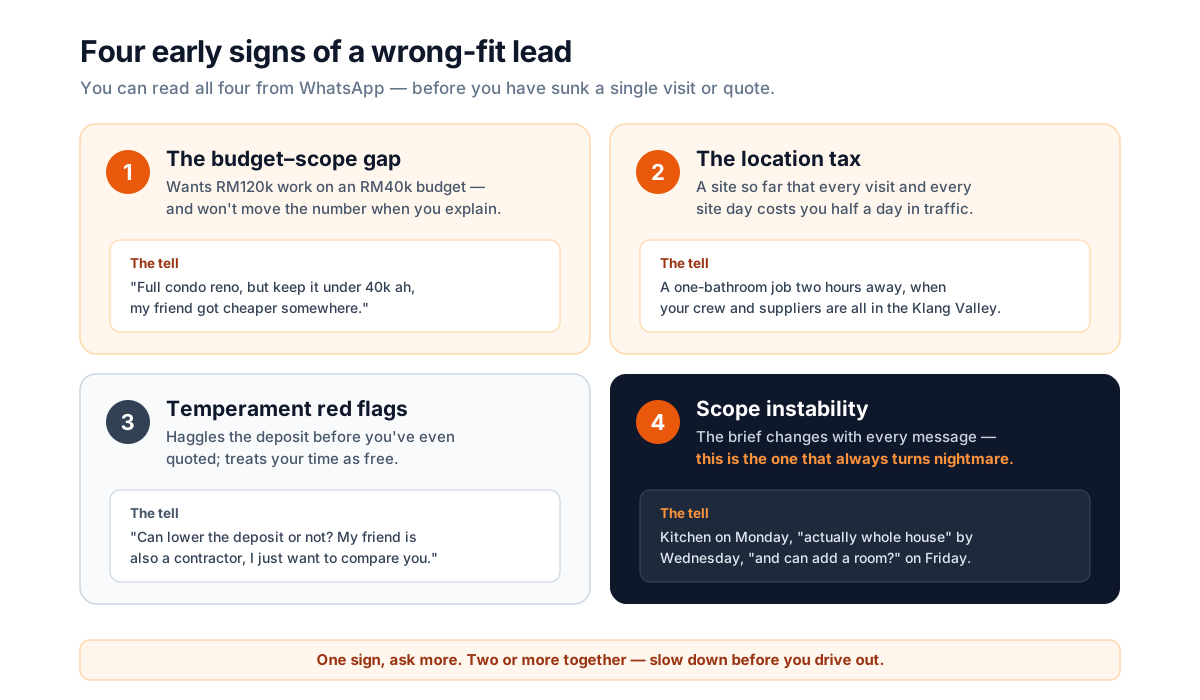
- The budget–scope gap. They want RM120k of work on an RM40k budget, and when you explain the gap, they don't adjust the scope or the number — they push back on you. A buyer who can flex one lever (smaller scope, or a bigger budget, or a phased plan) is workable. A buyer who wants champagne on a teh-tarik budget and won't move is telling you the job can only be delivered at a loss or a lie.
- The location tax. A single-bathroom job two hours from your base, when your crew, your suppliers and your other sites are all in the Klang Valley. Distance isn't wrong-fit by itself — a big enough job justifies the travel. But a small job far away means every visit, every delivery and every site day quietly costs you half a day you'll never bill for.
- Temperament red flags. They haggle the deposit before you've even quoted. They treat your time as free — expecting detailed costings, then going quiet, then reappearing to demand more. They play leverage games: "my friend is also a contractor, I just want to compare", or "another firm quote me cheaper, you match or not?" How someone treats you while they still want something from you is the kindest they will ever be. It only gets harder after they've paid a deposit.
- Scope instability. The brief changes with every message — kitchen on Monday, "actually whole house" by Wednesday, "and can add a room?" on Friday. This is the one that most reliably becomes a nightmare, because a job that won't hold still to be quoted won't hold still to be built. It's the lead-stage version of the variation-order problem: if the scope is already unstable before you've signed, it will be chaos after.
How do you say no fast without burning the referral or the review?
You make the no fast, warm and reasoned — and you understand that a fast no protects goodwill far better than a slow one. The instinct that gets owners into trouble isn't saying yes to a bad lead; it's not being able to say no cleanly, so they stall — half-reply, delay the quote, hope the lead loses interest so they never have to decline. That slow fade is the worst of all worlds: you still burn the visits and evenings, and you frustrate the buyer, and if it came through a referral you've now made your referrer look bad for recommending someone who went quiet.
A clean no does the opposite. Something like: "Thanks so much for thinking of us. Being honest — this one's a bit outside what we do best, and I'd rather point you to someone who'll do it right than take it on and risk disappointing you." Fast. Warm. A real reason. Where you genuinely can, refer them on — a firm that handles that area, that budget, that scope. That referral is worth more to your reputation than the job would have been, and it keeps the door open for the next enquiry from the same source, which might be a perfect fit.
This matters in Malaysia specifically because so much reno work rides on word of mouth — around 49% of how buyers find a firm, by ZenWeb's reckoning, ahead of Google and Facebook. A referrer who staked their own face on recommending you doesn't care whether you win the job — they care that you treated their friend well. A fast warm no does that. A slow ghost, or a resentful yes that ends in a two-star, poisons the exact channel that feeds you the good-fit leads.
Here's the contrast that decides which no you're giving:
| The slow no (what it costs you) | The fast warm no (what it protects) | |
|---|---|---|
| Timing | days or weeks of stalling and half-replies | same-day, once you've read two or more signs |
| The buyer's experience | ghosted, frustrated, tells others | thanked, redirected, respects you for the honesty |
| The referrer | embarrassed — you made them look bad | face intact — you treated their friend well |
| Your capacity | still burned on visits and re-quotes | freed for the good-fit lead behind them |
| Your reputation | risks the review and the word of mouth | earns goodwill even without the job |
When is a "bad-fit" lead actually worth taking?
Not every stretch is a wrong-fit lead, and this is where judgment beats a rigid rule. Some leads that trip a signal are worth taking on purpose — as long as you're doing it with your eyes open, not out of reflex.
- A genuinely quiet season. If your crew is idle and the trough is real, a thin-margin or far job that at least covers wages and keeps the team together can be the right call — the same logic as booking overflow forward in the fully-booked overflow piece, run in reverse. Just price it honestly as a capacity-filler, not as a job you're pretending is great.
- A strategic door-opener. A single unit that's really the front door to a landlord's several units, or a job in a development where you want a reference client, can justify a stretch on price or distance — because you're buying the next jobs, not just this one.
- A stretch you can contain. A far site or a tight budget is workable if the other signals are green — a straightforward, stable scope and a reasonable buyer. The leads that turn into nightmares are almost always the ones flashing multiple signals at once, especially scope instability plus a temperament red flag.
The distinction is intent. Taking a hard lead because you've weighed it and decided it's worth it is a business decision. Taking it because you can't bring yourself to say no is the habit that eats your week.
The bottom line
The wrong-fit lead is the leak that hides behind a virtue. "Never turn away work" sounds like hunger and professionalism, and for an idle firm it can be — but for a firm running near capacity it's the most expensive habit you have, because your crew, your estimator and your evenings are fixed, and every hour on a doomed lead is stolen from a winnable one. Worse, the wrong-fit lead you win can cost more than the one you lose — squeezed margin, a held final payment, a public two-star, even a RM50k tribunal claim — so "at least we got the job" is often the losing move. You can read the four signs early, from WhatsApp, before you've sunk a visit: a budget-scope gap, a location tax, temperament red flags, and a scope that won't hold still. And the discipline that saves your week isn't working harder — it's the fast, warm, reasoned no on day one that protects your capacity, your referral channel, and the review you'd otherwise have earned the hard way.
For the whole system this sits inside — capture, qualify, decide, quote, follow up and measure — start with the complete guide to managing renovation leads in Malaysia, and see how it connects to qualifying a lead on the first WhatsApp reply, the silent site visit, and the free site-visit trap.
How HotLead helps you decide faster, not just capture more
HotLead sits on top of your existing WhatsApp. It can't judge fit for you — reading a budget-scope gap or a temperament red flag is your call as the owner — but it makes the decision faster to reach and the fast no cheaper to give:
- Auto-greeting and capture on every enquiry, so a lead is acknowledged the moment it lands and you can read the signs on WhatsApp before you commit a Klang Valley afternoon to it.
- One owner per lead, with tags and a next action, so the wrong-fit lead you correctly decline is closed cleanly with a reason — not left half-open to drain your week, and not lost in a group chat where nobody remembers who was handling it.
- Overdue-follow-up flags, so if you do take a borderline lead on purpose, the follow-up you promised actually happens — and the ones you passed on don't quietly leak back into your to-do list.
- A funnel and team view, so you can see which enquiries convert and which sources send you good-fit versus wrong-fit leads — the data that tells you where to spend, and where to stop.
If your weeks keep dissolving into jobs you should have said no to, the fix isn't more discipline in the abstract — it's reading fit earlier and closing the wrong ones cleanly. See how HotLead works, or how it fits a renovation firm or a construction firm specifically.
Sources: Brooks Group — qualifying prospects (top teams' 40–60% win rate vs 20–25%; disqualifying weak-fit leads early); widely-cited MarketingSherpa figure that 79% of marketing leads never convert, largely on poor fit; Ranktracker — the 80/20 rule of client retention (a minority of clients drive most profit; a sizeable share are unprofitable to serve); KPDN — Tribunal for Consumer Claims (RM50,000 ceiling, RM5 filing, no lawyer); The Star — Iskandar Puteri homeowner wins RM50,000 refund for renovation delay and The Star — contractor ordered to pay RM50,000 for failing to finish home renovation; FindContractor.my — how to choose a renovation contractor in Malaysia 2026 (homeowners prioritise 4.5+ star ratings); ZenWeb (49% of reno buyers find a firm by word of mouth). Klang Valley visit-cost, margin and job-value figures as cited across the free site-visit trap and the complete guide to managing renovation leads in Malaysia.
Frequently asked questions
What is a "wrong-fit" renovation lead?
It's an enquiry that is a genuine, funded project but a bad job for your specific firm — the budget can't carry the scope they want, the site is too far to service without losing half a day each trip, the buyer's temperament signals a fight over price or payment, or the brief keeps changing so there's no stable job to price. It's different from an unqualified lead (which may not be a real project at all) and from a not-ready lead (a real buyer who's simply months early). A wrong-fit lead is real and ready — it's just wrong for you, which is why it's so easy to keep chasing.
Why is saying no to a renovation lead a good business decision?
Because a small reno firm has fixed capacity — usually one crew or two, one owner-estimator, and a finite number of evenings. Every hour spent on a lead that will never close well, or will close into a loss, is an hour not spent on a lead that would have. Sales research is consistent that the highest-performing teams disqualify weak-fit opportunities early and win more as a result, while chasing everything spreads a team thin and drops the win rate. Turning away a genuinely wrong-fit job isn't lost revenue — it's freeing the capacity your best jobs need.
How can the wrong-fit lead you win cost more than the one you lose?
A wrong-fit lead you lose costs you a few site visits, a couple of quotes and some evenings, and the bleeding stops the moment they sign with someone else. A wrong-fit lead you win keeps costing — the buyer who fought you on price before signing tends to fight the variations and hold back the final payment, the scope that kept changing balloons your costs, and a soured job can end in a public two-star review or a claim at the Tribunal for Consumer Claims, where renovation disputes up to RM50,000 are heard for a RM5 filing fee. "At least we got the job" is often the losing outcome.
How do I spot a bad-fit renovation lead early?
Read four things from the first few WhatsApp messages, before you drive out. First, a budget-scope gap — they want far more work than the number can carry and won't move it. Second, a location tax — a site so far that every visit and site day costs you half a day. Third, temperament red flags — haggling the deposit before you've quoted, treating your time as free, playing the "my friend is also a contractor" card. Fourth, scope instability — the brief changing with every message, which is the sign that most reliably turns into a nightmare job. One sign means ask more questions; two or more together mean slow down before committing a visit.
How do I turn down a renovation enquiry without burning the referral or getting a bad review?
Be fast, be warm, and give a real reason. A quick "thanks for thinking of us — honestly this one's a bit outside what we do best, and I'd rather point you to someone who'll do it right than take it on and disappoint you" protects goodwill far better than going quiet for two weeks and then declining, or worse, taking the job reluctantly and doing it resentfully. Where you can, refer them somewhere genuine. A fast warm no on day one keeps the referrer's face intact and keeps you out of the review that a wrong-fit job would have earned you.
Keep reading
- A Main Contractor Just Asked You to Quote a Package. Qualify the Payer First.When another contractor WhatsApps you to price a trade package, it looks like the cleanest lead of the month — a pro who knows what he wants. It's actually your riskiest, because the risk isn't the project, it's the payer. Here's how to handle it.
- 15 Live Leads, One Free Hour: Which Renovation Lead Do I Call First? I Let AI Rank My MorningA Kajang contractor opens WhatsApp at 8:40am with 15 live leads and one free hour before he's on-site in Semenyih. Who does he call first? The 2026 reflex is to ask AI to score the pipeline and rank the hot ones. I built it. The score read like data, so he worked the list it gave him for a week — and it quietly buried his best lead at the bottom. Here's why a confident 0-to-100 score is worse than no score, and the honest way to order a morning that actually earns its keep.
- How Often Should a Renovation Firm Check Each Number? The Review Rhythm That Fits a Malaysian FirmMost reno owners refresh revenue and the bank balance daily — the two numbers they can do least about — and never review the ones they could still fix this week. Here's how to set each number's review frequency by how fast it moves and whether you can act on it, with a daily, weekly and monthly rhythm built for a WhatsApp-run Malaysian firm.