

Here is a Monday every renovation and interior-design firm that has ever exhibited knows well. You spent the weekend at HOMEDEC — the big home design and interior show at KLCC, 200-plus exhibitors and around 40,000 visitors through the doors — or a mall roadshow in Setapak, or you ran a Qanvast campaign that dumped its enquiries into a sheet. You paid real money for the booth. Now you open the export and it is a mess: jumbled columns, half-empty budget and scope cells, names in three languages, a phone number in a "notes" field, and a couple of rows that look like the same auntie who came back twice.
Forty-plus strangers you spoke to for ninety seconds each, sitting in a spreadsheet nobody wants to re-type. So the 2026 question: can I just point AI at this and get clean lead records back? And the honest follow-up an owner actually cares about — can it do that without quietly losing me the jobs I paid a booth to get? I built it and ran it. Here is the problem, what the mess costs, what the AI builds did, and what you should do on Monday.
What does a messy expo lead list actually cost you?
It costs you the whole booth. A trade-show or campaign list is a paid asset — you spent thousands on the space, the display and two days of your team's time to collect it. Then the industry's dirty secret kicks in: research from CEIR (the Center for Exhibition Industry Research), widely cited across the events industry, puts the share of trade-show leads that are never followed up at all at around 80%, with less than 70% of exhibitors even having a formal follow-up plan (Exhibit Surveys). The number-one reason is not laziness — it is admin friction: cleaning the export, re-keying rows, sorting who gets what.
And the list is perishable. A visitor to a home show walks past dozens of booths in an afternoon; by Tuesday they have half-forgotten which firm was which. The same CEIR-linked figures put follow-up inside 24 to 48 hours at roughly 6 to 9 times likelier to convert than waiting a week. So the clock is the enemy, and re-typing 40 garbled rows by hand is hours nobody has on a Monday. The delayed rows go cold. And the worst-formatted rows — the ones hardest to read — get skipped entirely. At an expected gross profit of roughly RM1,280 on each winnable enquiry (the real ringgit value of a lead, reused here as a typical figure), a dump of 40 is not admin. It is money.
So can AI clean the list? Yes — and again the compute is basically free
Point a model at the CSV, describe the fields you want (name, unit or area, scope, budget signal, source, phone), and it parses each row in a second or two. At the token volumes involved, that is on the order of a tenth of a sen per row — the whole 40-row dump costs less than the parking at KLCC. As with drafting a first reply, the compute is a rounding error, and anyone telling you this is "too expensive" for a small firm is solving the wrong problem.
So if the question were only "can AI read a messy table cheaply?", the answer is an easy yes. But that is not the real question. The real question is what happens on the rows where it is wrong — and a bulk file is the one place where "wrong" hides in plain sight.
What happened when we told AI to just clean and complete the list?
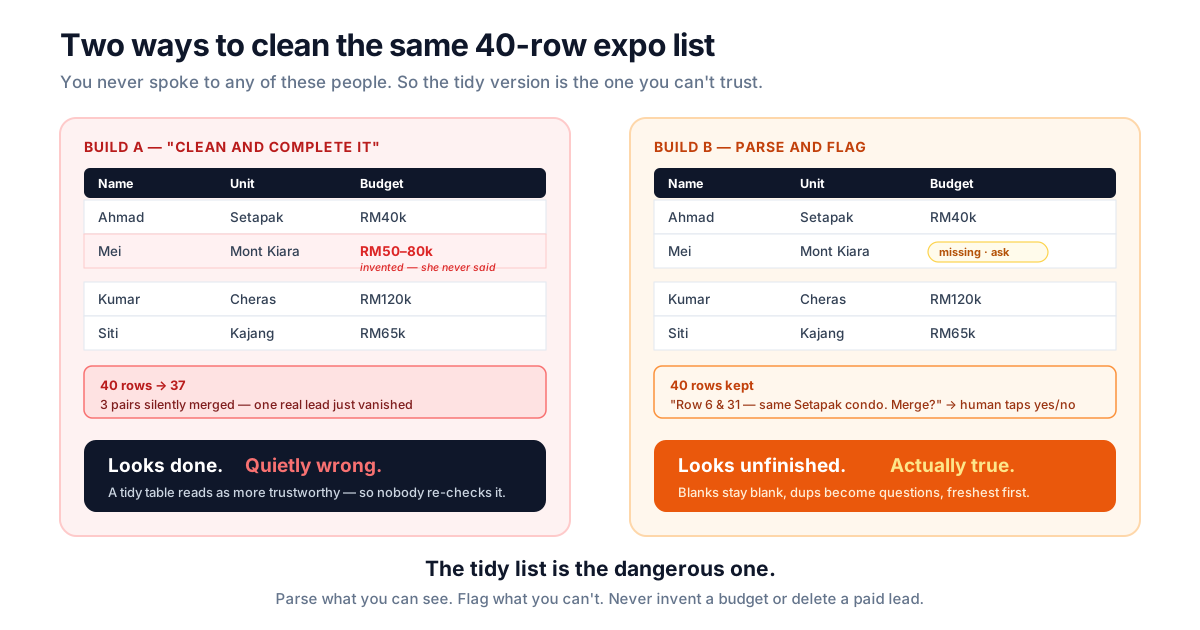
This was Build A: the obvious one. "AI, here is my expo spreadsheet — clean it up, fill in the gaps, remove the duplicates, give me finished lead records." On the tidy rows it was great. On the messy ones — which is the whole reason you were using it — two failure modes showed up fast. I want to be precise that these are the illustrative patterns I saw stress-testing it, not a published trial:
- It invented field values. A blank budget cell came back as a confident "RM50–80k". A blank scope became "full unit renovation". Not once — as a habit. This is not a prompt bug you can scold away; it is documented behaviour. The survey Large Language Models on Tabular Data names hallucination as the key open problem for LLMs on tables, and a 2026 study specifically on missing-value imputation finds models "impute patterns or hallucinate plausible yet incorrect" values when asked to fill blanks. Told never to leave a gap, the model fills it with fiction that reads like fact.
- It silently merged rows. Two rows — "Ahmad, Setapak, kitchen" and "Ahmad B., Setapak condo" — became one. Sometimes that is correct. Sometimes they are two different Ahmads in the same new condo, and one real, paid-for lead just vanished from the list with no trace that it ever existed.
Why is a bulk list the most dangerous place for AI to be wrong?
Because the error is invisible and un-auditable at scale. This is the part that makes a spreadsheet different from every other AI build in this series. With a single WhatsApp lead, you would catch a wrong budget because you are in the conversation — you can scroll up. With a 40-row export, you never spoke to any of these people. The parsed table becomes the only record there is. So a hallucinated "RM50k" or a dropped Ahmad has nothing to contradict it — and worse, a clean, complete-looking table reads as more trustworthy than the messy CSV it came from, so nobody re-checks it. The polish is exactly what hides the fabrication. (It is the same trap as AI reading a supplier quote — a tidy output you check less, not more — but now spread across 40 rows nobody will ever read line by line.)
Then there is the merge half, and the two mistakes are not equal. A missed duplicate is annoying but recoverable — both leads still exist, you sort it out later. A wrong merge fuses two different buyers, buries one thread under the other, and you answer one while silently losing the other with no way to even see it happened. This is the same asymmetry the duplicate-leads experiment ran into — and the record-linkage literature is blunt about it: false matches (overmatching) are the costly, hard-to-detect error, and you should tune the threshold toward the cheaper mistake (Coleridge Initiative, Big Data and Social Science). Across 40 rows, even a "95% accurate" matcher can bury a couple of real leads you paid for. Ninety-five percent is not 95% safe when the 5% each delete a job.
What actually worked: parse and flag, never invent or merge
Build B kept everything good about Build A and removed the part that lost money. It flips the job from "complete the table" to "organise what is really there and mark what is not." Concretely, on each row it:
- Parses only what it can see into fields — name, unit or area, scope, budget signal, phone, source — and keeps the original cell visible next to each parsed value, so verifying is a glance, not a re-read.
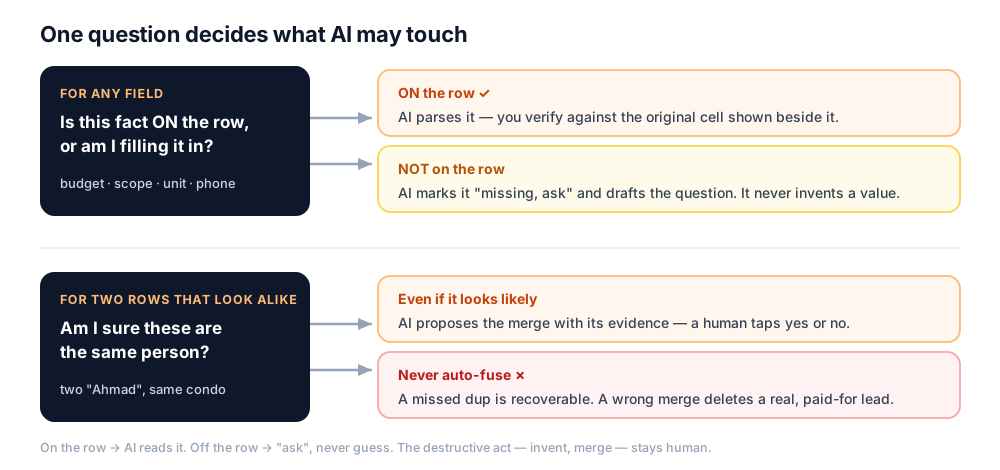
- Flags every empty or low-confidence field as "missing, ask" — never fills it. The blanks stay blank, on purpose.
- Proposes possible duplicates with evidence ("same Setapak condo, 2 rows, similar name — merge?") for a one-tap human yes or no. It never fuses anything itself.
- Tags the source as the event (HOMEDEC, the Setapak roadshow, the Qanvast campaign) so your per-channel numbers stay honest and you can tell whether the booth paid.
- Orders the list by freshness, hottest first, so the team works the perishable ones inside the 48-hour window instead of polishing a table.
The flags and the "missing, ask" markers are the product — not a tidy complete sheet. A list that looks unfinished but is honest beats one that looks done and is quietly wrong. Then a human works it fast.
| Build A — "clean and complete it" | Build B — parse and flag | |
|---|---|---|
| Blank budget / scope | Invents a plausible value | Marks "missing, ask" |
| Possible duplicate rows | Silently merges | Proposes, human confirms |
| Source of truth | The tidy table (looks done) | The row + the flags (stays honest) |
| A wrong cell | Buried, un-auditable | Visible next to the original |
| Compute cost | ~0.1 sen / row | ~0.1 sen / row |
| Cost when wrong | A deleted or mis-quoted paid lead | A ten-second human check |
| What you actually get | A confident, quietly-wrong list | A rough, correct, workable list |
What should an owner actually do on Monday?
You do not need an AI pipeline to fix this. Most of the win is discipline, and AI is a thin, careful assist on top:
- Capture cleaner at the source. A short structured form at the booth — name, unit, scope, one budget question, phone — beats a free-text scribble you parse later. Fewer blanks means fewer holes anything can hallucinate into. The cleanest lead list is the one you didn't have to clean.
- Split fast, work inside 48 hours. Speed on the split beats a perfect table on Wednesday for leads that went cold Monday. Work the freshest and hottest first — that is where the 6–9× is.
- If you use AI, make it parse-and-flag, never invent-and-merge. A blank is "ask", not a guess. A maybe-duplicate is a question, not an auto-fuse. If your tool cannot show you the original cell next to what it extracted, do not trust the tidy version.
- Tag the source and give the dump one owner. Set the source to the event so your cost-per-lead versus cost-per-job stays real — otherwise you will cut the booth that is actually working. And give the whole list one owner, or it sits in a shared drive while everyone assumes someone else is on it.
This is the same test that decides every AI question in this series (the honest limits map spells it out): is this fact on the row, or am I filling it in? On the row, let AI read it and you verify. Not on the row, the honest answer is "unknown, ask" — never a confident guess.
How HotLead fits — and what it deliberately does not do
I will be straight, because over-claiming is the hype I am arguing against. HotLead does not ship an AI spreadsheet-cleaner, a bulk CSV importer that fills your gaps, or an auto-dedupe engine — and that is on purpose, because this experiment is the reason why. Inventing a budget or silently deleting a paid lead is not a feature you want running unattended. What HotLead does is the boring plumbing that makes a paid list actually get worked instead of rotting:
- Capture onto one source-tagged record — however a lead reaches you, it lands in one place with the channel attached, so a HOMEDEC lead is marked a HOMEDEC lead.
- One owner by rule — the dump gets an accountable human, not a shared-drive limbo where everyone assumes someone else is calling.
- Next-action and overdue flags — so a fresh expo lead cannot quietly age out overnight, which is the exact leak the 80%-never-followed-up number is made of.
- A funnel and per-channel view — so you can finally see whether that RM-thousands booth actually paid, or just filled a spreadsheet.
In short, HotLead keeps the paid leads from dying of neglect and leaves the judgement — every invented cell, every merge — to a person. That is the build that pays. If a stack of un-worked lead lists is your leak, start with the complete guide to managing renovation leads in Malaysia, see how it fits a renovation firm or an interior-design studio, or read the companion piece on spotting the same buyer across channels.
Sources: trade-show follow-up and lead-perishability figures are widely-cited CEIR (Center for Exhibition Industry Research) and Exhibit Surveys data as aggregated by industry reports (Wave Connect — Event Marketing Statistics 2026) — about 80% of trade-show leads never followed up, under 70% of exhibitors with a formal follow-up plan, and roughly 6–9× higher conversion when following up within 24–48 hours; HOMEDEC event scale (KLCC, 200-plus exhibitors, ~40,000 visitors). LLM behaviour on tabular data — Large Language Models on Tabular Data: Prediction, Generation, and Understanding — A Survey (arXiv:2402.17944) (hallucination as the key open problem) and Large Language Models for Missing Data Imputation (arXiv:2603.22332) (models hallucinate plausible-but-incorrect values filling blanks). Record-linkage asymmetry — Coleridge Initiative, Big Data and Social Science (false matches are the costly, hard-to-detect error). The ~RM1,280 expected gross profit per lead, ~0.1 sen compute, and Malaysian renovation figures are reused from the complete guide and the cost-of-a-lost-lead piece, labelled illustrative or typical.
Frequently asked questions
Can AI clean a messy trade-show or expo lead list into individual records?
It can parse rows into fields fast and cheaply — about a tenth of a sen a row. What it should not do is fill the gaps or delete duplicates on its own. Asked to complete a table, an LLM invents plausible values for blank cells, and asked to dedupe it will sometimes merge two different people into one and quietly delete a real lead. The safe build has AI parse and flag what is missing, and a human confirm every fill and every merge.
Won't AI just fill in the missing budget and scope for me?
That is exactly the trap. When a budget or scope cell is blank because a booth chat only lasted 90 seconds, the honest value is "unknown". An LLM told to complete the row will instead write a confident, plausible number nobody at the event actually said — and because it reads as data, your team quotes and prioritises off a figure that was never real. A blank is a signal (early lead, ask fast), not a hole to paper over.
Is it safe to let AI auto-remove duplicate rows from a lead export?
No — not unattended. A missed duplicate is recoverable because both leads still exist; a wrong merge fuses two different buyers, buries one lead's details under the other, and you never see the one you lost. Across a 40-row dump, even a 95%-accurate matcher can bury a couple of real, paid-for leads. Let AI propose a merge with its evidence and have a human tap yes or no.
How fast do I need to work expo or roadshow leads?
Fast. A visitor to a home expo walks past dozens of booths, so your list is perishable — commonly cited CEIR figures put follow-up within 24 to 48 hours at roughly 6 to 9 times likelier to convert than waiting a week, yet about 80% of trade-show leads are never followed up at all. A perfect spreadsheet on Wednesday is worth less than a rough, correctly-flagged one worked on Monday.
Does HotLead clean and import my lead spreadsheets with AI?
No. HotLead does not ship an AI CSV-cleaner or an auto-dedupe engine — this experiment is why. What it does is the plumbing that makes a paid list actually get worked — capture each lead onto one source-tagged record, route it to one human owner so the dump is not orphaned, put a next-action and an overdue flag on it so a fresh expo lead cannot age out overnight, and show a per-channel view so you can see whether the booth paid.
Keep reading
- Quote Turnaround Time — The Renovation Benchmark (and What Each Day Costs)You measure how fast you reply in minutes. You never measure how fast you quote in days — yet that's where the money actually moves. Here's the quote-turnaround benchmark for a Malaysian renovation firm, and the ringgit value of every day you shave off it.
- "Boss, Berapa?" The Renovation Lead That Lands on the Wrong ChannelYour hottest organic leads often arrive where they found you — a comment under a project post, or a DM to your personal account — not the business WhatsApp you actually watch. Here's why those leads leak at the capture step, why an ignored public comment costs more than a missed message, and how to catch a lead no matter which door it walks in.
- "We Went With Another Contractor" — I Built an AI to Win Back a Lost Renovation Lead Instead of Slamming the DoorA Shah Alam firm quotes a RM70k job, chases it for three weeks, and finally gets the message every owner dreads — "thanks, we've decided to go with another contractor." The reflex is a terse "ok, all the best 🙏" and a closed chat. The 2026 reflex is to ask AI to detect the rejection and auto-fire a win-back discount. I built it, and it begged. Here's the version that keeps a near-free option on a re-win without ever chasing a no.