

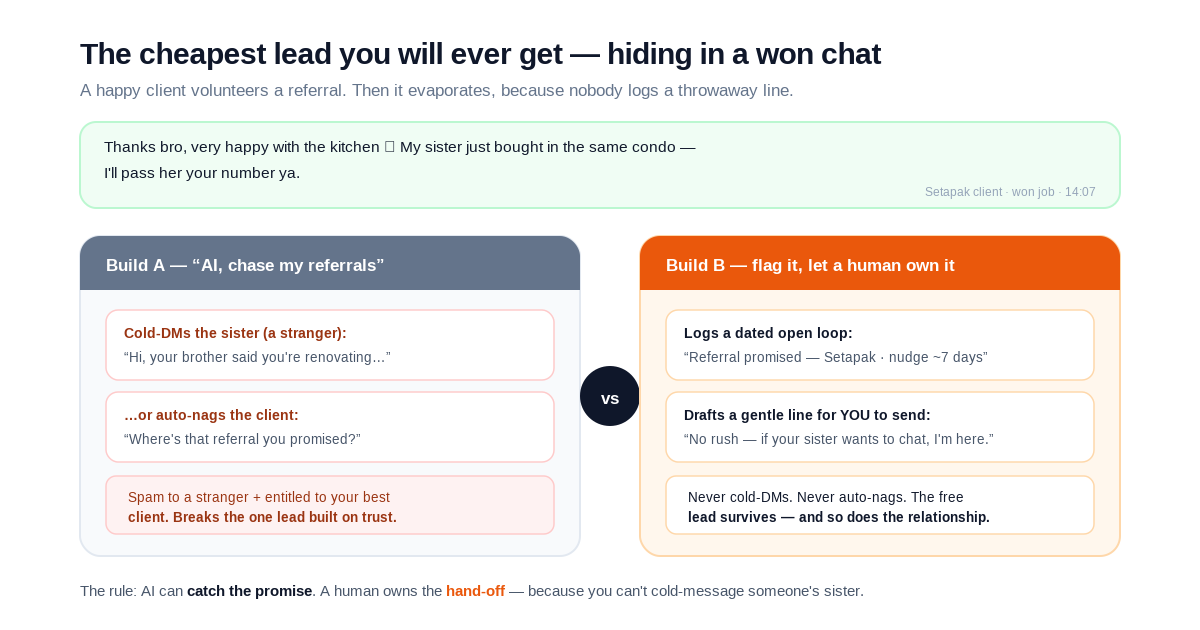
Here is a moment every renovation and interior-design owner has lived, and almost none of us have a system for. A job wraps up well. The client is happy — the wet kitchen is exactly what they wanted — and in the middle of a warm WhatsApp thank-you, they drop this: "My sister just bought in the same condo, I'll pass her your number ya." You reply "wah, thank you so much!" and you mean it. And then the project moves on, the chat scrolls up out of sight, and three months later you have completely forgotten the sister ever existed.
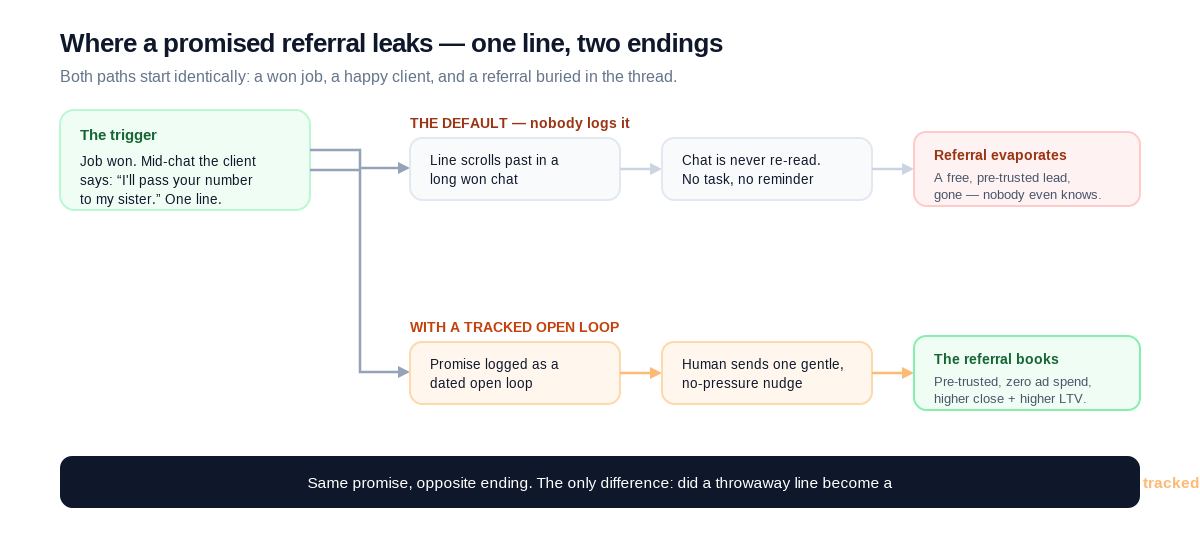
That sister was the cheapest lead you will ever get. She was pre-sold, pre-trusted, going to call you off a sibling's recommendation — the kind of enquiry that converts while cold leads bounce. And she evaporated, not because you chased her badly, but because nobody ever wrote the promise down. So the 2026 question an owner actually cares about is a fair one: can I get AI to catch these promised referrals before they disappear — and can it do it profitably? I built two versions and measured them. One closes a real leak. The other takes your single most valuable relationship and sets it on fire. Here is the difference.
What does a lost referral actually cost a renovation firm?
A lost referral costs you the most profitable lead in your entire pipeline — and it costs it silently, so you never even grieve it. Unlike a stalled quote, which at least sits in your head nagging at you, a forgotten referral leaves no trace. You cannot miss what you never logged.
The reason it hurts so much is that a referral arrives with the one thing every other lead makes you earn: trust. Nielsen's long-running global surveys keep finding that recommendations from people you know are the most trusted source of information there is — around 88% in their 2021 read, 92% back in 2012. Referred customers also behave better after they buy: in Christophe Van den Bulte and colleagues' research (Journal of Marketing Research, 2018), referred customers carried a lifetime value 16–25% higher than comparable non-referred ones, driven by both higher margins and lower churn; the earlier Schmitt, Skiera and Van den Bulte study of roughly 10,000 bank customers put the churn roughly 18% lower.
And this is not a Western quirk. In a small Malay Mail survey of first-time Malaysian homeowners, almost half (46%) said they chose their renovator by word of mouth — treat that as directional, not a national figure, but it matches what every operator in this trade already knows. Between Qanvast, Recommend.my and the family group chat, a Malaysian renovation reputation travels through people, not ads.
So the expected gross profit riding on a winnable enquiry — roughly RM1,280 in the cost-of-a-lost-lead maths — understates a referral, because a referral converts at a higher rate and sticks longer. Losing one is not a rounding error. It is giving away the best sale in the building for free.
Can't AI just read my chats and catch the referral? The reflex build
Yes — and the reading part genuinely works. Spotting a referral offer is an extraction task, and extraction is what large language models are actually good at. A referral is what linguists call a commissive speech act: the speaker commits to a future action. Microsoft's own patent work on identifying tasks and commitments defines a commissive exactly this way — a message where "a sender of the message promises to take an action in the future." Point an AI at a long won thread and ask "did the client offer to refer anyone?" and it will usually find the line, even buried a hundred messages deep where no owner would ever scroll back to.
So I built the obvious thing: an AI that watches won conversations, spots referral offers, and acts on them. And "acts on them" is where the reflex build drove straight off a cliff, in one of two ways.
Failure one: it cold-DMs the stranger. The client said "I'll pass your number to my sister." The AI, told to chase referrals, messages the sister: "Hi, your brother said you're renovating — I'd love to help!" Read that as the sister. A firm you have never heard of has your number and is messaging you about a renovation you mentioned to your brother in private. That is not a warm introduction; it is a cold approach wearing a stolen name tag. It embarrasses the client who vouched for you, and in Malaysia it runs straight into the Personal Data Protection Act 2010, whose general principle is that you process someone's personal data with their consent — which the sister never gave you. The MCMC is separately consulting on rules for unsolicited commercial messages aimed at exactly this kind of no-prior-relationship contact.
Failure two: it auto-nags the client. Tuned more cautiously, the AI instead messages your happy client: "Hi! You mentioned referring your sister — any update on that?" This is less illegal and more socially radioactive. You are chasing a favour that someone offered you, unprompted, out of goodwill. It reads as entitled, it makes a generous person feel billed for their generosity, and it sours the single relationship your whole referral engine depends on.
The tokens, as always in these experiments, are nothing — scanning a thread and drafting a line is a fraction of a sen, the same rounding error as in the first-reply build. The cost was never compute. The cost is the trust the reflex build spends on your behalf.
What actually worked — AI catches the promise, a human owns the hand-off
The build that paid did far less, on purpose. Instead of detect and act, the instruction became: read the thread, flag any moment the client offered a referral, surface it as a dated open loop, and draft one gentle line I can choose to send — to my client, never to anyone else. It catches; it never acts.
Concretely, when the AI sees "I'll pass her your number," it does three things and stops:
- Logs a dated open loop: "Referral promised — Setapak client, sister in same condo. Nudge in ~1 week?" — a task with a name and a date, exactly like a quote to chase.
- Drafts a soft line for the human: "No rush at all — but if your sister ever wants to chat about her unit, I'm happy to help. 🙏" Aimed at the client, low-pressure, easy to delete or rewrite.
- Does nothing else. It never messages the sister. It never sends anything on its own. It never chases without a human pressing send.
That is the whole build, and it closes the real leak — which was never that owners nudge referrals badly. It is that they never log them at all, so there is nothing to nudge. Even the narrow technical job of reliably spotting these asks is harder than it looks: in Lampert, Dale and Paris's NAACL 2010 study, detecting even plain requests in email only reached 83.76% accuracy after segmenting each message into functional zones, and their earlier work argued requests and commitments have to be defined at the utterance level, not the whole message, to be caught at all. AI is a useful catcher here — not a flawless one, and emphatically not a judge.
| Build A — "AI, chase my referrals" | Build B — catch it, human owns it | |
|---|---|---|
| Finds the promise in a long chat | Yes | Yes |
| Messages the referred stranger | Cold-DMs them (no consent, PDPA risk) | Never |
| Messages the client | Auto-nags: "where's that referral?" | Drafts a soft line; human chooses to send |
| Who decides if the referral is real | The AI (it can't) | A human, who knows the relationship |
| Effect on your best relationship | Burns it | Protects it |
| Net result | A free lead turned into spam | A free lead that survives |
What AI still can't do with a promised referral
The limits here are not rough edges — they are the reason the whole thing stays human, and they follow the same one-question test as the honest map of what AI can't do in a contractor's lead process: does deciding this need a fact that isn't in the chat? For a referral, almost everything that matters is off-channel.
- It can't tell a real promise from a polite one. "I'll refer you" and "we should get you connected with people sometime" look similar on the page. Whether the client genuinely will is a fact about their intentions and relationships, not their words — and it is nowhere in the thread.
- It can't make the introduction. The entire value of a referral is that a trusted person vouches for you to someone who trusts them. AI cannot be that person. The hand-off has to come from the client, which is also why it can't be cold-automated.
- It can't judge the timing. A week after handover might be perfect, or the client might be mid-move and stressed. Reading that is relationship sense, not pattern-matching.
- It can't own consent. You may not message the third party until they come to you. That is both the law and the etiquette, and it is non-negotiable.
So the split is the same one every build in this series keeps landing on: AI owns the catch, a human owns the hand-off. Catching is the cheap, safe, genuinely-missed half. The hand-off is the half that only works because a trusted human does it.
Why is this the honest answer for a Malaysian firm right now?
Because in this market the referral is not a nice-to-have channel — for a lot of good firms it is the channel, and it is the one most exposed to the "let AI handle it" pitch. Note this is a different lead from the returning client who messages you again themselves: that one has already walked back through your door. The promised referral is the one still trapped in someone else's goodwill, and distinct again from asking a won client for a review — a review is public proof; a referral is a private introduction, and the etiquette is stricter.
The grounded move is not to skip AI here. It is to point it at the job it is safe and good at — never letting a promised referral slip out of a long chat unlogged — and to keep a human firmly in charge of the introduction, because that human is the product. An AI that cold-DMs your clients' families to "grow referrals" is not a growth hack. It is a reputation leak with a chatbot attached.
What should an owner actually do on Monday?
You can capture nearly all of this upside with a habit, not a platform.
- Log every referral the instant it's offered. The moment a client says "I'll tell my sister," make a dated task with their name — the same reflex you have for chasing a quote. The leak is the un-logged promise, so this one habit closes most of it.
- Nudge the client, never the stranger. When the date comes, send one gentle, no-pressure line to the person who offered — "no rush, but if your sister wants to chat, I'm here." Never message the third party until they message you.
- If you use AI, let it catch, not act. Have it flag the promise and draft the soft line; you decide whether it's real, when to send, and what it says. Never let it message anyone on its own.
- Make "nothing forgotten" the floor. None of this works if the promise vanishes into chat history. It needs to become a tracked task with one owner.
How HotLead fits — and what it deliberately does not do
I'll be straight, because over-claiming is the exact hype I keep arguing against: HotLead does not read your WhatsApp chats, detect referral offers, or message anyone on its own. This piece is an experiment, and the experiment is precisely why that restraint is correct. What HotLead does is make the human fix survivable at a busy firm's pace:
- A next action and overdue-follow-up nudge on every lead, so a promised referral logged as a task can't silently die — the memory layer, surfaced to a person, never auto-sent.
- The whole thread on one lead record, so the "I'll tell my sister" line and the client's name live in one place instead of scrolling out of sight.
- One owner per lead, so the referral doesn't fall between two people, each assuming the other logged it.
- A funnel and per-channel view, so referral becomes a source you can actually see and measure — not a vibe, a number you can grow.
In other words, HotLead makes sure the cheapest lead you'll ever get becomes a tracked task owned by the person best placed to honour it — and leaves the introduction, rightly, to them. If referrals are leaking out of your won chats, start with the complete guide to managing renovation leads in Malaysia, see how it fits a renovation firm, or read the companion builds on recognising a returning client and what AI still can't do in a contractor's lead process.
Sources: Trust in recommendations from people you know (around 88% in 2021, 92% in 2012) from Nielsen — Global Trust in Advertising and later Nielsen survey coverage. Referred-customer lifetime value 16–25% higher, with higher margins and lower churn, from Van den Bulte, Bayer, Skiera & Schmitt — Journal of Marketing Research (2018); the ~18%-lower-churn and ≥16%-more-valuable figures from Schmitt, Skiera & Van den Bulte — Journal of Marketing (2011). The 46% word-of-mouth figure (a small survey of first-time Malaysian homeowners, treated as directional) from Malay Mail / TODAY. Commissive speech-act definition of a commitment from Microsoft's task-and-commitment patent (US9170993); request- and commitment-detection difficulty and the 83.76% zoned-request-detection figure from Lampert, Dale & Paris — NAACL HLT 2010 and their ALTA 2008 work on utterance-level requests and commitments. Malaysia's consent principle and the unsolicited-message consultation from Skrine — MCMC spam consultation and Christopher & Lee Ong — news alert on the UCEM framework. Expected-gross-profit-per-lead and Malaysian renovation cost context as derived in the cost of a lost renovation lead and the complete guide; illustrative compute cost on the order of a tenth of a sen per draft, as in prior builds in this series. Figures are cited for shape and direction, not false precision; no statistic here is invented.
Frequently asked questions
Can AI detect when a client promises a referral in a WhatsApp chat?
Mostly, yes — this is extraction, which AI does well. A referral offer is what linguists call a commissive: the sender promising a future action ("I'll pass your number to my sister"). AI can scan a long won thread and surface that line as a flagged open loop far more reliably than a busy owner who never re-reads the chat. What it cannot do well is judge whether the promise is genuine or just polite, because that depends on the client's real intentions — a fact that is not written anywhere in the chat. So treat AI as a catcher of the promise, not a judge of it.
Should AI automatically message the person who was referred to me?
No — this is the single most expensive mistake the reflex build makes. The client said they would pass your number to their sister; they did not connect you, and you do not have her consent to message her. An AI that cold-DMs that stranger off a half-sentence greets someone who never agreed to be contacted — it reads as spam, embarrasses the client who vouched for you, and can fall foul of Malaysia's PDPA rules on processing personal data without consent. The referral works precisely because a trusted person makes the introduction. Automating that away destroys the only thing that made the lead valuable.
Why do referral leads matter so much for a Malaysian renovation firm?
Because in this trade, trust is the product, and a referral arrives pre-trusted. Nielsen's global surveys consistently find recommendations from people you know are the most trusted source of all — around 88–92% of consumers. Referred customers also churn less and are worth more over time (16–25% higher lifetime value in Van den Bulte and colleagues' research). And in a small Malaysian survey of first-time homeowners, nearly half chose their renovator by word of mouth. A referred enquiry skips the whole trust-building fight that kills cold leads — it is the cheapest sale in your pipeline.
Does HotLead read my chats and catch referrals automatically?
No. HotLead does not read or analyse your WhatsApp conversations, detect referral offers, or message anyone on its own — this article is an experiment, not a description of the product, and the experiment is exactly why that restraint is right. What HotLead does do is make the fix survivable without AI: a promised referral becomes a next action with an overdue nudge so it cannot silently die, the whole thread sits on one lead record so the line is not lost, each lead has one owner so it does not fall between two people, and the funnel shows referral as a real source you can measure. The catching stays human; the never-forgetting is the system's job.
What is the best way to stop losing promised referrals without any software?
Make a one-line habit: the moment a client offers a referral, log it as a dated task with their name — "Setapak client offered to refer sister, nudge in a week" — the same way you would log a quote to chase. Then, when the date comes, send one gentle, no-pressure message to your client, never to the third party: something like "no rush at all, but if your sister ever wants to chat about her unit, I'm happy to help." That is the entire mechanism. The leak is not that firms chase referrals badly — it is that they never log them at all, so the cheapest lead they will ever get dies as a good intention.
Keep reading
- Can AI Reply to Your Renovation Firm's 1-Star Review? I Built It — and the Risk Is How Fast It ApologisesA 2-star review on Google or Qanvast is the first thing your next renovation lead reads — and most firms either ignore it or fire back and make it worse. The 2026 reflex is to let AI write the reply. I built it, and drafting a calm response costs a fraction of a sen. But an AI tuned to be helpful apologises too fast — it will concede a fault in writing, promise a refund that never happened, and grovel to a fake review from a competitor. Here's the build that protects your rank instead of torching it.
- Which Lead Signals Actually Predict a Sale? Reverse-Audit Your Own Won JobsMost firms grade a renovation lead on signals that feel predictive — enthusiasm, a long message, a fast reply — and never check whether those signals actually separate won jobs from lost ones. Here is how to run a reverse-audit on your own closed deals, which signals usually survive it, and why your pipeline is too small to pretend the score is more than directional.
- The "I Only Deal With the Boss" Lead: When the Buyer Refuses Your TeamYou finally hired someone to share the load — then the buyer messages "can I deal with you direct ah, boss?" and refuses to engage your staff. Every big lead quietly re-centralises onto the one person already maxed out, and your firm can never grow past the owner. Here's why caving caps you, why a flat "my staff will assist" loses a nervous buyer, and the move that keeps both.