

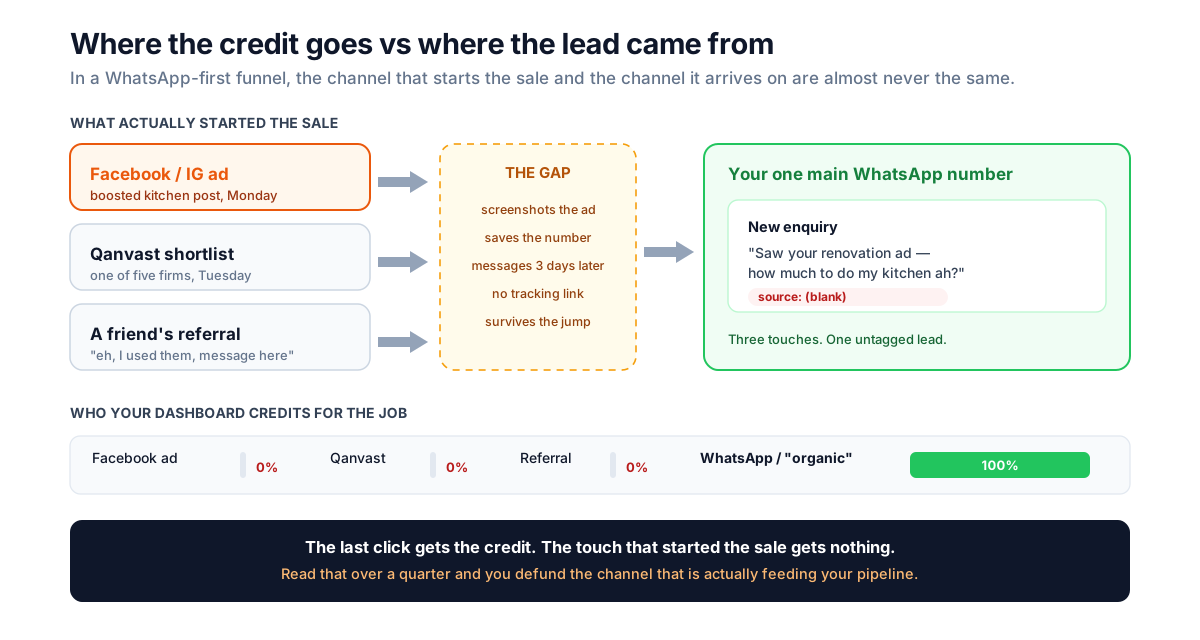
A renovation-firm owner in PJ nearly switched off the one thing that was working. He'd been boosting a kitchen-reno post on Facebook for three months, RM40 a day, and his dashboard was blunt about it: Facebook was sending almost nothing that closed. Qanvast looked fine. Word-of-mouth looked great. "Organic WhatsApp" was carrying the business. So he did the obvious thing — he killed the Facebook spend to move it to Qanvast.
His enquiry volume dropped within two weeks. Not the Facebook-tagged enquiries — those were already near zero. The organic WhatsApp ones. Because half of them had been people who saw the boosted post, screenshotted it, and messaged his main number three days later with "saw your renovation ad, how much ah?" — landing as untagged organic leads that his dashboard credited to nobody. He'd been paying Facebook to fill a bucket labelled organic, then he cut Facebook because the Facebook bucket looked empty.
So he asked the 2026 question: "Can't AI just read the chats and tell me where each lead really came from?" I ran the experiment. Short answer: AI can read a source the buyer stated, and it must not invent one when they didn't. The reason why is the useful part — because the wrong version of this build fails in a way you can't see.
Why is the source field blank on almost every lead?
Because in a WhatsApp-first funnel, the channel that starts a renovation sale and the channel it arrives on are almost never the same one — so a blank source isn't a setup mistake, it's the default state of your inbox. This is the un-Googleable core of the whole problem, and it's specific to how Malaysians actually buy a reno.
Think about the real path. A homeowner sees your boosted post while scrolling at night. They don't tap "Send Message" and start a tidy tracked conversation — they screenshot it, or just remember your name, because they're comparing firms and not ready to talk yet. Two days later a friend says "eh, I renovated with them, message here." By Thursday they've also opened your Qanvast profile, because Qanvast hands them up to five firms to shortlist. Then they message your one main WhatsApp number: "Hi, saw your renovation work, how much for a condo kitchen?"
Every one of those discovery touches is real. Not one of them is attached to the message that lands. The ZenWeb discovery survey has Malaysian reno buyers finding firms through word-of-mouth (about 49%), Google (about 58%) and Facebook/Instagram (about 53%) — the numbers add past 100 because buyers use several at once — but all of them funnel into the same WhatsApp inbox, stripped of where they began.
Doesn't Facebook already tell me which leads came from my ads?
Only for the tidy minority who complete the click-to-WhatsApp flow in one clean motion — and that's the honest nuance most "just track it properly" advice skips. When someone taps a genuine Click-to-WhatsApp ad, Meta attaches a click identifier (the ctwa_clid) to the referral object on the first inbound message, so that one conversation is attributable to the exact ad. That signal is real and worth capturing when it's there.
But it survives exactly one path: tap the ad → land in WhatsApp → send that first message, all in the same flow. The moment the buyer does anything a real reno buyer does — screenshots the ad to show their spouse, saves your number for later, asks a friend who forwards a different number, or lands on your Qanvast profile instead — the referral object is gone and the enquiry arrives with no ad data at all, as plain organic WhatsApp. Meta's own attribution catches the clean tap-through and misses the messy majority. That's why practitioners started calling click-to-WhatsApp an "attribution black hole": the trackable signal exists, but the buyer's normal behaviour walks straight out of it.
So you're left with a field that machine-tracking fills correctly sometimes, leaves blank often, and — if you're not careful — lets an over-eager AI fill wrongly the rest of the time.
So what happened when I let AI fill in the source field?
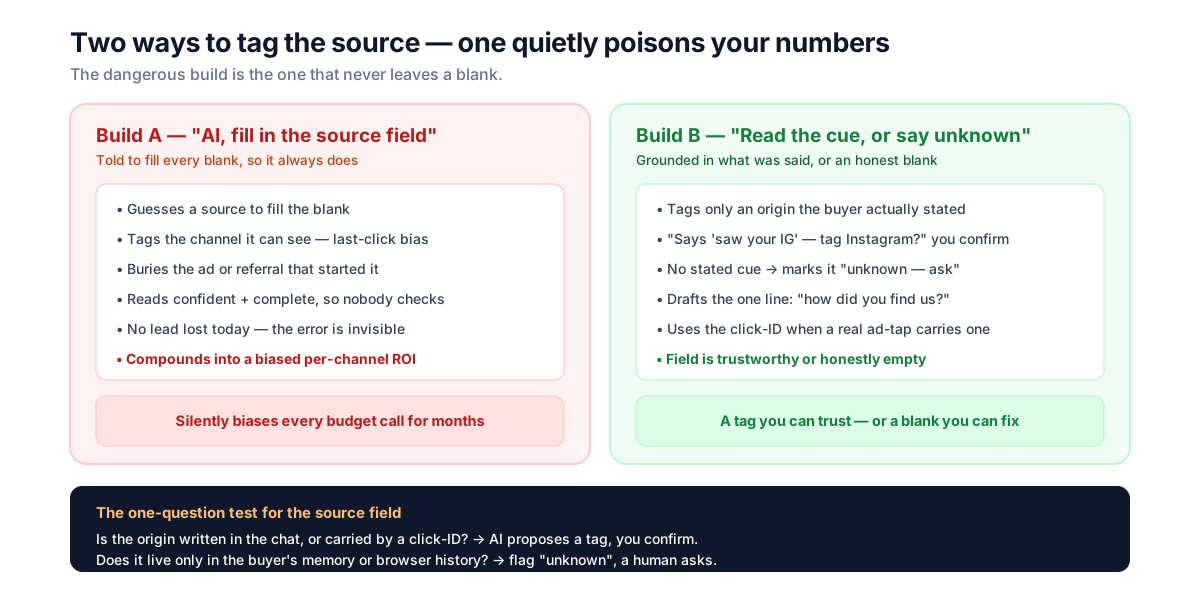
It filled it. Every time. Confidently. And that was the problem.
I gave a model the WhatsApp threads and the instruction any owner would type: "Read each conversation and tell me the lead source." Told to produce a source for every lead, it produced one for every lead — because a language model's job is to return a fluent, complete answer, and "I don't know" doesn't feel complete. When the buyer had actually said "saw your IG," it got it right. When the buyer had said nothing about origin — which was most of them — it didn't leave a blank. It guessed. And it guessed toward the channel it could see.
That's the trap. The only channel visible in the thread is the one the message arrived on — WhatsApp — so an AI asked to attribute a sourceless lead drifts to last-click by default, tagging it "WhatsApp" or "organic" or "direct." It reproduces the exact bias that started the whole mess, except now it's written into the record in confident language, so it looks like data instead of a guess.
Why is a wrong source tag worse than a blank one?
Because a blank tells you the truth — you don't know yet — and a wrong tag lies to you in a voice you trust. This is the asymmetry that makes the auto-fill build dangerous, and it's the same shape as the duplicate-lead problem: the two mistakes cost wildly different amounts, and the reflex build optimises for the cheap-looking one.
- A blank source field is recoverable. You know the gap exists. You can ask the buyer one question — "quick one, how did you find us?" — and fill it with something real, or leave it honestly empty and not count it. Nothing is corrupted.
- A wrong source tag is not. "WhatsApp / organic" on a job that actually came from a Facebook ad reads as a fact. You don't re-check facts. So it flows straight into your per-channel ROI, where it makes Facebook look like it doesn't convert and organic look like a genius. And unlike a lost lead — which at least hurts the day it happens — this costs you nothing visible today. No enquiry disappears. The damage is entirely in the numbers, and it only surfaces months later as a budget decision made on a lie.
That's what nearly happened to the PJ owner. The auto-tagger didn't lose him a single lead. It just quietly confirmed the story his dashboard was already telling — Facebook doesn't work — until he acted on it and watched his "organic" volume fall.
Isn't the self-reported answer good enough on its own?
It's the best single signal you've got, but treat it as a signal, not gospel — because even when you do ask "how did you hear about us," people misremember. This matters because Build B leans on the stated cue, and you should know its limits before you trust it blindly.
The research on "how did you hear about us" surveys is unkind. There's a strong position bias — Ruler Analytics found 47% of people who pick the first option in the list are mis-attributed, just clicking the top choice to move on. There's recency bias: buyers remember the most recent, most vivid touch (the friend who finally pushed them to message) and forget the ad they saw a month ago that planted the idea. And on a considered, months-long purchase like a reno — where the gap between first enquiry and signing runs weeks to months — that forgetting is guaranteed. The touch a buyer names is often the last nudge, not the first cause.
So the self-reported cue isn't a perfect source of truth. It's just a far better one than a model's confident guess, because at least it came from the buyer's mouth. The move is to hold three imperfect signals side by side and reconcile them:
| Signal | Where it comes from | Strength | Weakness |
|---|---|---|---|
Click-ID (ctwa_clid) |
Machine — a real ad-tap | Exact when present | Missing on most leads (screenshots, referrals, saved numbers) |
| Self-reported cue | The buyer states it in chat | Grounded, human | Recency + position bias; names the last nudge, not the first cause |
| Your own memory | The owner/rep who worked it | Catches "oh, that's Aunty Lim's neighbour" | Doesn't scale; fades over time |
None is complete alone. Together they're usually enough to tag a lead honestly — and to know which tags are firm and which are a best guess you shouldn't bet the budget on.
So what did the build that actually paid look like?
The one that flips the job: AI reads for a stated source and proposes a tag — or says "unknown" and asks. It never fills the field with a channel the buyer didn't mention. Same division of labour that's earned its keep at every other step of this chain — let AI do the reading, keep the judgment human.
- When the buyer states an origin — "saw your IG," "found you on Qanvast," "my neighbour Wong used you last year" — AI surfaces one suggestion with the evidence: "They said 'saw your IG' — tag source as Instagram?" You tap yes. One second, and now it's grounded in a real quote, not a guess.
- When there's no stated cue — most leads — it does not invent one. It marks the lead "unknown — ask" and drafts the one line to send: "Quick one before I prep your quote — how did you come across us?" Asked early, casually, while the buyer's engaged, that question fills the field with something real. This is the honest version of "always populate the field."
- When a click-ID is present, it uses it — the machine signal is exact, so let it fill itself. AI's job is the messy majority the click-ID missed.
- It never overwrites a human tag or a click-ID with a guess. The reading is cheap (a fraction of a sen per lead); the attribution decision stays with the person who worked the lead.
What should an owner actually do about lead attribution?
Spend your effort on making the source field honest, not full. A field that's 60% grounded and 40% openly unknown beats one that's 100% filled and quietly 40% wrong. The order matters — most of the win is a habit, not an AI.
- Set the source at capture, from a real signal. The click-ID where it exists, a human tag where you know, "unknown" where you don't. A blank you can see beats a guess you can't.
- Ask the one question early. "How did you come across us?" fits naturally into the first reply, before the buyer forgets and before you're deep in quoting. Asked at the right moment, it's the single most accurate source you'll get.
- Let AI propose the tag, never assign it. Treat a suggestion as a prompt to confirm, not a decision. And treat "unknown — ask" as a feature, not a failure.
- Weight the discovery touch, not just the last click. For a considered reno, the friend who referred you or the ad that planted the idea is what you're really paying to reproduce — so don't let the last nudge steal all the credit.
- Reconcile before you read per-channel ROI. Combine the three signals, resolve the obvious duplicates first, and only then decide where the marketing budget goes. This is the input side of the weekly numbers you act on — garbage in, wrong channel cut.
- Never defund a channel on unattributed data. If a third of your leads are "unknown," you don't actually know Facebook is failing. Fix the attribution first; cut the budget second.
How HotLead fits — honestly
I'll be straight, the way I try to be in all of these, because over-claiming is the exact hype I keep arguing against. HotLead does not ship an AI that guesses where every lead came from — the auto-source-guesser is the experiment in this piece, and the whole piece is an argument for why it shouldn't run unattended. What HotLead gives you is the groundwork that makes attribution honest:
- Capture onto one source-tagged record. Every WhatsApp, Facebook, Qanvast or referral enquiry lands on one record with a source field you or a rule set at capture — and the Click-to-WhatsApp signal fills itself where it exists. So your numbers are built on tags, not guesses.
- A per-channel ROI view that shows what each source actually returns — the numbers that decide your budget, which is exactly what a wrong tag corrupts. Honest inputs, honest outputs.
- One owner per lead, by rule. The human who works a lead is the one who'll remember "that's the referral from the Mont Kiara job" — the memory signal no model has. Round-robin, manual, or a custom rule by area or source.
- A next action and overdue nudge so the "how did you find us?" question actually gets asked, instead of being a good intention you forget once you're quoting.
The attribution judgment — which channel really started this job — stays with you, because it's the fact that isn't in the chat. If leaking, mis-measured leads are the problem underneath all this, start with the complete guide to managing renovation leads in Malaysia, see how it fits a renovation firm or an interior design studio, or read the companion builds on merging duplicate leads, what AI still can't do, and handling Facebook and Instagram ad leads on WhatsApp.
Sources: Dark social — that roughly 65% of social sharing now happens on private "dark social" channels (GWI, 2023) and that up to ~70% of "direct" traffic is really untracked dark-social sharing (Parse.ly, 2024 Content Analytics Benchmark) — from aggregated dark-social reporting; the term was coined by Alexis Madrigal in The Atlantic (2012). Self-reported-attribution limitations — the position bias whereby about 47% of respondents who select the first option in a "how did you hear about us" list are mis-attributed, plus recency and recall bias — from Ruler Analytics and the wider self-reported-attribution literature (Outbrain, getRecast). The Click-to-WhatsApp attribution mechanic — that Meta attaches a ctwa_clid click identifier to the referral object on the first inbound message of a genuine Click-to-WhatsApp ad, and that this signal is absent when the buyer doesn't complete the tap-through flow (screenshots, saved numbers, referrals) — from Meta's Click-to-WhatsApp ads / Conversions API for Business Messaging documentation as summarised by WhatsApp API practitioners; the "attribution black hole" framing is theirs. Malaysian discovery-channel percentages (word-of-mouth ~49%, Google ~58%, Facebook/Instagram ~53%) reused from the ZenWeb survey cited in the marketing-budget piece; the ~90.7% WhatsApp-for-business figure reused from earlier pieces in this series. Renovation lead-volume and value figures (40–60 enquiries a month, ~RM1,280 expected gross profit per enquiry) are typical operating numbers reused from the funnel-benchmarks and cost-of-lost-lead pieces, labelled typical, not a single quoted study; the attribution experiment and per-lead AI cost are described from practice and labelled illustrative, not a controlled trial or a quoted price.
Frequently asked questions
Can AI tell me where a WhatsApp lead came from?
It can read the thread for a source the buyer actually stated — "saw your IG", "found you on Qanvast", "my neighbour recommended you" — and propose that as a tag for you to confirm. What it should not do is fill in a source when the buyer never said one. The true first touch usually lives off-channel, in the buyer's memory or their browser history, not in the WhatsApp chat, so an AI told to always fill the field will invent a plausible answer — and it invents toward the channel it can see, which is the last click, not the ad or referral that actually started the job. The safe build proposes a tag only when there's a real cue, and marks the lead "unknown — ask" otherwise.
Why is the source field blank on so many of my leads?
Because in a WhatsApp-first market the channel that starts a renovation sale and the channel it lands on are different by default. A buyer sees your Facebook ad, screenshots it or just notes the name, and messages your one main WhatsApp number days later with no tracking link attached. Genuine Click-to-WhatsApp ads do pass a click-ID that identifies the ad, but that only survives if the buyer taps the ad and messages in that same flow — the moment they screenshot it, save your number, or come back through a referral, the tracking is gone and the lead arrives as an untagged organic WhatsApp enquiry. So a blank source field isn't a mistake in your setup; it's the resting state of the funnel.
Why is a wrong source tag worse than leaving it blank?
Because a blank is recoverable and a wrong tag is trusted. If the field is empty, you know you don't know, and you can ask the buyer "quick one, how did you find us?" If the field says "WhatsApp / organic" but the job actually came from a Facebook ad, you believe it — and you carry that false credit into your per-channel ROI, where it makes Facebook look like it doesn't convert. Read that over a quarter and you cut the ad budget that's feeding your pipeline. A wrong tag doesn't lose one lead loudly; it biases every budget decision quietly, for months.
Doesn't Facebook already tell me which leads came from my ads?
Only for the leads that complete the click-to-WhatsApp flow cleanly. When someone taps a genuine Click-to-WhatsApp ad, Meta attaches a click-ID to the first message so you can attribute it. But a big share of Malaysian reno buyers don't behave that way — they screenshot the ad, ask a friend, save your number, or land on your Qanvast profile, then message your main line later. Those arrive with no referral data at all. So Facebook's own attribution catches the tidy path and misses the messy majority, which is exactly the gap this piece is about. The trackable signal is worth capturing when it's there; it just can't be the whole answer.
Does HotLead automatically tag where every lead came from?
No, and I won't pretend it does — the automatic source-guesser is the experiment in this piece, not a shipped feature. What HotLead gives you is the groundwork that makes attribution honest — every enquiry is captured onto one record with a source field you (or a rule) set at capture, and a per-channel view that shows what each source actually returns. The captured Click-to-WhatsApp signal fills itself where it exists; everything else is a human tag or a quick "how did you find us?" The judgment — which channel really started this job — stays with you, because that's the fact that isn't in the chat.
Keep reading
- "Can Discount Ah?" Can AI Spot a Price-Shopping Renovation Lead — and Should It Decide the Next Move?A Puchong contractor gets "another firm quoted me RM55k, can match or not?" at 10pm and does what a tired owner does — he knocks RM6k off to not lose it. He's trained that buyer, and the ten after her, to push. So the 2026 reflex is to ask AI to read the thread, flag the price-shoppers, and either auto-discount to win them or bin them as tyre-kickers. I built it. It mislabels your best buyer as a time-waster and your margin as negotiable — because the signal is in the chat but the right move never is. Here's the build that earns its keep, and why "can discount ah?" is the start of a conversation, not a verdict.
- What a Referred Lead Is Actually Worth — and Why Your Best Ringgit Protects ItA referral isn't just a "free" lead — it wins on cost, close rate and lifetime value at the same time, and those three advantages multiply. Here's what a referred renovation lead is really worth against a paid one, why owners under-fund their single best channel, and why the highest-return marketing ringgit protects the referral engine instead of buying more cold strangers.
- "Boleh Buat Macam Ni Tak?" — The Expensive-Look, Small-Budget ID Lead in MalaysiaA homeowner sends a saved Instagram image of a RM250k penthouse look and asks for it on a RM90k budget. Most Malaysian ID studios either quote the dream and scare them off, or say "can can" and disappoint them later. Here's why this lead is actually one of your most winnable — and the "same look, three budgets" way to convert it without touching your margin.