

A contractor in Klang nearly re-priced his whole business off a rival that might not exist.
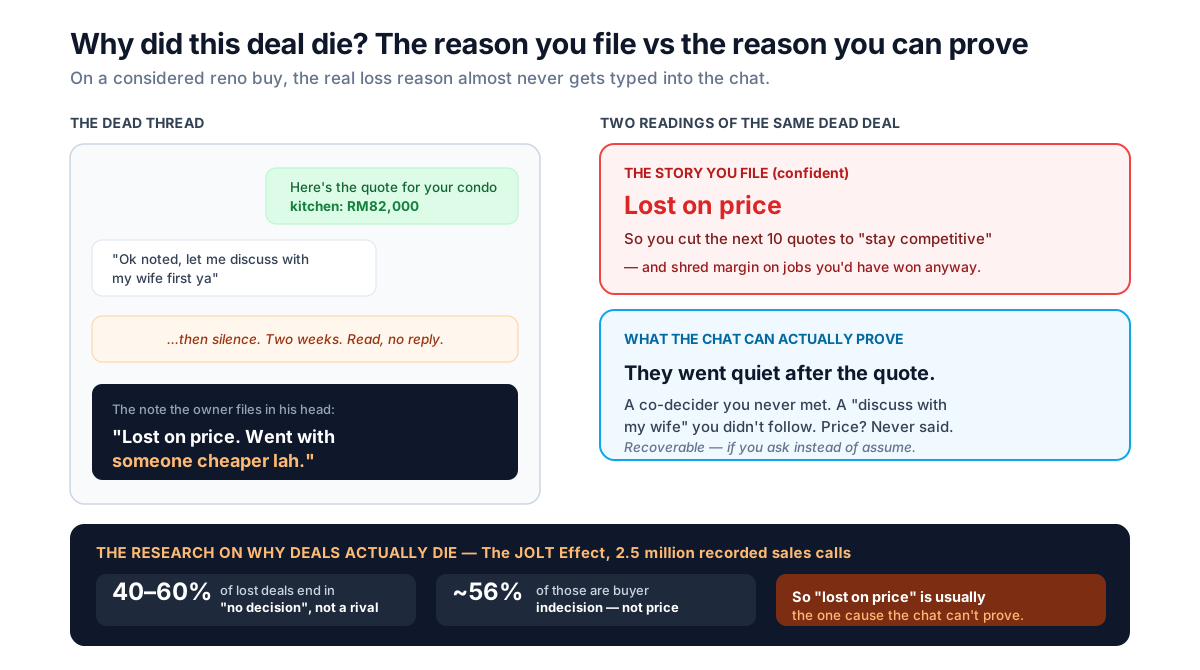
He'd quoted RM82,000 for a condo kitchen — a good scope, a fair number for the work. The buyer replied "ok noted, let me discuss with my wife first ya," and then nothing. Read, no reply, two weeks. So he did what every busy owner does: he filed it in his head under lost on price, went with someone cheaper lah, and moved on. He had maybe forty of these dead threads sitting in WhatsApp. He'd never once gone back and worked out why any of them actually died — because between site visits, quotes and chasing crews, a post-mortem is unpaid work that never feels urgent.
The problem is that the story he files quietly runs his business. Believe enough deals were "lost on price" and you start cutting your next ten quotes to compete with a phantom, shredding margin on jobs you'd have won at full price anyway. So he asked the 2026 question, the one I keep getting asked: "Can't AI just read all my dead chats and tell me why each one really died?"
I built it. Short answer: AI can propose a reason and show you the line it's reading — but the moment you let it auto-tag a cause for every dead deal, it starts inventing, because the real reason almost never made it into the chat. And a fluent, confident wrong reason is worse than an honest blank. Here's why, and here's the version that actually paid.
Why doesn't an owner ever learn why a deal died?
Because the post-mortem is unpaid, un-urgent work, and the reason you'd be digging for usually isn't in the chat to begin with. A lost lead hurts once — the day it goes cold — and then the brain does what brains do: it reaches for the tidiest story that lets you stop thinking about it. "Price" is that story. It's nobody's fault (not your quality, not your follow-up), it needs no evidence, and it closes the file.
The trouble is that the tidy story sends you to fix the wrong leak. This is the same trap as reading a wrong source tag: a confident wrong label is trusted, and a trusted wrong label quietly biases every decision downstream. If your mental ledger says most deals die on price, you'll compete on price — even when the real cost of that lost lead had nothing to do with your number.
And it's not just laziness. On a big renovation buy, the real reason genuinely lives off-channel. The buyer never types "actually my husband thought your firm looked too small to trust with RM82k." They never type "your quote came four days after the other guy's and by then we'd emotionally committed." They type "let me discuss with my wife," or nothing at all. The chat holds the symptom — silence after the quote — not the cause.
What does it actually cost to guess the loss reason wrong?
The money isn't the one dead deal — it's the wrong fix you buy off the wrong reason, applied to every deal after it. A single lost RM82k job costs you one job. A wrong belief about why you lose jobs costs you margin on all of them.
Run the arithmetic the way I run every one of these. Say a busy firm does 40 to 60 enquiries a month and closes around 7 to 8 percent — a handful of real jobs. If a wrong "lost on price" diagnosis convinces the owner to shave 8 to 10 percent off every quote to "stay competitive," he's handing away roughly half the gross profit on a job like this. On an RM80k reno at a typical ~20% margin — about RM16k of gross profit — a 10% discount is RM8k, or half the profit, gone on every job he'd have closed anyway. He does that all year to chase back deals that, per the research, mostly didn't leave over price in the first place.
So what happened when I let AI auto-tag the loss reason?
It gave me a confident cause for every single dead deal. And most of them were invented.
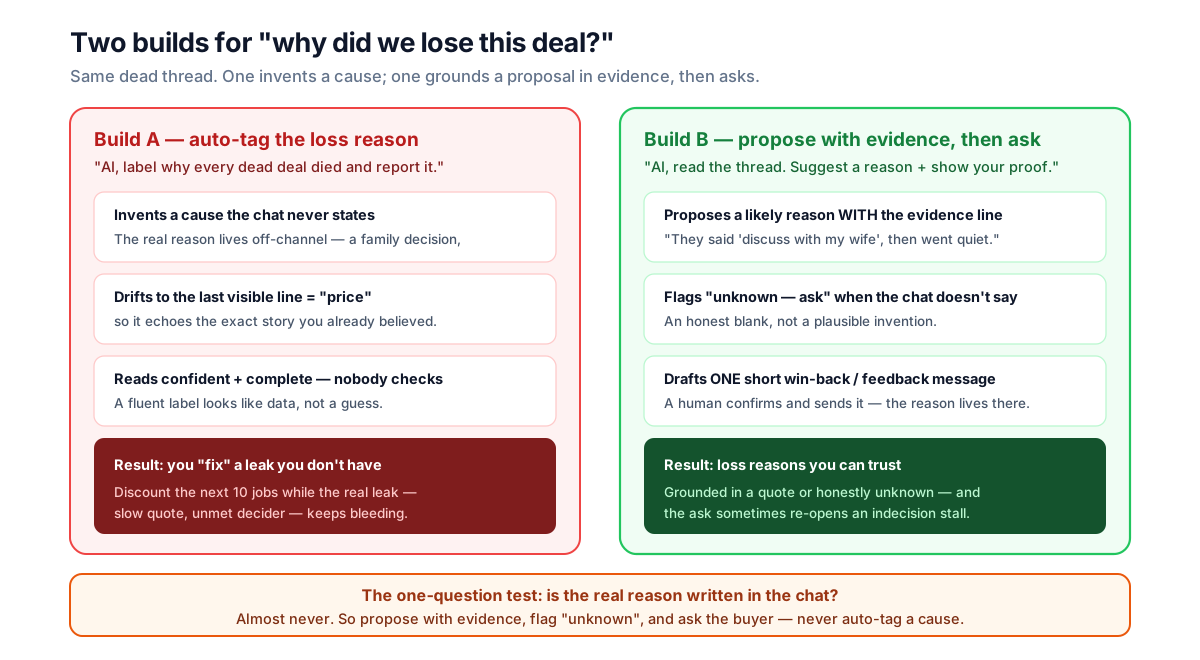
I fed a model the dead threads with the instruction any owner would type: "For each lost deal, read the conversation and tell me why we lost it." Told to produce a reason for every deal, it produced one for every deal — because a language model's job is to return a fluent, complete answer, and "the chat doesn't say" doesn't feel complete. When the buyer had actually stated something — "sorry bro, out of budget" — it read it correctly. But that was a small minority. For the rest, where the buyer just went quiet, it didn't leave a blank. It guessed. And it guessed toward the only cause the chat gives it something to point at.
That's the trap, and it's the exact same failure mode as the AI weekly-report narrator that invents a story to explain a number, and the source-tagger that fills a blank with the last-click channel. The last thing visible before a reno buyer ghosts is very often a soft price line — "wah, a bit high ah," "let me see budget first" — because that's the polite, face-saving thing Malaysian buyers say when the real reason is I'm not sure and I'm scared of getting this wrong. So the auto-tagger reads the cover story, writes "lost on price," and hands you back — in confident, data-shaped language — the exact belief you walked in with. It doesn't diagnose the leak. It launders your assumption.
Why is a wrong loss reason worse than an honest "I don't know"?
Because "unknown" sends you to ask the buyer, and "lost on price" sends you to cut your price. One opens the only door to the truth; the other slams it and hands you a bill. It's the same asymmetry that makes an auto-filled source tag dangerous, and the same shape as the duplicate-merge problem: the two mistakes cost wildly different amounts, and the reflex build optimises for the cheap-looking one.
- A blank loss reason is recoverable. You know you don't know. You can send one message — "mind if I ask what tipped your decision?" — and get something real, or leave it honestly unknown and not act on it. Nothing gets corrupted.
- A wrong loss reason is not. "Lost on price" reads as a fact, and you don't re-check facts. It flows straight into how you quote, how hard you chase, and which channels you keep funding. And it costs nothing visible today — no lead disappears — so nobody ever catches it. The damage is entirely in the lessons you draw, and it only shows up months later as a thinner margin and a habit of discounting.
This is where the research earns its place in a reno owner's head, not just a sales book. The instinct is to trust "lost on price" because it's the reason the chat shows. The data says that's precisely backwards.
What did the build that actually paid look like?
The one that flips the job: AI reads the whole dead thread, proposes a likely reason with the line it's reading, flags "unknown — ask" when the chat doesn't say, and drafts one short win-back message — and a human confirms. Same division of labour that's earned its keep at every step of this chain: let AI do the reading and drafting, keep the judgment human.
- When the buyer stated something real — "out of budget this year," "going with my cousin's contractor" — AI surfaces it with the quote: "They said 'out of budget this year' — tag as budget/timing?" You tap yes. Grounded in a real line, not a guess.
- When there's no stated cause — most dead deals — it does not invent one. It marks the deal "unknown — ask", and it drafts the one message that actually finds the reason: "Hi [name], we've closed off your kitchen enquiry on our side — totally fine if you've gone another way. Mind if I ask what tipped your decision? Helps us improve." This is the honest version of "give me a reason for every deal."
- When a proposal is offered, it comes with the evidence and a confidence flag, never a bare label — "likely: co-decider not engaged (they said 'discuss with my wife', then went quiet). Low confidence — ask to confirm." You can see exactly what it's inferring from, and how much to trust it.
- It reads across deals for a pattern, because that's where the signal is. One dead thread is an anecdote; twenty tagged the same way, at the same stage, is a leak worth fixing.
The reason this split matters is that the load-bearing output here isn't a label — it's a question sent to a human who might answer it. And that's a thing AI genuinely helps with: it never forgets to ask, it drafts the awkward message so you'll actually send it, and it does the reading you'd never find time for. It just doesn't get to decide the cause, because the cause isn't in the data it's reading.
Which reasons can the chat actually prove?
Almost none of the ones owners reach for — and knowing the gap is the whole discipline. Here's the honest map between the story owners file, what the WhatsApp thread can genuinely support, and the recoverable leak that usually hides behind the tidy version.
| The reason you file | What the chat can actually prove | The recoverable leak hiding behind it |
|---|---|---|
| "Went with someone cheaper" | Rarely — you never saw the rival's quote | A slow quote, weak follow-up, or a trust gap you could have closed |
| "Just a price shopper" | Only that they asked "how much" early | No qualifying question asked, so you never learned real intent |
| "They ghosted us" | That you stopped chasing — often at touch two | A stop-point set too early, not a dead lead |
| "Bad timing / no loan yet" | Sometimes stated outright | A real "not now" that belongs in nurture, not the lost pile |
| "Discuss with my wife" then silence | That a co-decider exists and never joined | The decision-maker you never got in the room |
Read down the right-hand column and you'll notice something: almost every "we lost on price" is actually a process leak you own and can fix — a quote that went out too slow, a follow-up that stopped too early, a co-decider you never engaged, a "not now" you mislabelled as "no." Those are worth real money to fix. "Charge less" isn't.
The one message that turns a dead lead into data
Send one short, no-pressure follow-up, and mean the "no pressure" part — because it does two jobs at once. First, it's the only reliable source of the real reason: most people will answer an honest "what tipped your decision?" when there's clearly nothing to sell them. Second — and this is the part the "lost on price" story would have talked you out of — it sometimes brings the deal back.
Remember the research: most dead reno deals didn't lose to a rival, they stalled on indecision. The JOLT authors' finding is that the fix for an indecisive buyer isn't more pressure or a lower price — it's taking the risk out of deciding. A calm message weeks later — "no rush, but if it helps, here's a past condo job like yours and the owner's number" — de-risks the choice for someone who froze, and a share of those ghosted-after-quote deals quietly re-open. A wrong "lost on price" tag tells you to stop chasing and go discount. The truth tells you to go reassure. Those are opposite moves, and only one of them is free.
What should an owner actually do about loss reasons?
Spend your effort making the loss reason honest, not filled in. A lost pile that's half grounded and half openly "unknown" beats one that's 100% labelled and quietly 60% wrong. Most of the win here is a habit, not an AI.
- Stop auto-tagging losses. A blank you can see beats a cause you can't. If you don't know why a deal died, the record should say so.
- Ask the one question. The reason lives with the buyer, not in the chat. One short, face-saving message, sent once, is the single most accurate loss data you'll ever get.
- Separate "no decision" from "lost to a rival." Most stalls are indecision, and indecision is recoverable — with reassurance, not a discount.
- Let AI read, propose and draft — never decide. Treat a suggestion as a prompt to confirm, and treat "unknown — ask" as a feature, not a failure.
- Read loss reasons by source and stage, not one at a time. One dead deal is a story; twenty are a signal. If deals die in a cluster — same stage, same channel — that pattern is the leak.
- Never re-price your business off unasked data. If a third of your "lost on price" deals were never actually asked, you don't know you lose on price. Fix the attribution of why, then decide what to change.
How HotLead fits — honestly
I'll be straight, the way I try to be in all of these, because over-claiming is exactly the hype I keep arguing against. HotLead does not ship an AI that decides why every deal died — the auto loss-reason tagger is the experiment in this piece, and the piece is the argument for why it shouldn't run unattended. What HotLead gives you is the groundwork that makes an honest post-mortem possible in the first place:
- The whole thread captured on one record. When you finally do ask why a deal died, the entire conversation — the quote, the "discuss with my wife," the silence — is right there, not scattered across three reps' phones. The evidence is preserved even when the cause isn't in it.
- One owner per lead, by rule. The human who worked the deal is the one who'll remember "oh, that's the couple who wanted their relative's contractor" — the memory signal no model has. Round-robin, manual, or a custom rule by area or source.
- A next action and overdue nudge. So "ask why we lost this one" becomes a tracked step that actually gets done, instead of a good intention you forget the moment the next enquiry lands.
- A funnel and per-channel view. So you read loss reasons as a pattern — which stage deals die at, which source they came from — instead of one anecdote at a time. That's how you tell a real leak from a story.
The loss-reason judgment — why this one actually died — stays with you, because it's the fact that isn't in the chat. If leaking, mis-diagnosed deals are the problem underneath all this, start with the complete guide to managing renovation leads in Malaysia, see how it fits a renovation firm, an interior design studio or a construction contractor, or read the companion builds on tagging lead sources honestly, spotting the real decision-maker, and what AI still can't do in a contractor's lead process.
Sources: The finding that 40–60% of lost deals end in "no decision" rather than a competitor win, and that roughly 56% of those no-decision losses are driven by buyer indecision (fear of a wrong choice) rather than a preference for the status quo, is from The JOLT Effect: How High Performers Overcome Customer Indecision by Matthew Dixon and Ted McKenna (Portfolio/Penguin, 2022), based on their analysis of ~2.5 million recorded sales conversations. The framing of "no decision" as the single largest category of B2B deal loss — larger than any individual competitor — is Gartner's, from its long-running B2B buying-behaviour research (echoed in CEB/Gartner's The Challenger Customer). The ~90.7% WhatsApp-for-business figure for Malaysia is reused from earlier pieces in this series (aggregated Malaysian messaging-usage reporting). Renovation lead-volume, close-rate and job-value figures (40–60 enquiries a month, ~7–8% close, ~RM80k job at ~20% gross margin) are typical operating numbers reused from the funnel-benchmarks and cost-of-lost-lead pieces, labelled typical rather than a single quoted study; the AI experiment and the Klang scenario are described from practice and labelled illustrative, not a controlled trial. No loss-reason percentage here is invented — the auto-tagger's failure is described qualitatively, because inventing a number for it would be the exact mistake the article warns against.
Frequently asked questions
Can AI tell me why I lost a renovation deal?
It can read the whole dead thread and propose a likely reason with the evidence it is based on — "they said 'discuss with my wife' then went quiet, looks like an unmet co-decider" — and it can flag a deal as "unknown" and draft the one question that finds the truth. What it must not do is invent a reason when the chat never states one, which is most of the time. On a considered renovation buy the real reason usually lives off-channel — in the buyer's head, a family decision, or a competitor's quote you never saw — so an AI told to always fill in a loss reason produces a fluent guess, and it guesses toward the last thing said, which is usually a polite price excuse. Let it read and propose; keep the verdict human and go ask.
Isn't the reason I lost usually just price?
Far less often than it feels. The JOLT Effect, a study of 2.5 million recorded sales conversations by Matthew Dixon and Ted McKenna, found that 40 to 60 percent of lost deals end in no decision rather than a competitor win, and that roughly 56 percent of those no-decision losses are driven by buyer indecision — the fear of making a wrong, expensive choice — not by status quo or price. Gartner's B2B research says the same thing — "no decision" is the single biggest category of lost deals, bigger than any one rival. A renovation is a big, once-in-a-decade, hard-to-reverse spend, so it is exactly the kind of purchase people freeze on. "Price" is the socially easy thing a buyer says and the socially easy thing an owner writes down. It is rarely what actually happened.
Why is a wrong loss reason worse than not knowing?
Because a wrong reason is a trusted instruction to change your business, and a blank is not. If a deal is marked "unknown," you know you don't know, so you go and ask the buyer — the only reliable source of the real reason. If it is confidently marked "lost on price," you believe it, and you act on it — you cut your next quotes, you second-guess your pricing, you defund a channel. A wrong loss reason does not cost you one job loudly the day it is written. It costs you quietly for months, because every fix you buy off it is aimed at the wrong leak.
Should I message a customer who already went with someone else?
Yes, once, briefly, and without pressure — because it is the only place the real reason lives, and occasionally it re-opens the deal. A short, face-saving line works — "Hi, we've closed off your kitchen enquiry on our side, totally fine if you've gone another way. Mind if I ask what tipped your decision? Helps us improve." Most people answer an honest, no-pressure question like that, and the answer is worth more than the guess. And because so many dead reno deals are stalled on indecision rather than genuinely lost to a rival, a calm follow-up that takes the risk out of deciding sometimes brings the buyer back — which is the opposite of the "stop chasing" instinct a wrong "lost on price" tag gives you.
Does HotLead automatically tag why deals are lost?
No, and I won't pretend it does — the auto loss-reason tagger is the experiment in this piece, and the whole piece is the argument for why it shouldn't run unattended. What HotLead ships is the groundwork that makes the post-mortem possible and honest — every enquiry captured onto one record so the whole dead thread is there when you do ask; one owner per lead so someone actually remembers the deal; a next action and overdue nudge so "ask why we lost" becomes a tracked step instead of a good intention; and a funnel plus per-channel view that shows where deals die, so you read loss reasons as a pattern instead of a feeling. The judgment — why this one actually died — stays with the human, because that fact isn't in the chat.
Keep reading
- Did We Already Say RM68k? Using AI to Stop Quote Drift Across a Long Renovation ThreadOver a weeks-long WhatsApp thread with two or three quote revisions, a rep re-states a number that contradicts an earlier promise — and re-opening a settled price quietly invites a discount that eats a whole job's profit. So I pointed AI at the drift. It works beautifully as a flag, and dangerously as an auto-corrector.
- The Warranty as a Closing Lever: Why a Longer Guarantee Beats a Discount on a Renovation DealA quote is stalling and the buyer wants a reason to say yes. Before you drop the price, look at the other lever in your hand — a longer workmanship warranty. It is the same expected-value decision as a discount, but the math runs the opposite way — a price cut costs you thousands with certainty, while extending the defects cover costs you a couple of hundred ringgit in expectation, for arguably more trust with a scam-wary buyer. Here is the EV case for the non-price concession, the trap that turns it into a hidden liability, and which leads it actually moves.
- "Can You Just Build It, My Neighbour Also Did" — Handling the Renovation Lead That Needs Council Approval FirstSome renovation enquiries can't legally start next month, no matter how ready the buyer is — a kitchen extension, a hacked-through wall, a roofed-over air well all need the council's written approval first. Quote a fast build price to win the job and you either lose it to a "boss, can start" cowboy, or win it and inherit the stop-work order, the RM50,000 fine and a client who later can't sell the house. Here's how to spot the permit-first lead and sell the approval as protection.