

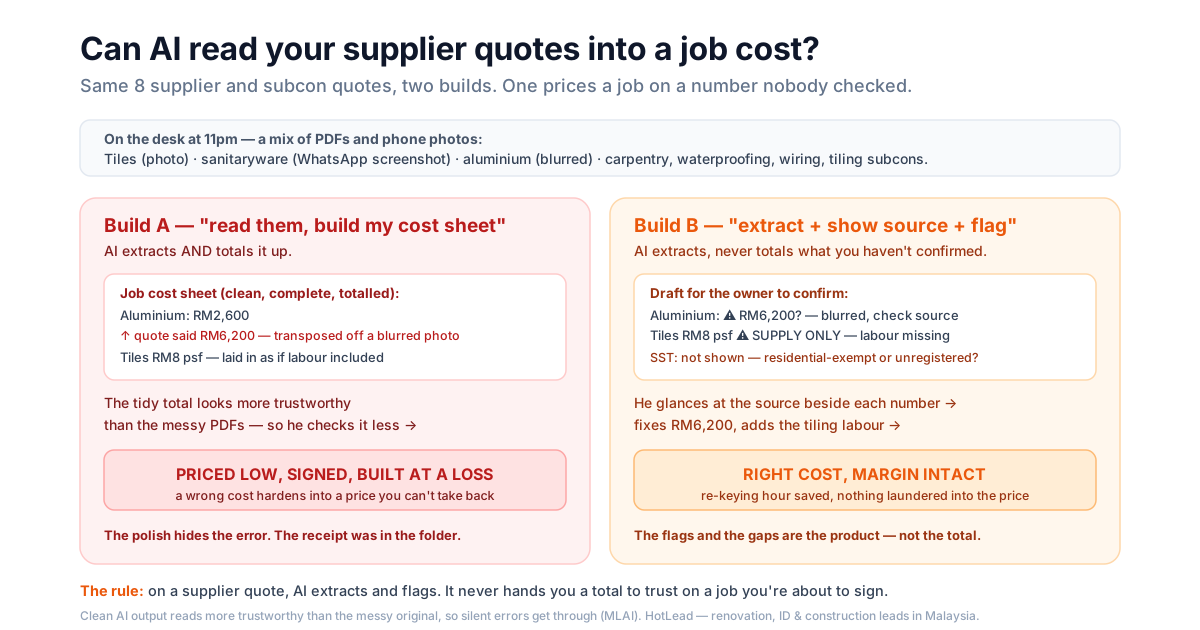
Here is a leak that hides inside a job you're about to win. A Cheras contractor — call him Wei — is pricing a full condo kitchen and two bathrooms in OUG. To build the customer's quote he first has to know his own cost, so he collects the pieces: a tile supplier's PDF, a sanitaryware quote screenshotted off WhatsApp, an aluminium sliding-door quote, and subcon quotes for carpentry, waterproofing, wiring and tiling labour. Eight documents, four formats. At 11pm, between two live sites, he re-keys them all into a costing spreadsheet and adds his markup.
Somewhere in that transfer, the aluminium line — RM6,200 — goes in as RM2,600. He doesn't notice. He prices the job off a cost that's RM3,600 light, comes in cheerfully under the other firm, and wins it. He finds the hole when the aluminium invoice lands for the real number, and by then the price is signed. He builds the job eating most of his margin on it.
That re-keying step is the leak, and it raises the 2026 question this column exists for: now that AI can read a document in seconds, can it pull those supplier and subcon quotes into the cost sheet — and save the typing — without a mis-read number quietly wrecking the margin? I built it two ways. Here's the problem, what the re-typing really costs, what the two builds did, and what an owner should actually do on Monday.
What does re-keying supplier quotes by hand actually cost?
More than the hour, and the hour isn't free either. Pricing a renovation job is really an assembly job: you gather quotes from suppliers (tiles, sanitaryware, aluminium, paint) and subcons (carpentry, waterproofing, wiring, tiling labour), then stack them into one costing sheet, add markup, and that becomes the number you quote the customer. On a small firm the person assembling it is usually the owner, doing it late from a scatter of PDFs and phone photos — exactly where a digit slips.
The benchmarks on manual transfer are unkind. Around 39% of manually processed invoices contain at least one error, and even skilled staff run a per-field error rate of roughly 1% under controlled conditions and 3–4% under real ones — fatigue, time pressure, mixed document quality. Eleven at night, eight documents, four formats: that's the top of the range, not the bottom.
And here is what makes a supplier quote different from any other number you type wrong. This is your cost of goods, not a customer-facing figure. A quote you send too high, you can revise; a cost you carry too low gets multiplied by your markup, wrapped into a price the customer signs, and then it's locked. You don't find out until the real invoice arrives. It's the quiet cousin of the slow-quote leak: the same late-night assembly that makes quotes go out slow is where the wrong number goes in — so throwing AI at it looks like an obvious win.
So can I just tell AI to build my cost sheet from the quotes? (Build A)
This is the build everyone reaches for, and it demos beautifully. Build A: drop the eight files in and prompt "you are my estimator — read these supplier and subcon quotes and give me a complete job cost sheet, line items and a total." And it delivers: a tidy sheet, every line filled, a confident number at the bottom that looks like something you'd hand your accountant. Re-keying hour gone. Magic.
It's magic plus fiction, and the fiction is the expensive part — for three reasons that all point the same way.
First, reading numbers off a document is where models slip. Much of what Wei feeds it is a photo of a printed quote or a WhatsApp screenshot, and general models are known to invent figures or transpose numbers, and to read one invoice correctly then fumble the next near-identical one. It isn't only sloppy scans: the finance-specific FAITH benchmark (arXiv, 2025) finds state-of-the-art models frequently misreport numerical values, and notes that even a 10–20% hallucination rate in complex financial reasoning has outsized impact once it's scaled across real decisions. RM6,200 becoming RM2,600 is not an exotic failure — it's the ordinary one.
Second — and this is the un-Googleable part, so it's worth being precise — a supplier quote is the opposite trap to a site voice note. With a voice note, the danger is there's no recoverable source of truth: the measurement was spoken once and lives only in the estimator's hand. With a supplier quote, the source is sitting right there, fully checkable — the PDF hasn't gone anywhere. So the risk isn't that you can't verify. It's that you won't — because the entire reason you ran Build A was to stop reading eight documents line by line. And a clean extracted sheet reads as more trustworthy than the messy original: models "smooth over" uncertainty into fluent, reasonable-seeming output, and that polish hides the error and makes manual review less likely to catch it. Silent, tidy hallucinations are more harmful than obvious ones precisely because they don't look wrong.
Third, it flattens scope it can't see — the failure that costs even more than a transposed digit, and it gets its own section next.
Put a ringgit on just the first one. Wei's aluminium line read RM2,600 instead of RM6,200 — RM3,600 light. On an illustrative RM60,000 condo job carried at a 20% gross margin, that's about RM12,000 of gross profit, and a single laundered line just ate RM3,600 of it — roughly a third of the margin — on a job he "won" by being cheap with a number nobody actually priced. (Values illustrative, using the condo job and 18–25% margin norms built across this series.)
What AI can't read off the number: supply-only, labour-only, and the new 6% SST question
Even with every digit read perfectly, Build A has a deeper problem: the number on a quote is meaningless without its scope, and the scope is often not on the page. Three lines can show the same figure and mean three completely different costs.
- Supply-only vs supply-and-install. A tile quote at "RM8 psf" might be tiles only — in which case you still owe RM10–30 psf in tiling labour on top — or it might be supply and lay. Same digits; on 350 sqft of floor that's a RM3,500–10,500 difference in what you actually pay. Malaysian contractors routinely bundle everything into a package price, so whether a line includes labour is frequently not stated on the quote at all.
- Labour-only vs all-in subcon. A waterproofing subcon at "RM4 psf" may be labour-only, with you supplying the membrane, or turnkey. The word that decides it is usually spoken on-site, not written in the PDF.
- The 6% SST question — brand new since July 2025. From 1 July 2025, construction and renovation services fall under a 6% service tax — but construction work for residential buildings is excluded, and a supplier only charges it once it crosses the RM1.5 million registration threshold. So when a quote shows no SST line, AI cannot know whether that's correct (residential job, or an unregistered supplier) or a RM3,000 gap that lands on a later invoice. Whether 6% belongs on the number is a scope-and-status question — residential or mixed-use, goods or services, registered or not — and none of it is printed in the digits.
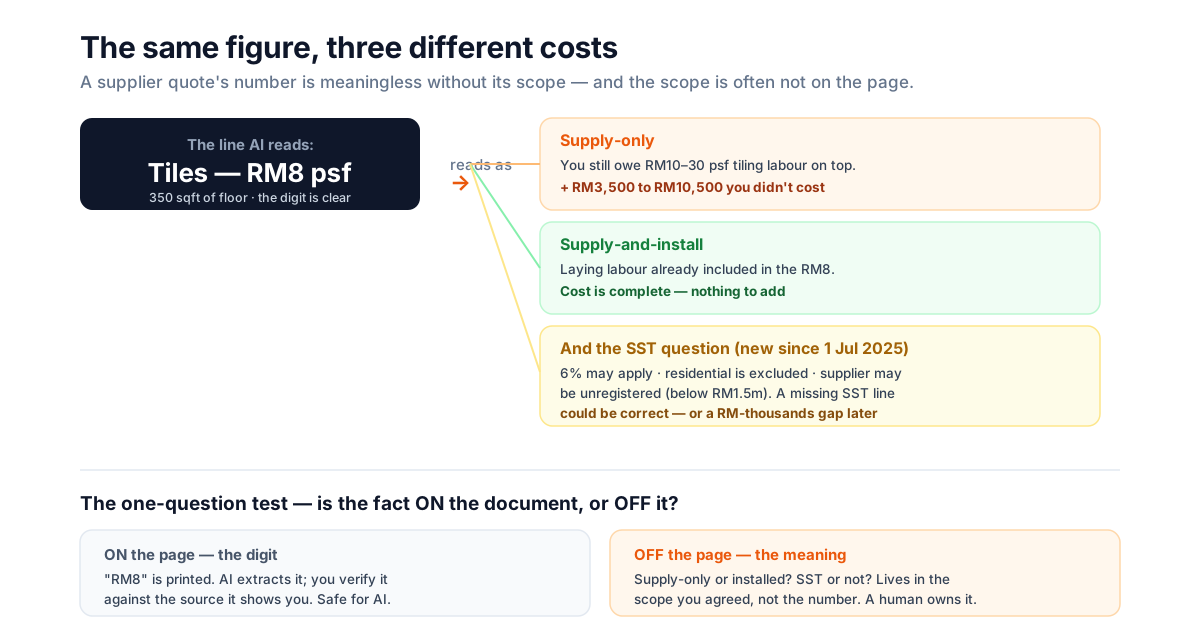
This is the one-question test the honest limits of AI in a lead process keep landing on, sharpened for costs: does answering need a fact that's on the document, or one that lives off it? The digits are on the document — AI can extract them, and you can check them against the source. But whether the line is supply-only, whether a "special price" is a padded anchor, whether SST applies — those live off the page, in the scope you agreed and the tax rules that apply. Build A answers all of them anyway, confidently, and hands you a total that treats a supply-only tile line and a supply-and-install one as the same money.
What actually worked: extract, show the source, flag, never total (Build B)
Build B kept the half AI is genuinely good at and cut the half that guesses. Same eight files, but the prompt flipped: "Extract every line item. Beside each number, show the exact snippet from the source document you took it from. Flag any figure you're not confident about — a photo, a handwritten line, a poor scan. For each line, tag whether it says supply-only, supply-and-install, or doesn't say, and whether SST is shown. Then list what's missing to cost this job. Do NOT produce a total I haven't confirmed line by line."
No laundered bottom line. A checkable draft where every figure wears its receipt. For the OUG job it returns something like:
- Aluminium sliding door — RM6,200 (source: "Aluminium sliding — RM6,200" — photo, slightly blurred, please confirm)
- Floor tiles — RM8 psf ⚠ tagged SUPPLY ONLY (no laying labour on this quote — separate tiling subcon needed)
- Waterproofing subcon — RM4 psf (quote doesn't state labour-only or all-in — confirm before costing)
- SST: not shown on the tile or sanitaryware quotes — confirm whether residential exclusion applies or supplier is unregistered
- Missing to cost this job: tiling labour (subcon quote not attached); confirmation the carpentry line includes the island; hacking and disposal.
The most valuable things on that page are the flags, the scope tags and the gap list — the number it wasn't sure of, the "supply only" it caught, the labour subcon it noticed was missing. That's not a limitation of the AI; it's the entire product. Wei now spends five minutes confirming a blurred figure against the source it shows him and answering three scope questions, instead of an hour re-keying and a month not knowing he under-costed the job. He catches the RM6,200 and the missing RM5,250 of tiling labour — because Build B put a spotlight on both instead of smoothing them into a total.
| Build A — AI builds the cost sheet | Build B — AI extracts, shows source, flags | |
|---|---|---|
| Reads line items | Yes | Yes |
| Shows the source beside each number | No — just the figure | Yes — snippet from the original |
| Handles a blurred or scanned figure | States it as fact — may transpose it | Flags it as low-confidence to confirm |
| Reads scope (supply-only, labour-only, SST) | Silently assumes — flattens it | Tags each line and asks |
| Produces a total | Yes — looks finished, may be short | Not until you've confirmed the lines |
| Effect on the owner | Trusts the tidy sheet, prices, signs | Confirms flags + scope, then prices |
| Worst case | A margin-eating cost, laundered as a total | Five minutes checking flags |
Why is a supplier quote a different trap from a photo or a voice note?
Because of where the truth lives — and this series has now hit all three cases, which is the whole point of the test. When AI is tempted to size a room from a photo, a single uncalibrated image has no scale at all, so the honest rule is you never let it put a number there. When AI transcribes a site voice note, the measurement was spoken once and has no recoverable source, so every number must be flagged for the estimator to confirm against his tape. A supplier quote is the third case: the truth is fully recoverable and sitting right there — which sounds safer, and is actually the sneakiest, because it lulls you into not checking. The document you'd verify against is the document you automated so you could stop reading.
So the fix isn't "trust it because the source exists" — it's "make the source impossible to skip." That's the one thing Build B does that Build A doesn't: it puts the original snippet next to every number, so verifying is a glance, not a re-read. The same read-and-organise-versus-judge split as auto-updating the CRM — AI drafts, the human owns the figure that matters. On a cost sheet, the figure that matters is all of them.
What should an owner actually do on Monday?
You don't need to build software to get most of this — you need one rule and, if you want, one prompt:
- Never let AI hand you a total. If you use it to read quotes, make it extract line items, show the source snippet beside each number, and flag anything off a photo or a scan. A confident bottom line with no receipts is a red light, not a time-saver — this is your cost of goods, so treat every number as unconfirmed until you've matched it to the original.
- Make it tag scope, not just numbers. The costliest errors aren't misread digits — they're supply-only read as installed, or a missing labour subcon. Prompt it to tag each line supply-only / supply-and-install / unstated, and to list what's missing to cost the job. The gap list is worth more than the tidy sheet.
- Handle the SST line as a question, not a number. Since July 2025 a quote might carry 6% construction SST, might be residential-exempt, or might be from an unregistered supplier — AI can't tell which. Confirm the tax treatment against the job type and the supplier's status yourself; don't let a model decide whether RM3,000 belongs in your cost.
- Keep every quote on the lead's record. Supplier PDFs, subcon photos and the customer chat belong on one record, not scattered across a personal phone — so when you assemble the cost, nothing's missing and the quote goes out fast. The reading can be assisted; the number that reaches your markup stays yours.
How HotLead fits — and what it deliberately does not do
I'll be straight, because over-claiming is the hype I keep arguing against. HotLead is a lead-management tool, not an estimating one — it does not ingest supplier quotes, extract line items, or compute a job cost, and this piece is an experiment, not a feature tour. What it owns is the part the experiment proved actually matters — keeping the material together and the follow-through tracked:
- Captures the whole enquiry on one record — every WhatsApp message, photo and PDF, source-tagged, so the documents a quote is built from aren't scattered across a phone you reconstruct at 11pm.
- One owner and a next action on every lead, so turning an enquiry into a sent quote is a tracked step that gets done — the fix for the slow-quote leak, not a forgotten intention.
- A funnel view that shows whether jobs stall at the quote stage — so you can see if slow or messy costing is quietly your leak.
In other words, HotLead keeps the raw material a good cost sheet needs in one place and makes the quote a tracked step — the estimating, the supplier numbers and the margin stay with you. If jobs won on a wrong cost are quietly costing you money, start with the complete guide to managing renovation leads in Malaysia, see how it fits a renovation firm or a construction outfit, or read the companion builds on turning site voice notes into a scope record and what AI still can't do in a contractor's lead process.
Sources: the 39% of manually processed invoices carrying at least one error from Factura.ai — invoice processing benchmark statistics; the ~1% controlled / 3–4% real-world per-field manual data-entry error rate from Conexiom — what's a good data entry error rate; the finding that general models invent figures, transpose numbers and read one invoice correctly then fumble the next from Invoice Data Extraction — invoice extraction using LLMs; state-of-the-art models frequently misreporting numerical values and the 10–20% hallucination-in-complex-financial-reasoning impact from FAITH: A Framework for Assessing Intrinsic Tabular Hallucinations in Finance (arXiv 2508.05201, 2025); the point that clean extracted output creates false confidence, that models "smooth over" uncertainty into fluent-but-wrong text, and that silent hallucinations are more harmful than obvious ones from MLAI Digital — don't use LLMs as OCR: lessons from complex documents; the 6% construction-and-renovation service tax from 1 July 2025 with the residential exclusion and RM1.5m registration threshold from the Ministry of Finance press release and EY Malaysia — SST expansion from 1 July 2025; tiling labour at RM10–30 psf on top of supply, and Malaysian contractors bundling into package prices that hide the material-versus-labour split, from FindContractor.my — bathroom renovation cost Malaysia 2026 and BINA+ — Klang Valley renovation cost per square foot 2026. The RM6,200-versus-RM2,600 transpose, the RM5,250 missing-labour line, the RM60,000 condo job at 18–25% gross margin and the ~0.1 sen compute cost are illustrative, labelled as such, and use the pricing and margin norms built across the complete guide and its siblings.
Frequently asked questions
Can AI read supplier and subcontractor quotes into a renovation costing sheet?
As an extract-and-check job, yes — as an extract-and-trust job, no. AI is genuinely useful at pulling line items out of a stack of supplier PDFs, WhatsApp photos and subcon quotes and laying them out as a draft in seconds for about a tenth of a sen, which saves the late-night re-typing. What it must not do is hand you a finished total you price a job on without checking. Point it at extracting each line, showing the source snippet beside every number, and flagging what it is unsure of — then confirm the numbers and the scope yourself before a single figure reaches your quote.
Why is it risky to let AI build the cost sheet straight from the quotes?
Because the payload is numbers and the output is polished. Reading figures off a photographed or scanned quote is exactly where models transpose and misread, and finance-specific research finds state-of-the-art models misreport numerical values often enough to matter. Worse, a clean extracted sheet reads as more trustworthy than the messy original supplier PDF, so you check it less, not more — and this is your cost of goods, so a wrong line silently sets your price too low and you build the job at a loss.
What is the difference between this and using AI on a site voice note or a photo?
They fail in different places. A photo has no scale, so AI can never measure it. A voice note has no recoverable source of truth, so a misheard measurement can't be checked against anything. A supplier quote is the opposite — the source is right there and fully checkable — so the danger isn't that you can't verify, it's that you won't, because the tidy output makes re-reading the original feel unnecessary. The honest rule across all three is the same — AI extracts and flags, and a human owns the number that goes into the price.
Does the 6% SST on construction affect a residential renovation quote?
Usually not directly — from 1 July 2025 construction and renovation services fall under a 6% service tax, but construction work for residential buildings is excluded, and a supplier only charges service tax at all once it crosses the RM1.5 million registration threshold. That is exactly why AI can't be trusted to judge the tax line — whether 6% belongs on a given quote depends on residential versus mixed-use, on materials versus services, and on the supplier's registration — none of which is printed in the number. It is a scope-and-status question, not an arithmetic one.
Does HotLead extract supplier quotes or do job costing?
No, and I won't pretend it does — this piece is an experiment, not a feature tour. HotLead is a lead-management tool, not an estimating one; it does not ingest supplier quotes or compute a job cost. What it does is keep every message, photo and PDF for a lead on one record with one owner and a next action, so the material a quote needs isn't scattered across a phone and getting the quote out is a tracked step rather than a forgotten one. The costing, and every number in it, stay with you.
Keep reading
- How Much Deposit Should a Renovation Firm Ask For? The Profit-Aware Number, Not a Round OneMost reno firms set their deposit at a round social number — a comfortable 10 percent, or they copy a rival's aggressive 50 percent. Both are wrong. Your deposit is the conversion event of your entire funnel and, at the same time, the only thing standing between your working capital and an unvetted stranger. Here's how to price the deposit from your at-risk cost, why a low deposit is really an interest-free loan to a stranger, and why in Malaysia's scam-scarred, loan-dependent market a high one doesn't just cost margin — it loses the deal.
- The 'Quick Question Ah?' Lead: When a Buyer Uses You as a Free Second Opinion for Someone Else's RenoSome of your busiest WhatsApp threads are with buyers who already have a builder — a cousin, a part-time reno friend — and are messaging you only to sanity-check his price, his tile, his scope. Every question you answer in full is a free consult that de-risks the other guy's job. Here's how to spot the sanity-check lead, why answering everything loses you the work, and how to convert a real doubt without becoming the unpaid QA department.
- Did We Already Say RM68k? Using AI to Stop Quote Drift Across a Long Renovation ThreadOver a weeks-long WhatsApp thread with two or three quote revisions, a rep re-states a number that contradicts an earlier promise — and re-opening a settled price quietly invites a discount that eats a whole job's profit. So I pointed AI at the drift. It works beautifully as a flag, and dangerously as an auto-corrector.