

Here is the part of the job nobody puts on a brochure: the quote goes out, and then nothing happens. The homeowner said "let me discuss with my husband," the designer moved on to three live jobs, and that RM80k enquiry just sits there — warm, winnable, and slowly going cold because no one remembered to chase it. The first reply was fast. The follow-up never came.
That is where renovation deals actually die. Not at hello — at the third or fourth touch that never gets sent. So the 2026 question an owner actually cares about: can AI just do the following-up for me? And the honest follow-up to the follow-up — can it do that profitably, without torching my WhatsApp number or annoying the buyers who were going to say yes? I built it and measured it. Here is the problem, what chasing costs before AI, what the builds did, which leads converted, and what the automation missed.
What does following up cost a renovation firm before any AI?
Before AI, follow-up costs you in the most expensive way there is: deals you already paid to win, lost to silence. The acquisition is sunk — the Meta ad spend, the Qanvast listing, the hour quoting — and then the chase that would convert it never happens because the person who should send it is on a site visit.
The numbers on giving up too early are blunt and well-travelled. Invesp's widely cited compilation puts it at 80% of sales requiring five or more follow-ups, while 44% of salespeople give up after a single follow-up (the "five touches" figure has a fuzzy origin and gets quoted loosely, but the shape — most deals need persistence, most reps quit early — matches what every reno owner sees). A renovation quote is exactly this kind of deal: the homeowner is comparing three firms, waiting on a bank loan, and managing a spouse. It rarely closes on touch one. It closes on touch four — if touch four ever gets sent.
And manual chasing is not just leaky, it is slow and draining when it does happen. Reps across industries spend only around 40% of their time actually selling (monday.com); the rest goes to admin, including the mental load of remembering who to chase and digging back through a WhatsApp thread to recall what was even quoted.
That is the leak worth pointing AI at — not because automated chasing sounds clever, but because the forgotten quote is costing real money. (Sarah's renovation lead follow-up system covers the manual discipline side; this piece asks what happens when you try to hand the discipline to a machine.)
So can AI just run the follow-ups? The reflex build — and why it backfired
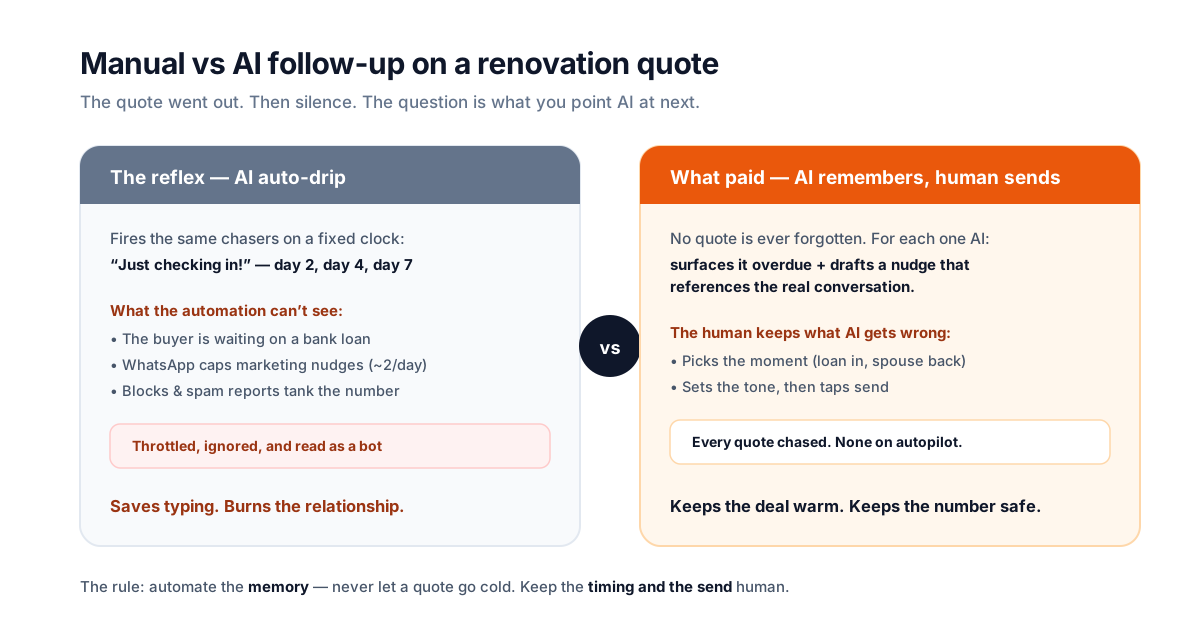
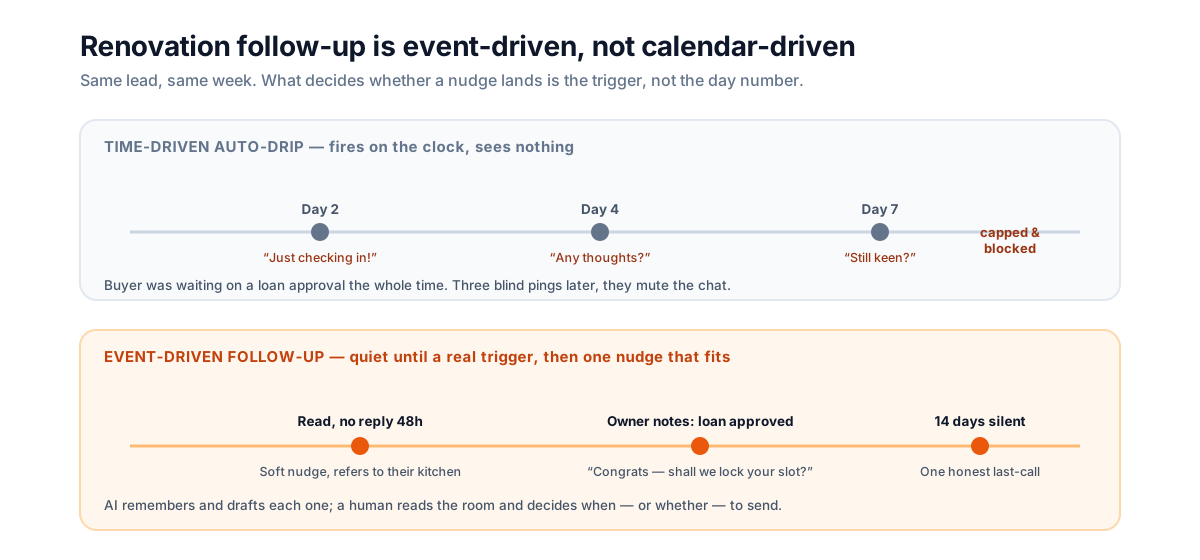
This was Build A, and it is the build almost everyone reaches for first: a fixed auto-drip. Quote goes out, and the system fires a sequence on a clock — "just checking in!" on day 2, "any thoughts?" on day 4, "still keen?" on day 7 — drafted and sent by AI, no human in the loop. It demos beautifully. On a spreadsheet it looks like discipline finally automated.
Then you watch it run on real renovation leads, and two problems show up fast. I want to be precise that these are the illustrative failure patterns I saw building and stress-testing it, not a published trial.
First, renovation follow-up is event-driven, and a clock can't see events. The buyer who went quiet on day 2 isn't ignoring you — they're waiting for their RHB renovation loan to clear, or for their spouse to get back from outstation, or for the keys to a unit that hands over next month. A blind drip pings them three times during that wait, each message proving you weren't listening. The one who actually went cold needed a different message entirely. Same sequence, two opposite situations, and the auto-drip can't tell them apart.
Second — and this is the one most owners never see coming — WhatsApp itself fights the auto-drip. Once the 24-hour customer-service window since the lead's last message closes, every business-initiated nudge has to be a pre-approved template, and "just checking in" chasers are marketing templates. Meta now caps marketing templates at roughly two per user per day across all brands combined — not two from you, two total — so your day-4 chaser can simply fail to deliver (error 131049, "saturation"). And your number carries a quality rating built from user blocks and spam reports over a rolling seven days; a handful of annoyed buyers tapping "block" drags it down and shrinks how much you can send to everyone. The automation meant to save ten minutes can quietly throttle your whole account.
So if the question is "can AI send a sequence of chaser messages cheaply?", the answer is a useless yes. The compute is a rounding error — a contextual nudge is maybe 700 input and 150 output tokens, on the order of a tenth of a sen at illustrative GPT-4o mini list pricing, same as in the first-reply experiment. The tokens were never the cost. The cost is what an unsupervised drip does to live deals and to your number.
What actually worked: AI remembers and drafts, a human keeps the timing and the send
Build B kept everything good about automating follow-up and removed the part that lost money. The split is the same one the qualification experiment landed on, applied to chasing: automate the memory, keep the judgement.
Concretely, AI never sends a chaser on its own. Instead it does two things humans are bad at when they're busy. One, it guarantees nothing is forgotten — every quoted lead surfaces on an overdue list with the context attached, so no winnable deal silently rots. Two, it drafts the next nudge in seconds, referencing the actual conversation — "Hi Mr Tan, hope the loan side is sorting out — happy to hold your March install slot while you decide." Then a person reads the room: is this the right moment, is the loan likely in, should this go today or wait three days, or does this one need a phone call instead of a text? They fix the timing and the tone, and they tap send.
That distinction — AI owns the memory and the draft, a human owns the timing and the send — is the whole product. You keep the discipline of automation (no quote forgotten, no blank-page delay) and you keep the judgement that AI doesn't have (when, and whether, to chase a specific human waiting on a specific thing).
| Build A — AI auto-drip | Build B — AI remembers + drafts, human sends | |
|---|---|---|
| Nothing forgotten | Yes | Yes |
| Compute cost | ~0.1 sen / nudge | ~0.1 sen / nudge |
| Reads the buyer's real situation | No — fires on a clock | Yes — human picks the moment |
| WhatsApp frequency cap / quality rating | Trips it — drip gets capped & blocks tank the number | Avoided — human-paced, in-context messages |
| Tone | Generic, clocks as a bot | Sounds like a person who read the chat |
| Failure mode | Silent — annoys live deals, throttles the account | Visible — a human chose to send or hold |
Which leads converted — and what the automation missed
Across the stress-test, the pattern was consistent enough to state plainly, even though the exact figures are illustrative: the leads that converted were not the ones chased fastest, they were the ones chased at the right moment. Build A's day-2 ping landed before the buyer had anything to say and trained them to ignore the thread. Build B's nudge, fired on a real trigger — a loan cleared, a read receipt with no reply after 48 hours, a fortnight of genuine silence — landed when the buyer was actually in a position to move.
What the automation missed, every time, was the thing that lives outside the chat window: the loan, the spouse, the handover date, the competing quote the buyer is quietly weighing. None of that is in the message history for AI to read, so a model scheduling chasers on text alone is flying blind on the only variable that matters — is now a good time? A human in the loop carries that context for free, because they remember the call where the customer said "let me sort financing first."
The honest measure, then, isn't "AI follow-up converts X% better." It's narrower and more useful: AI converts forgotten quotes into chased ones, and a human converts chased ones into the right-moment ones. Take either half away and you're back to a leak — forgotten deals, or annoyed buyers and a throttled number.
Why is this the honest answer for a Malaysian firm right now?
Because the channel and the market both punish the blunt version. WhatsApp is the renovation sales channel here, which means the WhatsApp rules aren't a footnote — they're the constraint. An auto-drip that would merely underperform over email can actively damage your sending reputation on WhatsApp, and that reputation is shared across every lead you talk to.
And most local SMEs are at exactly the stage where the wrong build does real harm. An AWS-commissioned study of 1,000 Malaysian businesses found 27% now use AI, but 73% are stuck on basic, off-the-shelf tools and only about 10% do anything advanced — with around half citing a digital-skills gap. Translation: a lot of owners are being sold "AI follows up with your leads automatically" as a finished feature, with no one on staff to notice when it's quoting into the void or quietly tanking the number. The grounded move isn't to skip AI on follow-up — it's to point it at the part that's safe and valuable (remembering, drafting) and keep a human on the part that isn't (timing, sending).
What should an owner actually do on Monday?
You don't need to build a follow-up engine this week to capture most of the upside. In order:
- Make "nothing forgotten" the first win. Before any AI sends anything, just guarantee every quote has a next action and an owner. Most of the leak is missing follow-ups, not bad ones — close that first.
- Follow up on events, not day numbers. Tie your chasers to real triggers — read-but-no-reply, a loan likely cleared, two weeks of silence — not a fixed day-2/4/7 clock. If you use AI to draft, draft against the situation, not the calendar.
- If AI drafts, a human still sends. Let the model write the contextual nudge in seconds. Keep a person on the decision of when, whether, and to whom — that's where the WhatsApp risk and the relationship live.
- Protect your number. Never let an unsupervised sequence blast marketing-template chasers. Frequency caps, blocks and spam reports are real, shared across all your leads, and slow to recover from.
How HotLead fits — and what it deliberately does not do
I'll be straight, because over-claiming is the hype I keep arguing against. HotLead does not fire automated AI drip sequences or send chasers on its own — and after this experiment, that's clearly the right call. What it does is the half the experiment proved is safe and valuable:
- A next action and an overdue-follow-up nudge on every lead, so no quote is ever forgotten — the memory layer, surfaced to a person, not auto-sent.
- One owner per lead, so the nudge reaches a specific human who remembers the loan and the spouse and the handover date — the context AI can't see.
- An optional AI assistant you can switch on that warms a brand-new enquiry instantly; the chasing of a quoted lead stays a human's decision, by design.
- A funnel and per-channel view, so you can see whether you're losing deals at follow-up or further down — and fix the right leak.
In other words, HotLead automates the remembering and hands the timing to your team — the build that actually converts. If forgotten follow-ups are your leak, start with the complete guide to managing renovation leads in Malaysia, see how it fits a renovation firm, or read the companion pieces on the manual follow-up system and what a lost lead really costs.
Sources: Follow-up persistence and drop-off figures (80% of sales need 5+ follow-ups; 44% of salespeople give up after one) from Invesp — The Importance of Sales Follow-Ups (a widely cited compilation; the "five touches" stat has a debated origin and is used here for shape, not precision); reps spend 40% of time selling from monday.com — how to qualify sales leads. WhatsApp marketing-template frequency cap (2 per user per day across all brands, error 131049) from Infobip — WhatsApp frequency capping and Meta — per-user marketing template message limits; quality rating built from user blocks and spam reports over a rolling 7 days, and its effect on messaging limits, from Meta Business Help — about your WhatsApp Business number's quality rating and Turn.io — quality ratings and messaging limits. Malaysian AI adoption (27% adoption, 73% basic, ~half cite a digital-skills gap, AWS-commissioned study) from Tech Wire Asia — Malaysia's AI adoption paradox. Illustrative compute cost uses GPT-4o mini API pricing (USD0.15 / 1M input, USD0.60 / 1M output). Expected-gross-profit-per-lead and lost-lead ringgit math as derived in the cost of a lost renovation lead; speed-to-lead and Malaysian renovation cost bands as cited in the complete guide.
Frequently asked questions
Can AI handle renovation lead follow-up automatically?
It can do the remembering and the drafting very well — never letting a quote go cold and writing a contextual next nudge in seconds for a fraction of a sen. What it should not do unsupervised is fire a fixed sequence of chasers, because renovation deals are event-driven (a buyer waiting on a bank loan or a spouse), so a blind drip annoys live buyers and misreads the silent ones. On WhatsApp it also gets frequency-capped. Use AI to remember and draft; keep the timing and the send human.
Why does an automated WhatsApp follow-up sequence get blocked or stop working?
Once the 24-hour customer-service window closes, every business-initiated nudge has to be a template, and "just checking in" chasers count as marketing templates. Meta caps those at roughly two per user per day across all brands combined, so later messages can simply fail (error 131049). Worse, your number's quality rating is built from user blocks and spam reports over a rolling seven days — a few annoyed buyers can drag it down and shrink how much you can send at all. A blind drip is the fastest way to trigger all of that.
How many times should you follow up on a renovation quote?
As many as it genuinely takes, on the right triggers — not a fixed number on a fixed clock. The widely cited figure is that about 80% of sales need five or more follow-ups, but in renovation the touches should fire on events (read-but-no-reply, loan approved, two weeks of real silence), not on day numbers. The goal is to never forget a quote and never send a nudge that ignores what the buyer is actually waiting for.
Is manual or AI follow-up better for a Malaysian renovation firm?
Neither alone. Pure manual follow-up leaks because busy installers forget to chase — most quotes never get a second touch. Pure AI auto-drip converts worse because it ignores context and gets throttled on WhatsApp. The build that converts is a hybrid — AI guarantees nothing is forgotten and drafts the next message, a person decides when and whether to send it. You keep the discipline of automation and the judgement of a human.
Does HotLead send AI follow-ups to my leads for me?
No. HotLead keeps a next action and an overdue-follow-up nudge on every lead so nothing is forgotten, and gives each lead one owner — it does not fire automated drip sequences or send chasers on its own. The reminder reaches a person, and that person decides the timing and the message. That is deliberately the split this experiment landed on. The optional AI assistant you can switch on warms a brand-new enquiry; the chasing of a quoted lead stays a human's call.
Keep reading
- The Only Three Ways to Grow a Renovation Firm — and Which Lever to Pull FirstEvery renovation firm's revenue comes down to three levers — how many leads you get, how many you close, and how big each job is. They multiply, so a modest lift on each compounds. But they cost wildly different amounts to pull, and most owners reach first for the one they should reach for last. Here's the ranking, with Malaysian numbers.
- Sight Unseen: Winning the Overseas Malaysian Who Renovates a Unit They Can't VisitA Malaysian working in Singapore collects the keys to a KL condo and messages you to fit it out — but they can't come to a site visit, can't walk your showroom, and will wire a deposit to a firm they've never met. Most firms treat this lead like a walk-in, go quiet when the buyer can't pop by, and lose the highest-budget job in the inbox. Here's why the remote buyer is your hardest-trust but best-paying lead, and how to build a remote lane that actually closes it.
- "Ok, Proceed" Isn't Money in the Bank — I Built an AI to Ask for the Deposit the Moment a Renovation Buyer Says YesA Cheras contractor closes a RM62k job on WhatsApp, the buyer says "ok proceed lah", and then the owner — mid-site, phone in a dusty hand — has to stop, pull the bank details, the agreed deposit and the scope, and type a careful money message. In that gap a hot yes quietly cools back to "let me think." The 2026 reflex is to ask AI to detect the yes and auto-fire the invoice. I built it, and it asked a half-committed buyer for 40% to a personal account two seconds after a soft "ok ok". Here's the version that kills the typing delay without asking for money off a misread.