

Ask a renovation-firm owner "how much did you make last month" and watch which number they reach for. Some quote the value of the jobs they closed. Some quote what landed in the bank. A few quote an actual profit figure. Here is the problem: all three are different numbers, they are true on different dates, and confusing them is one of the quietest ways a busy firm goes broke. A deposit is not revenue. Revenue is not cash. And an order book stuffed with won jobs is not money you can spend.
This is the definitional map the rest of the money pieces in this series build on. The deposit-and-progressive-payment guide covers how to structure your milestones and stay inside the deposit band buyers trust; the weighted-pipeline piece covers how to value the deals still open. This one steps back and answers the more basic question those two assume you already know: once a lead is won, what does the money actually become — and which version of it should you be steering your sales by?
Why can a firm with a full order book still miss payroll?
Because an order book measures demand, not money — and the gap between winning a job and banking its profit is weeks to months. You can be busy, profitable on paper, and still not have the cash to pay your team on the 28th.
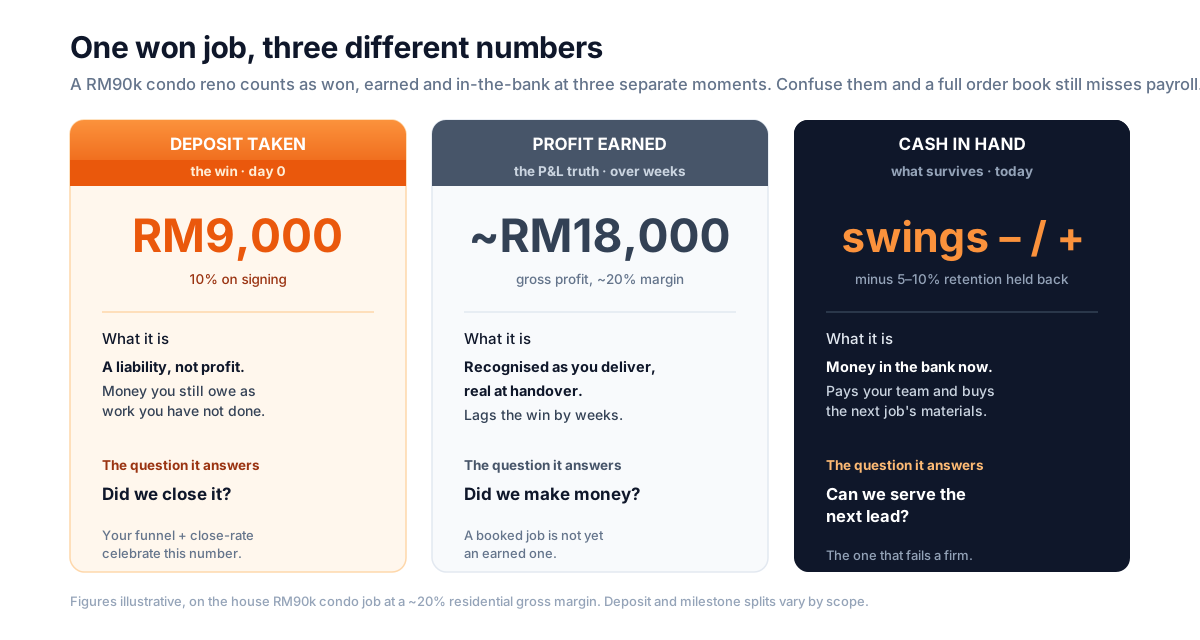
The reason is that a renovation firm quietly runs three scoreboards at once, and only one of them is the bank balance:
- What you won — the jobs you closed, at their full contract value. This is your order book and your close-rate. It feels like success, and it is, but it is a list of promises, not cash.
- What you earned — the profit inside those jobs, recognised as you actually deliver the work. This is the P&L truth, and it lags the win because the work takes weeks.
- What you collected — the money genuinely in your account today, after you have paid suppliers and labour and after the client has held back retention. This is the only number that pays wages.
Most owners run their whole business off the first number because it is the one that feels good and the one their pipeline shows them. But the widely-cited U.S. Bank study attributed to Jessie Hagen found that 82% of small businesses that fail do so because of cash-flow problems — not because they were unprofitable, but because they ran out of money while waiting to be paid. Malaysian SME advisers say the same thing in plainer language: a business can show RM100,000 of profit on paper while having RM5,000 in the bank, because profit is accrual-based — booked when earned, not when the cash actually arrives.
What is the actual difference between deposit, revenue and cash?
A deposit is the moment a lead converts, revenue is what you earn as you deliver, and cash is what is in the bank today — three answers to three different questions. Here is the whole map on one job.
| The number | When it's true | What it really is | The question it answers |
|---|---|---|---|
| Deposit taken | Day 0, when the buyer says yes | The funnel's conversion event. A first payment (~10%) and a liability — money you owe as work | Did we close it? |
| Revenue earned | As you deliver, real at handover | The profit inside the job, recognised as the work is done | Did we make money? |
| Cash in hand | Today, and every day | Money in the account after costs and retention | Can we survive and serve the next lead? |
The trap is that on the day you take the deposit, all three numbers look like they point the same way — you closed a RM90k job, so surely you "made" something and have money coming. But the RM90k is not revenue, the ~RM18k of gross profit inside it is not earned yet, and the RM9k deposit in your account is mostly already committed to the materials you are about to buy. One event, three numbers, and only a sliver of it is genuinely yours.
Why isn't a deposit just revenue?
Because you have not done the work yet — so under Malaysian accounting standards a deposit is a liability, not income. This sounds like accountant's pedantry until you see what it does to how you read your own business.
When a client pays you a deposit, they are paying ahead of the work. Both MFRS 15, the revenue standard, and the simpler MPERS regime most Malaysian SMEs report under, treat money received before performance as a contract liability — an obligation you owe the customer — and you recognise revenue only as you satisfy the work you promised. In plain terms: a deposit is not a reward for winning the job. It is the client pre-paying you to do it, and until the tiles are on the wall you are holding their money against a promise.
That is why counting deposits as "how much I made" is so misleading. Your deposit balance goes up every time you win a job — and it would keep going up even if you never finished a single one. The number that reflects real earning only moves when work actually gets delivered.
Why does a "RM1m year" still feel broke?
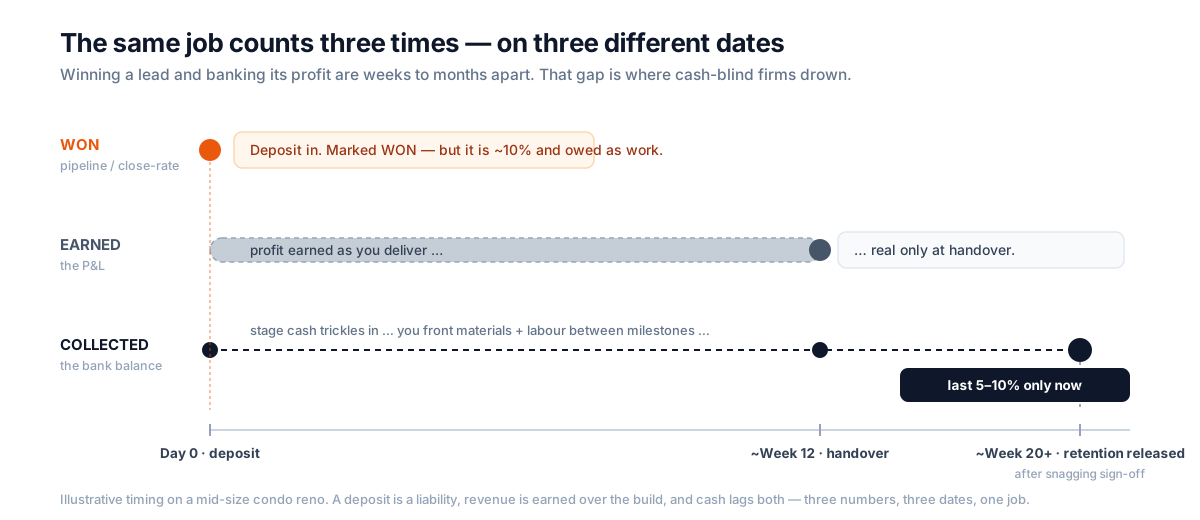
Because the three numbers are separated by time, and on a renovation that time is unusually long. A reno is not a shop sale where you hand over goods and collect cash the same minute. The work stretches across weeks, the payments come in tranches, and a slice is held back after you finish.
Walk the same RM90k condo job along the calendar:
- Day 0 — you win it. A 10% deposit (RM9k) lands. Your pipeline marks it won. But you are about to spend most of that RM9k on the first materials, so your cash barely moves.
- Weeks 1–12 — you earn it. As hacking, tiling, carpentry and painting get done, you are genuinely earning revenue and profit. But you are also fronting the materials and labour between milestone payments, so your cash dips and recovers, dips and recovers.
- Handover — the profit is real. Now the P&L can honestly say you made your ~RM18k gross profit on the job.
- Weeks after handover — you finally collect. The client holds a 5 to 10% retention until snagging is signed off. Only when that releases is the job truly collected.
Run three or four of those jobs at once, all at different stages, and your bank balance is the messy sum of everyone's half-fronted materials and unreleased retentions. That is the "busy but broke" feeling, and it is structural, not a sign you priced badly. It is made worse by a well-known Malaysian reality: late and slow payment is a chronic problem across the construction chain, and unlike a commercial contractor, a homeowner-reno firm has no CIPAA fast-adjudication backstop to chase a slow-paying client, because Section 3 exempts an individual's own low-rise home. Your milestone schedule is your cashflow protection.
Which number should you actually steer your leads by?
Steer by cash, not by bookings — because the number you optimise for silently decides which leads you chase. This is where a bookkeeping distinction becomes a lead-management decision.
If your scoreboard is the order book, you will treat every won job as equally good and chase the biggest ones hardest. But two jobs of the same size and margin are not worth the same to a cash-limited firm. A RM90k job on a clean 10/20/25/25/20 milestone schedule is a genuinely better lead than a RM110k job the buyer wants to pay 20% now and 80% at the end — the bigger job is the one that will strangle you, because you finance it out of your own pocket for months. When you are capacity-limited, and every small reno firm is, the job you can cash-flow beats the job that is merely larger.
This is the same logic as the cheapest lead often being your most expensive job: the number on the surface (a low cost-per-lead, a big order-book value) hides the number that actually decides whether you make money (cost per won job, cash freed per job). In both cases the fix is to stop steering by the vanity number and start steering by the one tied to real ringgit in the bank.
So the practical move is to keep the three scoreboards genuinely separate and read each for what it is good at:
| Decision | Wrong number to use | Right number to use |
|---|---|---|
| "Are we selling well?" | Cash in hand | Deposits taken / close-rate (the funnel) |
| "Are we profitable?" | Order-book value | Revenue earned at handover (the P&L) |
| "Can we pay the team and take the next job?" | Order book or profit | Cash in hand (the bank) |
| "Which lead should I chase first?" | Job size alone | Job size and the cash its terms free up |
The honest one-line summary
Your order book tells you how good your marketing and sales are. Your P&L tells you how good your pricing and delivery are. Your bank balance tells you whether you survive to do it again. They are three different report cards on three different subjects, and a small renovation firm needs to read all three — because you can be top of the class on the first two and still fail the third. That is not a rare accident. On the U.S. Bank numbers, it is the single most common way small firms die, and Malaysia's construction SMEs — the fastest-growing MSME segment in 2024, up 17.3% — are winning more work than ever, which means more of them than ever are carrying more cash tied up in more open jobs.
How HotLead fits — and where it doesn't
Be clear on the boundary: HotLead is lead management, not accounting. It does not recognise revenue, run your P&L, track your bank balance, or tell you your cash position — that lives in your accounting software, and you should have it. What HotLead does is give you an honest, separate view of the first of the three numbers — the won-and-converting one — so it never gets quietly confused with the other two, for Malaysian renovation, interior-design and construction firms on the WhatsApp they already use:
- A funnel in ringgit that shows conversion, not cash — enquiries to qualified to quoted to paid deposit by source, so you can read your selling performance without mistaking a full pipeline for a full bank account.
- Qualify on the first reply — capture budget, timeline and how a buyer reacts to a normal deposit, so a back-loaded-terms risk that would tie up your cash surfaces before you pour hours in.
- Next-action and overdue flags — so the warm quote waiting on a deposit decision is a tracked task that gets chased, keeping your won number honest instead of clogged with dead deals.
Start with the complete guide to managing renovation leads in Malaysia, read what a lost lead really costs and what your open pipeline is actually worth, or see the renovation, interior-design and construction playbooks.
Sources: Cash-flow rather than profit as the leading cause of small-business failure — the widely-cited U.S. Bank study attributed to Jessie Hagen (Synergy Strategies, "Top Reasons Why Businesses Fail"). The Malaysian "profitable on paper, broke in the bank" framing and profit-versus-cash (accrual) distinction — Starz Excellence, "Why Being 'Profitable' Is Killing Your Malaysian SME" and Douglas Loh, "Cash Flow Management for Malaysian SMEs" (2026). A deposit received before work is done is a contract liability, with revenue recognised as performance obligations are satisfied, under MFRS 15 and MPERS — Malaysian Institute of Accountants, "FAQs for MFRS 15 Revenue from Contracts with Customers" and ACCA, "IFRS 15 — Contract Assets and Contract Liabilities". Slow and late payment through the Malaysian construction chain — Hasmori et al., "Issues of Late and Non-Payment Among Contractors in Malaysia". The CIPAA Section 3 residential exemption — AIAC / KLRCA CIPAA Circular 1A. Malaysian MSME and construction-SME growth figures (MSMEs RM652.4bn / 39.5% of GDP in 2024, construction MSMEs up 17.3%) — Department of Statistics Malaysia, "MSMEs Performance 2024". Deposit, milestone, retention and margin figures (~10% deposit, 10/20/25/25/20 split, 5–10% retention, condo ~RM40k–150k jobs, ~18–25% residential gross margin, ~RM1,280 expected gross profit per winnable enquiry) are the house figures from the deposit-and-progressive-payment and cost-of-a-lost-lead pieces. All money figures in this article are illustrative — read your own accounts for your real numbers.
Frequently asked questions
Is a customer deposit counted as revenue?
No. A deposit is money received before you have done the work, so under both MFRS 15 and the MPERS standard most Malaysian SMEs report on, it is recorded as a contract liability — an obligation you owe the customer — not as revenue. You recognise revenue only as you satisfy the work you promised. For a renovation firm that means a signed deposit converts the lead and gives you some cash, but it is not yet profit and not fully yours until the job is delivered.
Why is my renovation business profitable on paper but always short of cash?
Because profit and cash are measured differently. Profit is accrual-based — it counts revenue when earned and costs when incurred — while cash is simply what is in the bank on the day. On a progressive-payment reno you front materials and labour between milestones, carry work in progress you have not billed, and wait out a 5 to 10% retention after handover, so your cash position lags your profit by weeks or months. A busy firm winning jobs faster than it collects can be profitable and still miss payroll.
What is the difference between deposit, revenue and cash for a contractor?
The deposit is the conversion event — the moment a lead becomes a won job and you take a first payment, usually around 10%. Revenue, and the profit inside it, is what you actually earn as you deliver, real at handover. Cash in hand is the money in your account right now, after you have paid suppliers and labour and after the client has held back retention. They are three answers to three different questions — did we close it, did we make money, and can we survive and serve the next lead.
Does an order book tell me how much money I have?
No, and treating it as if it does is dangerous. An order book is a list of won jobs at their full contract value — it tells you demand, not cash. Most of that value has not been earned yet and even less has been collected. A RM1m order book can sit on top of a near-empty bank account if the jobs are early, back-loaded, or slow to release payment. Use the order book to plan capacity, and a cash-flow view to decide what you can actually spend.
How should these numbers change which leads I chase?
Steer by cash, not just bookings. Two leads of the same size and margin are not equal if one pays a clean deposit on inspected milestones and the other wants to pay mostly at the end — the second ties up working capital you need for the next three jobs. When you are capacity-limited, re-rank your pipeline by the cash a job frees, not only its size, and treat a buyer who resists a normal deposit as a qualification signal to catch on the first reply.
Keep reading
- What a Referred Lead Is Actually Worth — and Why Your Best Ringgit Protects ItA referral isn't just a "free" lead — it wins on cost, close rate and lifetime value at the same time, and those three advantages multiply. Here's what a referred renovation lead is really worth against a paid one, why owners under-fund their single best channel, and why the highest-return marketing ringgit protects the referral engine instead of buying more cold strangers.
- "Boleh Buat Macam Ni Tak?" — The Expensive-Look, Small-Budget ID Lead in MalaysiaA homeowner sends a saved Instagram image of a RM250k penthouse look and asks for it on a RM90k budget. Most Malaysian ID studios either quote the dream and scare them off, or say "can can" and disappoint them later. Here's why this lead is actually one of your most winnable — and the "same look, three budgets" way to convert it without touching your margin.
- Can AI Route a Fresh Renovation Enquiry to the Right Next Step? We Tried ItMost solo reno owners fire one dead line at every lead — can share more details ah? That single generic reply stalls the buyers who were ready to book. So I asked whether AI can pick the right next step for each enquiry, and draft the reply that gets it there — without committing a slot or a price it cannot know.