

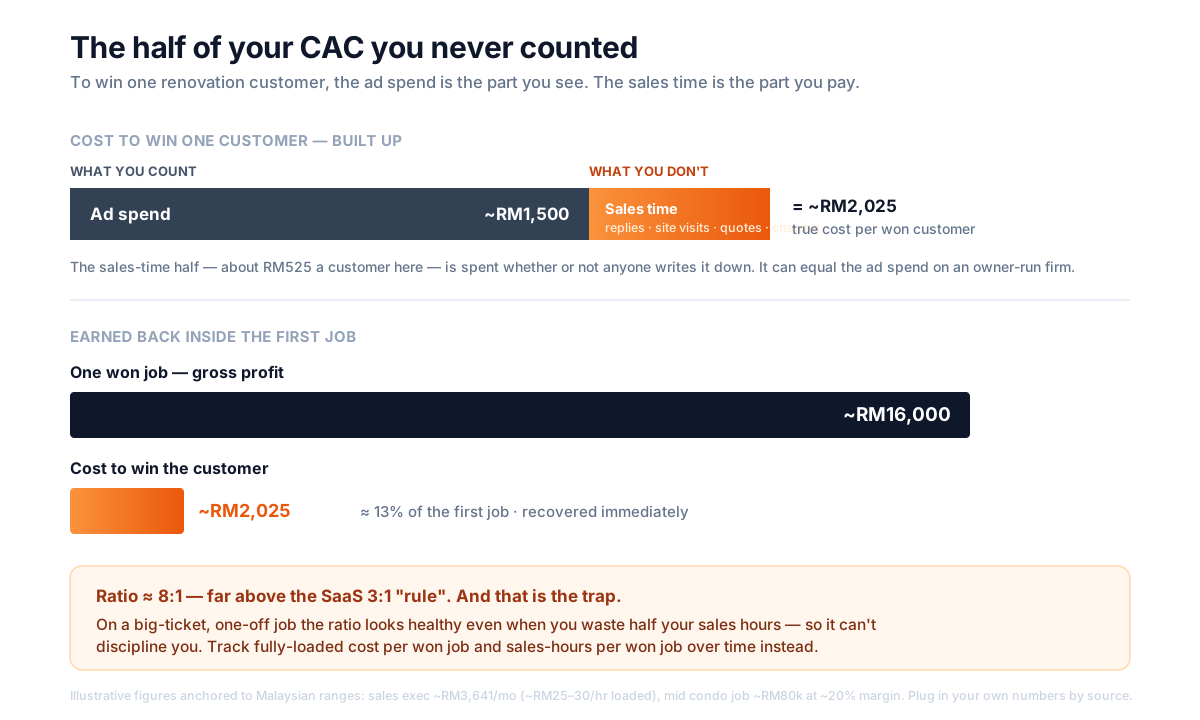
Ask a renovation-firm owner what it costs to win one customer and you'll usually get an ad number: "leads run me about RM60, and I close maybe one in ten, so — RM600?" It's a clean answer. It's also missing the larger, invisible half of the bill.
Your real customer acquisition cost is everything you spend to win a customer — ad spend plus sales time, platform fees and tools — divided by the customers you actually won. For a renovation firm the sales-time half is usually the bigger one, and it's the part nobody counts. Get the full number, and two things change: you find out your true cost per customer is well above the ad figure, and you discover that the famous rules for judging it — the SaaS 3:1 ratio, "recover CAC within a year" — quietly mislead a big-ticket reno business. Let's work it out with Malaysian numbers.
What actually counts as the cost of winning a renovation customer?
Everything you spend to turn a stranger into a signed deposit — not just the ad that made them message you. Marketing frameworks are explicit about this: CAC is total sales and marketing cost divided by new customers, where "sales" includes the people and their time, not only the media spend. Most renovation firms silently drop the biggest term.
Here's the full list for a reno or ID firm:
- Ad and platform spend. Meta and Google budgets, plus any paid lead-gen. This is the part everyone counts.
- Sales time. The hours a salesperson or the owner spends replying to enquiries, qualifying them, driving to and running site visits, preparing quotes, and chasing quiet leads. This is the part almost nobody counts — and for renovation it's usually the largest.
- Platform fees and tools. Qanvast/Atap listings (no per-lead fee, but the effort to service them), your CRM or lead tool, phone plans.
The reason sales time dominates isn't obvious until you price it. A renovation sale is not a checkout — it's a series of human hours spread over days or weeks. And those hours cost real money whether or not you put them on a payslip.
What does a sales hour actually cost a Malaysian reno firm?
More than owners assume, because they mentally price their own time at zero. A sales executive in Malaysia earns around RM3,641 a month on average (Indeed Malaysia), and renovation-specific sales roles advertise anywhere from RM2,500 to RM10,000 with commission (JobStreet/Indeed listings). Take the average, add employer EPF, SOCSO and EIS plus a share of overhead, and one working hour lands at roughly RM25–30.
That's the floor. If the owner is doing the selling — which is the norm on a small reno or ID firm — the hour is worth much more, because the owner's time is the scarcest, most valuable resource in the business. Every hour the boss spends re-typing a WhatsApp quote is an hour not spent winning a bigger project or running a site. So the hidden CAC is actually largest on exactly the small, owner-run firms that never track it.
Now count the hours behind a single won job. To close 4 jobs from 50 enquiries in a month, a team might spend:
| Sales activity | Rough hours / month |
|---|---|
| Replying to and qualifying ~50 enquiries | ~15 |
| Running ~12 site visits (incl. Klang Valley travel) | ~30 |
| Preparing ~12 quotes | ~18 |
| Following up quiet leads across the pipeline | ~12 |
| Total sales time | ~75 hrs |
At RM28 an hour, that's about RM2,100 of sales time a month — spent whether or not anyone writes it down. Split across 4 won jobs, it's ~RM525 of pure labour baked into every customer, on top of the ad spend. And notice the single biggest line: site visits. As we covered in the free site-visit trap, the real cost of a measurement visit isn't the petrol — it's the Klang Valley hours. Those hours are CAC, and driving to unqualified no-shows is the fastest way to inflate it.
So what is a renovation firm's real, fully-loaded CAC?
Add the two halves and the number jumps. Take a Klang Valley reno firm spending RM6,000 a month on ads, producing 50 enquiries, closing 4 jobs (an 8% conversion). Watch the ad-only figure and the honest figure diverge:
- Ad-only CAC = RM6,000 ÷ 4 jobs = RM1,500 per customer. This is the number the owner quotes.
- + Sales time =
RM2,100 ÷ 4 = **RM525 per customer.** - Fully-loaded CAC = ~RM2,025 per customer — about 35% higher than the ad figure.
And RM525 of hidden cost is the tidy case. For a firm that runs lots of unqualified site visits, or whose owner sells at a RM60–80/hour opportunity cost, the sales-time half can equal or exceed the ad spend — doubling the true CAC while the dashboard still reads RM1,500. That gap is invisible precisely because it never leaves the ad platform's report.
How many jobs does it take to earn that back?
Less than one — and that's the twist. A mid-range condo renovation of about RM80,000 at a roughly 20% residential gross margin carries around RM16,000 of gross profit (the same house figures we used in what a lost lead costs). Set the fully-loaded CAC of ~RM2,025 against that:
| The payback maths | Value |
|---|---|
| Fully-loaded CAC per customer | ~RM2,025 |
| Gross profit, one won job | ~RM16,000 |
| CAC as a share of the first job | ~13% |
| LTV:CAC ratio (one job) | ~8:1 |
You recover the entire acquisition cost out of the first 13% of a single job's gross profit. Payback isn't measured in months, the way a SaaS business measures it against monthly recurring revenue — it's essentially immediate, inside the first job. And the LTV:CAC ratio comes out around 8:1, comfortably above the celebrated 3:1 benchmark.
Which sounds like great news. It's actually the trap.
Why the SaaS 3:1 rule quietly misleads a renovation firm
Because on a big-ticket, one-off purchase the ratio can't fail — so it can't discipline you. The 3:1 LTV:CAC rule and the "recover CAC within 12 months" guideline both come from SaaS, where lifetime value is recurring revenue collected slowly over years and the risk is that you spend too much upfront to acquire a subscription that dribbles back. Renovation is the opposite shape: the "lifetime" value arrives almost entirely in one large lump, and it's so much bigger than any plausible acquisition cost that the ratio looks healthy no matter what.
Run the numbers on our inefficient Firm B — RM2,300 CAC, still ~7:1. Double its wasted sales time again — still above 3:1. A firm can burn half its sales hours on no-shows and its LTV:CAC will still clear the SaaS benchmark with room to spare. The ratio isn't wrong; it's just useless as a control here, because a RM16,000 gross profit swamps the signal you actually need to see.
Why referrals and repeat clients break the whole calculation (in your favour)
Because renovation is transactional, and that changes where the value is. In SaaS, a mediocre CAC gets rescued by the recurring tail — the customer keeps paying. A renovation customer renovates roughly once; there is no subscription to bail out a bad acquisition cost. Every job has to pay its own way, which makes the shape of your channels matter enormously.
That's exactly why the near-zero-CAC channels are worth more than their volume suggests:
- A referral carries almost no CAC. No ad spend, far less qualifying (they arrive pre-sold by a friend's finished kitchen), and a close rate several times higher than cold paid social — warm referrals convert in the 15–25% band versus roughly 1% for cold social. A referred customer's LTV:CAC isn't 8:1; it's effectively off the chart.
- Repeat and second-project clients are the only thing that gives a reno firm a genuine "lifetime" value at all. US home-services data shows referred customers carry meaningfully higher lifetime value and repeat rates than ad-acquired ones (Cornerstone Advertising; Service Nation) — and renovation's repurchase cycle is longer than an HVAC service business, so a reno firm's lifetime value leans even harder on referrals than on repeat visits.
The practical read: because paid channels each have to earn back their fully-loaded CAC on a single job, the cheapest way to lower your blended CAC isn't a better ad — it's converting more of the near-free leads you already have. Answer the referral fast, service the Qanvast shortlist properly, and re-contact past clients. Those are CAC-free customers you're currently losing to slow follow-up.
How do you actually track this for your firm?
Three numbers, tracked per source and compared over time — not a blended guess:
- Fully-loaded spend per period. Ad spend + sales-and-owner hours at a loaded rate (~RM25–30, higher for the owner) + platform fees and tools. The hours are the part you have to start measuring, because they're the part that's been invisible.
- Won jobs per source. Every enquiry tagged with where it came from at arrival, carried through to won or lost. Without this, referrals and paid leads blur into one anonymous WhatsApp inbox and you can never see that your referrals are near-free.
- CAC efficiency, over time. Fully-loaded cost per won job and sales-hours per won job, by source, this quarter vs last. That trend is your real control — the thing the ratio can't tell you.
The reason so few firms have these isn't the arithmetic — it's that a shared WhatsApp number and a spreadsheet don't capture source or time reliably, because the tagging depends on a busy person remembering to back-fill it, which collapses in exactly the busy months when it matters. This is the same discipline behind the four numbers every reno firm should track: the data only exists if the system captures it automatically.
How HotLead fits in
HotLead is built so Malaysian renovation, interior-design and construction firms can see the real cost of a customer — not just the ad number — on top of the WhatsApp they already use. It captures every enquiry with its source attached, so a referral, a Qanvast handoff and a boosted-post lead don't blur into one inbox and you can finally see which customers arrive near-free. It keeps first replies fast and the next follow-up owned, so fewer winnable leads leak into wasted sales hours. And its funnel and per-channel ROI view shows enquiries, wins and drop-offs by source — the raw material for a real, fully-loaded cost per won job, instead of a comfortable ratio that can't tell you you're wasting time.
Start with the complete guide to managing renovation leads in Malaysia, see the renovation lead playbook, or go deeper on cost per lead vs cost per job and what a lost renovation lead really costs.
Sources: CAC and LTV:CAC methodology — Harvard Business School Online, "LTV/CAC Ratio", Chargebee and HubSpot on the 3:1 benchmark (a SaaS-origin guideline; First Page Sage and others note it fits recurring-revenue models, not one-off transactional ones); CAC-payback-period methodology (S&M ÷ gross-margin-adjusted revenue; healthy SaaS 5–12 months) via Wall Street Prep, Corporate Finance Institute and Stripe. Malaysian salary data — Indeed Malaysia (sales executive RM3,641/month) and JobStreet/Indeed renovation-sales listings (RM2,500–10,000 with commission). Malaysian ad-cost ranges (Meta CPM ~RM8–25, reno/ID Google CPC ~RM3–8) per ZenWeb and Listing.my, as used in our cost-per-job article. Job-value and margin figures — Malaysian 2025–2026 renovation cost guides (condo ~RM40k–150k) and residential gross-margin benchmarks (18–25%). Referral and repeat lifetime-value data — US home-services benchmarks via Cornerstone Advertising and Service Nation (referred customers carry higher lifetime value and repeat rates than ad-acquired), applied directionally given renovation's longer repurchase cycle. All ringgit CAC and payback figures in this article are illustrative worked examples anchored to these ranges — plug in your own ad spend, sales hours, job value and won-job counts by source for your real number.
Frequently asked questions
What is customer acquisition cost for a renovation firm?
It's the total cost of winning one paying customer — all sales and marketing effort over a period divided by the number of jobs won in that period. The mistake most renovation firms make is counting only ad spend. A complete CAC also includes sales time (the hours spent replying to enquiries, qualifying, driving to site visits, preparing quotes and following up), any platform or lead-gen fees, and tools. For most reno firms the sales-time component is larger than the ad spend, so the real CAC is well above the number on the ad dashboard.
How do you calculate CAC for a Malaysian renovation business?
Add up everything you spent winning customers in a month — ad spend, plus sales-and-owner hours valued at a loaded rate (a Malaysian sales exec at roughly RM3,641 a month works out to about RM25–30 an hour once you add EPF, SOCSO and overhead), plus platform fees and tools — then divide by the number of jobs you won that month. Do it per source where you can. The result is your fully-loaded cost per won customer, which is usually 30% to 100% higher than the ad-only figure.
How many jobs does it take to earn back the cost of acquiring a renovation customer?
Usually less than one. A mid-range condo renovation of around RM80,000 at a roughly 20% gross margin carries about RM16,000 of gross profit, while a fully-loaded CAC typically lands around RM1,500–2,500. So you recover the acquisition cost out of roughly the first 10–15% of a single job's gross profit — payback is essentially immediate. That's why the danger for a reno firm isn't slow payback; it's that the maths looks so healthy it hides wasted sales time.
Does the 3:1 LTV:CAC rule apply to a renovation firm?
Not usefully. The 3:1 lifetime-value-to-CAC benchmark comes from SaaS, where value is recurring revenue collected over years. A renovation job is a single, large, one-off purchase, so one job's gross profit already dwarfs almost any realistic CAC — the ratio comes out well above 3:1 even when a firm is wildly inefficient with its sales time. A rule that can't fail can't discipline you. For a reno firm, track fully-loaded cost per won job and sales-hours per won job over time instead.
Why are referrals and repeat clients worth more than their share of leads?
Because renovation is transactional — most customers renovate roughly once, so unlike a subscription business there's no recurring revenue to rescue a bad acquisition cost. A referral or repeat client arrives at a near-zero CAC — no ad spend, far less qualifying, and a much higher close rate (referred buyers convert several times better than cold paid social). US home-services data shows referred customers carry meaningfully higher lifetime value and repeat rates than ad-acquired ones. For a one-off-purchase business, referrals are the only channel that turns customer acquisition into something close to a lifetime-value business.
Keep reading
- The Only Three Ways to Grow a Renovation Firm — and Which Lever to Pull FirstEvery renovation firm's revenue comes down to three levers — how many leads you get, how many you close, and how big each job is. They multiply, so a modest lift on each compounds. But they cost wildly different amounts to pull, and most owners reach first for the one they should reach for last. Here's the ranking, with Malaysian numbers.
- Sight Unseen: Winning the Overseas Malaysian Who Renovates a Unit They Can't VisitA Malaysian working in Singapore collects the keys to a KL condo and messages you to fit it out — but they can't come to a site visit, can't walk your showroom, and will wire a deposit to a firm they've never met. Most firms treat this lead like a walk-in, go quiet when the buyer can't pop by, and lose the highest-budget job in the inbox. Here's why the remote buyer is your hardest-trust but best-paying lead, and how to build a remote lane that actually closes it.
- "Ok, Proceed" Isn't Money in the Bank — I Built an AI to Ask for the Deposit the Moment a Renovation Buyer Says YesA Cheras contractor closes a RM62k job on WhatsApp, the buyer says "ok proceed lah", and then the owner — mid-site, phone in a dusty hand — has to stop, pull the bank details, the agreed deposit and the scope, and type a careful money message. In that gap a hot yes quietly cools back to "let me think." The 2026 reflex is to ask AI to detect the yes and auto-fire the invoice. I built it, and it asked a half-committed buyer for 40% to a personal account two seconds after a soft "ok ok". Here's the version that kills the typing delay without asking for money off a misread.