

Every renovation-firm owner arrives at the same question eventually, usually after a slow month: how much should I actually be spending on marketing? And there's a tidy, confident answer waiting — a percentage of revenue. It's the number agencies quote and benchmark reports publish. It's also the wrong place to start.
The benchmark is real: marketing spend runs about 7.7–9.4% of revenue across industries, and roughly 5–15% for contractors depending on how established you are. But for a small renovation firm, a percentage of revenue is a sanity-check band, not a budget. The number that actually keeps you honest is built from the bottom up — from the jobs you can deliver and the rate at which you convert enquiries — because two things a percentage ignores decide whether your marketing ringgit makes money or burns: your close rate, and your build capacity. Let's work through both, with Malaysian numbers.
So what is the benchmark percentage?
If you want a number to sanity-check against, here it is. Across all industries, marketing budgets sit at about 7.7% of revenue (Gartner's 2025 CMO Spend Survey) to 9.4% (The CMO Survey, run by Deloitte, Duke University and the American Marketing Association) — with B2C product companies spending much more (15.5%) and B2B services less (9%). For construction and home-services contractors specifically, published guidance clusters in a 5–15% band, and where you sit depends heavily on your stage:
| Firm stage | Typical marketing spend | Why |
|---|---|---|
| Established, strong referral base, just holding the pipeline | ~3–7% of revenue | Repeat clients and word of mouth do the heavy lifting; you're topping up |
| Growth mode — adding a crew, new service area, bigger jobs | ~8–12% of revenue | You're buying demand faster than referrals can supply it |
| New firm, first few years, no referral network yet | ~12–20% of revenue | You have to buy the reputation you haven't earned yet |
That's a genuinely useful reference. A KL reno firm turning over RM2 million a year and spending RM4,000 a month (RM48k, 2.4%) while trying to grow is almost certainly under-investing; one spending RM40k a month (24%) had better be a brand-new firm buying its way in. But notice what the table is really keyed on — it isn't the percentage, it's your stage and your referral base. The percentage is a symptom of those, not a rule you set.
Why is "percentage of revenue" the wrong place to start?
Because it's circular, and because it's blind. Both problems are fatal for a small firm.
It's circular. A percentage-of-revenue budget sets next year's spend from this year's revenue — but the whole point of marketing is to change revenue. If you had a slow year, the percentage cuts your budget exactly when you need to spend to recover; if you had a big year, it inflates your budget whether or not you can deliver more work. The method anchors your growth spend to the past instead of to what you're trying to do.
It's blind to close rate. Two firms both spending 10% of revenue on ads are not spending equally well. One converts enquiries to jobs at 3%, the other at 8%. The second firm gets nearly three times the jobs from the same budget — but "10% of revenue" says they're doing the same thing. The percentage measures how much you spend, and tells you nothing about whether the funnel it's feeding actually holds water.
It's blind to capacity. A percentage can happily tell you to spend RM30k a month when your team can only build four jobs a month. Software companies can absorb unlimited demand; a reno firm cannot pour concrete faster because the ad account is flush. We'll come back to this — it's the biggest one.
Why you can't out-spend a leaky funnel
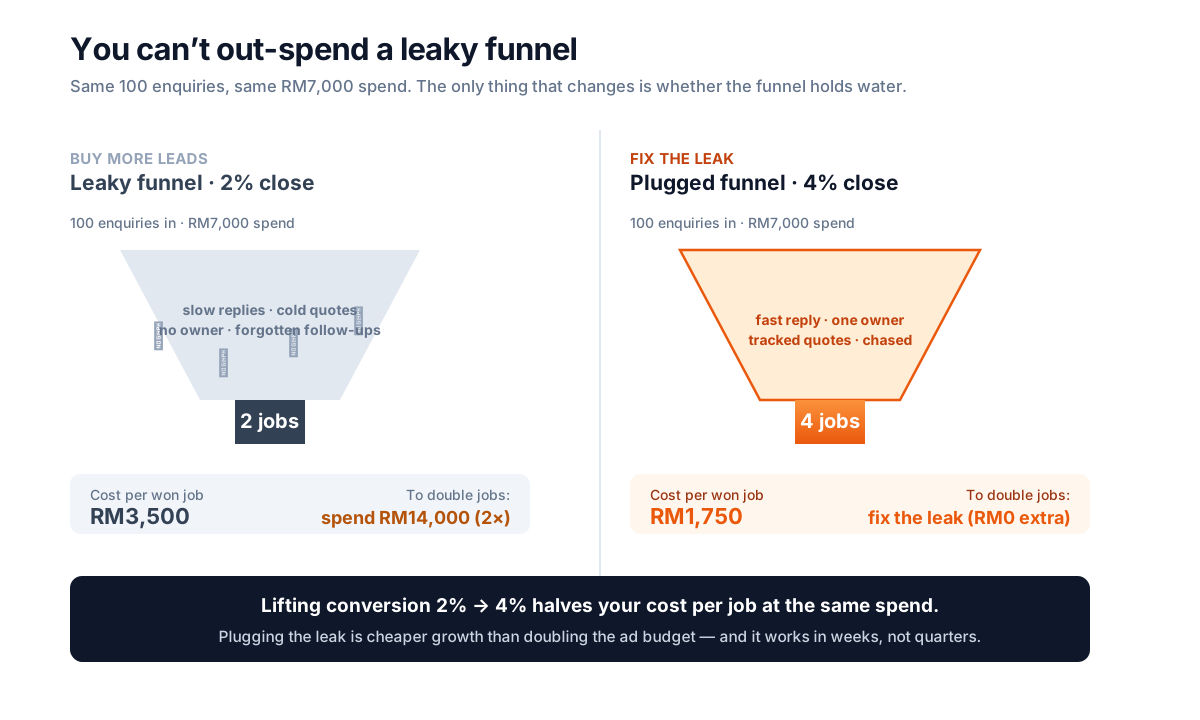
This is the single most expensive mistake in renovation marketing: trying to fix a conversion problem by buying more leads. If your funnel leaks — winnable enquiries dying on slow replies, forgotten follow-ups, quotes that sit for a week — then every extra ringgit of ad spend pours more water into a leaking bucket. You pay full price for leads and lose the same proportion of them.
The arithmetic is unforgiving, and it cuts the other way too. Marketing economics are blunt on this point: improving your conversion rate lowers your cost per customer without spending a sen more on ads. A funnel converting at 2% with a certain cost per lead has double the cost per job of the same funnel at 4% — same traffic, same spend, half the cost per job (ClicksGeek and CRO-vs-traffic analyses put conversion optimisation at several times the ROI of buying more traffic, precisely because the spend doesn't change). Watch it on a reno firm's numbers:
| Same 100 enquiries, same RM7,000 spend | Leaky funnel | Plugged funnel |
|---|---|---|
| Enquiry → won-job conversion | 2% | 4% |
| Jobs won | 2 | 4 |
| Cost per won job | RM3,500 | RM1,750 |
| To double jobs, you could instead… | spend RM14,000 (2× budget) | fix the leak (RM0 extra spend) |
Getting from 2% to 4% on a renovation funnel is not exotic — it's usually replying inside the first hour instead of the next day, giving every lead one clear owner, and chasing the quiet quotes that currently go cold. None of that costs ad budget. And it shows up in weeks, where doubling your ad spend is a permanent monthly cost. So the honest first question isn't "what should my budget be?" — it's "how much of what I already buy am I losing?"
The real ceiling: your build capacity, not a percentage
Here's the constraint every percentage-based budget ignores, and it's the one that actually caps a renovation firm: you can only sell as much work as you can build well. A percentage-of-revenue budget assumes marketing spend converts smoothly into growth. For a capacity-constrained trade, past a certain point it converts into damage.
Think about what happens when a firm already running at capacity doubles its ad spend. The extra leads arrive — but the team is on site, the owner is the bottleneck, and there's no slack to serve them. So the new enquiries get slow replies, rushed or cancelled site visits, and follow-ups that never happen. You paid full price for those leads and delivered them a bad experience. Worse, the overload spills onto the leads you would have won, because a flooded inbox slows everyone's response.
And this is where it stops being merely wasteful and starts being destructive. In Malaysia, 49% of renovation buyers find their firm by word of mouth — the No.1 discovery channel (ZenWeb). That channel is fed by delivered jobs and happy clients. When you overbuy leads and your service slips, you don't just waste the ad spend — you thin out the referrals and reviews that are your cheapest, highest-converting source of future work. You spend money to shrink your best channel.
The lesson isn't "don't grow." It's that growing a reno firm means growing delivery capacity and conversion first, then buying demand to fill it — never the reverse. Marketing spend is the last lever, not the first.
How to actually set the number: build it from jobs you can deliver
Set your marketing budget bottom-up, from capacity and cost, then sanity-check it against the percentage — not the other way round. Four steps:
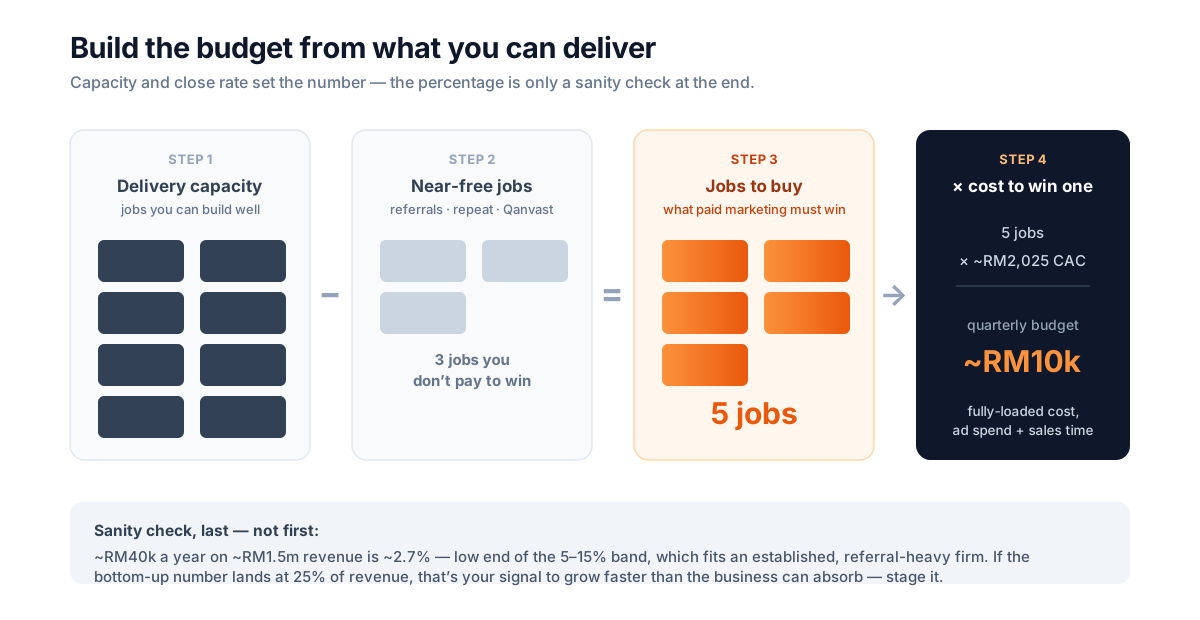
- Start from delivery capacity. How many jobs can you build well next quarter without your service slipping? That's your ceiling. If it's ~8 jobs, no marketing budget should be sized to win 15.
- Subtract the near-free jobs. How many of those will come from referrals, repeat clients and your existing Qanvast/Atap profile — channels you don't pay per lead for? Say 3. Those are the cheapest jobs you'll win; they don't need the ad budget.
- What's left is what you must buy. 8 − 3 = 5 jobs to win through paid marketing next quarter.
- Multiply by your fully-loaded cost to win one. Not the ad-only cost — the true, sales-time-included CAC, commonly around RM2,025 for a Malaysian reno firm. 5 jobs × RM2,025 ≈ RM10,000 for the quarter, or ~RM3,400 a month.
Now sanity-check: if that firm turns over ~RM1.5m a year, RM40k of annual marketing is ~2.7% of revenue — at the low end of the band, which fits an established, referral-heavy firm. If the bottom-up number had come out at 25% of revenue, that's your signal the plan is to grow faster than the business can absorb, and you'd stage it. The percentage becomes a check on the plan, which is the only job it's any good at.
Spend the first ringgit where Malaysian buyers actually look
Once you have a number, allocation matters more than size — and the Malaysian discovery data points somewhere most ad budgets don't. Buyers here use three to four channels in parallel to find a firm: 49% word of mouth, 58% Google, 53% Facebook/Instagram (ZenWeb). Read in cost-per-job terms, that ranks your ringgit clearly:
- Protect the referral engine first — it's the cheapest "channel" and it isn't an ad. Word of mouth costs nothing to buy and converts several times better than any paid lead. But it's bought with delivered jobs, fast replies and reviews, not media spend. The highest-ROI money you spend is on the systems and speed that keep past clients recommending you — that's marketing budget too, just not the kind that shows up in an ad account.
- Then fund high-intent search. Someone Googling "renovation contractor Cheras" is looking now. Google Search clicks for reno/ID keywords run ~RM3–8 (higher for competitive KL terms), pricier per lead than a boosted post but far higher intent — which usually wins the cost-per-job comparison.
- Keep a Qanvast/Atap presence. No per-lead fee; you're shortlisted against rivals. The cost is being the slow one of five, not a media bill.
- Top up with Meta last. Broad boosted posts are cheap per lead (Meta CPM ~RM8–25) and low-intent by default; click-to-WhatsApp pulls warmer enquiries. Useful to fill capacity your high-intent channels can't — but the first ringgit shouldn't go here.
Notice the through-line: your best channel is nearly free and depends entirely on not leaking leads. Which brings the whole argument back to one point — for a renovation firm, the funnel is the budget. Spend on keeping it tight before you spend on filling it fuller.
How HotLead fits in
HotLead doesn't set your marketing budget or run your ads — that's your call and your agency's. What it does is make the budget you already have work harder, by attacking the two things a percentage ignores: the leak, and the blindness. It keeps first replies fast and every enquiry owned with a clear next action, so fewer of the leads you paid for die in the funnel — the cheapest growth there is. It captures every enquiry with its source attached and tracks it to won or lost, so its funnel and per-channel ROI view shows you which spend actually buys jobs instead of just enquiries — the raw material for a bottom-up budget. And by keeping your response fast even in a busy month, it protects the word-of-mouth engine that is your biggest and cheapest channel.
Start with the complete guide to managing renovation leads in Malaysia, see the renovation lead playbook, or go deeper on what it really costs to win one customer and cost per lead vs cost per job.
Sources: All-industry marketing-spend benchmarks — Gartner 2025 CMO Spend Survey (budgets flat at 7.7% of revenue) and The CMO Survey (Deloitte, Duke University's Fuqua School and the American Marketing Association; 9.4% of revenue in 2025, B2C product 15.5%, B2B services ~9%). Contractor and home-services ranges (5–15% of revenue; established/referral-heavy 3–7%, growth 8–12%, new firms 12–20%; US residential builders ~2.8–3.2%) — JMCO 2025 construction performance benchmarks, Pipeline On, BaaDigi and Boomcycle contractor-marketing-budget guides; treat as directional US/global figures (no published Malaysia-specific reno benchmark exists). Conversion-vs-traffic economics (lifting conversion lowers cost per acquisition at the same spend; CRO delivers several times the ROI of buying more traffic) — ClicksGeek and CRO-vs-traffic analyses. Malaysian discovery-channel mix (49% word of mouth, 58% Google, 53% Facebook/Instagram; buyers use 3–4 channels in parallel) — ZenWeb Malaysian renovation buyer survey. Malaysian ad-cost ranges (Meta CPM ~RM8–25, reno/ID Google CPC ~RM3–8) — ZenWeb and Listing.my, as used in our cost-per-job article. Qanvast: free service, no commission from firms, up to five recommendations per enquiry. Fully-loaded CAC (RM2,025), job-value and margin figures (condo RM80k, ~20% gross margin, ~RM16k gross profit) and referral-vs-cold close rates (15–25% vs ~1%) are the illustrative house figures used across this series — plug in your own capacity, close rate, CAC and revenue for your real budget.
Frequently asked questions
What percentage of revenue should a renovation firm spend on marketing?
As a benchmark, all-industry marketing spend runs about 7.7–9.4% of revenue (Gartner's 2025 CMO Spend Survey puts it at 7.7%; The CMO Survey from Deloitte, Duke and the AMA puts it at 9.4%). Contractor and home-services guidance lands in a wider 5–15% band — established firms with a strong referral base spend as little as 3–7%, growth-mode firms 8–12%, and firms in their first few years without a referral network often need 12–20%. Those are useful sanity-check ranges, but a percentage of revenue is a poor way to actually set the number for a small renovation firm, because it ignores your close rate and your build capacity.
Is it better to spend more on ads or improve my conversion rate?
Improve your conversion rate first. Marketing economics are blunt here — if you convert enquiries into jobs at 2% and lift that to 4%, you halve your cost per won job at exactly the same ad spend. Doubling your ad budget to get the same number of extra jobs costs real money every month; fixing the conversion costs mostly effort and pays back in weeks. A firm losing winnable leads to slow WhatsApp replies is paying to pour more water into a leaking bucket. Plug the leak before you turn up the tap.
How do I calculate a renovation marketing budget bottom-up?
Start from delivery capacity — how many jobs can you actually build well next quarter? Subtract the jobs you'll win from near-free channels (referrals, repeat clients, an existing Qanvast profile). What's left is the number of jobs you need to buy through paid marketing. Multiply that by your fully-loaded cost to win one customer (ad spend plus sales time — commonly around RM2,000 for a Malaysian reno firm) and you have a budget grounded in reality. Then check it against the 5–15%-of-revenue band as a sanity test, not the other way round.
Can a renovation firm spend too much on marketing?
Yes — more easily than most owners think. Because a renovation firm can't scale delivery the way software can, there's a hard ceiling — the number of jobs you can build well. Spend past it and the extra leads you can't serve get slow replies, rushed site visits and forgotten follow-ups. That slow response doesn't just waste the ad spend — it damages your reputation and your referral flow, which for a Malaysian reno firm is the single biggest source of new work. Past capacity, more marketing spend can actively lose you money.
Where should a Malaysian renovation firm spend its first marketing ringgit?
On protecting the free channel you already have. In Malaysia, 49% of renovation buyers find a firm by word of mouth (ZenWeb) — the No.1 discovery channel, ahead of Google (58% of buyers use it too, in parallel) and Facebook/Instagram (53%). Word of mouth costs nothing to "buy" but depends entirely on delivered jobs, fast replies and reviews. So the highest-return spend isn't an ad at all — it's the systems and speed that keep past clients recommending you. After that, fund high-intent channels (Google Search, Qanvast/Atap) before broad, low-intent boosted posts.
Keep reading
- Did We Already Say RM68k? Using AI to Stop Quote Drift Across a Long Renovation ThreadOver a weeks-long WhatsApp thread with two or three quote revisions, a rep re-states a number that contradicts an earlier promise — and re-opening a settled price quietly invites a discount that eats a whole job's profit. So I pointed AI at the drift. It works beautifully as a flag, and dangerously as an auto-corrector.
- The Warranty as a Closing Lever: Why a Longer Guarantee Beats a Discount on a Renovation DealA quote is stalling and the buyer wants a reason to say yes. Before you drop the price, look at the other lever in your hand — a longer workmanship warranty. It is the same expected-value decision as a discount, but the math runs the opposite way — a price cut costs you thousands with certainty, while extending the defects cover costs you a couple of hundred ringgit in expectation, for arguably more trust with a scam-wary buyer. Here is the EV case for the non-price concession, the trap that turns it into a hidden liability, and which leads it actually moves.
- "Can You Just Build It, My Neighbour Also Did" — Handling the Renovation Lead That Needs Council Approval FirstSome renovation enquiries can't legally start next month, no matter how ready the buyer is — a kitchen extension, a hacked-through wall, a roofed-over air well all need the council's written approval first. Quote a fast build price to win the job and you either lose it to a "boss, can start" cowboy, or win it and inherit the stop-work order, the RM50,000 fine and a client who later can't sell the house. Here's how to spot the permit-first lead and sell the approval as protection.