

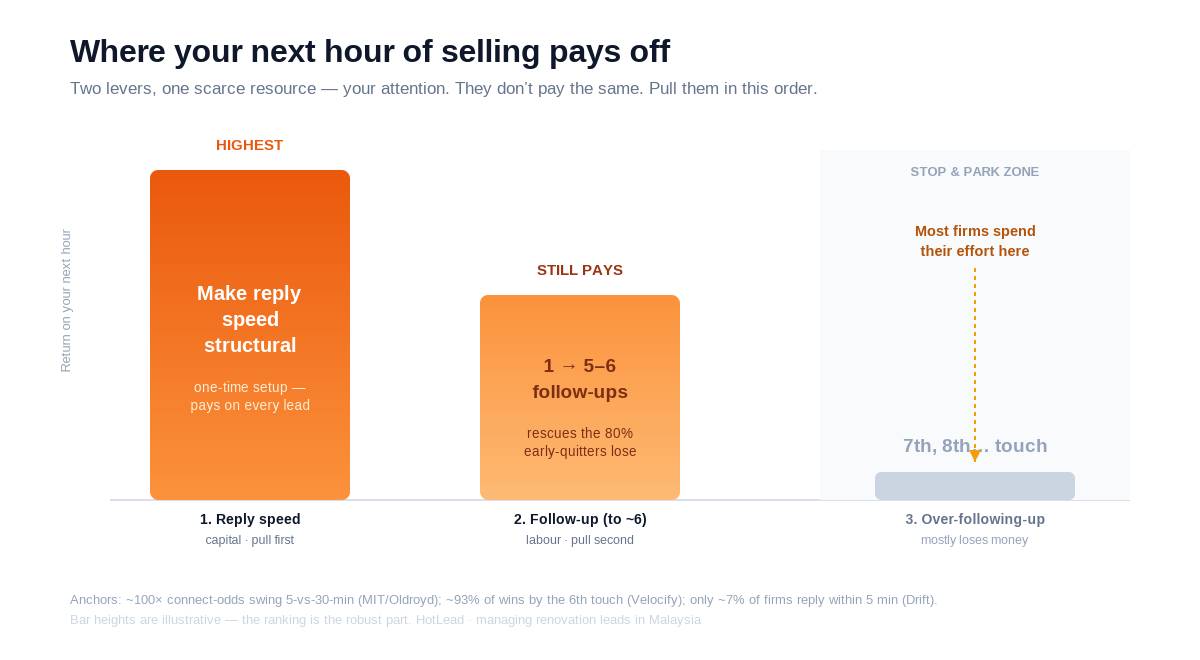
Ask the internet how to win more renovation jobs and you'll get two answers, over and over: reply faster and follow up more. Both are correct. Both are backed by real data. And a busy Klang Valley reno owner reading both at 11pm, after a full day on site, quietly concludes the same thing: I should just do everything better.
That's not a plan. It's a to-do list with no priority, and it ignores the one constraint that actually governs a small reno firm — there is only so much of you. Reply speed and follow-up persistence are not two independent dials you can both turn to eleven. They draw from the same tank: your attention, measured in the handful of selling hours you have left after quoting, site visits and chasing the tiler.
So the real question isn't "are these good ideas?" They are. It's the question nobody answers: if you can only improve one thing this month, which one buys you more? This piece puts the two levers side by side, with the numbers, and gives you an order to pull them in. It's the decision that sits on top of the response-time benchmark and the diminishing-returns-of-follow-up math — those two articles each analyse one lever; this one makes you choose between them.
The two levers aren't the same shape — one is capital, one is labour
Reply speed is a one-time structural fix. Follow-up is a recurring effort cost. That single difference decides which one to pull first, before you look at a single conversion number. They feel like the same kind of thing — "be more on top of your leads" — but economically they're opposites.
Think about what each actually costs you after the decision to improve it:
- Reply speed, done right, costs you time once. You set up an instant acknowledgement on WhatsApp, you make sure every enquiry has one named owner, and you make the phone buzz the moment a lead lands. After that, speed happens on every future lead whether you're on site, asleep, or balik kampung. It's capital — you invest the setup once and it pays on lead after lead.
- Follow-up costs you time every single time. Every touch is a message a human has to compose, remember to send, and decide whether to send again. There's no "set it once." It's labour — and labour is exactly the thing a one-person or three-person reno firm has least of.
This is why the honest comparison isn't "which lever is more powerful?" It's "which lever gives me more return per hour of the attention I'll never get back?" And on that test, the two levers separate fast.
Which lever decides whether you even get in the race?
Reply speed does — and that's why it comes first. Follow-up can only work on a lead you're still in contention for, and in a WhatsApp market you lose contention in minutes, not days. A renovation buyer in Malaysia doesn't message one firm. They fire the same "Hi, berapa cost to renovate my kitchen?" at three or four firms off a Qanvast shortlist or an Instagram scroll, usually within the same few minutes.
That makes the first reply a race you win or lose at the start:
- The odds of even connecting with a lead fall roughly 100x between a 5-minute and a 30-minute reply, and over 10x within the first hour — the curve is steepest right at the start (MIT / Dr James Oldroyd's Lead Response Management study, with InsideSales.com). These are US inside-sales phone numbers, so copy the shape, not the exact minutes — but the shape is brutal and it's the same shape on WhatsApp.
- A large share of sales go to whoever responds first, and it climbs in competitive markets. A renovation buyer messaging four firms at once is a competitive market by definition.
- Yet most firms are slow. A widely cited survey found only about 7% of companies reply to a new enquiry within five minutes, while more than half don't respond within five business days (Drift). An older audit of 2,241 companies found an average first response of about 42 hours, with 23% never replying at all (HBR).
Here's the uncomfortable implication for the follow-up lever: you cannot follow up your way back into a shortlist you never made. If your first reply landed at hour three, a faster firm has already booked the consult. Adding a fourth and fifth follow-up to that lead is spending your scarcest labour on a race that was decided before you sent touch number one.
So does that mean follow-up doesn't matter?
No — it matters enormously, but second, and with a hard ceiling. Once you're reliably in the race, follow-up is where winnable deals are saved or lost; the catch is that only the first few touches pay. This is the other half of the decision, and it's where the famous statistic gets abused.
Everyone quotes it: 80% of sales need five or more follow-ups, and 44% of sellers quit after just one (Invesp). True — and it proves that quitting early throws away winnable deals. But people stop reading there and conclude "so chase everything forever." The same research says the opposite about the tail:
- In Velocify's analysis of roughly 3.5 million leads, about 93% of converted leads are reached by the sixth contact — only ~7% convert after that.
- Leads that need more than seven calls are around 45% less likely to convert in the first place, and prospects start to feel harassed past that point.
So follow-up is a lever with a steep, front-loaded payoff and a dead zone after it. Going from one touch to five or six rescues most of the 80% that early-quitters lose — that's high-return labour. Going from six to twelve mostly burns your scarcest hours on near-dead leads while a fresh, high-intent enquiry waits — and on WhatsApp it risks opt-outs and a quality-rating hit that throttles your other messages.
Where does your next hour actually pay off?
Put the two levers on one axis — return on your next hour of effort — and the ranking is clear: make speed structural first, then push winnable leads to five or six touches, and stop there. The cover chart shows that ranking; the decision that produces it is a short flow you can run on any firm.
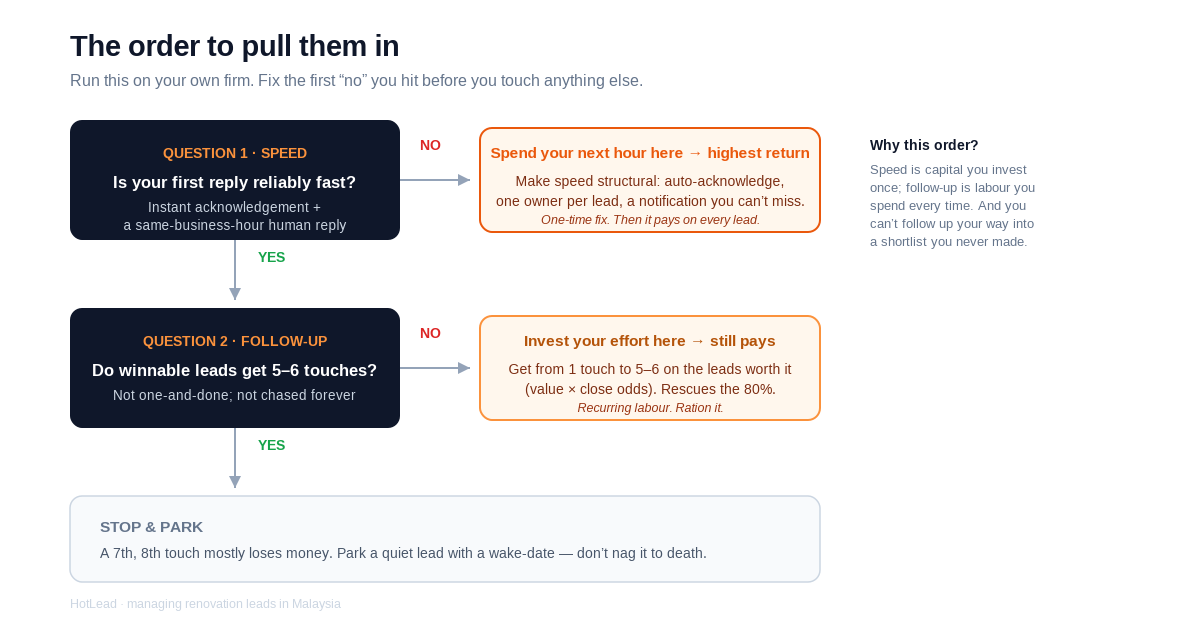
The ranking, not the exact heights, is the point:
| Reply speed | Follow-up persistence | |
|---|---|---|
| Economic type | One-time fix (capital) | Recurring effort (labour) |
| When it works | Decides if you make the shortlist | Only on leads you're still in contention for |
| The payoff shape | Huge and front-loaded, then automatic | High for touches 2–6, then near-zero |
| Ongoing cost to you | ~Zero once set up | Every touch is manual effort |
| What the data says | ~100x connect-odds swing, 5 vs 30 min (MIT/Oldroyd) | ~93% of wins by the 6th touch (Velocify) |
| Pull it… | First | Second, and cap it |
And this is exactly where most reno firms get the order wrong. The advice that circulates loudest — be persistent, follow up, don't give up — sends a time-starved owner to pour manual effort into the second lever while the first one, the one-time fix that would pay on every lead, sits unpulled. They're adding a fifth follow-up to leads they lost on minute one.
How to actually pull them, in order
Make speed structural once, then spend your freed-up attention on disciplined follow-up for the leads that deserve it. The sequence matters more than the intensity.
Step 1 — Make the first reply fast without a human (this is the one-time hour). Set up an instant acknowledgement so every enquiry gets a reply in seconds, 24/7, with no one awake. Give every lead one named owner so nothing sits in a group chat with diffusion of responsibility. Make the notification impossible to miss. Done once, this lever now works on every lead — which is the point of pulling it first. (The field version of this is replying fast without chaining yourself to your phone.)
Step 2 — Now spend your follow-up effort where it pays. With speed on autopilot, your scarce labour is free for the second lever. Follow up — but ration it by lead value times close odds, not a fixed cadence. A cold boosted-post lead closing near 1% earns a few quick touches; a warm referral worth far more in lifetime value and closing at 15–25% earns patient, personal persistence. Most winnable deals land inside five to six touches, so that's your working ceiling for the average lead.
Step 3 — Park, don't nag, the ones on their own clock. A reno non-response is often not a no — it's dated to a loan approval, VP keys, or festive cash (roughly 63% of enquirers don't buy for three or more months; 20% not for over a year, per Marketing Donut). The third road past "chase or give up" is to park the lead with a wake-date and stop spending touches until the situation changes. That's how you keep the follow-up lever from quietly becoming the money-losing tenth touch.
This is also why the speed lever is the one to fix first if you're forced to choose: it's the lever that frees the time the follow-up lever needs. Pull them out of order and you stay busy and slow at the same time — the owner-operator bottleneck in one sentence.
Where HotLead fits (and where it doesn't)
Be clear about the boundary. HotLead doesn't write your follow-ups or sell the job for you — the messages, the judgment and the relationship are yours. What it does is make the speed lever structural and the follow-up lever disciplined, which is precisely the split this article argues for:
- Capture + auto-greeting fire the instant acknowledgement on every enquiry automatically — the one-time speed fix that then pays on every lead, awake or not.
- One owner per lead + next-action and overdue flags turn follow-up into a tracked task instead of a memory you lose to the next site fire — and they surface the lead that's owed a touch and the one you should stop chasing, so your scarce effort lands on the right leads.
- The funnel and per-channel view lets you actually see both numbers — how fast first replies go out, and how many touches your winnable leads get — so you can tell which lever is leaking instead of guessing.
The honest reason most firms can't pull these levers in order isn't that they don't know the advice — it's that a shared number and a spreadsheet can't make speed automatic or follow-up reliable when the one person holding it all is on a roof in Cheras.
For the whole system this sits inside — capture, reply, qualify, quote and follow up — start with the complete guide to managing renovation leads in Malaysia. From here, the two levers in depth are the response-time benchmark and how many follow-ups is too many; for the bigger picture of which growth lever to pull at all, see the three growth levers for a reno firm. If you run a renovation firm, this is the order worth pinning above your desk.
Sources: Response-speed figures — MIT / Dr James Oldroyd, Lead Response Management Study (2007, with InsideSales.com; 100x drop in contact odds 5 vs 30 min, >10x decay in the first hour, 21x qualification lift, and a large first-responder win share rising in competitive markets); Harvard Business Review, "The Short Life of Online Sales Leads" (2011) (2,241-company audit; ~42-hour average first response, 23% never respond); Drift Lead Response Report (433 B2B companies; only ~7% respond within five minutes, 55% not within five business days). Follow-up figures — Invesp follow-up statistics (80% of sales need five or more follow-ups; 44% of sellers quit after one); Velocify, The Ultimate Contact Strategy, an analysis of roughly 3.5 million leads (about 93% of converted leads reached by the sixth contact; leads needing more than seven calls ~45% less likely to convert; widely summarised, e.g. via the National Law Review and the Sales Lead Management Association); Marketing Donut (roughly 63% of enquirers don't buy for three or more months, 20% not for over a year). WhatsApp share in Malaysia (90% of internet users) via DataReportal. These are predominantly US inside-sales phone-and-email studies, so treat the multipliers and touch counts as directional shape for a WhatsApp renovation enquiry, not laboratory-exact. The close-rate bands (~1% cold vs 15–25% referral), lifetime-value figures and the marginal-return heights in the chart are the illustrative house figures used across this series — the ranking of the levers is the robust part; plug in your own first-reply times and touches-to-win to find your own.
Frequently asked questions
Should I reply faster or follow up more?
If you can only fix one thing this month, fix reply speed first — but understand why. Reply speed is a one-time structural change (set up an instant acknowledgement once and it works on every lead forever), while following up more is ongoing manual effort with fast-diminishing returns. So the highest-return hour you can spend is making your first reply reliably fast, because that lever decides whether you even make the buyer's shortlist. Once speed is handled, your next-best effort is getting winnable leads from one touch to five or six. Beyond that, more follow-ups mostly lose money.
Why is reply speed a one-time fix but follow-up isn't?
Because speed can be built into your system and then runs without you. An auto-acknowledgement on WhatsApp, one named owner per lead, and a notification the moment an enquiry lands are set up once and then fire on every future lead at near-zero ongoing effort. Follow-up is the opposite — every touch is a message someone has to actually send, remember to send, and decide whether to send again. One is capital you invest once; the other is labour you spend every day. That difference is the whole reason to pull the speed lever first.
Doesn't the research say 80% of sales need five or more follow-ups?
It does, and that is true — but it is a floor, not an instruction to chase every lead forever. The same body of research shows the curve flattens hard — about 93% of winnable deals are reached by the sixth contact (Velocify), and leads needing more than seven calls are around 45% less likely to convert. So the 80%-need-5+ figure proves that quitting after one touch (which 44% of sellers do) loses winnable deals; it does not mean the tenth touch pays. The first few follow-ups are high-return; the rest are not.
How fast is fast enough for a WhatsApp renovation enquiry?
Acknowledge within five minutes and have a real human reply within the same business hour. On WhatsApp the acknowledgement can be near-instant and automatic, so the practical bar is higher than for an email lead. The benchmark to beat is low — a widely cited survey found only about 7% of firms respond to a new enquiry within five minutes (Drift) — so a reliable instant acknowledgement already puts you ahead of most of the vans the buyer messaged at the same time.
When should I stop following up?
When the expected value of the next touch stops beating the cost of sending it. For a cold, low-intent lead that is a few fast touches; for a warm referral worth far more, it is patient, personal persistence. A practical rule is to stop active chasing around the fifth or sixth touch for most leads, and for a lead that has simply gone quiet on its own clock — waiting on a loan, keys or a spouse — park it with a wake-date and stop spending touches until something changes, rather than nagging it to death.
Keep reading
- Can AI Reply to Your Renovation Firm's 1-Star Review? I Built It — and the Risk Is How Fast It ApologisesA 2-star review on Google or Qanvast is the first thing your next renovation lead reads — and most firms either ignore it or fire back and make it worse. The 2026 reflex is to let AI write the reply. I built it, and drafting a calm response costs a fraction of a sen. But an AI tuned to be helpful apologises too fast — it will concede a fault in writing, promise a refund that never happened, and grovel to a fake review from a competitor. Here's the build that protects your rank instead of torching it.
- Which Lead Signals Actually Predict a Sale? Reverse-Audit Your Own Won JobsMost firms grade a renovation lead on signals that feel predictive — enthusiasm, a long message, a fast reply — and never check whether those signals actually separate won jobs from lost ones. Here is how to run a reverse-audit on your own closed deals, which signals usually survive it, and why your pipeline is too small to pretend the score is more than directional.
- The "I Only Deal With the Boss" Lead: When the Buyer Refuses Your TeamYou finally hired someone to share the load — then the buyer messages "can I deal with you direct ah, boss?" and refuses to engage your staff. Every big lead quietly re-centralises onto the one person already maxed out, and your firm can never grow past the owner. Here's why caving caps you, why a flat "my staff will assist" loses a nervous buyer, and the move that keeps both.