

A contractor I know in the Klang Valley nearly turned down the best client his firm ever had.
The WhatsApp looked ordinary: "Hi, we need a condo unit fully fitted out — kitchen, wardrobes, the works. Can you quote?" He was mid-busy-season, so he almost fired back his standard "sure, send me the unit details and we'll arrange a site visit." Then one line further down made him stop: "It's our show unit for a launch in September. Gallery has to be open by the 6th."
That wasn't a homeowner. That was a property developer, the "unit" was a marketing asset built to sell a whole tower, and "the 6th" was an immovable, advertised, sales-team-booked launch date. He'd been about to treat a launch-critical, deadline-locked B2B job like a walk-in kitchen reno — quote it slow, negotiate on price, give a comfortable timeline.
He caught it, changed how he handled it completely, and won the job. More importantly, he won the developer — and three years later, when that tower handed over, he was the first name in the WhatsApp broadcast the developer sent its buyers about renovating their new units.
That's the lead I want to walk through, because in Malaysia the show-unit enquiry arrives wearing a homeowner costume, and firms that are brilliant at homeowner jobs fumble it in the first reply.
What is a show-unit lead, and how is it different from a homeowner fit-out?
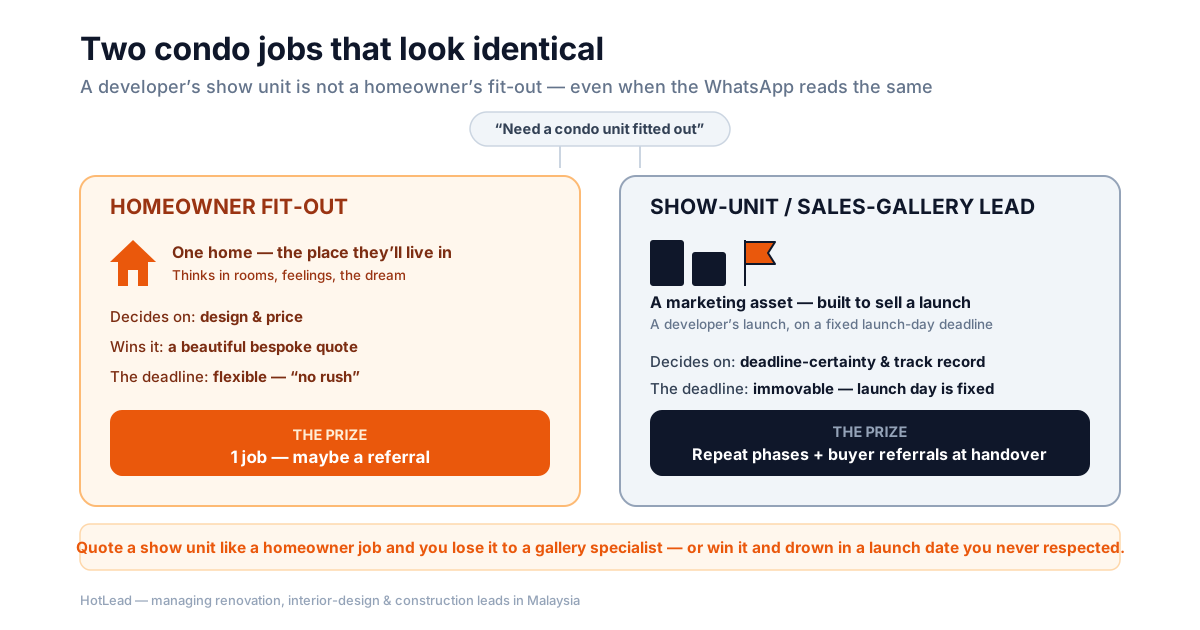
A show-unit or sales-gallery lead is a property developer or a project marketing agency asking you to build a marketing asset that sells a launch — not a home someone will live in. It's a distinct lead type with a different buyer, a different way of winning, and a completely different clock.
A homeowner is renovating the place they'll live in. They think in rooms, feelings and their family's routine; the decision is emotional; the timeline is usually flexible ("when can you start?"); and it's one job. A developer commissioning a show unit is building a sales tool. A show unit is a fully furnished, fitted-out sample apartment that lets buyers physically experience the finished product, and the sales gallery is the wider environment — reception, a development scale model, material displays and consultation areas — where the launch is sold. Nobody sleeps there. Its entire job is to convert visitors into bookings on a launch weekend that's already been advertised.
That single fact — it exists to sell, on a fixed date — flips almost everything about how you handle the lead. And it's not a rare corner of the market: NAPIC data presented at REHDA's 2025 sales-and-marketing summit shows 12,498 residential units were launched across Malaysia in Q1 2025, more than double the 5,585 a year earlier, with Johor overtaking Selangor as the busiest launch market. Every one of those launches needed a gallery and a show unit to sell it.
Why does a show-unit enquiry read like a normal condo job?
Because it comes through the same channel, in the same plain words, and often doesn't announce itself as a developer job until the second or third message. A marketing manager types "need a condo unit fitted out" the same way a homeowner does.
Three things keep the disguise on. First, the channel is identical — a developer's project team messages the same signboard, the same Qanvast or Atap profile, the same Facebook page a homeowner would. Second, the early words overlap almost perfectly: "condo unit," "full fit-out," "kitchen and wardrobes," "how much." Third, a busy firm is pattern-matching to its bread and butter — homeowner renos — so it reads "condo fit-out" and reaches for the homeowner playbook before the words "show unit," "launch," or "gallery" have even registered.
So the very signals that should make you sit up — a launch date, a scale model, talk of brand and image, a company rather than a couple — are the ones a firm skims past. You end up answering a launch-critical B2B lead with a homeowner reflex, the same way firms misread a landlord with five units as a single homeowner or a government tender as a direct project lead.
Why is a show-unit lead won on deadline-certainty, not price?
Because the developer's downside from a missed launch is enormous and public, and no fit-out cost saving comes close to covering it. They're not shopping for the cheapest gallery. They're buying a firm that will absolutely hit the date.
Think about what's riding on launch day. The date is advertised. The sales team is rostered. Buyer traffic — the weekend footfall developers spend heavily to drive to the gallery — is scheduled. The whole marketing spend is timed around the gallery being open and impressive on that weekend. If your show unit is half-finished on launch day, the developer doesn't have "a slightly late renovation." They have a dead launch, an embarrassed sales team standing in an unfinished room, and sunk advertising with nothing to convert. Against a loss like that, saving RM40k on the fit-out is meaningless.
That's why the pitch that wins a homeowner — the most beautiful design at the keenest price — is the wrong pitch here. What a developer is really asking, underneath the brief, is: "Can I bet my launch on you?" The firm that answers with a portfolio of comparable galleries delivered on time, a schedule counted backwards from launch day, and a calm, senior point of contact beats the firm that answers with a lower number and a vague "should be about six weeks." Malaysian gallery designers are blunt about the timeline reality: developers are advised to appoint their show-unit and gallery team five to seven months before launch, with the design-and-build running roughly 10 to 18 weeks — 4 to 6 weeks of design, procurement lead time, then 6 to 10 weeks of construction and installation. If a developer reaches you late, the honest thing to lead with is the deadline risk, not the price.
What does a developer actually care about on a show-unit job?
Certainty, reputation, and one accountable person — the things that protect a launch — not the design flourishes and low price that win a homeowner. Speak to those and you're immediately the firm that "gets it."
- Deadline-certainty above all. Can you prove you'll be finished, snagged and photo-ready before launch day? A credible schedule that works backwards from the launch date, with procurement lead times built in, is worth more than any render.
- A track record they can point to. A developer's own reputation is on the line the moment buyers walk in, so they want a firm that's delivered galleries and show units before. Your portfolio of past launches is your single strongest asset — often more persuasive than the quote itself.
- Finish quality that photographs and sells. The show unit has to look like the aspirational finished product and survive thousands of visitors tramping through it over a launch period. That's a different spec from a home — built fast, built to impress, built to take footfall.
- One senior, contactable owner. A developer coordinating a launch cannot chase a group chat. They want one experienced person who answers, owns the date, and doesn't need everything repeated — the opposite of a lead that gets lost in a team WhatsApp with no clear owner.
Homeowner fit-out versus show-unit lead — the reflexes that flip
Run a show-unit lead through your homeowner reflexes and you'll pitch the wrong things and miss the deadline that matters. Here's how the two differ, and why nearly every winning move flips — the same pattern you see on a strata committee job or a takeover of an abandoned renovation.
| Homeowner fit-out | Show-unit / sales-gallery lead | |
|---|---|---|
| Who's buying | A resident, for themselves | A developer or marketing agency, for a launch |
| What it's for | A home to live in | A marketing asset to sell other units |
| What they optimise | Design, feel, price | Deadline-certainty, brand, reliability |
| The deadline | Flexible — "when can you start?" | Fixed and public — launch day can't move |
| What wins it | A beautiful bespoke quote | A track record + a schedule that hits the date |
| What "expensive" means | Over budget for the dream | Anything that risks the launch |
| The real prize | This job, maybe a referral | Repeat phases + buyer referrals at handover |
| Right point of contact | Whoever's free | One senior owner who owns the date |
Who's actually asking — the developer or a project marketing agency?
Ask early, because a developer's own project team and an appointed project marketing agency are two different clients with two different decision chains. The words in the enquiry can be identical; who signs off and who pays is not.
Sometimes the developer's own project or marketing division commissions and pays for the fit-out directly — a cleaner chain, but often slower sign-off through internal approvals. Other times a project marketing agency hired to sell the launch is the one briefing and coordinating contractors on the developer's behalf, which can mean faster decisions but an extra layer between you and the party whose money it is. Either way, you want to know two things fast: who is the client I'm actually contracting with, and who signs off the design and the payment? Getting that clear up front protects you on scope changes and on getting paid — the same discipline as separating a tender's procurement rules from a direct lead's. Don't assume the person messaging you is the person who pays you.
The hidden prize: how one show unit feeds a pipeline of buyer referrals
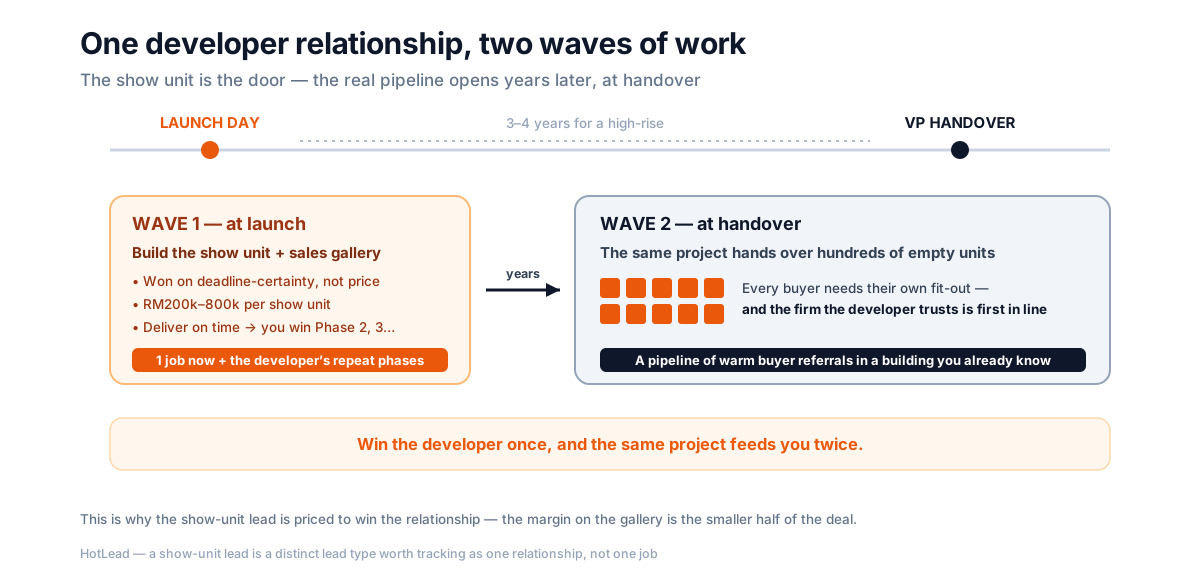
The margin on a single gallery is the smaller half of the deal — the real value is repeat launch work and a wave of warm buyer fit-out referrals when that same project hands over years later. A show-unit lead is a two-stage asset, and firms that only see stage one leave the bigger half on the table.
Stage one is the launch: deliver the show unit and gallery on time, and you become the developer's default for the next phase and the next project. Developers launch in phases and blocks, so one trusted relationship is repeat, predictable work. Stage two arrives years later. A high-rise typically completes three to four years after launch, and when it reaches vacant possession, hundreds of individual buyers take their keys — and renovations and fit-out works are a standard part of what they do next. That's the same property-handover surge every reno firm chases — except you're not a cold contractor fighting for attention. You're the firm the developer already trusts, in a building you already know inside out, often introduced to buyers by the developer itself.
How do you spot and handle a show-unit lead?
Catch the launch language on the first reply, tag it as its own lead type, and hand it to one senior person who pitches reliability and counts the schedule backwards from launch day. Five moves:
- Read for the tells before you reach for the homeowner playbook. "Show unit," "sales gallery," "launch," "opening date," "scale model," "our project," "marketing," a company name instead of a couple, and above all a fixed date. Any of those means stop — this isn't a walk-in reno.
- Qualify who the client is and how hard the date is. Developer or marketing agency? Who signs off and who pays? What's the launch date, and is it firm? If they've come to you late against a 10-to-18-week build, say so honestly now — deadline risk is the conversation, not the price.
- Lead with reliability and your portfolio, not a bespoke design. Put your track record of delivered galleries and on-time launches first. That's what a developer is actually buying. The design conversation matters, but it's downstream of "can I bet my launch on you?"
- Give it one senior owner and a launch-backwards schedule. Assign your most experienced, most reliable person as the single point of contact, and present a schedule that works backwards from launch day with procurement and snagging built in — not a vague "few weeks." A developer needs to see the date is safe in your hands.
- Price to win the relationship, and track it as one. The prize is repeat phases and handover referrals, not the margin on this gallery. Lock the job with clear staged payment terms, keep the developer relationship owned and followed up long after the launch, and treat the future handover wave as a pipeline you're already holding.
When is a show-unit lead not worth taking?
Walk away when you genuinely can't hit the launch date, when the developer wants gallery quality at homeowner prices, or when the launch keeps slipping and dragging your schedule with it. A missed launch damages your name in exactly the market you most want to be trusted in.
Take it when the date is real and reachable, you have or can build the track record, the client and sign-off are clear, and the relationship is worth pricing for. Be wary when the deadline is already impossible for an honest 10-to-18-week build and no one will admit it — winning that job means failing publicly. Be wary of a developer who wants a show-piece finish at a bread-and-butter price, because a thin, rushed gallery photographs badly and sells nothing. And be wary of the launch that's been "next month" for six months — a slipping date ties up your best people and your calendar. As with any lead you're better off declining early, the discipline is to protect your reputation and your schedule, and to say a fast, honest no when the date can't be met — because on a show unit, a blown deadline is a review the whole industry watches.
How HotLead helps you catch show-unit leads before you quote them like homeowner jobs
HotLead sits on top of the WhatsApp your enquiries already land in — nothing changes for the developer or agency messaging you — and it's built so a launch-critical B2B lead gets handled on the right process instead of the homeowner reflex:
- Captures and tags every enquiry the moment it arrives, so a "show unit for a launch" message can be marked as its own lead type and routed into a reliability-and-schedule conversation, not the bespoke-quote lane.
- Assigns one owner instantly — round-robin, manual, or a custom rule we set up during onboarding — so a developer deals with one senior, accountable point of contact who owns the launch date, not a rotating cast in a group chat.
- Keeps a next action and flags overdue follow-ups, so the launch-backwards schedule, the sign-off chase, the next-phase conversation, and the handover referrals years later all get tracked rather than forgotten.
- Shows your funnel and per-channel ROI, so you can see your developer relationships as pipeline — which launches are live, what the repeat-and-referral value is worth, and whether developer work is a lane worth building.
HotLead doesn't design your gallery or guarantee your build — that's your craft and your operations, and on a show unit the launch date is the whole game. What it does is make sure the lead that arrived looking like a walk-in condo job gets caught, tagged and owned by the right person before someone fires back a homeowner quote and loses a developer relationship worth years of work.
If your firm keeps quoting "condo fit-outs" that turn out to be show units for developers you never win, the leak usually isn't your pricing — it's that you answered a launch-critical B2B buyer like a homeowner and never saw the launch behind the unit. Start with the interior-design lead hub, the contractor hub or the renovation hub, read the complete guide to managing renovation leads in Malaysia, or see how HotLead works.
Sources: Show unit and sales gallery definitions, purpose and the guidance that developers should appoint their show-unit and gallery team roughly 5–7 months before launch, with a design-and-build of about 10–18 weeks and typical fit-out costs of RM200,000–800,000 per show unit and RM400,000–2.5 million-plus for a sales gallery, from Designed Design Associates — How Expert Show Unit Design Accelerates Property Sales in Malaysia and PropertyGuru — A Guide to New Launch Property. New-launch volume of 12,498 residential units in Q1 2025 (more than double the 5,585 a year earlier), with Johor overtaking Selangor, from NAPIC data reported by EdgeProp — Johor overtakes Selangor for new launches in 1Q2025. High-rise completion typically three to four years after launch, and vacant possession bringing renovation and fit-out works as buyers take handover, from PropertyGuru — A Guide to New Launch Property and PropertyGuru — New Property Handover Procedures in Malaysia. The Klang Valley, KL and launch-referral scenarios are illustrative; the two-stage pattern — launch work followed by handover referrals — is the real prize of a developer relationship.
Frequently asked questions
How do I tell a show-unit or sales-gallery lead from a normal homeowner condo fit-out?
Listen for a launch, a deadline, and a business buyer instead of a resident. A homeowner talks about their family, their dream kitchen and how they want it to feel, with a flexible timeline. A show-unit lead talks about a launch date, a sales gallery, a "show unit", a scale model, brand and image, and it comes from a developer, a project marketing agency, or a marketing manager — often with a fixed, non-negotiable open date. If the enquiry is about a unit nobody will live in, built to sell other units, on a date that cannot move, you are looking at a B2B marketing-asset lead wearing a homeowner-fit-out costume.
Why is a show-unit lead won on deadline-certainty rather than price?
Because the developer's downside from a missed deadline is enormous and public. Launch day is advertised, the sales team is booked, the buyer traffic is scheduled, and the whole marketing spend is timed around the gallery being open. If the show unit isn't ready, the launch is either dead or embarrassing, and no fit-out cost saving comes close to covering that loss. So the developer is buying a firm that will absolutely, provably hit the date — evidenced by a portfolio of past galleries delivered on time — rather than the lowest quote. A firm that competes on price and gives a vague timeline is answering a question the developer isn't asking.
A property developer wants me to fit out a show unit. Should I just quote it like a big condo job?
No — quoting it like a scaled-up homeowner job is exactly how firms lose it or get hurt by it. A show unit is a marketing asset on an immovable launch deadline, so your pitch has to lead with deadline-certainty, a portfolio of comparable galleries, and a schedule counted backwards from launch day, not with a bespoke design and a negotiable price. Malaysian sales-gallery designers advise developers to appoint their show-unit team five to seven months before launch, and the design-and-build itself runs roughly ten to eighteen weeks, so if the developer is coming to you late, the deadline risk is the first thing to be honest about, not the last.
Who actually commissions a show unit — the developer or a marketing agency?
Both happen, and it changes how you handle the lead. Sometimes the developer's own project or marketing team commissions and pays for the fit-out directly. Other times a project marketing agency appointed to sell the launch is the one briefing and coordinating contractors on the developer's behalf. The decision chain, the sign-off, the payment terms and how quickly you get paid can all differ between the two, so one of your first questions should be who the client actually is and who signs off. It's the same discipline as separating a government tender from a direct project lead — same words, different buyer, different rules.
Is a show-unit job worth more than a normal renovation?
Usually far more, but the value is in the relationship, not the single gallery. A developer who trusts you to deliver a launch on time will come back for the next phase and the next project — repeat, predictable work. And the same building you built the show unit for hands over hundreds of empty units to individual buyers years later, every one of them needing their own fit-out, with your firm as the name the developer and its buyers already know. So a show-unit lead is really a two-stage asset — a marketing job now, and a pipeline of warm buyer referrals at handover — which is why it's worth pricing to win the relationship rather than to squeeze margin on unit one.
Keep reading
- "Did They Even See It?" I Built an AI to Read the Silence After a RM62k Renovation QuoteA Puchong reno firm sends a detailed RM62k kitchen quote on WhatsApp, then gets three days of silence. Did they read it? Comparing? Sticker shock? Nobody knows, so the follow-up is a blind "just checking in" fired into the dark. The 2026 reflex is to ask AI to score the buyer's intent and auto-chase. I built it — and it confidently invented a signal it couldn't actually see, then sent the one message that re-opens the price. Here's why the honest build, which admits what it can't know, is the one that earns its keep.
- The Three Numbers That Predict Your Next Quarter of Renovation LeadsYour paid-lead numbers tell you about this month. Reviews earned per won job, your referral rate and your repeat rate tell you about next quarter — they're leading indicators of the free pipeline most reno firms only notice once it dries up. Here's how to read the three trust numbers, why you should measure behaviour instead of a loyalty survey, and how to spot a dry quarter while there's still time to prevent it.
- A Main Contractor Just Asked You to Quote a Package. Qualify the Payer First.When another contractor WhatsApps you to price a trade package, it looks like the cleanest lead of the month — a pro who knows what he wants. It's actually your riskiest, because the risk isn't the project, it's the payer. Here's how to handle it.