

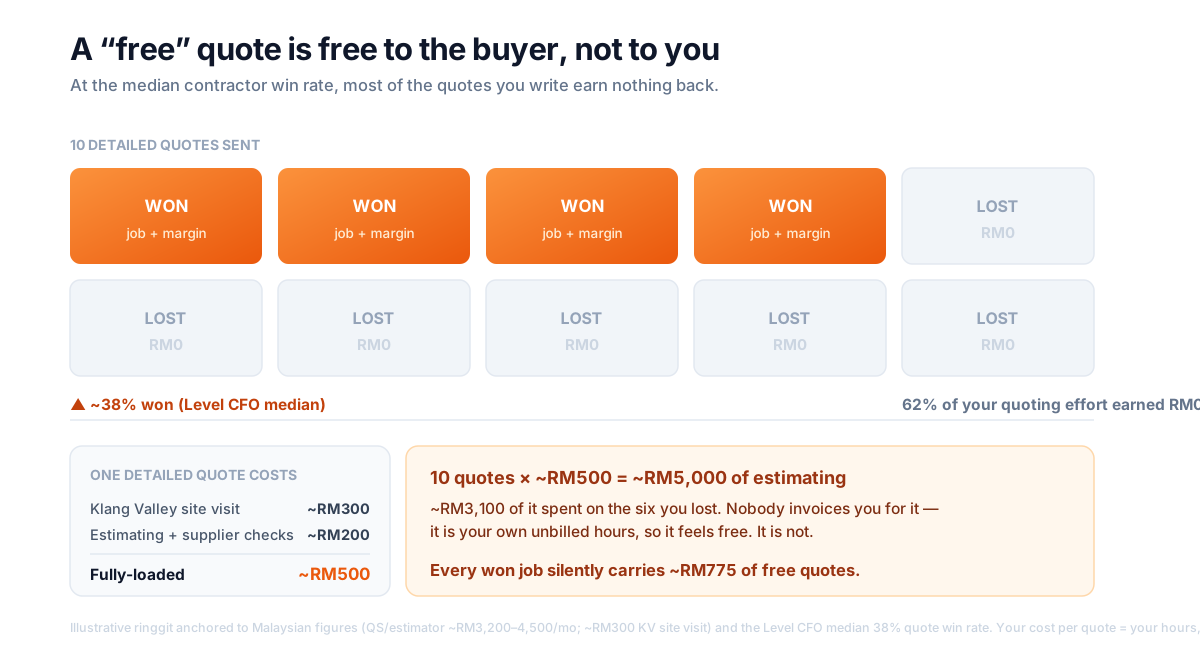
Here is a cost that never appears on any job ticket, yet you pay it every single month: the quotes you write and lose. The median contractor wins about 38% of the quotes it sends — which means 62% of all that estimating effort produces zero revenue (Level CFO). For a renovation firm, where a proper quote means a site visit, a takeoff and a round of supplier price-checks, that 62% is not a rounding error. It's a real slice of your margin, spent on buyers who signed with someone else.
A free quote is free to the buyer. It is never free to the firm that writes it. This piece puts a ringgit figure on what a renovation quote actually costs to produce, shows how the win rate multiplies that cost onto the jobs you win, and works through the arithmetic that decides whether you fix a low win rate by quoting faster or by quoting smarter. Spoiler: the reflex answer is only half right.
What does a "free" quote actually cost a renovation firm?
A detailed renovation quote costs roughly RM400–600 to produce — not in cash, but in a site visit plus two to four hours of your estimator's or your own time. It feels free because you never write a cheque for it; you pay it in hours that show up on no invoice.
Break down where that number comes from for a typical Klang Valley reno or ID firm. These are illustrative components anchored to real Malaysian figures, not a fixed price:
- The site visit — ~RM300. As we covered in the free site-visit trap, the cost of a measurement visit isn't the petrol — it's the half-day of Klang Valley hours nobody counts. Drive to Semenyih and back for a 40-minute look and you've spent the most expensive thing a small firm owns: senior time.
- Estimating and takeoff — a few hours. Measuring up, pricing materials against current supplier rates, calling around one or two subcontractors, then writing it up cleanly. A Malaysian quantity surveyor or estimator earns roughly RM3,200–4,500 a month (Indeed / Jobstreet), which loads to somewhere around RM20–30 an hour before you add the owner's own time — and an owner's hour is worth more than that.
- The invisible overhead. As one contractor finance guide puts it, "the hours you spend at night writing quotes are an overhead cost that shows up on no job ticket, but you pay it every month no matter what" (JobEstimator).
Add it up and a serious itemised quote lands around RM500. That's the same insight behind what a new client really costs to acquire: the biggest cost in your sales process is usually time, not ad spend — and because it's time, it stays invisible until you deliberately count it.
If the quote is free to the buyer, why does it drain your margin?
Because you don't win them all — and the cost of the ones you lose doesn't disappear. It gets absorbed by the ones you win. Estimating cost per won job = cost per quote ÷ your win rate. That one division is the whole story.
At a RM500 quote and the median 38% win rate, you produce about 2.6 quotes for every job you win. So each won job quietly carries the cost of roughly 1.6 quotes you gave away for nothing — about RM800 of free estimating baked into every job, before you've laid a single tile. Scale it up: ten quotes a month at RM500 is RM5,000 of estimating effort; win four, and roughly RM3,100 of that was spent on the six you lost.
The uncomfortable part is what happens when the win rate moves. Because it's a divisor, small changes swing the cost hard:
| Quote win rate | Quotes per win | Estimating cost per won job (RM500/quote) |
|---|---|---|
| 25% (open competitive) | 4.0 | ~RM2,000 |
| 38% (median — Level CFO) | 2.6 | ~RM1,316 |
| 50% (qualified pipeline) | 2.0 | RM1,000 |
| 60% (warm / repeat-heavy) | 1.7 | ~RM833 |
Read down the last column. Lifting your win rate from 38% to 50% doesn't just win more jobs — it cuts about RM316 of estimating cost off every job you win, and it hands back the hours you'd have burned on the quotes you no longer write. The win rate isn't only a sales number. It's a cost number.
So should you just charge for quotes?
In most cases, no — not for a competitive residential quote. It's the obvious reflex once you see the numbers, and it's usually the wrong one in the Malaysian market. Here's why: serious renovation buyers shortlist and compare three to five firms (Qanvast recommends up to five; Recommend.my's own guidance is to compare three quotes). Nobody pays three to five quotation fees to choose one contractor. So a blanket quote fee filters out your best buyers — the ones doing their homework — as fast as it filters out tyre-kickers, and hands them straight to the firm still quoting for free.
This is the identical trap to charging for the free site visit and to giving away a free 3D render: a hard gate repels the shortlist buyer before it protects you. Charging for a quote only makes sense in narrow situations:
- A paid, deliverable-grade output — a measured survey, a detailed design or a drawing the buyer keeps and could build from. Then you're selling a product, not gating a sales conversation.
- A commercial or far-flung job where the visit and estimating genuinely cost real money and the buyer expects a professional fee.
- When demand already exceeds the capacity you can build — a fee becomes a legitimate filter because you don't need the marginal lead.
For everyday residential work, the answer isn't a fee. It's deciding which leads earn a full quote in the first place.
Then what's the real fix — quote faster, or quote less?
Neither, on its own. The fix is to match the depth of the quote to the lead. The popular advice is speed: quote first, because the first complete quote tends to win and a quote left to go stale dies. That's true — but it's only half the lever, and taken alone it backfires.
If you simply quote everything faster, you also produce your losing quotes faster. You scale the 62% waste instead of shrinking it. Speed makes a good pipeline better and a bad pipeline more expensive. The other half of the lever is selection — being deliberate about which leads get the expensive, itemised treatment at all.
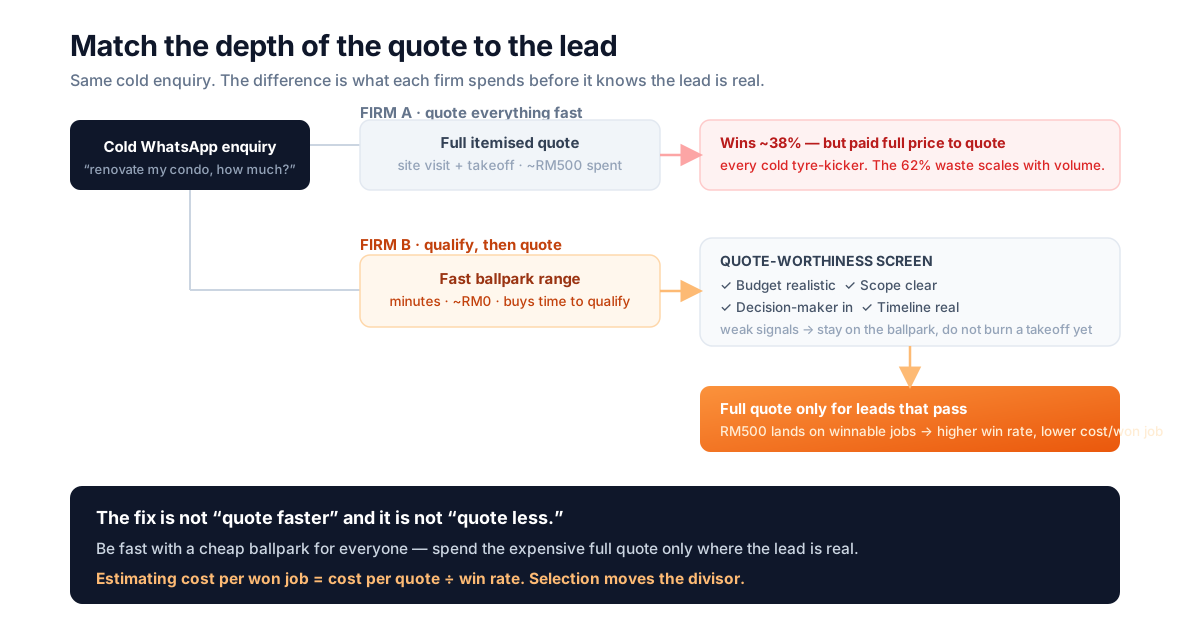
So speed and selection aren't rivals — they're complements:
- Be fast for everyone. Acknowledge instantly, and give a cheap ballpark range (not a committed number) that keeps you in the running and buys you time to qualify. A ballpark costs you minutes; a full quote costs you RM500.
- Be selective about the full quote. Reserve the site visit, the takeoff and the itemised document for leads that have shown they're real.
That's the same logic as cost per lead vs cost per job: the cheapest thing to produce is not the thing that pays. A cheap ballpark for all, an expensive quote for the qualified few.
How do you build a quote-worthiness screen?
Before you commit a site visit and a takeoff to a lead, run it against four fast signals — the same ones from qualifying a lead on the first WhatsApp reply:
- Is the budget realistic? Not "what's your budget" as an interrogation, but a light anchor — "condo kitchen refits usually land RM18–38k, does that fit what you had in mind?" A buyer expecting RM8k for a RM40k job isn't a quote, it's a lesson.
- Is the scope clear enough to price honestly? A one-photo "renovate this" isn't yet quotable — it needs one or two questions first, not a full takeoff. (An image alone can't be measured or priced; a number off a photo is a guess.)
- Is the decision-maker actually in the conversation? Quoting to someone who "needs to check with my husband / the committee" means you may be quoting a messenger.
- Is the timeline real? "Getting keys in September" is a live lead to diarise; "just looking around for now" is a ballpark-and-park.
Weak signals don't mean reject — they mean stay on the ballpark and don't burn a takeoff yet. And here's the guardrail: don't over-tighten the screen. Decline too hard and you starve the funnel — the same failure as chasing only the cheapest leads. The screen's job isn't to quote less; it's to spend your expensive quoting where it can win, while still answering everyone fast and cheaply. Qualify hard on the RM500 quote, stay generous with the RM0 ballpark.
What numbers tell you it's working?
You can't manage the cost of quoting if you can't see it. Track three things, and track them by source, because a blended average hides which channels are worth a full quote:
- Quote-to-win rate by source. Referral and repeat-client quotes should convert far better than cold boosted-post quotes. If they don't, your problem isn't the quote — it's who you're quoting.
- Quotes produced per won job. This is your divisor. If it's climbing, your estimating cost per job is climbing with it, whether or not you feel it.
- Full quotes on unqualified leads. The one to drive toward zero — every RM500 quote that went to a lead who never passed the screen.
None of this needs fancy software — it needs the source tag to survive from the first message to the won-or-lost outcome, which a busy shared WhatsApp inbox and a spreadsheet quietly lose in exactly the busy months the data matters most.
How HotLead fits in
HotLead doesn't write your quote or judge whether a lead is worth one — the takeoff and the go/no-go call are your expertise. What it does is make sure your expensive estimating hours land on the right leads and don't die once spent. It captures and tags every enquiry by source, so you can see quote-to-win rate per channel and learn which leads deserve a full quote. Its qualify-on-first-reply step captures the budget, scope, decision-maker and timeline signals before you commit a site visit. Its next-action and overdue-follow-up tracking makes each sent quote a task that gets chased instead of going silent — so the RM500 you did invest actually gets a decision. And its funnel and per-channel view shows quote-stage conversion by source, which is the number that tells you whether your quoting is landing on winnable jobs or scaling the waste.
Start with the complete guide to managing renovation leads in Malaysia, see the renovation lead playbook or the construction lead playbook, and go deeper on cost per lead vs cost per job and enquiry-to-deposit conversion benchmarks.
Sources: Level CFO — "The 7-Day Rule: Why Stale Quotes Kill Contractor Revenue" (median contractor converts 38% of quotes sent; 62% of quoting effort produces zero revenue, "lost to silence and inaction," not only price); JobEstimator — "Contractor quote close rate: what's normal and how to fix it" (healthy residential close rate ~25–30%+; quoting hours as unbilled overhead "that shows up on no job ticket"); Associated General Contractors (AGC) bid-to-win benchmarks via industry summaries (general-contractor win ratios ~20–35% average, ~10–20% hard competitive vs ~30–50% negotiated/selective; a large share of estimating labour produces no revenue at typical win rates); Indeed Malaysia — quantity surveyor salaries and Jobstreet/Glassdoor (QS/estimator ~RM3,200–4,500/month, 2025–2026); preconstruction/estimating commonly budgeted at ~1–3% of project value; in-house estimator cost ~USD65k–120k/year inclusive of overhead (industry estimating-cost guides). Ringgit cost-per-quote figures (RM400–600, ~RM300 site visit) are illustrative examples anchored to these Malaysian figures and to house figures reused across this series — replace them with your own site-visit and estimating hours to get your real cost per quote and cost per won job.
Frequently asked questions
How much does it cost a renovation firm to produce a quote?
A quick verbal ballpark costs almost nothing. A detailed, itemised renovation quote is different — it usually needs a site visit, a takeoff, current supplier price-checks and a couple of subcontractor call-arounds, then the write-up. For a Klang Valley firm that is roughly a RM300 site visit (mostly the hours lost in traffic, not petrol) plus two to four hours of estimator or owner time, landing around RM400–600 per detailed quote. The exact figure varies, but the point holds — it is real cost, paid in your own unbilled hours rather than a cash invoice, which is exactly why owners feel free quotes as free.
What is a normal quote win rate for a renovation contractor?
Across contractors, the median converts about 38% of the quotes it sends (Level CFO), and general-contractor bid-to-win ratios sit around 20–35% on average (AGC), higher for negotiated or repeat work and lower for open competitive bids. Residential service work below roughly 25–30% usually signals a problem — often leads that were never qualified before being quoted, or quotes left to go silent. The number itself matters less than tracking your own by source, because a blended average hides which channels send quote-worthy leads.
Should a renovation firm charge for quotes or estimates?
Usually no, for a competitive residential quote. In Malaysia serious buyers shortlist three to five firms and expect a free quote, so a blanket fee filters out your best buyers as fast as it filters tyre-kickers and hands them to the firm still quoting for free. Charging works only in narrow cases — a paid, deliverable-grade design or measured drawing; a commercial or far-flung job where the visit itself is costly; or when demand exceeds the capacity you can build. The better lever is not a fee but a qualification screen that decides which leads earn a full quote.
How do you reduce the cost of quoting without losing jobs?
Match the depth of the quote to the lead. Answer every enquiry fast with a cheap ballpark range that costs you almost nothing and keeps you in the running. Spend the expensive, itemised quote only on leads that pass a worthiness screen — realistic budget, clear enough scope, the decision-maker involved, and a real timeline. That raises your win rate, which mathematically lowers your estimating cost per won job, and it frees the hours you were burning on quotes that were never going to close. The mistake is scaling quoting speed without scaling selection.
Is quoting faster enough to fix a low win rate?
Speed helps — the first complete quote often wins, and stale quotes die — but speed alone is only half the answer. If you quote everything faster, you also produce your losing quotes faster, so you scale the 62% waste rather than shrink it. Speed and selection are complements — be fast for qualified leads, and be selective about which leads get a full quote at all. Quoting first is worth most when you are quoting the right lead first.
Keep reading
- Did We Already Say RM68k? Using AI to Stop Quote Drift Across a Long Renovation ThreadOver a weeks-long WhatsApp thread with two or three quote revisions, a rep re-states a number that contradicts an earlier promise — and re-opening a settled price quietly invites a discount that eats a whole job's profit. So I pointed AI at the drift. It works beautifully as a flag, and dangerously as an auto-corrector.
- The Warranty as a Closing Lever: Why a Longer Guarantee Beats a Discount on a Renovation DealA quote is stalling and the buyer wants a reason to say yes. Before you drop the price, look at the other lever in your hand — a longer workmanship warranty. It is the same expected-value decision as a discount, but the math runs the opposite way — a price cut costs you thousands with certainty, while extending the defects cover costs you a couple of hundred ringgit in expectation, for arguably more trust with a scam-wary buyer. Here is the EV case for the non-price concession, the trap that turns it into a hidden liability, and which leads it actually moves.
- "Can You Just Build It, My Neighbour Also Did" — Handling the Renovation Lead That Needs Council Approval FirstSome renovation enquiries can't legally start next month, no matter how ready the buyer is — a kitchen extension, a hacked-through wall, a roofed-over air well all need the council's written approval first. Quote a fast build price to win the job and you either lose it to a "boss, can start" cowboy, or win it and inherit the stop-work order, the RM50,000 fine and a client who later can't sell the house. Here's how to spot the permit-first lead and sell the approval as protection.