

Every renovation firm obsesses over two questions it can only half-control: where leads come from (the ad, the Qanvast listing, the referral) and how they choose to reach out (a call, a WhatsApp, a "berapa?" DM). But there is a third question, entirely in your hands, that most firms never decide on purpose: once a buyer is interested, where do you send them?
A bare phone number. A web contact form. A click-to-WhatsApp button. A Linktree bio link. That destination is a design decision — the one part of the funnel you fully own — and most firms pick it by accident, usually by copying whatever looks most "professional". That is the wrong test. The only test a destination has to pass is this: does a click turn into a live conversation with a human?
What does "where to send a lead" actually mean — and why is it the one part you control?
It is the destination and conversion path you point an interested buyer at: the button, the link, the form that stands between "I want to know more" and "I'm now talking to someone". Source and mode are chosen by the buyer and the market. The destination is chosen by you — in your ad, your bio, your website, your Google listing — which makes it the cheapest lever you have, because changing it costs a link edit, not a bigger ad budget.
Keep it separate from two things it is often confused with. It is not the source (where the lead came from — that is the channel ROI question). It is not the first-contact mode (how the buyer chose to reach out, and what that signals — covered in call, WhatsApp, form or DM). The destination is the thing you put in front of them to start the conversation on. Four show up again and again for Malaysian reno and ID firms:
- A bare phone number — "call us at 01x-xxx".
- A web contact form — name, phone, email, message, submit, wait for a callback.
- A click-to-WhatsApp button or link — a
wa.melink or Meta's click-to-WhatsApp, one tap into a chat. - A Linktree / bio link — a menu of links, used where a platform allows only one URL.
What should you optimise the destination for?
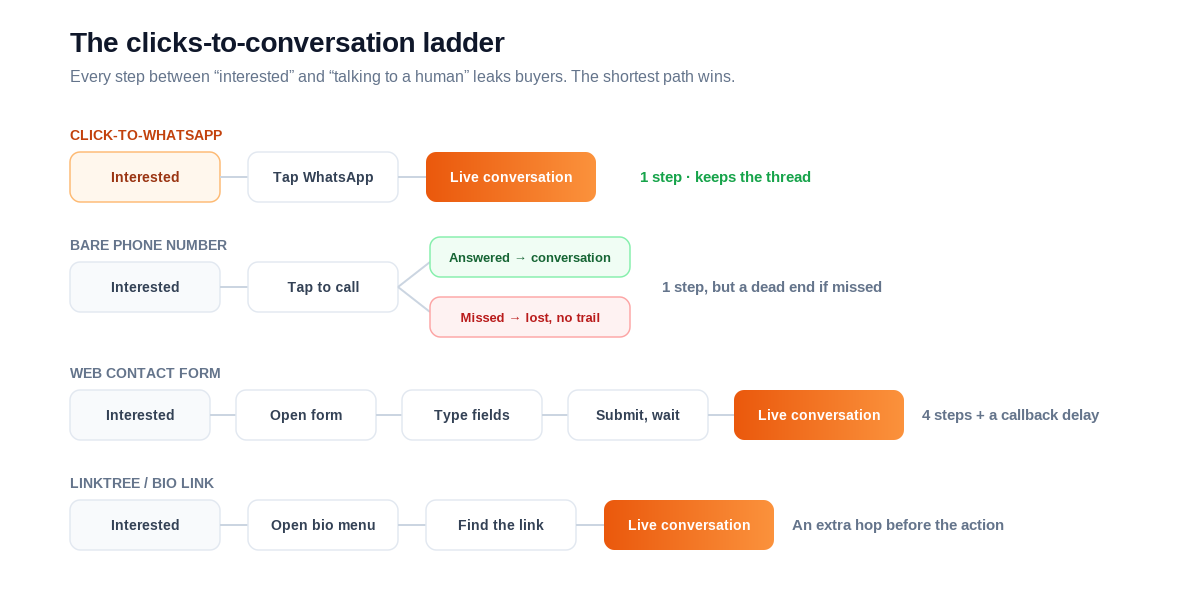
Clicks that become conversations — nothing else. Not how modern the page looks, not how many fields you can capture, not whether it matches your brand deck. The destination's entire job is to shorten the distance between a buyer's interest and a real human reply. The useful way to measure that distance is to count the steps between "interested" and "talking to a person", because every step is a place buyers quietly drop out.
A web form looks like one step but is really several: read the fields, type your details, submit, then wait — and the wait is the killer. The buyer who filled your form at 10pm is still comparing three other firms, and the first one to actually reply to them usually wins. Speed-to-lead studies are blunt about this: the classic MIT and InsideSales research found that contacting a web lead within five minutes made it about 21 times more likely to qualify than waiting 30 minutes, and Velocify's analysis of millions of leads found a reply inside 60 seconds converting far above a 30-minute reply. A form inserts exactly the delay that kills the number. A click-to-WhatsApp tap collapses the whole path into one step — the conversation is the first contact.
The four destinations, compared
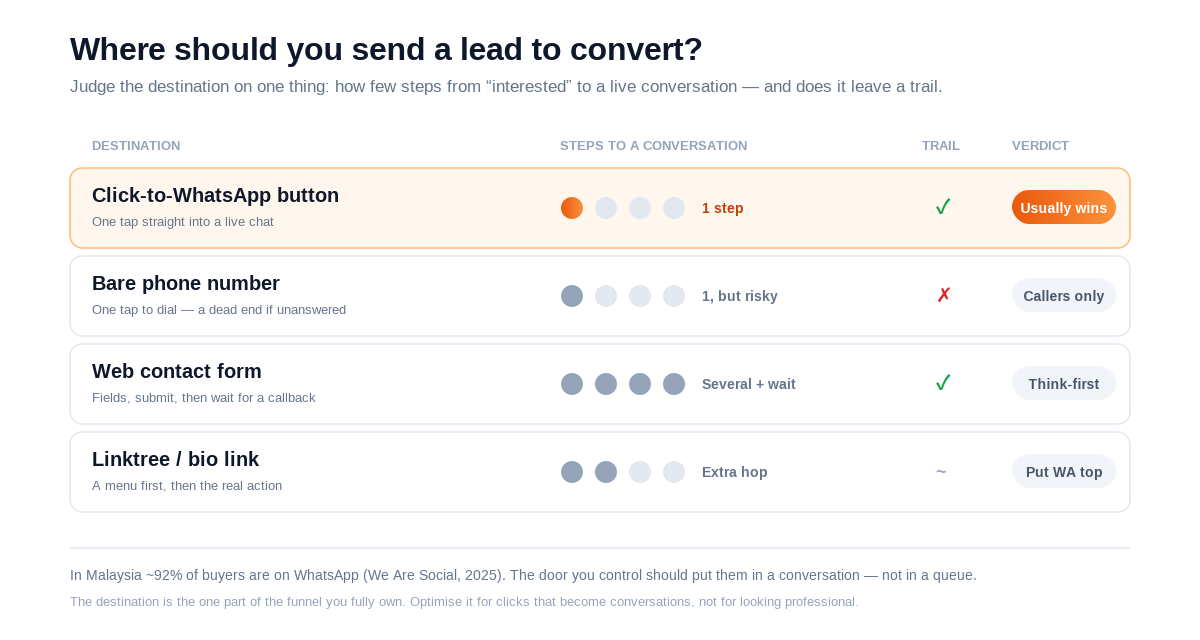
Here is how the four stack up on the only things that matter — the steps to a live conversation, whether you keep a trail, and what each is quietly good or bad at.
| Destination | Steps to a conversation | Leaves a trail? | Best at | Weak at |
|---|---|---|---|---|
| Click-to-WhatsApp button | 1 tap — straight into a live chat | Yes — the full thread is saved | Turning interest into a conversation fast, with a record | Nothing structural; you still must reply fast |
| Bare phone number | 1 tap to dial, but a dead end if unanswered | No — a missed call leaves no thread, often no name | The caller who wants to talk now | The ~half of buyers who would rather message; no follow-up if missed |
| Web contact form | Several — fields, submit, then wait for a callback | Yes, but one-directional until you reply | Capturing the think-first buyer and pre-qualifying | The delay; fewer than half who reach it finish it |
| Linktree / bio link | 1 tap to the menu, then another to the real action | Depends where it lands | Holding several links where only one URL is allowed | Every extra hop leaks; buries the one button that matters |
The pattern is clear: the destinations that win are the ones that put the buyer in front of a human in the fewest steps and keep the thread so you can follow up. In a market where almost everyone is already on WhatsApp, one of them does that better than the rest.
Why does click-to-WhatsApp usually win in Malaysia?
Because it is the only destination that is a conversation, not a doorway to one — and in Malaysia the whole market already lives there. About 92% of Malaysians use WhatsApp (We Are Social's 2025 ranking put Malaysia top in the region), so sending a buyer to WhatsApp asks them to do nothing new. The tap lands them in a live chat, which blends the immediacy of a call with the written trail of a form — the two things the other destinations each only half-deliver. A phone call is immediate but leaves no record; a form leaves a record but adds a wait. WhatsApp gives you both.
It also removes form fatigue. Zuko's 2025 benchmarking found only about 45% of people who reach a form actually complete it, and Typeform's 2025 data showed a 10-field form converting roughly 28% worse than a tight 3-field one. Every field is a chance to quit. A WhatsApp chat has no fields — the buyer just talks, and you ask your qualifying questions inside a conversation they are already having. Meta's own case studies point the same way: running click-to-WhatsApp alongside lead forms has been shown to lift submitted conversions, because it drops the buyer into a chat instead of a form.
For most Malaysian reno and ID firms, this decision is even more concentrated than it looks, because the "website" is often an Instagram bio or a Facebook page, not a site at all. The whole landing-destination question collapses into one practical choice: what is the single link in your bio? A bare phone number there is a wasted slot. A click-to-WhatsApp link (wa.me/60…, ideally pre-filled with a greeting) turns every profile visit that sparks interest into a one-tap conversation.
When is a form or a landing page actually the right destination?
When the buyer wants to think before they talk, or has never heard of you and needs proof first. WhatsApp wins on average, not always — and a data-led decision names the exceptions honestly:
- The think-first buyer. Some people, especially on bigger or more private jobs, are not ready for a live chat. They want to leave their details on their own terms and be contacted later. A short form captures that buyer, who would abandon a "message us now" prompt. Keep it to three or four fields — name, contact, unit type, rough scope — because every extra field costs you completions.
- The high-ticket cold stranger. A buyer who found you cold, with no referral and no portfolio in mind, may not message a number they do not trust yet. For that buyer a real landing page earns its place — not for decoration, but to carry the proof (past projects, a real address, reviews, a named team) that makes messaging feel safe. Even then, the call to action on that page should still be click-to-WhatsApp. The page builds trust; WhatsApp converts it.
- After-hours capture. A form or an auto-reply catches the 11pm browser when no one is awake to chat. The trick is to make the follow-up fast the moment you are back, because that lead is cooling against your competitors by the minute.
So what should you actually do?
Give every interested buyer one obvious WhatsApp door, add a short form for the people who want it, and keep the phone number for the callers — then make sure nothing that comes through leaks. Concretely:
- Make click-to-WhatsApp the primary button everywhere you can be found — website, Instagram bio, Facebook page, Google Business Profile, ad CTAs. Pre-fill it with a friendly greeting so the buyer does not face a blank chat.
- Keep a short form as the quiet second option for the think-first buyer. Three to four fields, no more.
- Keep the phone number, but never let it be the only door.
- Fix the top of your bio link if a platform forces you into one. Put WhatsApp first; don't bury it.
The destination gets the buyer into a conversation. What happens next — replying before they cool, not losing the thread between five staff, following up the ones who go quiet — is where the job is actually won or lost. That is the part HotLead handles: it captures your WhatsApp, Facebook and Instagram enquiries into one sorted inbox, greets each new one instantly so the live conversation starts even while your team is on site, assigns each to a single owner, keeps the follow-ups on a next-action list, and shows you per source which destination and channel actually send buyers. It is honest about its edges — it does not build your website or your landing page — but it makes sure every buyer who taps your WhatsApp door lands somewhere, with an owner, and never falls between the cracks.
Design the door for one thing: turning a click into a conversation. For the signal the buyer's chosen mode gives you once they do, see call, WhatsApp, form or DM; for the capture leak when leads land on comments and personal DMs instead of your business line, see "Boss, berapa?" the lead on the wrong channel; and for how fast you must reply once the conversation starts, see lead response time vs close rate. It all feeds the same renovation lead playbook, and matters most for renovation and interior-design firms, where one won job is worth thousands.
The Klang Valley firm above is an illustrative composite; the conversion and completion figures are from the named sources, not from a single firm's books.
Frequently asked questions
Should I use a contact form or a WhatsApp button on my renovation website?
Offer both, but make click-to-WhatsApp the obvious primary button and keep the form as the quieter second option. In Malaysia, where about 92% of people use WhatsApp, the WhatsApp tap converts best because it turns interest into a live conversation in one step and leaves you a written record. A form still matters for the buyer who wants to think before talking, or who is browsing after hours and would rather not start a chat — but it should not be the only door, and it should be short. Fewer than half the people who reach a typical form finish it.
Is it a mistake to only put a phone number on my renovation firm's page?
For most Malaysian reno and ID firms, yes. A bare phone number does two things badly — it filters out the large share of buyers who would rather message than call, and a missed call leaves you no trail and no way to follow up, because you often never learn who rang. A click-to-WhatsApp link captures the same "I want to talk now" intent, works for the people who hate calling, and keeps the thread so nothing leaks. Keep the number for the callers, but lead with WhatsApp.
Do click-to-WhatsApp ads really beat Facebook or Instagram lead forms?
It depends on what you measure. Honest agency A/B tests tend to find lead forms produce cheaper raw leads, while click-to-WhatsApp produces fewer but warmer ones that cost less per actual sale. In one reported test the cost per raw lead favoured the form by about 2.6 times, but the cost per closed enrolment favoured click-to-WhatsApp by about 17%. For a high-ticket reno job where one close is worth thousands, the warmer conversation usually wins — but treat vendor percentages as a direction, not a law, and watch your own cost per booked job.
What about a Linktree or bio link — is that a good destination?
A bio link is a hallway, not a room. It is fine as a container when a platform only lets you post one URL, such as an Instagram bio, but every extra hop between interest and a conversation leaks buyers. If you use one, put the click-to-WhatsApp link at the very top so a hot buyer can reach you in one more tap, and do not bury it under a menu of six equal buttons.
Does HotLead build my website or landing page for me?
No. HotLead is not a website builder — it is what catches the enquiry once the buyer taps your WhatsApp. It pulls your WhatsApp, Facebook and Instagram enquiries into one sorted inbox, greets each new one instantly so the live conversation starts even if your team is on site, assigns it to a single owner, keeps the follow-ups on a next-action list, and shows you per source which destination and channel actually send buyers. You design the door; HotLead makes sure nobody who walks through it gets lost.
Keep reading
- Can AI Reply to Your Renovation Firm's 1-Star Review? I Built It — and the Risk Is How Fast It ApologisesA 2-star review on Google or Qanvast is the first thing your next renovation lead reads — and most firms either ignore it or fire back and make it worse. The 2026 reflex is to let AI write the reply. I built it, and drafting a calm response costs a fraction of a sen. But an AI tuned to be helpful apologises too fast — it will concede a fault in writing, promise a refund that never happened, and grovel to a fake review from a competitor. Here's the build that protects your rank instead of torching it.
- Which Lead Signals Actually Predict a Sale? Reverse-Audit Your Own Won JobsMost firms grade a renovation lead on signals that feel predictive — enthusiasm, a long message, a fast reply — and never check whether those signals actually separate won jobs from lost ones. Here is how to run a reverse-audit on your own closed deals, which signals usually survive it, and why your pipeline is too small to pretend the score is more than directional.
- The "I Only Deal With the Boss" Lead: When the Buyer Refuses Your TeamYou finally hired someone to share the load — then the buyer messages "can I deal with you direct ah, boss?" and refuses to engage your staff. Every big lead quietly re-centralises onto the one person already maxed out, and your firm can never grow past the owner. Here's why caving caps you, why a flat "my staff will assist" loses a nervous buyer, and the move that keeps both.