

A contractor I know in Petaling Jaya nearly deleted the best lead he got all year.
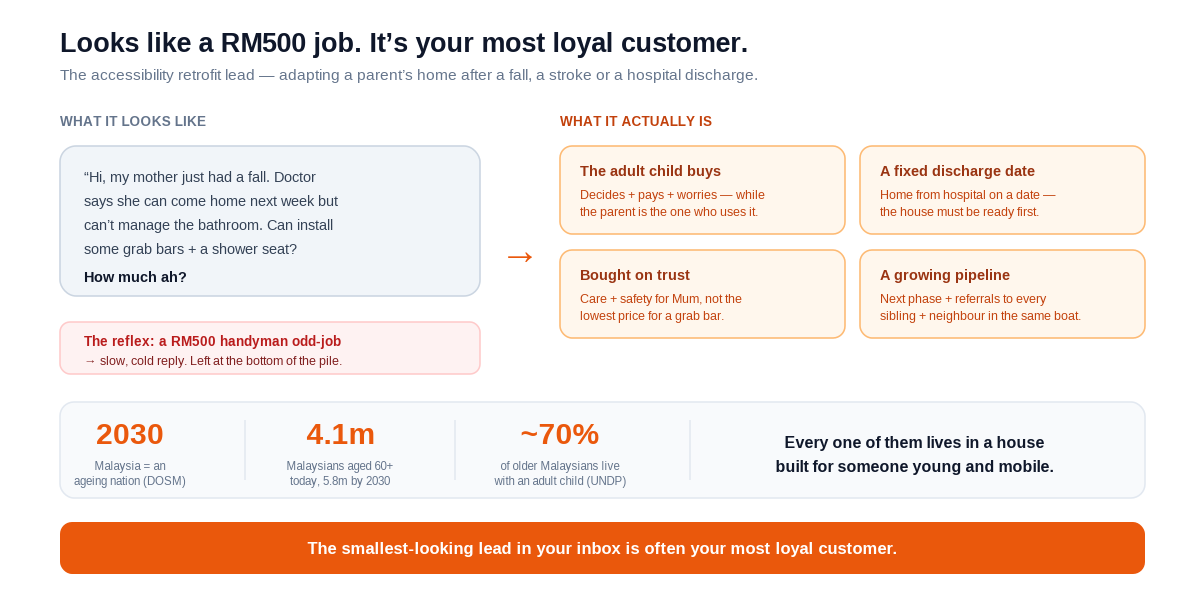
It came in on a Tuesday afternoon: "Hi, my mother just had a fall, now in hospital. Doctor says she can come home next week but she can't manage the bathroom anymore. Can you install some grab bars and maybe a seat in the shower? How much ah?" He read it as a handyman job — a couple of bars, half a day's work, RM400 or so — the kind of small enquiry he usually left until he'd cleared the "real" quotes. He sent a one-line reply two days later with a rough price and nothing else.
By then the daughter had booked someone else. Not because his price was high — because another firm had replied the same afternoon, asked how her mother would be getting around, offered to come look before the discharge date, and talked to her like the problem was her mother's safety and not a grab bar. That firm did the bathroom, then came back three months later to sort the entrance step and the bedroom downstairs, then did the daughter's own condo kitchen, then her brother's place in Cheras. One warm, worried WhatsApp about a fall turned into four jobs — for the firm that didn't treat it as a RM400 odd-job.
That's the lead in this piece: the accessibility retrofit — adapting an existing home so an ageing or less-mobile person can live in it safely. In a country that's ageing fast, it's arriving more and more often, dressed as the cheapest, smallest enquiry in your inbox. It is almost the opposite.
What makes an accessibility retrofit lead different from a normal reno enquiry?
It's a distinct lead type because three things that are usually simple all flip at once — who the customer is, what the clock is, and what "a good job" means. On a normal reno the owner messages, agrees a scope and design, and the job is judged on how it looks and what it costs. On an accessibility retrofit, the person messaging usually isn't the person who'll use the works, the deadline is often a fixed hospital discharge date, and the thing being bought isn't a look — it's safety and trust.
The works themselves sound small and familiar: grab bars by the toilet and in the shower, a walk-in or kerbless shower instead of a step-over tub or a raised kerb, a seat in the shower, anti-slip flooring, a ramp over the entrance step, wider doorways for a wheelchair, better lighting on the stairs, sometimes a bedroom and bathroom relocated downstairs so a parent never has to climb. Any contractor can do most of it. That's exactly why the lead gets mishandled — the work looks like a handyman call, so the lead gets handyman treatment.
Who is the customer on an accessibility retrofit — and why does that change everything?
The customer is almost always the adult child, not the parent who'll use the works — and the child is judging you on care and reliability, not on the lowest price. This is the part that trips up firms used to selling to the person who'll live with the result.
Picture the real scene. The parent is in a hospital bed or just home and shaken. The one messaging you is a son or daughter, often juggling a full-time job, who's suddenly responsible for making the family home safe and has no idea where to start. Around 70% of older Malaysians live with an adult child (UNDP), so this is the normal shape of the decision, not an edge case. The child decides, the child pays, the child worries — and the child will happily pay a fair bit more to a firm that makes them feel their parent is in safe hands than to the cheapest quote from a stranger.
This overlaps with the lead where the decider isn't the one in the chat, but it's not the same problem. There, the messenger is a go-between and your job is to reach the real decision-maker. Here, the messenger is the decision-maker and the payer — the parent just isn't in a position to choose a contractor. So the move isn't to get past the child to the parent; it's to recognise that the anxious child is your actual buyer, and to sell to their worry.
Why is the hospital discharge date the clock nobody mentions?
Because a parent coming home after a fall or a stroke usually can't be discharged into an unsafe house — so the works have an immovable deadline hiding inside a casual-looking enquiry. This is the contrarian heart of the lead, and it's the one firms miss most.
When an older Malaysian breaks a hip — and hip fractures are projected to roughly triple here by 2050 (The Star, January 2026), with patients typically in their mid-to-late 70s and mostly women — they don't walk out of hospital the way they walked in. In Malaysian hip-fracture studies, essentially every patient needed a walking aid on discharge: around 70% a walking frame, 28% a wheelchair. A parent recovering from a stroke is often the same. That means there's a date — the day the hospital says they can go home — and on that date the house has to be ready for a frame or a wheelchair, not the staircase and the step-over tub it has today.
So the enquiry that reads "no rush, when free can quote" often has a hard deadline the family hasn't spelled out because they assume you'll ask. It behaves like the lease clock behind a commercial fit-out or an outright "can you come today" emergency: the real question under the brief is can you finish before Mum comes home? Quote a vague two-week timeline against a discharge in five days and you've lost it to whoever asked about the date. Win it on a loose promise and under-respect the deadline, and you've got a frail parent discharged into a house that isn't ready — the worst possible way to start a relationship built on trust.
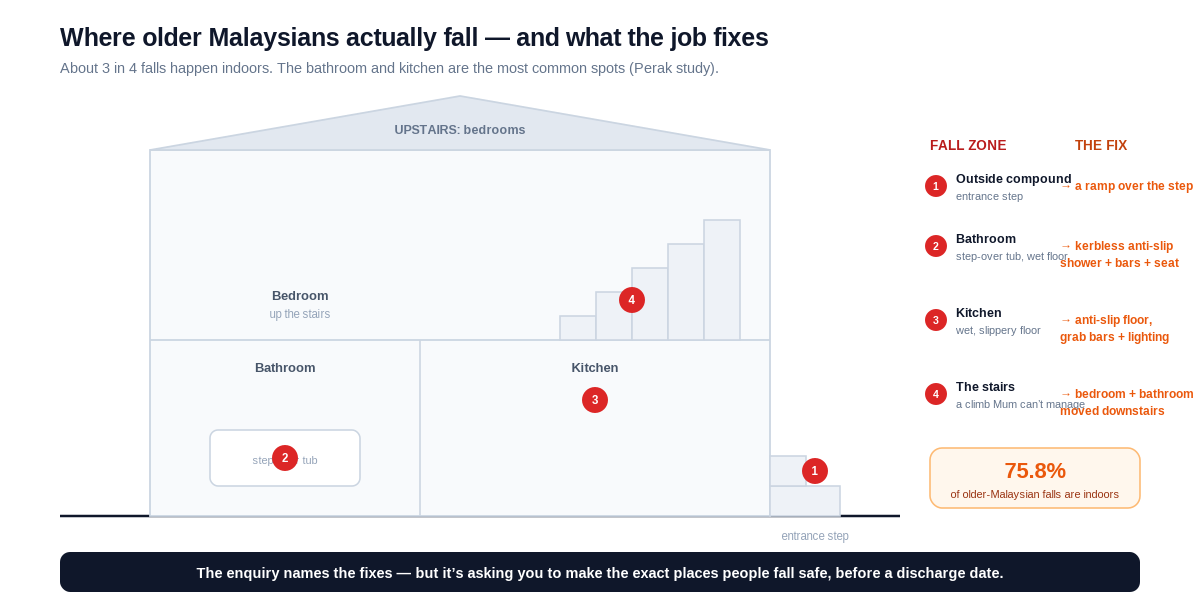
Those fall spots aren't a guess. In a Perak study of community-dwelling over-60s, three-quarters of falls happened indoors, and the most common specific spots were the outside compound, the bathroom and the kitchen — exactly the zones an accessibility retrofit targets. The grab bar by the toilet and the kerbless shower aren't cosmetic upgrades; they're aimed squarely at where the next fall would otherwise happen.
How much does this cost in Malaysia — and who pays?
Small safety fixes are genuinely cheap, bigger adaptations aren't, and the hard truth is that there's almost no help paying for any of it — so families self-fund and buy on trust. Being straight about both ends of the price range is part of handling the lead well.
At the small end, one senior-living provider (iElder) lists grab bars and handrails at roughly RM100–RM500 each and portable threshold ramps at RM150–RM500, and puts most basic safety fixes under RM5,000. At the bigger end, a stair lift or home lift runs RM30,000–RM80,000+, and as The Edge Malaysia notes, while grab bars and changed door handles are inexpensive, ripping out slippery flooring like marble is a costly affair. A full downstairs bedroom-and-bathroom conversion sits somewhere in between. Treat those as rough provider and market figures, not a fixed price list — but they tell you the shape: cheap to start, real money once you're moving walls or floors.
Now the part that's genuinely un-Googleable for most families, and the reason trust matters so much here:
Because they're self-funding, families are careful with money — but careful is not the same as cheapest. They're spending their own ringgit on their own mother's safety, with no grant to fall back on, which is precisely why they gravitate to the firm that feels honest and competent over the one that's RM200 cheaper. That's your opening, not your threat.
Why is the cheapest grab-bar quote often the dangerous one?
Because a grab bar is a safety device, and a bar screwed into the wrong wall is worse than no bar at all — it gives way at the one moment it's meant to hold. This is the specialist core that separates a real accessibility firm from a handyman, and it's the line a cheap quote silently deletes.
A grab bar is only as strong as what it's fixed to. Screw one into tiles over a hollow partition wall and it'll feel solid on the showroom tug — and then rip clean out the first time an 80kg adult actually falls against it, which is the exact scenario it exists for. As The Edge Malaysia points out, bars need solid or reinforced backing to do their job, which on many walls means opening up and adding a proper fixing substrate before tiling back. The same goes for the wet area: a kerbless shower only works if the floor is properly graded and waterproofed and genuinely anti-slip, or you've just built a nicer place to fall. Monash University Malaysia's home-modification pilot work shows what good looks like — anti-slip flooring, well-anchored grab bars, even an emergency call system — none of it exotic, all of it done properly.
So this is the same trap as the wet-works job whose real risk is the waterproofing nobody can see: the cheapest number wins by leaving out the invisible part that matters most. Here the invisible part isn't the downstairs neighbour's ceiling — it's whether the bar holds when Mum grabs it.
Handyman odd-job vs accessibility retrofit lead — the reflexes that flip
| Handyman odd-job (the trap) | Accessibility retrofit lead (the reality) | |
|---|---|---|
| Who's the customer | The person messaging | The adult child — decides, pays, worries — while the parent uses the works |
| What it's judged on | Lowest price for the fitting | Care, trust and safety — "can I trust them with my mother?" |
| The clock | None — "when free" | Often a fixed hospital discharge date |
| What "good" means | Bar is up, looks fine | Bar holds a real fall; wet area is safe and won't cause the next one |
| The payoff | One small invoice | A loyal family, the next phase, and referrals across their peers |
| How you lose it | Slow, cold, cheapest-quote reflex | Reading it as an odd-job instead of the relationship it is |
How should a firm handle an accessibility retrofit lead?
You handle it by spotting it the moment it lands, replying with care instead of a price, and running it as its own kind of lead — because a sensitive, deadline-bound, trust-driven job will die in a group chat if you treat it like a quick repair. Five moves:
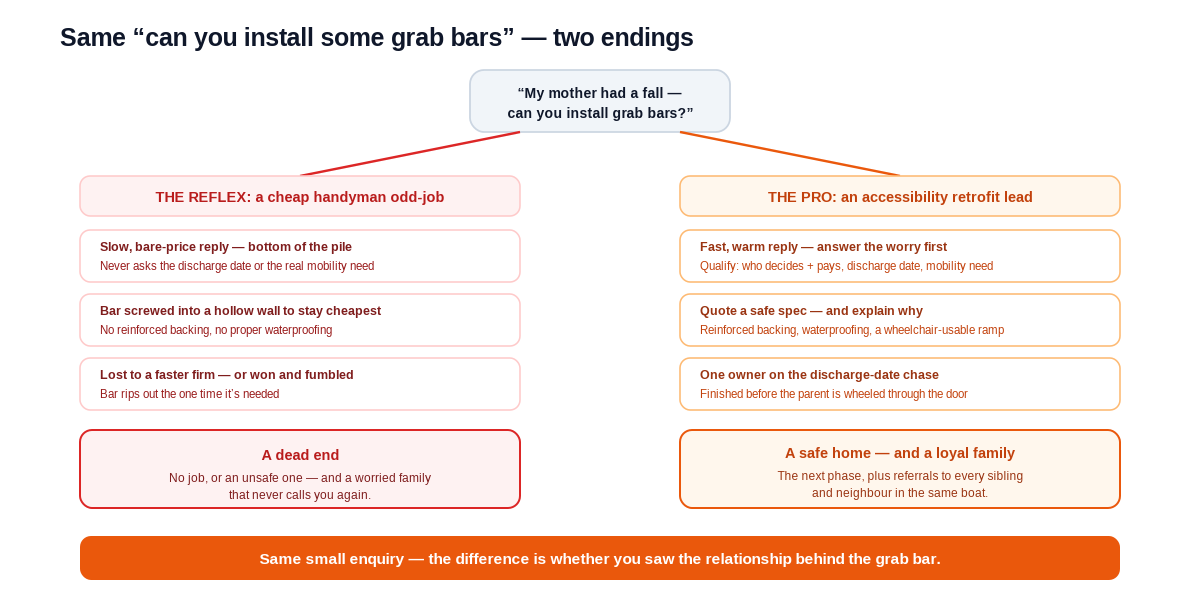
- Read the signs and tag it as its own lead type. Words like my mother/father, after her fall, post-stroke, coming home from hospital, wheelchair, grab bars, walk-in shower mean this is an accessibility retrofit, not a handyman call. That one label stops a teammate firing back a bare price and leaving it at the bottom of the pile.
- Reply fast and warm — answer the worry before the ringgit. Speed still wins the lead, because an anxious family hires the firm that answers first and clearest. But your reply should acknowledge what's really going on — "sorry to hear about your mum, let's get the house safe for her coming home" — before any number. The price can follow; the reassurance can't.
- Qualify the three things that drive the whole job. On the first reply, find out who's deciding and paying (almost always the child), whether there's a discharge or fixed date, and what the parent can actually do — walking frame, wheelchair, one weak side after a stroke — ideally with any advice the hospital's physiotherapist or occupational therapist has given. The spec follows the need, so this is just qualifying properly on the first reply instead of guessing at a bathroom you haven't seen.
- Quote the safe spec honestly, and explain why. Price reinforced backing for the bars, proper waterproofing and anti-slip for the wet area, and a ramp at a gradient a wheelchair can actually use — as visible line items — and treat the look-before-you-quote assessment as a real, valuable step rather than something to give away cheap. The firm that can explain why a bar needs solid backing is the one the family trusts.
- Give it one owner and keep the dates visible. This runs across a discharge date, a nervous family and often a second phase, so put one person on it instead of letting it get lost in a group chat, and keep a dated next action so the chase and the follow-up actually happen. You want to see at a glance which of these jobs are racing a discharge date and which are done and ready for the next phase.
One caveat on timing: if the home is a condo or serviced apartment, a wet-area change usually needs the building management's sign-off first, so don't promise a discharge-date finish the building's approval can't allow. Ask about the building early.
Is an accessibility retrofit lead worth chasing?
Yes — more than almost any other small lead in your inbox, because it's the front door to a loyal, repeat, referral-rich relationship in the fastest-growing part of the market. Malaysia becomes an ageing nation in 2030; the 60-plus population is heading from about 4.1 million toward 5.8 million by the end of the decade, and the share aged 65+ is projected to hit 17.3% by 2040 (DOSM). Every one of those people lives in a house that was built for someone young and mobile, and most of them live with an adult child who will, sooner or later, send exactly the WhatsApp that opens this article.
A family that trusts you with their mother's safety behaves nothing like a one-off price-shopper. They come back for the next phase as the parent's needs change — the stair lift, the other bathroom, the second parent — and they refer you to every sibling, neighbour and friend going through the same thing, because caregiving is a conversation people have constantly. It's the same compounding logic as the repeat client coming back for their next project, except the trigger here is demographic and relentless.
The one time to be honest with yourself is if your firm genuinely isn't set up for small, caring, deadline-bound jobs and you'd handle this one badly — then it's kinder to say so warmly and refer it on than to win it and fumble a vulnerable family. But recognise what you're turning away: not an odd-job, but the front door to a growing, loyal segment that most contractors are still mishandling.
How HotLead helps a firm handle the accessibility retrofit lead
HotLead sits on top of the WhatsApp your enquiries already land in — nothing changes for the family messaging you — and it's built so a small-looking but sensitive, deadline-bound job doesn't get treated like a throwaway repair:
- Captures and tags every enquiry as it arrives, so "my mother had a fall, can you install grab bars" can be marked as an accessibility retrofit and worked properly, instead of being answered like a RM400 odd-job and left at the bottom of the pile.
- Assigns one owner instantly — round-robin, manual, or a custom rule set during onboarding — so an anxious family dealing with their parent's safety gets one familiar person, not a different reply from whoever happens to see the chat.
- Keeps a next action and flags overdue follow-ups, so the discharge-date chase, the look-before-you-quote assessment and the next-phase conversation actually happen across the days and weeks these jobs run — the slow follow-through that beats a team running on memory.
- Shows your funnel and per-channel ROI, so you can see which accessibility jobs are racing a discharge date versus done and ready for the next phase, and whether this segment is a real, growing pipeline for your firm.
To be straight about it: HotLead doesn't assess the home, decide what fittings a person with a particular mobility need requires, or do the install — that's your trade, often alongside a physiotherapist's or occupational therapist's advice from the hospital. What it does is stop a genuine, high-trust, relationship-building lead from leaking out of your inbox because it looked too small to bother with.
If your firm keeps letting small "can you install some grab bars" enquiries go cold while competitors quietly build a loyal base of ageing-parent families, the fix usually isn't your building work — it's that you answered a relationship lead like an odd-job. Start with the renovation lead-management hub or the interior-design hub, read the complete guide to managing renovation leads in Malaysia, or see how HotLead works.
Sources: that Malaysia is projected to become an ageing nation in 2030 when the population aged 60 and over surpasses 15%, from DOSM's 2010–2040 population projection as reported by Malay Mail; that the 60-plus population is now about 4.1 million (around 12%) and projected to reach 5.8 million by 2030, from DOSM data as of April 2026 reported by Sinar Daily; that the share aged 65+ is projected to reach 17.3% by 2040, from DOSM as reported by The Star; that about three-quarters (75.8%) of falls among community-dwelling older Malaysians happen indoors, most commonly in the outside compound, bathroom and kitchen, with a past-year fall prevalence of 4.07% in a Perak study of 811 over-60s (and 47% among older people attending a KL primary-care clinic), from a community falls study in Perak (PMC); that hip fractures are projected to roughly triple in Malaysia by 2050, with patients typically in their mid-to-late 70s and mostly women, from The Star; that essentially all Malaysian hip-fracture patients need a walking aid on discharge (about 70% a walking frame, 28% a wheelchair), from a review of hip-fracture management in Malaysia (PMC); indicative Malaysian costs for grab bars and handrails (RM100–RM500 each), portable ramps (RM150–RM500), basic fixes (under RM5,000) and a stair/home lift (RM30,000–RM80,000+), from senior-living provider iElder; that grab bars and door handles are inexpensive while replacing slippery flooring such as marble is costly and bars need solid/reinforced backing, from The Edge Malaysia; good-practice home modifications (anti-slip flooring, well-anchored grab bars, an emergency call system), from Monash University Malaysia's home-modification research; that Malaysia has no broad private-home retrofit grant while Singapore subsidises senior home modifications through HDB EASE, and that Selangor's BRAIS 2026 offers RM1,500 towards a disability-friendly toilet only for registered OKU-card holders who are Selangor voters, from RinggitPlus; and that around 70% of older Malaysians live with an adult child (UNDP), reused from this playbook's demographic anchors. The PJ, Kajang and Cheras scenarios are illustrative; the pattern is one we see repeatedly.
Frequently asked questions
What is an accessibility retrofit lead, and how is it different from a normal renovation enquiry?
It's an enquiry to adapt an existing home so an older or less mobile person can live in it safely — grab bars, a walk-in or kerbless shower, a ramp over the entrance step, wider doorways for a wheelchair, anti-slip flooring, better lighting, or a bedroom and bathroom moved downstairs. What makes it different from a normal reno is who's involved and what's driving it. The person messaging is usually the adult child, not the resident; the real decision turns on safety and trust, not design flair or the lowest price; and there's often a fixed hospital discharge date behind it. Treat it like a casual handyman job and you misread all three.
Who is actually the customer — the elderly parent or the adult child?
Almost always the adult child, and sometimes a few siblings together. They're the ones messaging, deciding, paying and worrying — and they're judging you on whether they can trust you with their parent's safety while they're at work. The parent is the person who'll use the grab bars and the ramp, so their needs drive the spec, but the person you sell to and follow up with is the child. This is the one lead where pitching hard to the resident, or quoting their taste over the family's safety priority, means you've read the room wrong.
Is there any government grant to help pay for making a home safe for an elderly parent in Malaysia?
Not in any broad way for a private home. Unlike Singapore, which subsidises grab bars and ramps for seniors through its HDB EASE scheme, Malaysia has no national equivalent for ordinary homeowners. The support that exists is narrow and tied to a registered OKU (disability) card — for example Selangor's BRAIS 2026 offers RM1,500 towards a disability-friendly toilet, but only for registered OKU-card holders who are Selangor voters. A parent who is simply old and frail often isn't a registered OKU and wouldn't qualify. The practical reality is that most families pay for this themselves, which is exactly why they care so much about getting a firm they can trust.
Why can't I just quote a cheap price to install a few grab bars?
Because a grab bar is a safety device, not decoration, and the cheapest install is often a dangerous one. A bar is only as strong as what it's screwed into — tile over a hollow partition will rip out the first time someone actually falls against it, which is the exact moment it was meant to hold. Proper fitting needs solid or reinforced backing, and a safe wet-area change needs real waterproofing and anti-slip detail. The firm that quotes that honestly, and explains why, looks more expensive than a handyman and is worth far more. Racing a handyman to the bottom on a safety job is how you win a price and lose a reputation.
Does HotLead assess the home or tell me what fittings an elderly person needs?
No. Reading a home, judging what a person with a particular mobility need actually requires, and specifying it safely is your trade — often alongside a physiotherapist's or occupational therapist's advice from the hospital. What HotLead does is make sure the lead doesn't leak while all that happens. It captures and tags the enquiry as its own type so it isn't answered like a cheap odd-job, puts one named owner on a sensitive family conversation, and keeps a dated next action so the discharge-date chase and the follow-up actually happen. The care and the spec stay yours; the follow-through stops falling through the cracks.
Keep reading
- Can AI Reply to Your Renovation Firm's 1-Star Review? I Built It — and the Risk Is How Fast It ApologisesA 2-star review on Google or Qanvast is the first thing your next renovation lead reads — and most firms either ignore it or fire back and make it worse. The 2026 reflex is to let AI write the reply. I built it, and drafting a calm response costs a fraction of a sen. But an AI tuned to be helpful apologises too fast — it will concede a fault in writing, promise a refund that never happened, and grovel to a fake review from a competitor. Here's the build that protects your rank instead of torching it.
- Which Lead Signals Actually Predict a Sale? Reverse-Audit Your Own Won JobsMost firms grade a renovation lead on signals that feel predictive — enthusiasm, a long message, a fast reply — and never check whether those signals actually separate won jobs from lost ones. Here is how to run a reverse-audit on your own closed deals, which signals usually survive it, and why your pipeline is too small to pretend the score is more than directional.
- The "I Only Deal With the Boss" Lead: When the Buyer Refuses Your TeamYou finally hired someone to share the load — then the buyer messages "can I deal with you direct ah, boss?" and refuses to engage your staff. Every big lead quietly re-centralises onto the one person already maxed out, and your firm can never grow past the owner. Here's why caving caps you, why a flat "my staff will assist" loses a nervous buyer, and the move that keeps both.