

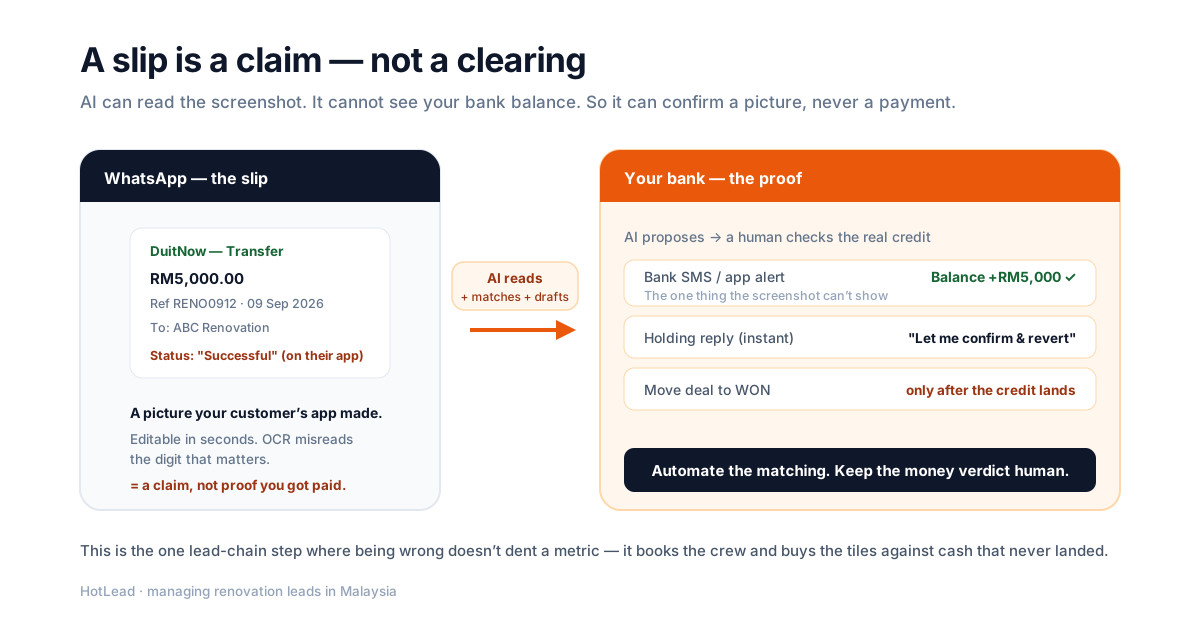
Here is the best kind of WhatsApp message a renovation firm can get, and a trap hiding inside it. After two weeks of quotes, a site visit and one nervous "let me discuss with my wife," the Kajang semi-D owner finally sends it: "ok boss, dah transfer deposit, ni resit" — and a screenshot of a DuitNow transfer. This is the moment every earlier piece in this series was building toward. A lead just became a won job.
And then it sits there. The salesperson is on a Cheras site and doesn't see it for three hours. When they do, the honest next steps are annoying: open the banking app, check the money actually landed, match it to the right customer, reply "received, thank you," and move the deal to won so the crew can be slotted and the material ordered. On a busy week with a dozen of these, that admin slips — and a buyer you fought to win sits in "eh, you got my transfer or not?" limbo, cooling off.
So the 2026 question an owner actually asks: can AI just read the slip and confirm the deposit for me — flip the deal to won, automatically? And the sharper one I always end up asking: what happens the day it's wrong? Because this is the one step in the whole lead chain where being wrong doesn't dent a metric — it spends real ringgit. I built it and measured it. Here's the problem, what confirming a deposit costs before AI, what the two builds did, and the version that actually held up.
What does confirming a deposit actually cost a renovation firm before any AI?
Before AI, confirming a deposit costs you in two directions at once — and most owners only price one of them. The obvious cost is the admin and the limbo: someone has to check the bank, match the payment to the customer, acknowledge it, and advance the record. Until that happens, a deal you already won is invisible. The buyer, who has just parted with a few thousand ringgit, is watching a silent chat wondering if they sent it to a scammer. That silence is where hard-won deposits wobble and, occasionally, get clawed back.
The less obvious cost is the one that makes this step different from everything else in the chain: acting on money that isn't there. A deposit is the go signal for real spending. The moment it's confirmed, a good firm books the crew for that slot, turns away or reschedules other work, and often orders the first materials. If the confirmation was wrong — the transfer failed, went to an old account, is still "processing," or the slip was fake — you've committed labour and cash against nothing. On a RM40k–150k condo job, a 10% deposit is RM4,000–15,000; that's the size of the hole.
And this is a WhatsApp-first, transfer-first market. PayNet processed 8.44 billion digital-payment transactions in 2025, and DuitNow instant transfer is simply how Malaysians move money now. Almost none of your deposits arrive as cash across a counter you can see. They arrive as a screenshot in a chat — a picture of a payment, sent to the same inbox where 90.7% of your business already happens. Which is exactly why "can AI just read the screenshot and confirm it" is such a tempting question.
So can AI just read the slip and mark the deal won? The reflex build — and why it spends cash you don't have
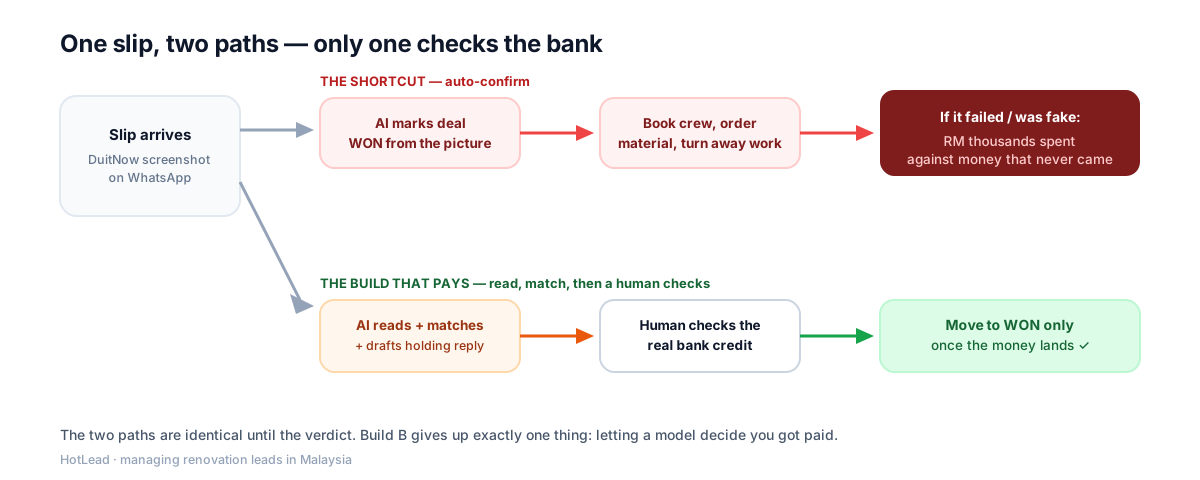
This was Build A, and it demos beautifully: a slip lands, AI runs OCR on the screenshot, extracts the amount, date and reference number, matches it to the open lead, drafts "Deposit received, thank you!", and — the reflex step — moves the deal to won with no human in the loop. On a clean, genuine slip it's the future: your customer transfers, and by the time you glance at your phone the deal is booked. Then you run it against reality, and it fails three different ways, each one landing on money.
First, and most important: a slip is a claim, not a clearing. A DuitNow screenshot is a picture your customer's app made, saying a transfer was attempted. It is not evidence the money reached your account. The transfer can be to a stale account number, it can fail, it can sit in "processing," or the reference can be wrong. The only thing on earth that proves a deposit cleared is your own bank's credit notification — the SMS or app alert that says your balance went up. AI reading the customer's screenshot has no window into your bank at all. So the deepest problem isn't that the AI reads badly — it's that even a perfect read confirms the wrong thing. It can confirm a picture exists. It cannot confirm you got paid.
Second, OCR misreads exactly the characters that matter. Payment slips arrive as WhatsApp-compressed phone photos — re-saved, dimmed, sometimes a screenshot of a screenshot. Receipt OCR runs around a 3.5% character error rate on messy scans, and the documented failure modes are precisely the financial ones: a misread decimal, a swapped digit, a dropped or added zero. RM1,500 reads as RM1,600; RM500 becomes RM5,000. On the one field where the number is the whole point, the model is quietly least trustworthy on a bad image.
Third, the screenshot is trivially faked. Changing the amount, date or status on a transfer receipt takes seconds with a free phone app, and receipts are now churned out by AI image tools too. This isn't hypothetical in Malaysia — sellers and landlords have been burned by faked transfer slips, including cases where the same fake-receipt tactic was used to string along businesses across Melaka and Negeri Sembilan. An auto-confirm build treats a forged screenshot and a real one identically, because to OCR they are identical. You've now automated the exact step a scammer needs you to skip.
Where does AI genuinely earn its keep on deposit confirmation?
On everything except the money verdict — and that's still most of the tedious work. The mistake is asking AI to be the one who says "you got paid." The right job is to make the human's confirmation instant, matched and impossible to forget. Here's the safe half, and it's real:
- Read and structure the slip. Pull the amount, date, reference and payer name off the screenshot and lay them out cleanly, so the human isn't squinting at a compressed image. For a fraction of a sen.
- Match it to the right open lead. This is the genuinely fiddly part across 40–60 live enquiries a month — which of your open deals does "RM5,000, ref RENO0912" belong to? AI surfacing "this looks like the Kajang semi-D deposit — RM5,000, matches the quoted 10%" saves the hunt.
- Draft the holding reply, not the confirmation. The instant response that stops the limbo without lying: "Terima kasih! Let me confirm the transfer on our side and revert shortly." Warm, immediate, and it commits to nothing until the money's checked.
- Flag it into the next-action list. Surface "unconfirmed deposit — check bank credit" as a live task with the amount and reference attached, so the one step that matters can't sit unseen while the salesperson is on a roof.
That's the same division of labour that's earned its keep at every other step of this chain: AI does the reading and the drafting, the human owns the irreversible call. When AI updated the CRM it drafted the note but a person confirmed the load-bearing stage; here it drafts the acknowledgement but a person confirms the load-bearing money. The rule the whole series keeps landing on — give the human the verdict that lives off-channel — is at its sharpest here, because the off-channel truth is literally your bank balance.
Build A vs Build B — the honest comparison
| At the deposit step | Build A — AI auto-confirms | Build B — AI reads & matches, human confirms |
|---|---|---|
| Reading the slip | Fast, cheap | Fast, cheap |
| Matching to the right lead | Automatic | Automatic (proposed) |
| Acknowledgement speed | Instant | Instant (holding reply) |
| The "won" verdict | Set by the model from a screenshot | Set by a human against the real bank credit |
| If the transfer didn't land | Books the crew, orders material anyway | Caught before any spend — a friendly re-check |
| Against an edited/fake slip | Confirms it, indistinguishably | Never clears without the bank alert |
| Cost of one error | Thousands of ringgit + a wrong booking | A few seconds of a human's attention |
The two builds are identical right up to the verdict. Everything AI is genuinely good at — reading, matching, drafting, flagging — Build B keeps. It gives up exactly one thing: letting the model decide you got paid. That one line is the whole difference between a tool that saves an hour and a tool that, on its worst day, hands a fraudster your crew's week.
What should an owner actually do about confirming deposits?
Point AI at the matching and the message; keep a human — and your bank — on the money. The order matters, and most of the win is discipline, not model cleverness.
- Treat the slip as a prompt to check, never as proof. Internalise the one sentence that makes you scam-proof: a screenshot is a claim, my bank notification is the proof. Confirm against your own account or the bank's SMS/app alert, every time, before the deal moves.
- Let AI kill the limbo, not close the deal. Use it to fire the instant "let me confirm and revert" reply and to match the slip to the lead — so the buyer isn't left in silence — while the won status waits for the bank.
- Give the confirmation one named owner. A deposit that's "everyone's to check" is no one's. One person confirms money landed and advances the record — the same reason every lead needs a single owner.
- Make "unconfirmed deposit" an overdue-able task. A won deal waiting on a payment check should nag like any overdue follow-up, so it can't quietly sit for a week while momentum drains.
- Watch your booked-to-deposit-received advance rate. If agreed deals keep stalling between "yes" and "money in," that's a leak worth a number — and it's the difference between revenue on paper and cash in the bank that actually funds the job.
How HotLead fits — honestly
I'll be straight, the way I try to be in every one of these, because over-claiming is the hype I keep arguing against. HotLead does not ship an AI payment-verifier — the auto-confirm build is the experiment in this piece, and the whole piece is an argument for why a model should never be the one that says you got paid. Verifying money landed is a bank fact your finance person owns. What HotLead gives you is the plumbing that stops a won-but-unconfirmed deposit from going cold:
- One owner per lead, by rule. Round-robin, manual, or a custom rule by area or source — so a deposit that needs confirming has a named human accountable for it, not a group chat where everyone assumes someone else checked.
- A next action and overdue flag on every lead, so "waiting on deposit — check bank" is a live, nagging task, not a mental note lost on a site visit. The unconfirmed deposit is exactly the kind of quiet, momentum-draining gap the overdue nudge exists to catch.
- A funnel view that shows your booked-to-deposit-received advance rate, so you can see where agreed deals stall between the handshake and the money — the leak this whole piece is about, made visible.
- Capture and one clean record per lead, so the slip, the quote and the whole thread live together — and the human confirming the money has the full context in one place, not scattered across a phone.
The verdict on whether the money's real stays with you and your bank, where it belongs. If leaking, scattered leads are the problem underneath all this, start with the complete guide to managing renovation leads in Malaysia, see how it fits a renovation firm or an interior design studio, or read the companion builds on auto-updating the CRM and what AI still can't do in a contractor's lead process.
Sources: Malaysian digital-payment scale — that PayNet processed 8.44 billion digital-payment transactions in 2025, with DuitNow instant transfer and QR the dominant rails — from PayNet's 2025 results as reported by Fintech News Malaysia. Receipt/invoice OCR accuracy — that engines average roughly 3.5% character misreads on messy scans, that accuracy drops sharply on low-quality phone photos and compressed images, and that the common financial failure modes are misread decimals and swapped subtotals/totals, reaching 99%+ only with confidence-based human review — from invoice/receipt OCR error analyses and receipt-OCR challenge write-ups. Fake and edited payment slips in Malaysia — that transfer-receipt screenshots are trivially altered (amount, date, status) with phone apps and increasingly generated by AI tools, and that Malaysian sellers and landlords have been scammed with faked slips, including a Melaka case linked to the same tactic used against businesses in Negeri Sembilan — from MustShareNews' report on a Malaysian fake-payment-receipt case. The AWS-commissioned study of 1,000 Malaysian businesses (27% use AI, 73% stuck on basic off-the-shelf tools) is reused from earlier pieces in this series. Renovation deposit and job-value figures — a ~10% deposit, condo jobs ~RM40k–150k, ~RM1,280 expected gross profit per winnable enquiry, and 40–60 enquiries a month across channels — are the house figures from the deposit-and-progressive-payment, profit-versus-cash and funnel-benchmarks pieces, labelled as typical operating numbers, not a single quoted study. The ~90.7% WhatsApp-for-business figure is reused from earlier pieces. The per-slip AI cost is described from practice and labelled illustrative, not a controlled trial or a quoted price. All money figures in this article are illustrative — check your own bank account for your real ones.
Frequently asked questions
Can AI confirm a customer's deposit from a WhatsApp payment slip?
It can read the screenshot and match it to the right lead very cheaply, but it cannot confirm the money is in your account. A payment slip is a claim that a transfer was made — the only proof it cleared is your own bank's credit notification, which the AI never sees. So AI can extract the amount, date and reference and draft a "let me confirm and revert" reply, but a human should check the actual bank credit before marking the deal won. Confirming a picture is not the same as confirming a payment.
Why is it risky to auto-mark a renovation deal 'won' from a payment slip?
Because unlike every other step in the lead process, being wrong here spends money. If the transfer was to the wrong account, failed, is still pending, or the slip was edited, an auto-confirm build flips the deal to won and triggers everything downstream — you slot the crew, order material, turn away other work — against cash that never arrived. A mis-set CRM stage costs you a wrong forecast; a mis-confirmed deposit costs you the deposit. The verdict has to stay human.
Can AI tell a fake payment slip from a real one?
Not reliably, and you should not ask it to. Editing a screenshot to change the amount, date or status takes seconds with a phone app, and receipts are now generated by AI tools too — Malaysian sellers have been burned by faked transfer slips, and there is no visual tell an OCR model can trust. The defence is not smarter image analysis; it is checking your own bank account or the bank's SMS/app notification before you act. AI helps by surfacing and matching the slip fast; the confirmation is a bank fact, not an image fact.
How much does it cost to have AI read a payment slip?
Almost nothing in compute — reading one screenshot and returning the amount, date and reference is on the order of a tenth of a sen at illustrative vision-model list pricing. The cost that matters was never the tokens. On a renovation job, a 10% deposit on a RM40k–150k condo project is RM4,000–15,000 — so a single wrongly-confirmed slip is worth thousands, and that is the number the build has to protect.
Does HotLead confirm deposits or verify payments with AI?
No — HotLead does not ship an AI payment-verifier, and this experiment is why. Verifying that money landed is a bank fact your finance person owns, not something a model should decide. What HotLead does is the plumbing that stops a won-but-unconfirmed deposit from going cold — one owner on the lead so someone is accountable for confirming and advancing it, a next action and overdue flag so "waiting on deposit" cannot sit silent for a week, and a funnel view that shows your booked-to-deposit-received advance rate so you can see where agreed deals stall.
Keep reading
- Did We Already Say RM68k? Using AI to Stop Quote Drift Across a Long Renovation ThreadOver a weeks-long WhatsApp thread with two or three quote revisions, a rep re-states a number that contradicts an earlier promise — and re-opening a settled price quietly invites a discount that eats a whole job's profit. So I pointed AI at the drift. It works beautifully as a flag, and dangerously as an auto-corrector.
- The Warranty as a Closing Lever: Why a Longer Guarantee Beats a Discount on a Renovation DealA quote is stalling and the buyer wants a reason to say yes. Before you drop the price, look at the other lever in your hand — a longer workmanship warranty. It is the same expected-value decision as a discount, but the math runs the opposite way — a price cut costs you thousands with certainty, while extending the defects cover costs you a couple of hundred ringgit in expectation, for arguably more trust with a scam-wary buyer. Here is the EV case for the non-price concession, the trap that turns it into a hidden liability, and which leads it actually moves.
- "Can You Just Build It, My Neighbour Also Did" — Handling the Renovation Lead That Needs Council Approval FirstSome renovation enquiries can't legally start next month, no matter how ready the buyer is — a kitchen extension, a hacked-through wall, a roofed-over air well all need the council's written approval first. Quote a fast build price to win the job and you either lose it to a "boss, can start" cowboy, or win it and inherit the stop-work order, the RM50,000 fine and a client who later can't sell the house. Here's how to spot the permit-first lead and sell the approval as protection.