

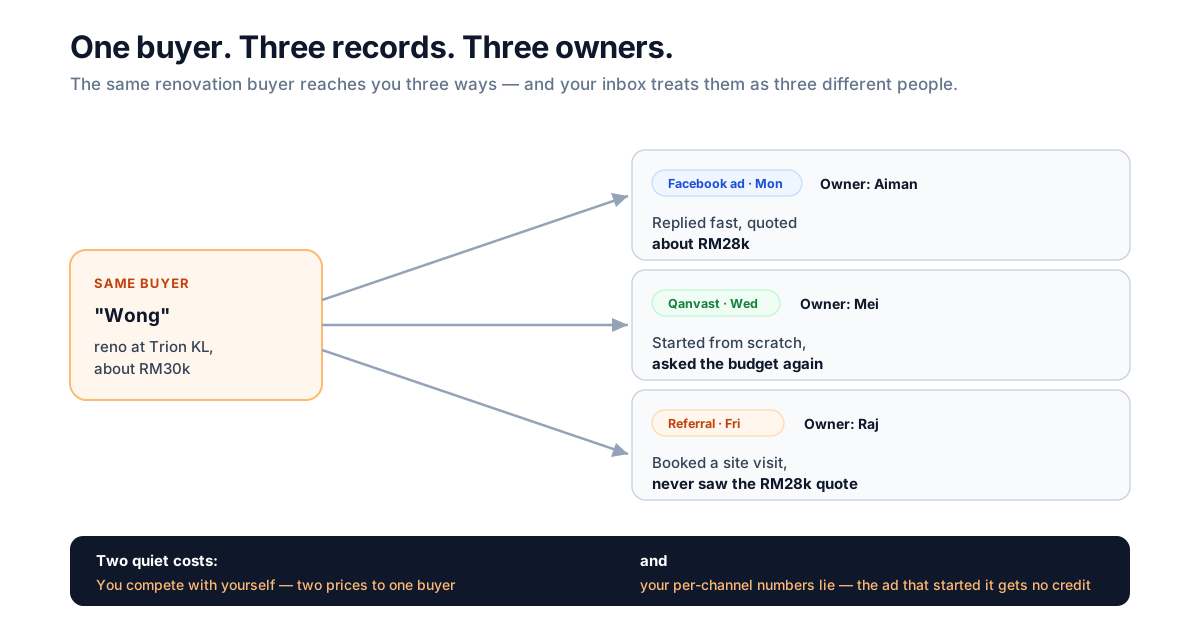
A renovation-firm owner in KL sent me a screenshot last month that I keep thinking about. It was his sales team's group chat, and three of his people were, without realising it, quoting the same customer. One had caught the buyer from a boosted Facebook post on Monday and sent a number. Another picked him up off Qanvast on Wednesday and started from zero, asking for the budget again. The third got him as a WhatsApp referral on Friday and booked a site visit — never seeing that a colleague had already put a price on the table two days earlier.
One buyer. Three records. Three owners. And by Friday the firm had managed to look disorganised, quote itself twice, and — the part nobody noticed — completely scramble which channel actually earned the sale. So he asked the obvious 2026 question: "Can't AI just spot that these are the same person and merge them for me?"
Short answer: it can spot them well, and it must not merge them by itself. Here's the whole experiment, because the reason why is the useful part.
Why do the same renovation buyer's leads pile up in the first place?
Because a considered, high-ticket purchase like a renovation is supposed to touch many channels — so a buyer reaching you two or three separate ways isn't a fluke, it's the normal path. A Malaysian homeowner researching a reno doesn't pick one door. ZenWeb's discovery survey has them finding firms through word-of-mouth (about 49%), Google (about 58%) and Facebook/Instagram (about 53%) — the percentages add past 100 precisely because they use several at once. Salesforce puts the average firm at around 10 selling channels, with 73% of buyers moving across multiple channels in a single journey.
Stack that on the way reno buyers shop — Qanvast openly hands them up to five firms to shortlist, and they compare three to five quotes — and it's almost guaranteed that a serious buyer will hit your firm through more than one channel before they sign. Your ad catches them, then a friend says "eh, I used them too, message here," then they also happen to have your Qanvast profile open.
This isn't a rare data-hygiene footnote. Across the CRM world, duplicate records typically run 10 to 30% of a database and climb the longer nobody cleans, while a healthy, monitored setup sits nearer 2 to 5%. When HubSpot deduplicated its own CRM it found 18% duplicate contacts — a lot of them active prospects being worked by more than one rep at the same time. Experian found 94% of organisations suspect their customer data is inaccurate, with duplicates a prime cause. A small reno firm getting 40 to 60 enquiries a month across five channels is not somehow immune to a problem that big companies with data teams can't fully beat.
What does a duplicate lead actually cost a renovation firm?
Not the awkward double reply — that's just the symptom you can see. The real cost is two things sitting underneath it, and the second one quietly bleeds money for months.
- You compete with yourself. Two of your reps, two rough numbers, one buyer. Even a RM2,000 gap between Aiman's "around 28k" and Mei's fresh guess reads as these people don't have their act together — on a job where the buyer is already scanning for reasons to distrust a contractor. You didn't lose on price; you lost on looking like you'd lose the job.
- You split the history that would have closed it. The referral that booked a site visit never saw that the buyer had already stated a RM30k budget and reacted well to a RM28k quote. The most valuable context — the stuff a good rep uses to close — is scattered across three threads, so each owner is working with a third of the picture.
- Your per-channel numbers lie — and that's the expensive one. This is the cost that never shows up as a lost lead. If the buyer originated on your Facebook ad but the record you eventually win on is the Qanvast one, your dashboard hands all the credit to Qanvast and none to Facebook. Read that over a quarter and you'll cut the ad channel that's actually feeding your pipeline, because on paper it "doesn't convert." Duplicate leads don't just waste effort — they corrupt the exact numbers you use to decide where your marketing budget goes.
Why doesn't matching on phone number just solve it?
Because in a WhatsApp-first market, the two things you'd match on — number and name — are exactly the two that break. Exact phone matching, the tidy old fix, fails in both directions here.
One number isn't one lead. A husband and wife enquiring about the same renovation from their shared home number are one lead — merge them, good. But a property agent, or a condo management-office coordinator, messaging you about several different units from one office number is several leads on one number — merge them and you've just fused unrelated jobs into a mess. Same signal, opposite correct answers.
One buyer isn't one number. The number a Facebook lead form captures isn't always the WhatsApp the person actually messages you from. People enquire from a personal line, then the business rings a different one. And email — the other classic unique key — barely exists as a signal when 90.7% of the conversation happens on WhatsApp and nobody's typing their email into a chat.
Then there's the name. Malaysian names are a romanisation minefield for a string-matcher: Mohd / Muhammad / Md / Mohamad, bin and binti, dialect spellings like Wong / Huang / Ng / Wee, and half your inbox saved as "Auntie Tan Kitchen" or "Encik Reno Cheras." With about 22% Chinese and 6.5% Indian citizens (DOSM 2024), your book of leads spans several naming systems at once. Exact string matching under-catches (misses Md Faiz vs Mohd Faiz); loosen it to catch those and it over-catches (fuses two different Ahmads in the same condo). That gap — too strict misses, too loose over-merges — is exactly where people reach for AI.
So what happened when I let AI fuzzy-match the leads?
The matching itself was genuinely good — and that's what made the reflex build dangerous. I gave a model pairs of lead records with the signals a human would use: name variants, phone, the project and unit, the stated scope and budget, and how far apart in time they arrived. Asked "are these the same buyer?", it read the fuzzy stuff well — it knew Wong and Huang can be the same surname, it spotted "same Trion Tower A unit, budget about 30k, two days apart" as a near-certain match, and it correctly kept two same-name-different-unit enquiries apart.
If I'd stopped there and wired it to auto-merge — the obvious "AI, clean up my duplicate leads" build — I'd have shipped a quiet lead-shredder. Because a matcher that's, say, 95% accurate isn't 95% safe. The 5% it gets wrong aren't evenly costly. And that asymmetry is the whole game.
Why is a wrong merge so much worse than a missed one?
Because the two mistakes have completely different price tags, and the reflex build optimises for the cheap one at the expense of the expensive one. This is the un-Googleable core of the whole thing, so let me be precise about it.
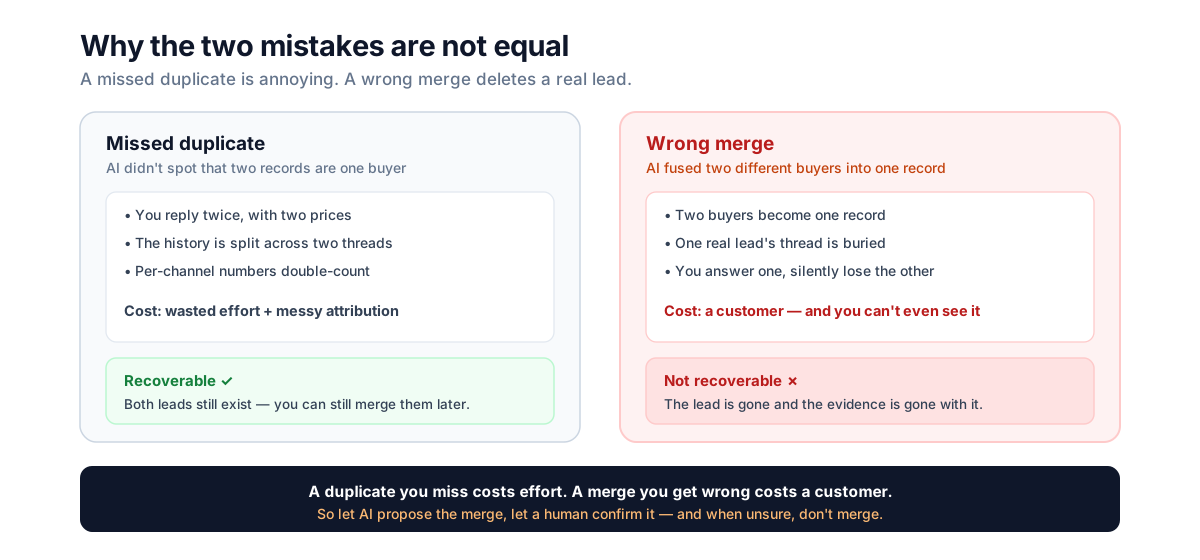
A missed duplicate (the AI didn't catch it) is recoverable. You reply twice, the history's split, your channel numbers double-count for a while. Annoying, a bit unprofessional — but both leads still physically exist. You can spot it next week and merge them then. Nothing is destroyed.
A wrong merge (the AI fused two different buyers) is not. Now two unrelated people share one record. One real buyer's entire conversation is buried inside another buyer's history. You answer the person on top; the person underneath gets silence, assumes you're not interested, and signs with a firm from their shortlist of five. You didn't just lose a lead — you lost it invisibly, because the evidence that a second buyer ever existed got absorbed into the first record. You can't even do the post-mortem.
This isn't my opinion; it's the settled position of the field that studies this. In record linkage and entity resolution, false positives — overmatching, fusing distinct entities — are described as the most persistent and costly error, and the standard advice is to explicitly specify a loss function for the uneven cost of a false match versus a missed match and tune the threshold accordingly. Set the bar too low and you over-merge; too high and you miss some. When the two errors cost different amounts, you deliberately lean toward the cheaper mistake.
What's the strongest signal for matching reno leads — and the one a generic tool ignores?
The project and the unit — because a renovation lead is anchored to a physical place in a way a generic sales lead never is. This is where a reno-specific approach beats a generic CRM's dedup, and it's the signal that both catches real duplicates and prevents wrong merges.
| Signal | Generic CRM weighting | Renovation reality | Why |
|---|---|---|---|
| Phone number | Highest (treated as unique) | Weak / ambiguous | Shared household & agent numbers; lead forms catch a different number |
| Name | High (string match) | Noisy | Romanisation variants; nicknames; saved as "Auntie Tan" |
| High (unique key) | Mostly absent | WhatsApp-first, rarely collected | |
| Project + unit | Ignored | Highest | A reno is pinned to one physical unit; same unit = same job, different unit = different job |
| Scope + budget | Medium | Supporting | "Kitchen, ~30k" corroborates a match, doesn't make one alone |
| Timing | Low | Supporting | Two channels within days raises the odds; months apart lowers them |
Two enquiries about the same unit at the same condo within a few days are almost certainly the same job, even if one says Wong and the other Huang. And the same name about two different units is almost certainly two different jobs — the exact case a name-and-number matcher gets wrong. A generic tool throws the unit away because most industries don't have one. For a reno firm it's the single most reliable thing in the record. Weighting it highest is what lets you catch the true duplicates and refuse the dangerous merges.
So what did the build that actually paid look like?
The one that flips the job: AI proposes, a human confirms — and it never merges on its own. Same division of labour that's earned its keep at every other step of this chain — let AI do the reading, keep the irreversible action human.
- When the signals line up strongly — same unit, close in time, corroborating scope, plausible name variant — AI surfaces one suggestion with its evidence: "These two look like the same buyer — same Trion Tower A unit, budget about 30k, name Wong/Huang, two days apart. Merge?" The owner reads the evidence and taps yes or no. One second.
- When it's ambiguous — same number but two different unit numbers, or a strong name match with nothing else — it doesn't guess. It asks a question: "Same number, but one says Trion and one says M Vertica — same person doing two units, or two people sharing a line?" That's a fact that lives off-channel; the one-question test says give it to the human.
- It never fuses records automatically, no matter how confident it looks. The merge is the destructive act, so the merge is the human's.
That's the entire design principle, and it's the same one that worked when AI updated the CRM (draft the note, keep the stage verdict human) and when AI assigned leads (tag the lead, let a plain rule route it). AI reads and proposes for a fraction of a sen; the human owns anything you can't cleanly undo.
What should an owner actually do about duplicate leads?
Spend your effort on making duplicates catchable and cheap, not on a clever auto-merger. The order matters — most of the win is upstream of any AI.
- Tag every lead's source at capture. You can't reconcile channels you didn't record. This is also what stops the per-channel numbers from lying, which is the costliest part.
- Give every lead one owner by rule. A human watching a conversation is your best duplicate detector — they're the one who'll think "this sounds familiar." A lead lost in the group chat with no owner is the one that spawns a silent second record.
- Keep the whole history on one record, so when you do confirm a match, merging actually consolidates the context instead of picking one thread and losing the rest.
- Let AI propose merges, never perform them. Confirm with one tap. Treat a high-confidence suggestion as a prompt to look, not a decision.
- When in doubt, don't merge. Internalise the asymmetry: a missed duplicate is a Tuesday-afternoon cleanup; a wrong merge is a lost customer you'll never see. Lean toward leaving them separate.
- Reconcile duplicates before you read per-channel ROI. Otherwise you're making budget decisions on numbers that double-count — and cutting the channel that started the job.
How HotLead fits — honestly
I'll be straight, the way I try to be in every one of these, because over-claiming is the hype I keep arguing against. HotLead does not ship an automatic duplicate-merge engine — the auto-merger is the experiment in this piece, and the whole piece is an argument for why it shouldn't run unattended. What HotLead gives you is the groundwork that makes duplicates catchable and cheap:
- Capture onto one source-tagged record. Every WhatsApp, Facebook, Qanvast or referral enquiry lands captured and tagged with where it came from — so your per-channel view can be reconciled instead of quietly double-counting the buyer who reached you three ways.
- One owner per lead, by rule. Round-robin, manual, or a custom rule by area or source. A named human on each conversation is the thing most likely to notice a duplicate — the detector no algorithm replaces.
- A funnel and per-channel view that shows where leads leak and what each source really returns — the exact numbers duplicates corrupt, which is why tagging at capture matters so much.
- A next action and overdue nudge on every lead, so a real buyer buried on the wrong thread doesn't just go silent forever.
The matching-and-merging judgment stays with you, where it belongs. If leaking, scattered leads are the problem underneath all this, start with the complete guide to managing renovation leads in Malaysia, see how it fits a renovation firm or an interior design studio, or read the companion builds on what AI still can't do and auto-updating the CRM.
Sources: Duplicate-record prevalence — that a typical CRM runs 10–30% duplicates and climbs without cleanup, that a healthy database sits nearer 2–5%, that HubSpot found ~18% duplicate contacts (many active prospects worked by multiple reps) when it deduplicated its own CRM, and that Experian found 94% of organisations suspect their customer data is inaccurate — from aggregated duplicate-record data-quality statistics. The multi-channel buying reality (the average firm sells across ~10 channels; 73% of buyers use several channels in one journey) from Salesforce. The asymmetric-cost principle — that false positives (overmatching / fusing distinct entities) are the most persistent and costly error in record linkage, and that you should specify a loss function for the uneven cost of false matches versus missed matches and tune the matching threshold accordingly — from the Coleridge Initiative's Big Data and Social Science record-linkage chapter and the wider entity-resolution literature. Malaysian discovery-channel percentages (word-of-mouth ~49%, Google ~58%, Facebook/Instagram ~53%) reused from the ZenWeb survey cited in the marketing-budget piece; the ~90.7% WhatsApp-for-business figure and the ~22% Chinese / 6.5% Indian citizen split (DOSM 2024) reused from earlier pieces in this series. Renovation lead-volume figures (40–60 enquiries a month across several channels) are typical operating numbers reused from the funnel-benchmarks piece, labelled as typical, not a single quoted study; the deduplication experiment and per-lead AI cost are described from practice and labelled illustrative, not a controlled trial or a quoted price.
Frequently asked questions
Can AI find and merge duplicate leads across my channels?
It can find the likely duplicates well — matching name variants, the same condo project and unit, overlapping scope and budget, and timing is exactly the fuzzy pattern-reading AI is good at. What it should not do is merge them by itself. The two possible mistakes aren't equal. A missed duplicate wastes some effort and is fully recoverable because both leads still exist. A wrong merge fuses two different buyers into one record, buries one real lead's whole conversation under the other's, and you lose a winnable job without even knowing it happened. So the safe build has AI propose a merge with its evidence and a human confirm it with one tap, never auto-fuse.
Why doesn't matching on phone number just solve it?
Because in a WhatsApp-first market one number isn't one lead and one lead isn't one number. A husband and wife enquiring about the same renovation from the shared home number are one lead, but a property agent or a management-office coordinator messaging you about several different units from one number are several leads — same number, opposite answers. And the same buyer often reaches you on different numbers, because the number captured by a Facebook lead form isn't always the WhatsApp they message from. Email, the other classic key, is rarely given at all when the whole conversation lives on WhatsApp. Exact matching therefore both misses real duplicates and merges people who were never the same.
What's the strongest signal for matching two renovation enquiries?
The project and the unit. A renovation lead is pinned to a physical place — a specific unit at a named condo, or a house at an address — in a way a generic sales lead isn't. Two enquiries about the same unit within a few days, across two channels, are almost certainly the same job even if the names are spelled differently. And the same name about two different units is almost certainly two different jobs. A generic CRM weights name and phone and ignores the unit; a renovation firm should weight the unit highest. It's the signal that catches the real duplicates and, just as importantly, stops the wrong merges.
Isn't it safer to just auto-merge everything to keep the inbox clean?
No — that's tuning the system to make the expensive mistake. Auto-merge maximises "catch every duplicate," which sounds tidy, but every wrong merge among them silently deletes a lead by hiding its thread inside another buyer's record. You can always merge two leads you missed later. You can't un-lose a customer whose conversation got buried and who signed with someone else while you were answering the wrong person on a mixed-up thread. The rule from the record-linkage field applies directly here — when the cost of the two errors is uneven, tune toward the cheaper one. Here that means propose, don't merge — and when in doubt, don't merge.
Does HotLead automatically merge duplicate leads?
No, and I won't pretend it does — the automatic-merge engine is the experiment in this piece, not a shipped feature. What HotLead gives you is the raw material that makes duplicates catchable in the first place and cheap when they happen. Every enquiry is captured onto one record tagged with its source, so your per-channel numbers can be reconciled instead of silently double-counting. Every lead gets one owner by rule, so a human is watching each conversation and is the most likely thing in your setup to notice "wait, I think I've spoken to this person." And the funnel and per-channel view is exactly what duplicates corrupt, which is why tagging the source at capture matters. The matching-and-merging judgment stays with you.
Keep reading
- Did We Already Say RM68k? Using AI to Stop Quote Drift Across a Long Renovation ThreadOver a weeks-long WhatsApp thread with two or three quote revisions, a rep re-states a number that contradicts an earlier promise — and re-opening a settled price quietly invites a discount that eats a whole job's profit. So I pointed AI at the drift. It works beautifully as a flag, and dangerously as an auto-corrector.
- The Warranty as a Closing Lever: Why a Longer Guarantee Beats a Discount on a Renovation DealA quote is stalling and the buyer wants a reason to say yes. Before you drop the price, look at the other lever in your hand — a longer workmanship warranty. It is the same expected-value decision as a discount, but the math runs the opposite way — a price cut costs you thousands with certainty, while extending the defects cover costs you a couple of hundred ringgit in expectation, for arguably more trust with a scam-wary buyer. Here is the EV case for the non-price concession, the trap that turns it into a hidden liability, and which leads it actually moves.
- "Can You Just Build It, My Neighbour Also Did" — Handling the Renovation Lead That Needs Council Approval FirstSome renovation enquiries can't legally start next month, no matter how ready the buyer is — a kitchen extension, a hacked-through wall, a roofed-over air well all need the council's written approval first. Quote a fast build price to win the job and you either lose it to a "boss, can start" cowboy, or win it and inherit the stop-work order, the RM50,000 fine and a client who later can't sell the house. Here's how to spot the permit-first lead and sell the approval as protection.