

A renovation firm in Puchong showed me a WhatsApp thread that made him wince. A good lead — a Bukit Jalil condo owner, ready to renovate, asking to book a site visit. The buyer had thrown out the usual dance: "this Sat morning can? or maybe Sunday after 3?" The reply came four hours later, because the owner was up a ladder on another job when it landed. By then the buyer had booked someone else for Saturday. "I didn't lose that on price or on the quote," he said. "I lost it because nobody was at a desk to say yes, Saturday 11am while she was still asking."
That is the step this piece is about — the one almost nobody in the lead chain talks about. Between qualifying a lead and actually visiting the site sits a small, unglamorous act: booking the appointment. And it turns out to be one of the most fumbled steps in the whole process, because the person who can book it is exactly the person who is never free to. So he asked me the obvious 2026 question: "Can't AI just read the chat and book the visit for me?"
Short answer: it can read the booking, and it can draft it — but the moment I let it confirm the slot, it did something that would have cost him more than the slow reply ever did. Here is the whole story, because the failure is the lesson.
Why is booking the site visit the most fumbled step in the whole chain?
Because it is won on speed, and speed is the one thing a renovation firm structurally can't spare at that moment. The booking is a small conversion event — the buyer has moved from "just asking" to "come and look" — and whoever locks a time first usually wins it. Home-service response data is blunt about this: a text reply that lands inside a minute books the appointment about 73% of the time, while one that arrives after 30 minutes books around 4%, and 78% of buyers go with the first business that responds. The gap between best-in-class and typical response time is worth real money over a year.
Now put that against who's holding the phone. The owner or estimator who can actually say "yes, Saturday works" is physically on a job site during the exact hours enquiries arrive. So the booking request lands, sits, and cools — not because anyone is lazy, but because replying fast collides with where people have to be. A booked site visit is worth chasing: it's one step from a quote, and a winnable lead carries around RM1,280 of expected gross profit. For an interior-design studio the booked consultation is the conversion event a Qanvast or Atap enquiry is fighting toward. Losing it at the booking step, over nothing but a slow "yes," is a genuinely stupid way to lose a job. Which is why letting AI grab that "yes" instantly is such an appealing idea.
So can't AI just read the chat and book the visit?
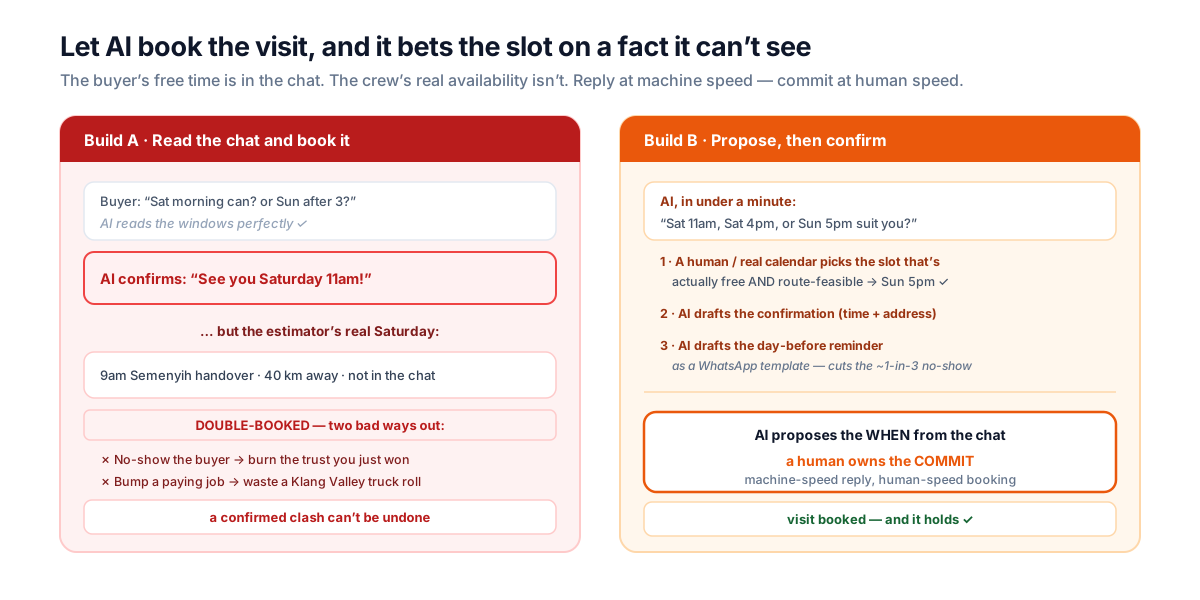
That's the reflex build, and the first half of it works beautifully. I gave Build A the WhatsApp thread and told it to read the buyer's availability and book the visit. It handled the messy part with ease — the "Sat morning ah, or Sunday after 3, but not too early" back-and-forth that a human has to scroll and decode. It pulled out the windows cleanly: buyer prefers Saturday before noon, fallback Sunday afternoon after 3. Then it did what I asked. It picked Saturday 11am, fired back a confident confirmation — "Great, we'll see you this Saturday at 11am!" — and marked the visit booked.
On the demo, it looked like magic. Instant, well-worded, no owner needed. This is exactly the kind of thing the shiny AI scheduling assistants promise. And it was the most dangerous thing I built in this whole series, because of what it didn't know when it said yes.
So what went wrong when I let it actually book?
It confirmed a slot the estimator couldn't keep — because the estimator's real availability was nowhere in the chat. AI booked against the buyer's calendar and was completely blind to the firm's.
Think about where a small reno firm's true availability actually lives. Not in a clean shared Google Calendar — most small contractors run on a whiteboard, a notes app, or a chain of group texts, which is fine at four jobs a week and quietly breaks at fifteen. The estimator knows he's got a handover inspection in Semenyih on Saturday morning, a supplier run after, and that his afternoon is soft — but he knows it, in his head and his van route. None of it is written anywhere AI can read. So when the buyer said "Saturday 11am," AI had exactly one side of the equation and confidently filled in the other with a guess dressed as a fact.
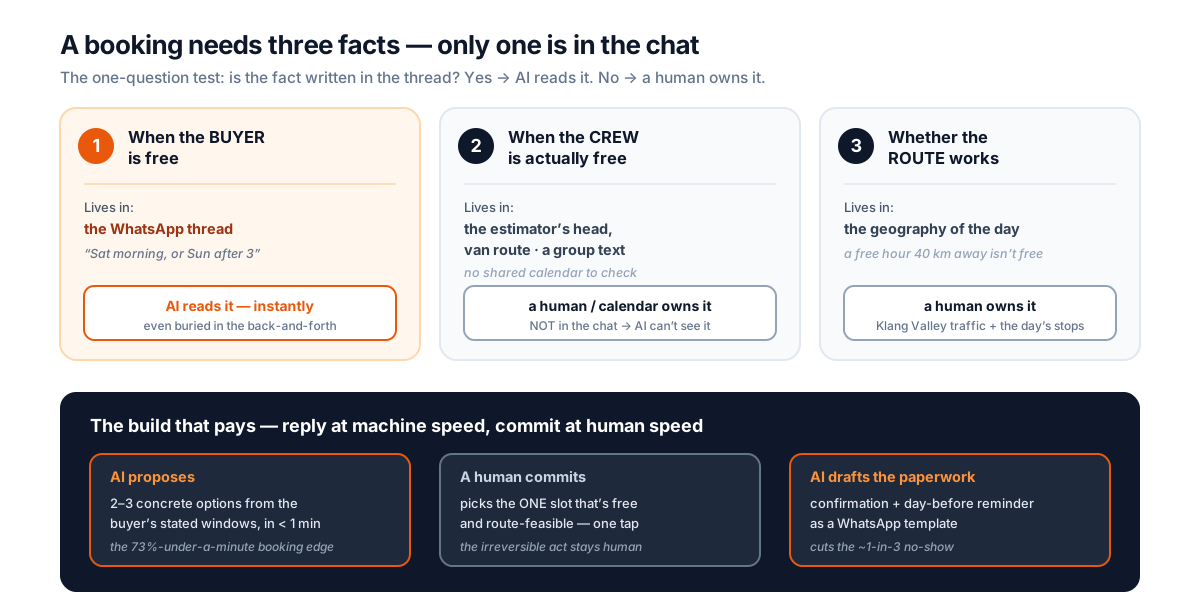
This is the same limit that shows up everywhere AI touches the lead chain: the deciding fact isn't in the message. The one-question test settles it cleanly — is the fact written in the chat, or does it live off-channel?
| A booking needs this fact | Where it lives | Who should own it |
|---|---|---|
| When the buyer is free | Written in the WhatsApp thread | AI reads it — instantly, from the mess |
| When the crew is actually free | The estimator's head, van route, other sites, a group text | A human or a synced calendar |
| Whether the route works that day | Klang Valley geography + the day's other stops | A human who knows the ground |
AI owns the top row and only the top row. Build A pretended it owned all three — and the AI-scheduling tools themselves warn about this: double-bookings happen in the visibility gaps, when the assistant can't see a calendar it wasn't given. Except a small reno firm doesn't have a calendar to give it. The gap isn't a sync bug you can fix with permissions. It's structural.
Why is a double-booking so much worse than a missed slot?
Because the two errors aren't equal, and auto-confirming picks the expensive one. This is the same asymmetry that killed the auto-merge idea in the duplicate-leads experiment: one mistake is recoverable, the other isn't.
If AI proposes a slot that turns out not to work, no harm done — you offer another time, the buyer picks again, the conversation continues. Cheap, reversible. But if AI confirms a slot the crew can't keep, you're now holding a promise you have to break, and both ways out are bad:
- No-show the buyer. You just won the appointment on speed, then failed to turn up — to a warm buyer who is comparing three to five firms and now has a concrete reason to cross you off. The first-responder trust you bought with the fast "yes" is spent in one missed Saturday.
- Bump a booked job. You keep the new visit and reschedule something you'd already committed to — annoying a paying client, and often wasting a Klang Valley truck roll worth about RM300 in hours.
It's not just the time — it's the place
Here's the part the calendar-sync vendors miss, because it's specific to how renovation visits work in Klang Valley. A visit slot isn't a point in time — it's a time and a place, and the two are welded together by traffic. A Saturday-11am slot that shows as free on a calendar but sits in Cheras while the estimator is finishing in Semenyih at 10:30 is not actually free. He physically cannot be there, or he arrives late and frazzled to a first impression that needed to go well.
So even a perfect shared calendar wouldn't make Build A safe, because route feasibility is a second off-channel fact — it lives in the geography of the day, not in any single time-free/time-busy flag. KV commuters already lose hundreds of hours a year to traffic; a scheduler blind to it will happily scatter three visits across Klang, Kajang and Ampang in one afternoon and call it a productive day. Batching visits by area is exactly the kind of judgment a human makes in two seconds and an AI reading only the chat can't make at all.
So what did the scheduler that actually paid look like?
Build B keeps the speed and gives back the commit. Instead of "read the chat and book it," the instruction is "read the buyer's windows, propose the options, and prepare the paperwork — but a human or a real calendar locks the slot." Same division of labour that's paid off at every step of this chain: AI reads and proposes, the human decides and owns the irreversible act.
Mechanically it does three things, fast:
- It extracts the buyer's stated windows the second the message lands and fires back two or three concrete options — "Would Saturday 11am, Saturday 4pm, or Sunday 5pm suit?" — pulled from what the buyer already offered. That's the under-a-minute reply that books the meeting, captured even while the owner is on a roof. Crucially, it proposes times the firm has pre-marked as generally bookable, not a slot it invented.
- A human or a synced calendar confirms the one that genuinely works — free and route-feasible for that day. This is the commit, and it stays with someone who can see the van route. One tap, and the slot is real.
- It drafts the confirmation and the day-before reminder. The confirmation carries the time, the address and what to have ready. The reminder is the quiet money-maker: without a nudge, roughly a third of booked appointments are missed, and systematic reviews of appointment reminders show a day-before reminder cuts missed appointments by around a third. That evidence is from clinics, but a renovation site visit is the same beast — a booked appointment a distracted buyer forgets — so the mechanism carries over.
There's one Malaysian-channel wrinkle Build B has to respect, and it's the kind of thing a generic scheduler gets wrong. On WhatsApp, once 24 hours pass since the buyer's last message the conversation window closes, and an unprompted day-before reminder then needs an approved message template and an opt-in — you can't just free-type "see you tomorrow!" two days later. So the reminder is drafted as a proper template the buyer agreed to receive, not a casual message that silently fails to send. Miss that, and your no-show reminder never leaves the building.
What should an owner actually do to stop losing visits at the booking step?
You don't need an AI that runs your calendar. You need to reply at machine speed and commit at human speed — and keep those two jobs separate.
- Reply with options in seconds, even when you're on site. The booking is won by whoever locks a time first. Let AI (or a saved quick-reply) fire back two or three concrete slots the instant the request lands, so the lead never cools waiting for you to get off the ladder.
- Never let the machine confirm the slot. Confirming is the irreversible act, and it depends on facts — crew availability, the day's route — that aren't in the chat. A person or a real calendar owns the "yes."
- Treat a slot as a time and a place. Before you commit, check the day's route, not just whether the hour is free. A free hour 40 km away is not free.
- Always send a day-before reminder — as a proper template. It's the cheapest no-show insurance there is, but on WhatsApp it has to respect the 24-hour window, so build it as an opt-in reminder, not a free-typed afterthought.
- Make the booking a tracked step, not a memory. "Confirm the visit, remind them the day before" should sit on a lead as a next action with an overdue flag, owned by one named person — so it can't quietly evaporate the way the Puchong lead nearly did.
How HotLead fits — honestly
Straight, the way I try to be in all of these: HotLead is not a crew scheduler, a route planner or a shared calendar. Booking a slot against your team's real availability is a job for a calendar and a human who knows the van route — this whole experiment is why I won't pretend a chat-reading AI can do it safely. What HotLead does is make sure the booking step never leaks:
- Instant capture and auto-greeting on every enquiry, so a "can we book a site visit?" doesn't go cold while your estimator is on a roof — the lead is acknowledged the second it lands, on one record.
- One named owner per lead, so the person who actually knows the crew's week is the one who confirms the time — no diffusion in a group chat where everyone assumes someone else replied.
- The confirmation and reminder as a tracked next action with an overdue flag, so "book it, then remind them the day before" is a step the system won't let you forget — the honest, un-hyped version of a scheduling assistant.
- A funnel view that shows where booked visits leak, so you can see whether you're losing jobs at the booking step or after it.
The proposing is where AI earns its keep; the committing stays with a human who can see the whole day. If leads cooling between "come and look" and the actual visit is the problem underneath this, start with the complete guide to managing renovation leads in Malaysia, see how it fits a renovation firm or an interior-design studio, or read the two companion builds on either side of the visit — briefing the estimator before it and what AI still can't do in your lead process.
Sources: Speed-to-lead booking rates — that a reply inside a minute books the meeting far more often than one after 30 minutes, and that most buyers go with the first responder — from PipelineOn's home-service response data and Home Service Direct, labelled directional. That small contractors typically schedule on a whiteboard, notes app or group texts rather than a shared calendar, from Knowify's crew-scheduling guide. AI-scheduler double-booking as a visibility-gap failure from Cal.com's calendar-management guidance. No-show and reminder evidence — that roughly a third of appointments are missed without a reminder and a reminder cuts missed appointments by about a third — from appointment-reminder statistics compiled by Dialog Health and the systematic review in The American Journal of Medicine; this is clinic data, presented as directional for a renovation visit, which shares the same booked-appointment failure mode. The WhatsApp 24-hour conversation window and the template-plus-opt-in rule for messaging after it from YCloud and Enchant. Renovation house figures — the ~RM1,280 expected gross profit per winnable lead, the ~RM300 cost of a wasted Klang Valley visit, and 40–60 enquiries a month — reused from the cost-of-lost-lead and free-site-visit-trap pieces and labelled as typical operating numbers, not a single quoted study. The scheduling experiment and the propose-versus-commit split are described from practice and labelled illustrative, not a controlled trial.
Frequently asked questions
Can AI schedule a renovation site visit from a WhatsApp conversation?
It can read the buyer's side of the booking and draft it, but it should not confirm the slot on its own. Pulling "this Saturday morning, or Sunday after 3" out of a messy thread is exactly what AI is good at. The problem is the other half of a booking — whether your crew is actually free at that time and whether the location fits the day's route. Most small renovation firms keep that in someone's head, a van route and a group chat, not a shared calendar AI can check, so an auto-booker confirms times that collide. The safe build has AI propose two or three options fast and a human or a synced calendar commit the one that genuinely works.
Why not just let AI auto-book to reply faster?
Because speed only helps if the booking holds. The whole reason to book fast is that buyers go with whoever locks a time first, so a slot you have to cancel an hour later is worse than a slightly slower one that sticks — you have now shown up as unreliable to a warm buyer who is comparing three to five firms. A double-booking forces an ugly choice — no-show the buyer, or bump a paying job and waste a truck roll. Propose in seconds, confirm against real availability, and you get the speed without betting the appointment on a fact AI cannot see.
What does AI genuinely help with at the booking step?
Three things, all of them reading and drafting rather than deciding. It extracts the buyer's stated availability from the thread instantly, even when it is buried in back-and-forth. It drafts a clear confirmation message with the agreed time, address and what to prepare. And it drafts the day-before reminder that cuts no-shows — which matters because roughly a third of booked visits are missed without one. What it should not do is pick and lock the slot, because that depends on the crew's real calendar and the day's route, both of which live off the chat.
Does a day-before reminder actually reduce site-visit no-shows?
The evidence from appointment-heavy fields is strong and directional for a renovation visit. Systematic reviews of clinic reminders find that a reminder before the appointment cuts missed appointments by roughly a third, with most studies reporting a clear positive effect. A renovation site visit is a booked appointment with the same failure mode — the buyer forgets, double-books their own weekend, or goes cold — so a short, specific confirmation the day before does the same work. On WhatsApp there is a wrinkle — once 24 hours pass since the buyer's last message, an unprompted reminder needs an approved template and an opt-in, so it has to be built to respect that window.
Does HotLead book visits or run a crew calendar?
No, and it is worth being clear about the boundary. HotLead is not a crew scheduler, a Gantt chart or a route planner — booking a slot against your team's real availability is a job for a calendar and a human who knows the van route. What HotLead does is make sure the booking step never gets dropped — it captures every enquiry on one record with an instant auto-greeting so the lead does not go cold while your estimator is on site, routes it to one named owner, and turns "confirm the visit and remind them the day before" into a tracked next action with an overdue flag. The scheduling stays where it belongs; the follow-through stops leaking.
Keep reading
- Did We Already Say RM68k? Using AI to Stop Quote Drift Across a Long Renovation ThreadOver a weeks-long WhatsApp thread with two or three quote revisions, a rep re-states a number that contradicts an earlier promise — and re-opening a settled price quietly invites a discount that eats a whole job's profit. So I pointed AI at the drift. It works beautifully as a flag, and dangerously as an auto-corrector.
- The Warranty as a Closing Lever: Why a Longer Guarantee Beats a Discount on a Renovation DealA quote is stalling and the buyer wants a reason to say yes. Before you drop the price, look at the other lever in your hand — a longer workmanship warranty. It is the same expected-value decision as a discount, but the math runs the opposite way — a price cut costs you thousands with certainty, while extending the defects cover costs you a couple of hundred ringgit in expectation, for arguably more trust with a scam-wary buyer. Here is the EV case for the non-price concession, the trap that turns it into a hidden liability, and which leads it actually moves.
- "Can You Just Build It, My Neighbour Also Did" — Handling the Renovation Lead That Needs Council Approval FirstSome renovation enquiries can't legally start next month, no matter how ready the buyer is — a kitchen extension, a hacked-through wall, a roofed-over air well all need the council's written approval first. Quote a fast build price to win the job and you either lose it to a "boss, can start" cowboy, or win it and inherit the stop-work order, the RM50,000 fine and a client who later can't sell the house. Here's how to spot the permit-first lead and sell the approval as protection.