

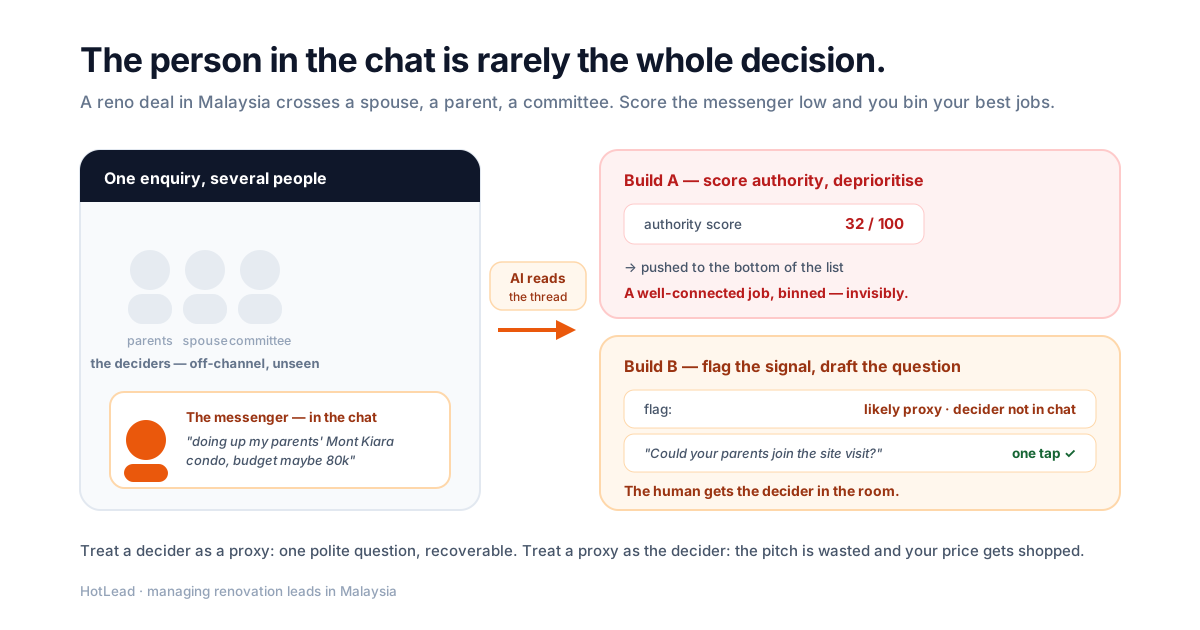
Here is a deal I watched slip, and it is one of the most common ways money leaks in this business. A PJ interior-design studio gets a warm Qanvast enquiry: a young professional, clear taste, messaging fast, "looking to do up my parents' condo in Mont Kiara, budget maybe 80k." The designer does everything right — quick reply, good mood board, a tidy RM82k quote two days later. Then silence. Three weeks on, the studio owner bumps into the buyer at a showroom and learns the parents went with someone else. The parents had never seen the studio's work, never met the designer, never heard the pitch. The whole sale had been carried second-hand by an enthusiastic adult child who was never the one signing the cheque — and the firm had aimed everything at the messenger.
Every AI build in this series has taken apart a single step of the lead chain. This one is about a fact that sits underneath all of them and that nothing in the chain owns: a renovation deal is almost never one person. The husband and wife. The adult kid sourcing for the parents. The office admin sourcing for the boss. The landlord versus the tenant living in the unit. The JMB or MC committee signing off building works. In a market where the average household is 3.8 people and roughly one in five households is still an extended family under one roof (DOSM), the person in your WhatsApp thread is very often not the person who can say yes.
So the 2026 reflex is tidy and dangerous: can AI just read the thread, score each lead's authority, and let me spend my time on the real decision-makers? I built exactly that. It quietly pushed some of the best jobs to the bottom of the list. Here is the problem, what talking to the wrong person actually costs, what the two builds did, and the version that held up.
Why does talking to the wrong person cost a renovation firm real money?
Because a pitch delivered second-hand almost never survives the trip. When you sell hard to a messenger, everything you say — the value, the reasoning, the answer to "why are you RM10k more than the other guy" — has to be re-told by someone who is not a salesperson, to a decider who was not in the room. Objections you could have handled in thirty seconds go unanswered. Your price arrives naked, with none of the argument that justified it. And you have no way to read the decider's face, because you have never seen it.
The B2B world measured this the expensive way, and the numbers are brutal. Sales research on multi-threading — engaging more than one person in the buying group — finds that single-threaded deals close at roughly 5% while multi-threaded deals with about five stakeholders close nearer 30%. The reason is structural: a single thread breaks the instant that one person can't answer an objection, loses interest, or goes quiet, and the deal resets to zero. Gartner puts a complex buying committee at six to ten people; Forrester's State of Business Buying 2024 puts the average purchase at thirteen stakeholders.
A family renovation is not a corporate procurement — but it is the same shape. A months-long, high-trust, five-figure decision that crosses more than one person. Swap the procurement manager for a spouse and the CFO for a parent, and the physics are identical: if you only ever talk to the messenger, you are running a single-threaded deal against firms who got the decider in the room.
So can AI just score each lead's authority? The reflex build — and why it bins your best jobs
This was Build A, and it demos convincingly: AI reads the thread, looks for authority cues, assigns each lead an "authority score," and pushes the low-scorers — the ones who "sound like proxies" — down the priority list so the team spends its hours on the "real deciders." Run it against real Malaysian enquiries and it fails in two ways that cost you the jobs you most want.
First, the proxy is usually your best route in, not a weak lead. This is the same score-and-bin trap that makes lead-qualification scoring dangerous: a low score doesn't mean a bad lead, it means a lead at an early or indirect position. The adult child messaging about the parents' condo is frequently the serious filter — the tech-comfortable one who found you on Qanvast, vetted three firms, and will personally bring the deciding parent to the site visit. The wife running the shortlist decides which three firms even get to quote. Deprioritise them and you have binned the best-connected deals in your inbox. Malaysian household research bears this out: a survey of 1,778 married Malaysians found women are often the final decision-makers on everyday spending while men more often make the final call on large household expenditures — so the person doing the sourcing and the person signing the big number are routinely two different people, both essential, neither a "low-value lead."
Second, AI guesses the decider from exactly the cues it gets wrong. How does a model decide who "sounds like" the authority? From surface signals — who mentions the budget, a male name, a formal tone, decisive language. That is precisely the failure mode documented in recent research on how LLMs infer who they're talking to: models make demographic and role inferences from stereotypical cues, and hold onto them even when the user signals otherwise — confidently, in fluent language that reads as data. Point that at "who decides in this family" and you get a machine that quietly assumes the husband decides because he's the husband, or that the person quoting a number is the buyer, and hands you a ranked list built on a stereotype wearing a decimal point.
Where does AI genuinely earn its keep here?
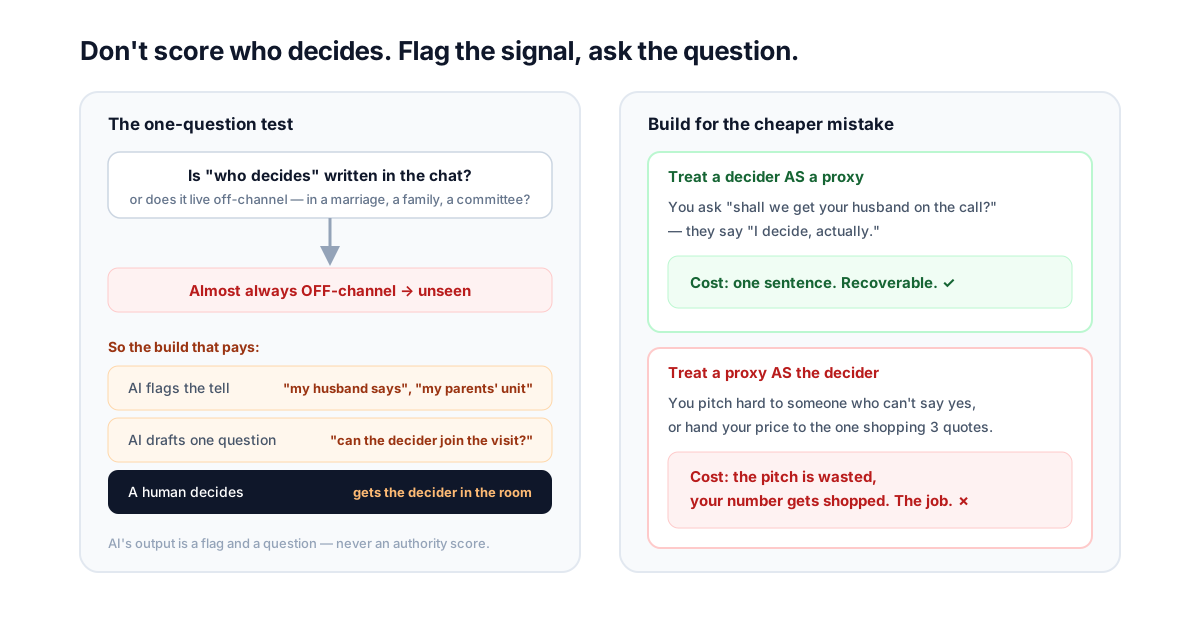
On spotting the signal, never on making the judgement. The mistake is asking AI to rank who matters. The useful job is to catch the tells that you're probably talking to a messenger and nudge the human to ask the one question that settles it. That is real, and it's cheap:
- Flag the proxy tells. Surface the phrases that mean "the decider isn't in this chat" — "my husband says", "need to check with my parents", "my boss wants", "the committee will decide", "it's my tenant's unit" — as a soft flag on the lead, not a score. A tired owner reading forty threads misses these; a model catches them for a fraction of a sen.
- Draft the one qualifying question. Prepare a warm, natural line for the rep to send — "Sounds like a lovely project for your parents! Would they be able to join the site visit so we can get the details right for them?" — so asking the decisive thing takes one tap, not a fresh think each time.
- Keep the whole cast on one record. As more people surface in the thread, note them — messenger, likely decider, others mentioned — so whoever picks the lead up sees the full picture, not just the last message.
- Never score-and-rank authority. Leave "who actually decides here" to the human who can read a family. AI's output is a flag and a question, not a verdict.
That is the same division of labour the whole series keeps landing on: AI reads and drafts, the human owns the judgement that can't be undone. It's the one-question test again — is "who decides" a fact written in the chat, or does it live off-channel? Almost always off-channel, in a marriage or a committee — so AI flags the signal and a person gets the decider in the room. Same shape as tagging a lead rather than picking the rep, and same reason Sarah's "who do we even quote to" pain never resolves from the thread alone.
Build A vs Build B — the honest comparison
| Reading who decides | Build A — AI scores authority & deprioritises | Build B — AI flags the signal & drafts the question |
|---|---|---|
| Spotting proxy tells | Yes | Yes |
| What it produces | An authority score and a ranked list | A soft flag plus a drafted qualifying question |
| The adult-kid / spouse proxy | Scored low, pushed down the list | Flagged as your route to the decider |
| How it decides "who's the boss" | Inferred from stereotypical cues | Not inferred — left to a human to ask |
| When it's wrong | Bins well-connected jobs, invisibly | Costs one polite question |
| Who makes the call | The model, silently | The rep, after getting the decider in the room |
| Cost of one error | A lost five-figure job you never see | Ten seconds and one message |
The two builds catch the same tells. The difference is what they do next. Build A converts a fuzzy guess into a confident ranking and quietly acts on it. Build B stops at the flag and hands the human a ready-made question. One tries to know a family's power structure from four WhatsApp lines; the other just makes sure you ask.
The asymmetry that should decide how you build it
The two ways to be wrong here are not equally expensive — and, as with merging duplicate leads, you should build for the cheaper mistake. Treating a real decider as a proxy is mildly annoying: you ask "shall we get your husband on the call too?" and they say "I decide, actually" — a two-second recovery, no harm done. Treating a proxy as the decider is the costly one: you pitch your whole case to someone who cannot say yes, or you hand your price to the person who is comparing you against two other firms — and now your number is being shopped around a family WhatsApp group with none of your reasoning attached. One error costs a sentence. The other costs the job.
What should an owner actually do about multi-decider deals?
Treat "who else decides?" as a standard qualifying step, not an awkward one — and let AI remind you to ask, never answer for you.
- Ask the one question early, before you reveal a price. Some version of "who else will be involved, and can we get them to the site visit or the quote presentation?" It's normal for a big spend, and it gets the budget-holder in the room instead of letting your pitch travel second-hand.
- Treat the proxy as your ally, not a weak lead. The person messaging you found you, vetted you, and is willing to carry your name to the decider. Help them do it well — give them the one thing that makes the internal case — rather than pushing them down the list.
- Get the decider to the visit or the presentation. The site visit is your best multi-threading moment. A wasted single-decider visit is a truck roll; a visit with the actual budget-holder present is where five-figure jobs close.
- Keep the whole cast on one record. When a spouse, a parent or a committee member surfaces, note them, so the deal isn't a single fragile thread through one messenger.
- Use AI for the reminder, not the ranking. Let it flag "decider not in chat" and draft the question. Keep the read on who really holds the money human — it lives in a family, and no model can see inside one.
How HotLead fits — honestly
I'll be straight, the way I try to be in every one of these. HotLead does not ship an AI authority-scorer or a decision-maker detector — the flag-and-draft build is the experiment in this piece, not a product page. And the honest conclusion of the experiment is that guessing who holds the money off a single chat is exactly the judgement that belongs to a human who can read a family. What HotLead gives you is the plumbing that makes multi-decider selling manageable:
- Capture the whole thread on one record, so every "check with my husband" and "my parents' unit" tell is sitting in one place for whoever runs the deal — not scattered across three phones.
- One owner per lead, by rule. Round-robin, manual, or a custom rule by area or source — so the relationship with a family or a committee runs through one accountable person, the human best placed to work out who really decides.
- A next action and overdue flag on every lead, so "book the parents onto the site visit" is a tracked step, not a good intention that evaporates when the next fire starts.
- A per-channel funnel and team performance view, so you can see whether the deals that stall are the ones where you only ever spoke to the messenger — the leak this whole piece is about, made visible.
Who actually decides stays a human read, where it belongs. If leaking, single-threaded, quoted-to-the-wrong-person deals are the problem underneath all this, start with the complete guide to managing renovation leads in Malaysia, see how it fits a renovation firm, an interior-design studio or a construction and contracting outfit, or read the companion builds on structuring a messy enquiry into a lead card and what AI still can't do in a contractor's lead process.
Sources: Buying-committee size — that a complex B2B purchase involves roughly six to ten decision-makers (Gartner) and that the average business purchase now spans around thirteen stakeholders (Forrester, State of Business Buying 2024) — from Traction Complete's buying-committee guide and Attainment Labs. Multi-threading win rates — that single-threaded deals close at roughly 5% versus about 30% for multi-threaded deals with around five stakeholders, and that a single thread resets the deal to zero when that contact goes quiet — from Landbase's multi-threading analysis. Couples and renovation decisions — that nearly one in five couples had one partner make a significant design or purchase decision without telling the other — from HomeAdvisor's couples home-improvement survey. Malaysian household decision-making — that women are often the final decision-makers on everyday spending while men more often decide large household expenditures, from a survey of 1,778 married Malaysians in the Journal of Family and Economic Issues; and that the average household is 3.8 people with roughly a fifth still extended families (DOSM), via Statista's household-size series and MPRH's overview of Malaysian families. AI inferring who it's talking to — that LLMs infer demographic and role attributes from stereotypical cues and hold onto them even when signalled otherwise, confidently — from Reading Between the Prompts (arXiv 2505.16467). Renovation operating figures — 40–60 enquiries a month, a ~7–8% close rate, and ~RM1,280 of expected gross profit per winnable enquiry — are the house figures used across this series (see the funnel-benchmarks and pillar pieces), labelled as typical operating numbers rather than a single quoted study. The per-lead AI cost is described from practice and labelled illustrative. All money figures here are illustrative — measure your own to know what talking to the wrong person really costs you.
Frequently asked questions
Can AI tell who the real decision-maker is in a renovation enquiry?
Not reliably, because who holds the money is usually an off-channel fact — it lives in a marriage, a family or a committee, not in the WhatsApp thread. What AI can do well is spot the tells that you are probably talking to a messenger — phrases like "my husband says", "need to check with my boss", "my parents' unit" — and prompt the rep to ask the one qualifying question early. It should flag the signal and draft the question, not score the lead's authority and rank it, because it guesses the decider from stereotypical cues and gets it confidently wrong.
Why is it a mistake to deprioritise a lead just because they seem to be a proxy?
Because in a Malaysian reno or ID sale the proxy is very often your best route in, not a weak lead. The adult child who found you on Qanvast is frequently the serious filter who will bring the deciding parent to the site visit. The wife running the shortlist is the one who decides which three firms even get a quote. An authority score that pushes these down the list bins exactly the well-connected jobs you most want — the same score-and-bin trap that makes lead-qualification scoring dangerous.
What is the single most useful question to ask a renovation lead early?
Some version of "who else will be involved in deciding, and can we get them to the site visit or the quote presentation?" It is polite, it is normal for a big spend, and it does the one thing that matters most — it gets the actual budget-holder in the room instead of letting your pitch travel second-hand through a messenger who cannot answer objections for you. Asking it early, before you reveal a price, also stops your number being carried off to be shopped against two other quotes.
Does treating a renovation like a B2B committee sale really apply to a family?
The shape is the same even though the players are not. A big renovation is a months-long, high-trust, high-value decision that crosses more than one person — a spouse, a parent, sometimes a whole strata committee. B2B sales research found that deals with only one contact close at a fraction of the rate of deals where several stakeholders are engaged, because a single thread breaks the moment that person cannot answer an objection or goes quiet. A family reno breaks the same way when you only ever speak to the messenger.
Does HotLead score or detect decision-makers with AI?
No — HotLead does not ship an AI authority-scorer or a decision-maker detector, and this experiment is part of why. Guessing who holds the money off a single chat is exactly the judgement that belongs to a human who can read a family. What HotLead does is the plumbing that makes multi-decider selling manageable — capture the whole thread on one record so every "check with my husband" tell is visible, one named owner per lead so the relationship with the family runs through one person, and a next action so booking the decider onto the visit is a tracked step, not a hope.
Keep reading
- Did We Already Say RM68k? Using AI to Stop Quote Drift Across a Long Renovation ThreadOver a weeks-long WhatsApp thread with two or three quote revisions, a rep re-states a number that contradicts an earlier promise — and re-opening a settled price quietly invites a discount that eats a whole job's profit. So I pointed AI at the drift. It works beautifully as a flag, and dangerously as an auto-corrector.
- The Warranty as a Closing Lever: Why a Longer Guarantee Beats a Discount on a Renovation DealA quote is stalling and the buyer wants a reason to say yes. Before you drop the price, look at the other lever in your hand — a longer workmanship warranty. It is the same expected-value decision as a discount, but the math runs the opposite way — a price cut costs you thousands with certainty, while extending the defects cover costs you a couple of hundred ringgit in expectation, for arguably more trust with a scam-wary buyer. Here is the EV case for the non-price concession, the trap that turns it into a hidden liability, and which leads it actually moves.
- "Can You Just Build It, My Neighbour Also Did" — Handling the Renovation Lead That Needs Council Approval FirstSome renovation enquiries can't legally start next month, no matter how ready the buyer is — a kitchen extension, a hacked-through wall, a roofed-over air well all need the council's written approval first. Quote a fast build price to win the job and you either lose it to a "boss, can start" cowboy, or win it and inherit the stop-work order, the RM50,000 fine and a client who later can't sell the house. Here's how to spot the permit-first lead and sell the approval as protection.