

An owner asked me about this one straight: "Everyone online is selling an AI that phones your leads back in sixty seconds. Should I buy it?" Fair question. The pitch is genuinely tempting — you can't always reply in five minutes, a hot enquiry goes cold, and here's a tireless agent that calls every one of them back instantly, at two sen a minute, in a voice you can barely tell from a person's. It's the slickest demo in the lead-automation world right now.
So I ran it at the only thing that matters: a Malaysian renovation firm's actual reality. And the honest answer is no — but not for the reason anyone warns you about. It isn't that the AI sounds robotic (it doesn't), and it isn't that it's expensive (it's almost free). It's that in Malaysia, in 2026, an unknown number calling you is the single most distrusted thing that can happen on your phone — and the robocall burns the exact trust you were paying to build. Here's the math, the local fact that breaks the imported playbook, and the build that actually earns its keep on this step.
What problem is the AI voice agent actually solving?
The real one: the enquiry you can't answer in time. A WhatsApp message lands at 9:40pm, or during a site visit, or while you're already on another call — and by the time you reply, the buyer has messaged two other firms. The lead-response research behind the "five-minute rule" is blunt about the cost: reply within five minutes and you're on the order of 100 times more likely to connect than at thirty, and far likelier to qualify the lead. Miss the window and you're chasing a buyer who's already warm with someone else.
The AI voice agent promises to close that gap without hiring a night receptionist. The moment an enquiry hits, it dials the lead, greets them, asks a couple of qualifying questions, and books a slot — 24/7, for pennies. On paper it's speed-to-lead solved. The question a grounded owner asks isn't "is it clever?" (it is) but "does it actually move money, here, for me?" To answer that you have to follow the call past the demo and into a Malaysian buyer's hand.
What did the slow callback cost before AI?
Enough to take the idea seriously. A renovation enquiry isn't worth zero and it isn't worth a whole job — it's worth its expected value, roughly RM1,280 in gross profit per enquiry once you account for job size, margin and close rate, as worked out in the real cost of a lost renovation lead. Lose four winnable ones a month to slow or forgotten follow-up and that's about RM61k a year walking out the door.
So the problem is real and the money is real. That's precisely why the voice agent deserves an honest test instead of a reflex yes or a reflex no. If a cheap automation recovers even a slice of that leak, it pays for itself many times over. The only way it doesn't pay is if the first touch it makes is worse than no touch at all. Hold that thought.
What happens when an AI voice agent calls a Malaysian reno lead?
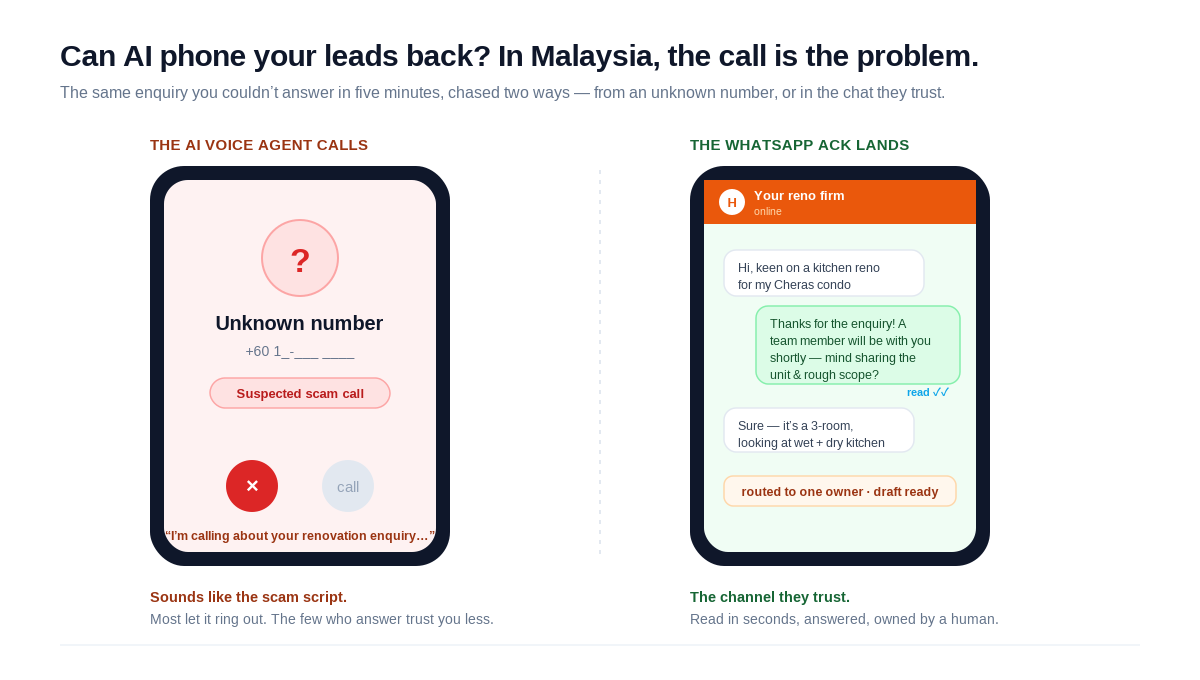
Mostly, nothing — the phone rings out. And when someone does answer, the call often does damage. Here's why, and it's the whole argument: Malaysia is in the middle of a phone-scam epidemic, and it has retrained how everyone treats an unknown number.
The numbers aren't subtle. Whoscall's annual report recorded 2.98 million scam calls in Malaysia in 2024, an 82.81% jump from 1.63 million the year before, with reported losses rising to RM1.57 billion from RM1.22 billion. MCMC says it has blocked on the order of 2.2 billion suspicious calls since 2022. Malaysia ranked among the worst-hit in Asia for scam exposure. When a country gets trained that hard, a rational reflex sets in: you don't answer numbers you don't know, and if you pick up by accident, you're already suspicious.
Now drop an AI voice agent into that world. It dials from a number the buyer has never seen. If they answer at all, a smooth, slightly-too-even voice says, "Hi, I'm calling about your renovation enquiry — can I ask a few quick questions?" To a Malaysian ear in 2026, that is not reassuring. That is the opening line of a scam. Unknown number, synthetic voice, "I'm calling about your [thing], just confirm a few details" — the agent has, with perfect fluency, impersonated the exact thing the whole country is on guard against.
So you get hit twice. First, a low pickup rate, because most people let the unknown number ring out. Second, and worse, the pickups that do happen often go negative — you've introduced your brand as a suspicious cold call to a buyer who was, moments ago, a warm inbound lead who messaged you. You took someone who raised their hand and made them flinch.
Why does the US playbook break at the Causeway?
Because it quietly depends on two things that are true there and false here. The imported advice — "AI-dial every web lead inside sixty seconds" — isn't wrong in its home market. It's just local, and nobody selling it to you mentions the local part.
| In the US playbook | In Malaysia, 2026 | |
|---|---|---|
| Caller ID | Branded / verified caller ID is common — a business name can show before you answer | No reliable branded caller ID on a normal outbound line; it's just an unknown number |
| Answer culture | Slipping, but calls are still a normal first touch (though ~80% won't answer an unknown number, per Pew) | An unknown number is treated as a probable scam — 2.98m scam calls in 2024 trained the reflex |
| Trusted channel | Phone + SMS still carry business conversations | WhatsApp is the default; ~90.7% of reno leads start there |
| What a cold call signals | "A business is being responsive" | "Someone got my number — is this a scam?" |
Look down the right column. Every single condition the playbook leans on is inverted here. A tactic built for verified caller ID and a phone-first culture, dropped into a market with no branded caller ID and a scam-trained, WhatsApp-first culture, doesn't degrade gracefully — it points the wrong way. This is the same lesson as what AI still can't do in a contractor's lead process: the tool works fine; the context it's dropped into is what decides whether it pays.
Isn't it cheap enough to just try anyway?
This is where the ROI-thinking matters, because "it's so cheap, what's the harm" is exactly the reasoning that quietly bleeds a pipeline. Published rates for the AI voice platforms (Vapi, Retell, Bland) land around US$0.07 to US$0.31 a minute all-in once you add the model, voice and telephony — call it RM1 to RM4 for a short callback (illustrative, at late-2026 rates). That really is a rounding error per call.
But the airtime was never the cost. The cost is the lead. On the earlier figure, each enquiry carries roughly RM1,280 of expected gross profit. So the P&L of a cold AI call isn't "two sen a minute, basically free." It's:
- Per call: about RM1 to RM4 in airtime. Trivial.
- Per lead it mishandles: a dented first impression on a warm inbound buyer — some fraction of RM1,280 in expected profit, every time the cold dial turns a raised hand into a flinch.
A tool that costs two sen and risks a four-figure asset is not a cheap tool. It's an expensive one wearing a cheap price tag. The grounded move is to judge AI by the outcome it moves, not the invoice it generates — and on this step, the outcome moves the wrong way.
Where does AI actually earn its keep on the callback problem?
On the same channel the buyer trusts, doing the part that's safe to automate. The problem the voice agent was hired for — hit the five-minute window when I can't — is completely real and worth solving. You just solve it where it doesn't look like a scam.
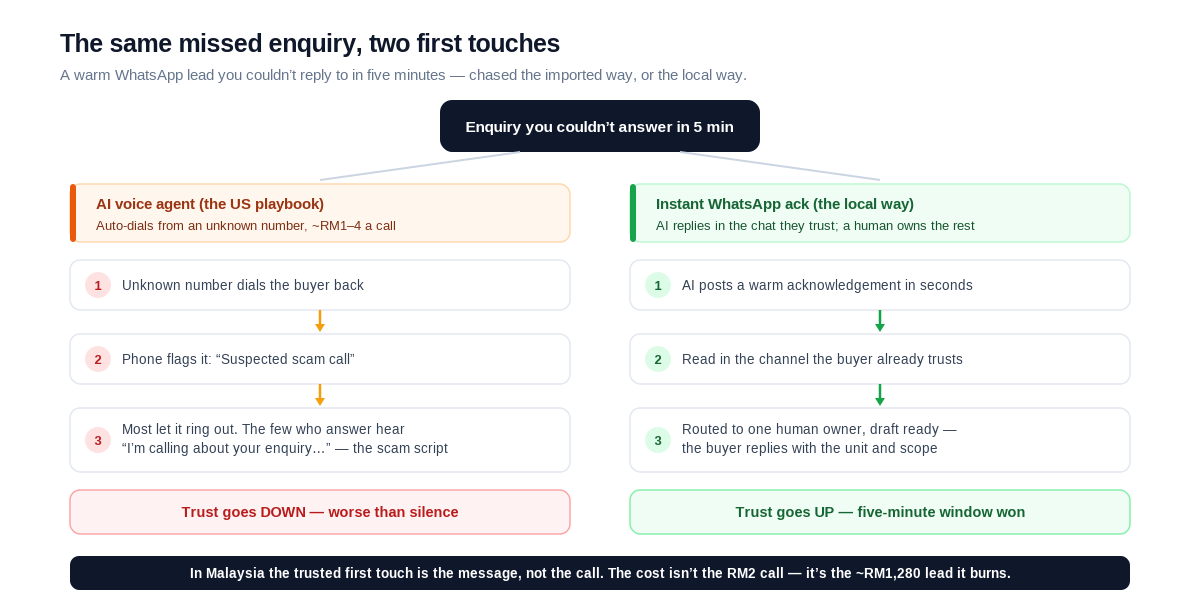
Run the same enquiry through WhatsApp and the mechanics flip in your favour:
- Instant acknowledgement, on the trusted channel. An AI assistant can post a warm, on-brand reply the second an enquiry lands — "Thanks for the kitchen enquiry! One of our team will be with you shortly, mind sharing the unit and rough scope?" — so you hit the five-minute window without a human awake, and it arrives where the buyer already feels safe. This is the AI first-reply build, and it's safe precisely because the message is in-channel and expected.
- Route to one human owner. The moment the lead is captured, it goes to a single named person so the follow-up is owned, not lost in a group chat.
- Draft, don't dial. AI prepares the next message; a human sends it, adds the judgment, and — if a call genuinely helps — phones from a saved business number after the chat has warmed up, so the buyer sees a name they've already been messaging, not a cold unknown number.
That's the split that pays: speed on the acknowledgement, a human on the conversation, and the phone kept for after trust exists, never before. You keep the five-minute win and you don't spend your first impression looking like fraud.
What should an owner actually do on Monday?
Don't buy the robocall. Do solve the real problem it was pointing at.
- Make your fast first touch a WhatsApp message, not a phone call. Switch on an instant auto-acknowledgement on your WhatsApp enquiries so every lead gets a reply inside the five-minute window — on the channel they trust.
- Route each new lead to one owner immediately. Speed is wasted if the follow-up has no name on it. One lead, one human, a next action logged.
- Keep the phone for later, and keep it human. If a call adds value — a complex scope, a hot buyer — make it after a WhatsApp exchange, from a saved business number, by a person. Never let a machine cold-dial a lead from a number they don't recognise.
- Judge any AI tool by the outcome, not the price. Before you switch something on, ask what it does to the lead, not what it costs per call. On this step, the cheap option is the one that quietly costs you the most.
How HotLead fits — and what it deliberately doesn't do
I'll be straight, because over-claiming is the hype I keep arguing against. HotLead is built on exactly this split, and it deliberately doesn't auto-dial your leads:
- It captures every enquiry and warms a brand-new WhatsApp lead instantly with an optional AI assistant — the fast first touch, placed on the channel buyers actually trust.
- It gives each lead one owner and routes by round-robin, area or custom rule, so the follow-up is always someone's job.
- It keeps a next action and an overdue-follow-up nudge so a warm lead never goes cold while everyone assumes someone else has it.
- It shows you a funnel and per-channel view so you can see which channels send leads that actually convert — and spend there.
What it does not do is phone your leads with a synthetic voice from an unknown number. That's the experiment this article is about, and the reason it isn't a feature. If slow or leaking follow-up is your problem, start with the complete guide to managing renovation leads in Malaysia, see how fast first contact fits a renovation firm, or read the companion builds on AI first replies and the honest limits of AI in a lead process.
Sources: Malaysian scam-call figures (2.98 million scam calls in 2024, up 82.81% from 1.63 million in 2023; reported losses of RM1.57 billion, up from RM1.22 billion; Malaysia among the worst-hit in Asia for scam exposure) from the Whoscall / Gogolook 2024 Annual Report, reported via Asia News Network; MCMC's cumulative 2.2 billion suspicious calls blocked since 2022 as reported by Malaysiakini. AI voice-agent pricing (US$0.07–0.31/minute all-in across Vapi, Retell and Bland once model, voice and telephony are included) from published 2026 platform comparisons (Retell AI pricing comparison, Beri.net breakdown); ringgit conversion and the per-call RM1–4 figure are illustrative at late-2026 rates. US answer-culture context (80% of Americans won't answer an unknown number) from Pew Research, as cited in industry speed-to-lead coverage. The five-minute / ~100× connect-rate figure is from the much-cited lead-response research summarised in how response time affects close rate. WhatsApp lead-channel share (90.7%) and expected-gross-profit-per-lead (~RM1,280) as established in the complete guide and the cost of a lost renovation lead. The "unknown number reads as a scam" buyer reflex is described here from the Malaysian scam-call data and field observation, not a single published statistic.
Frequently asked questions
Can an AI voice agent call my renovation leads back automatically?
Technically yes — tools like Vapi, Retell and Bland can dial a lead within seconds of an enquiry and hold a natural conversation, and they are cheap, roughly RM1 to RM4 for a short call. The problem in Malaysia is not whether it can call, it is whether anyone picks up and whether the call helps or hurts. With 2.98 million scam calls logged in 2024 and RM1.57 billion lost, Malaysians have learned to let unknown numbers ring out, and a synthetic voice opening with "I'm calling about your renovation enquiry" sounds exactly like the scam script. So most calls go unanswered, and the ones that connect often cost you trust rather than building it.
Why does an AI callback work in the US but not in Malaysia?
Two things hold in the US that don't here. First, verified and branded caller ID is widespread, so a business call can show a name a buyer recognises before they answer. Second, there is still a culture of answering unknown numbers, though even that is slipping — a Pew survey found about 80% of Americans won't answer an unknown number. In Malaysia there is no reliable branded caller ID on a normal outbound line, and the scam-call epidemic has trained everyone to treat an unknown number as a threat. The playbook isn't wrong; it's local, and the local conditions are the opposite of ours.
Isn't a cold AI call still worth it because it's so cheap?
That's the trap. The call itself is a rounding error — a couple of ringgit. But the cost that matters is not the airtime, it's the lead. A renovation enquiry is worth roughly RM1,280 in expected gross profit, so a first touch that makes a nervous buyer trust you less has quietly spent far more than the few sen it cost to place. Cheap-per-call and expensive-per-outcome is exactly the mistake that makes AI look like it's "working" while the pipeline leaks.
What should I use instead to reply to a reno lead fast?
Reply fast on the channel the buyer already trusts — WhatsApp. An AI assistant can post an instant, warm acknowledgement the second an enquiry lands, so you hit the five-minute window without a human awake, then route the lead to one named owner with a drafted reply ready to send. That keeps the speed that wins the lead and keeps a human on the conversation that closes it. A phone call, if it helps at all, comes later and from a saved business number — after the message has earned the pickup.
Does HotLead make AI voice calls to my leads?
No, and deliberately. HotLead captures every enquiry, warms a brand-new WhatsApp lead instantly with an optional AI assistant, gives each lead one owner, routes by round-robin, area or custom rule, and keeps a next action and an overdue-follow-up nudge so nothing is forgotten. It does its fast first touch where buyers actually trust it — in the chat — and leaves the phone call to the human owner. Auto-dialling leads from an unknown number is the experiment this article is about, and the reason it isn't a feature.
Keep reading
- Can AI Reply to Your Renovation Firm's 1-Star Review? I Built It — and the Risk Is How Fast It ApologisesA 2-star review on Google or Qanvast is the first thing your next renovation lead reads — and most firms either ignore it or fire back and make it worse. The 2026 reflex is to let AI write the reply. I built it, and drafting a calm response costs a fraction of a sen. But an AI tuned to be helpful apologises too fast — it will concede a fault in writing, promise a refund that never happened, and grovel to a fake review from a competitor. Here's the build that protects your rank instead of torching it.
- Which Lead Signals Actually Predict a Sale? Reverse-Audit Your Own Won JobsMost firms grade a renovation lead on signals that feel predictive — enthusiasm, a long message, a fast reply — and never check whether those signals actually separate won jobs from lost ones. Here is how to run a reverse-audit on your own closed deals, which signals usually survive it, and why your pipeline is too small to pretend the score is more than directional.
- The "I Only Deal With the Boss" Lead: When the Buyer Refuses Your TeamYou finally hired someone to share the load — then the buyer messages "can I deal with you direct ah, boss?" and refuses to engage your staff. Every big lead quietly re-centralises onto the one person already maxed out, and your firm can never grow past the owner. Here's why caving caps you, why a flat "my staff will assist" loses a nervous buyer, and the move that keeps both.