

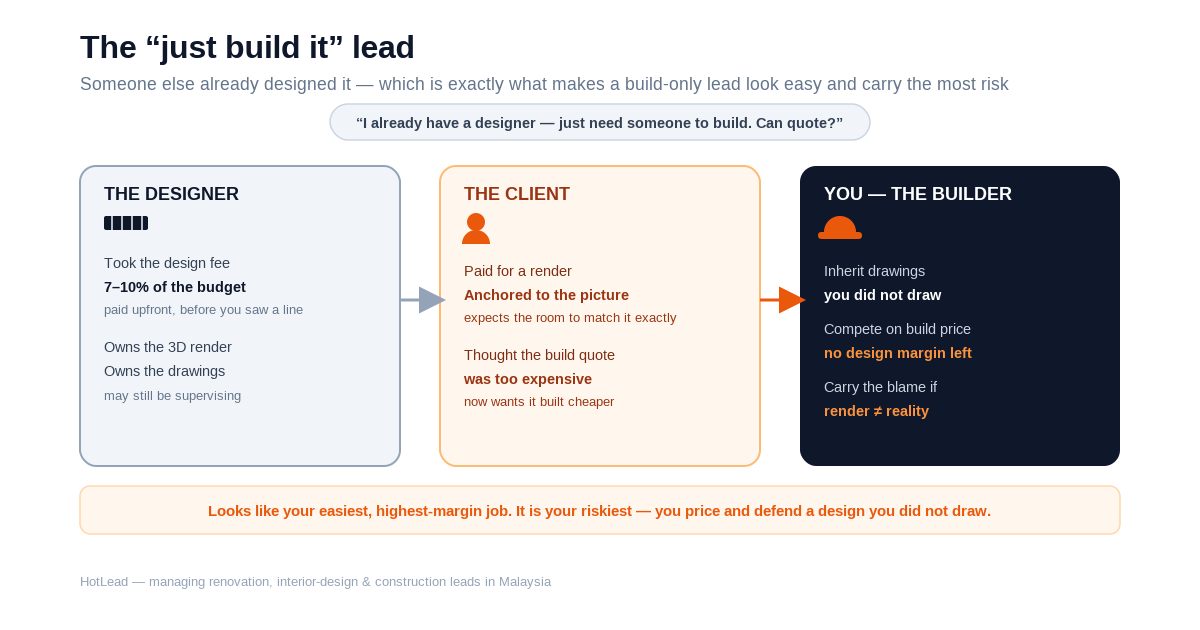
A contractor friend in Petaling Jaya told me about the WhatsApp that nearly cost him a month of his crew's time — and it looked, at first, like the best lead of the week.
The message was clean: "Hi, I already engaged an interior designer, drawings and 3D all done. I just need someone to build. Can quote?" No vague "how much to renovate ah," no photo of an empty condo, no decisions to drag out of the client over three weeks. Scope defined, design done, a buyer who clearly knows what they want. He did what most firms do with a lead that looks that easy — he asked them to send the drawings over, glanced at the 3D render, and fired back a keen price the same afternoon, because why not, the hard part was already done.
The hard part had not been done. The drawings were a beautiful set of renders with a floor plan, and almost nothing a builder actually prices from — no dimensioned elevations for the carpentry, no electrical points marked, no material schedule, a feature wall detail that could not be built the way it was drawn, and a kitchen layout that ignored where the existing plumbing stack actually was. He won the job on his keen price. Then he spent the next two months absorbing every gap the drawings missed, arguing with a client who kept holding up the 3D on their phone and saying "but the designer drew it like this," and quietly watching the margin he thought he had evaporate.
That's the lead I want to walk through — the build-only lead, the one where a client hands you someone else's design and says "just build it." In Malaysia it arrives looking like a gift, and firms that are brilliant at normal renos mishandle it in the first reply, because they price the thing they can see and never price the thing they're actually taking on.
What is a build-only lead, and how is it different from a normal reno?
A build-only lead is a client who has already paid a designer for the drawings and the look, and is now asking a contractor to construct it — design done, build only. It's a distinct lead type with a different economic shape, a different risk profile, and one more party in the room than a normal renovation.
On a normal renovation lead, you either design and build it yourself, or the client has no fixed design and you shape it together. Either way, the design decisions are yours or shared, the margin includes a design component, and there are two parties — you and the client. A build-only lead breaks all three of those. Someone else made the design decisions. The design fee has already been taken by that someone else. And there are now three parties — the designer who drew it, the client who paid for it, and you, who have to build it. A Malaysia renovation guide puts it bluntly: "A contractor builds; a designer designs" — and the build-only lead is a client who has deliberately split those two roles and is handing you only the second half.
Why does the build-only lead look like the easiest job in your inbox?
Because every surface signal says low-effort, high-certainty — the scope is defined, the design work is done, and you can quote fast. Set it next to the leads you usually get and it looks like the one you'd pick every time.
Think about what a contractor normally fights through. The vague one-line enquiry with just a photo that can't be priced. The client who makes you drag every decision out over weeks. The site visit that goes nowhere. Against all that, a build-only lead arrives with the homework done — real drawings, a clear picture, a client who has already spent money and is committed enough to have hired a designer. So the firm's instinct is finally, an easy one, and it reaches for speed: send the drawings, eyeball the render, quote keen before a competitor does.
That instinct is the trap. The things that make it look easy — the design is done, you don't have to think about it — are the exact things that make it risky, because "the design is done" quietly means "the design is done by someone you can't talk to, to a standard you haven't checked, with gaps you won't find until you're on site." The lead that needs the most qualifying is the one that looks like it needs the least.
Where did your margin go? It left with the design fee
The client already paid the designer 7–10% of the renovation budget upfront, so on a build-only lead you compete on build rate alone — and the design profit a normal job carries is simply not there for you. Understanding this before you quote is the difference between pricing it right and pricing it to lose.
Here's the money map. A Malaysian interior designer — in this example, Blaine Robert of Blaine Robert Design, writing on Qanvast — charges a "design fee … generally between 7-10% of the renovation budget," paid upfront with the first invoice, covering the site visits, measurements, 3D drawings, technical drawings and permit submissions. The build itself is then priced per square foot — roughly RM80–100 for core renovation, RM100–150 for designer renovation, and RM150–180 for turn-key. (Other guides put the design fee at 8–15% of project cost; the point stands either way.)
When a client splits design from build, they do it precisely to strip the design markup out of the build — the contractor-only route is "cheapest, you pay for labour + materials, no design markup," best for owners who already have a clear plan. That's good for the client. For you, it means you've been handed a job where the profitable, judgment-heavy part has already been billed by someone else, and you're left tendering on the commodity part — the build rate — against other builders doing the same. It's commonly said that a designer's "free" or low build quote simply recovers the design fee through the contractor pricing; on a build-only lead, you don't even get that cushion.
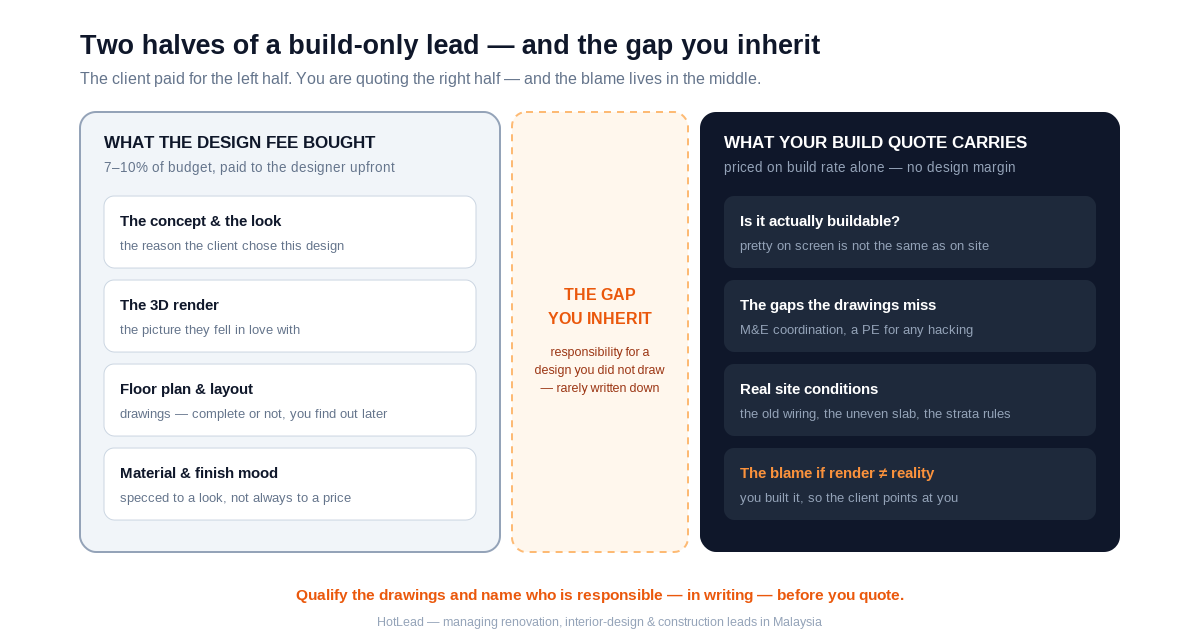
The anchor problem: they love a picture you didn't paint
On a build-only lead the client is emotionally committed to a 3D render that someone else sold them, so every difference between that picture and what's actually buildable becomes your problem to explain and your fault to fix. This is the part firms never price for, and it's where the goodwill goes.
A 3D render is a sales tool. It is lit perfectly, furnished aspirationally, and often drawn without full regard for the real ceiling height, the actual window position, the existing beam, the plumbing stack, or what a material does at full scale in Malaysian humidity. The designer's job was to make the client fall in love with it, and they did their job — the client paid 7–10% partly for that feeling. Now you arrive to build it, and reality intrudes: the feature wall can't cantilever like that without a steel support the render doesn't show, the seamless island has to have a joint, the paint looks different under real downlights. To you these are normal build truths. To a client holding the render on their phone, each one is a disappointment, and because you are the one building, each one reads as you falling short of the designer's promise — not the designer over-promising.
Who's actually responsible when the design is wrong?
On a build-only job, nobody agreed in advance — and that grey zone is the single biggest reason this lead type burns contractors. You need to close it in writing before you start, because the law and common practice won't close it for you.
In a design-and-build arrangement, one firm designs and builds, so the contractor carries the design liability clearly — Malaysian research on design-and-build notes the contractor takes on the speculative design risks, with fit-for-purpose duties sometimes implied even where the contract is silent. The moment a client splits design from build, that clean line disappears. You built what the drawing specified. If the drawing was flawed, the designer says you should have caught it; you say you built to issued drawings; the client — who isn't technical and can't adjudicate — blames the firm physically in front of them. That's you.
The defence isn't legal cleverness; it's the same boring discipline that protects any Malaysian reno. A written contract is essential — building or renovating without one puts homeowners (and contractors) at real risk, and a CIDB-registered contractor is far less likely to be treated as fly-by-night. On a build-only job, your written scope has to do one extra thing a normal contract doesn't: state that you are building to the drawings as issued, attach a dated list of what those drawings omit or what you'd advise against, and name who approves and pays for every change. Thirty minutes of writing that down is what stands between you and a two-month argument.
Normal reno lead versus build-only lead — what flips
Run a build-only lead through your normal-reno reflexes and you'll misprice it and mis-set expectations. Here's how the two differ, and why nearly every instinct has to flip — the same lead-type discipline that applies to a government tender versus a direct project lead or a commercial fit-out on a lease clock.
| Normal renovation lead | Build-only lead | |
|---|---|---|
| Who designed it | You, or you and the client together | A third-party designer, already paid |
| Where your margin is | Design judgment + build | Build rate only — design margin is gone |
| What the client is anchored to | A shared plan you shaped | A 3D render someone else sold them |
| Who owns the drawings | You do | The designer does — you build to them |
| Who's liable if the design fails | Clear — it's your design | Grey — "builder should've flagged it" |
| Parties in the room | Two — you and the client | Three — designer, client, builder |
| The real prize | This job + a referral | The designer as a repeat referral channel |
The hidden prize: a designer is a pipeline, not a one-off
The margin on a single build-only job is thin by design, but a good designer who trusts your build is a steady stream of warm, pre-qualified leads — and that's the real reason to handle this lead type well. Firms that only see the one cheap build miss the bigger half.
Designers in Malaysia — the ones sourcing clients through Qanvast, Atap and their own portfolios — are constantly looking for a build partner they don't have to babysit. A designer's reputation lives or dies on how the finished space looks, and a contractor who builds their drawings faithfully, flags gaps early instead of covering them up, and doesn't make them look bad in front of their client is rare and valuable. Become that contractor for one good designer and you stop tendering — they bring you every project they win, pre-sold, with the design already done and the client already committed. That's a referral channel with zero acquisition cost and a warm introduction every time, which is worth far more than squeezing margin on job one. It's the same logic that makes a returning repeat client worth more than a cold enquiry — the relationship compounds.
How do you spot and handle a build-only lead?
Catch the "I already have a designer" language on the first reply, qualify the drawings and the responsibility before you quote, and decide whether it's a relationship worth building or an undercut race worth declining. Five moves:
- Read for the tells and tag it. "I already have a designer / an ID," "drawings done," "3D done," "just need someone to build," "can you quote from my drawings," "designer's quote too expensive." Any of those means this is a build-only lead — tag it as its own type, not a normal reno, the moment it arrives.
- Qualify the drawings before you price anything. Dimensioned plans and elevations, or just a render and a mood board? A material and finish schedule? M&E coordination? A structural engineer for any wall hacking, which Malaysian practice requires? You cannot safely quote a scope you haven't verified — and a quote off incomplete drawings is a loss you've already booked.
- Map the three parties. Who is the designer, and are they still supervising or stepping away? Is the designer happy for another builder to quote, or are you being used to beat down their number? Who signs off variations? Clarity here is the same discipline as separating a tender's rules from a direct lead's.
- Price the real scope and put responsibility in writing. Quote the build plus the gaps the drawings miss and the coordination you'll carry — not "cheap because design's done." Attach a written line that you build to the drawings as issued, a dated list of what they omit, and who owns changes.
- Decide — relationship or race. A clean referral from a reliable designer with complete drawings and a fair client is worth winning and handling impeccably. A pure undercut on someone else's incomplete drawings is a mass-blast quote-shop in disguise — decline it fast and keep your crew free for the leads that compound. Don't let either get lost in a team WhatsApp with no clear owner.
When is a build-only lead not worth taking?
Walk away when the drawings are too incomplete to price safely, when you're clearly being used only to undercut the designer's quote, or when the design itself is something you can't build to a standard you'd put your name on. A thin-margin job you spend two months defending is worse than no job.
Take it when the drawings are complete enough to price with confidence, the responsibility can be agreed in writing, the client is fair about the render-versus-reality gap, and — best of all — there's a good designer attached who could become a referral source. Say a fast, honest no when the set is a 3D and a prayer, when the client wants a guaranteed low price on a scope nobody has nailed down, or when you can already see the design won't survive contact with the site and you'll be blamed for it. As with any lead you're better off declining early, the discipline is to protect your margin, your crew's time and your reputation — and on a build-only lead, that reputation is being judged against a picture you didn't paint.
How HotLead helps you catch build-only leads before you quote them like normal jobs
HotLead sits on top of the WhatsApp your enquiries already land in — nothing changes for the client messaging you — and it's built so a build-only lead gets handled on the right process instead of the easy-job reflex:
- Captures and tags every enquiry the moment it arrives, so an "I already have a designer, just need to build" message can be marked as its own lead type and routed into the qualify-the-drawings-first lane, not the fire-off-a-quick-quote lane.
- Assigns one owner instantly — round-robin, manual, or a custom rule we set up during onboarding — so a build-only lead with a designer, a client and a set of drawings in play has one accountable person owning it, not a rotating cast in a group chat.
- Keeps a next action and flags overdue follow-ups, so qualifying the drawings, chasing the missing details, and nurturing the designer relationship over months all get tracked rather than forgotten.
- Shows your funnel and per-channel ROI, so you can see whether build-only and designer-referred work is a pipeline worth building — which designers send you leads, which convert, and what that channel is actually worth.
HotLead doesn't draw the drawings or decide whether a design is buildable — that's your craft and your judgment, and on a build-only lead the whole game is qualifying what you've been handed before you price it. What it does is make sure the lead that arrived looking like a gift gets caught, tagged and owned by the right person before someone fires back an easy-job quote and inherits a design they can't defend.
If your firm keeps winning "just build it" jobs that turn into two months of arguing over a render you didn't draw, the leak usually isn't your pricing. It's that you treated a three-party, no-design-margin, someone-else's-liability lead like an easy reno and never qualified what you were really taking on. Start with the contractor hub, the interior-design lead hub or the renovation hub, read the complete guide to managing renovation leads in Malaysia, or see how HotLead works.
Sources: Design-fee range of 7–10% of the renovation budget, paid upfront, and the per-square-foot build rates (core RM80–100, designer RM100–150, turn-key RM150–180), from interior designer Blaine Robert (Blaine Robert Design) writing on Qanvast — An interior designer reveals how he charges for a renovation. The contractor-only route being "cheapest … no design markup," the 8–15% design-fee alternative figure, the design-and-build bundled markup and the advice to insist on a line-itemised quote, and the "a contractor builds; a designer designs" distinction, from Malaysia4u — Home Renovation Guide. Who produces drawings versus who builds, the "if you already have a design, get a renovation contractor to manage the build" path, and the structural-engineer requirement for wall hacking, from Recommend.my — Architect, draftsman, engineer or contractor: which one do you need for your renovation?. The design-and-build risk concentration on the contractor and implied fit-for-purpose liability from UiTM institutional repository — Risk on design and build for construction projects (Muhammad Syakirin Ismail). The importance of a written contract and CIDB registration from New Straits Times — Building a home without written contract leaves homeowners at risk (Aug 2026). The "free design fee recovered through contractor pricing" observation is a commonly reported view on Lowyat.NET renovation forums. The Petaling Jaya and KL scenarios are illustrative; the three-party economics, the render-versus-reality anchor, the design-liability grey zone and the designer-as-referral-channel pattern are the real mechanics of a build-only lead.
Frequently asked questions
A client already has a designer and just wants me to build from their drawings — isn't that an easy job?
It is the lead that looks easiest and behaves hardest, so treat it as its own type, not a shortcut. On the surface everything a firm wants is there — the scope is defined, the design work is done, and you can fire back a quote fast. Underneath, three things make it risky. You have no design margin, because the client already paid the designer 7–10% of the budget, so you are competing on build rate alone. You are building to drawings you did not draw, which may be incomplete or impractical, and you own none of the decisions behind them. And the client is anchored to a 3D render they fell in love with, so any gap between that picture and what is actually buildable on site lands on you. Quote it like a normal reno and you either under-price the gaps and bleed, or win a job you spend months defending.
Should I just quote straight off someone else's drawings?
No — qualify the drawings first, because a quote off incomplete drawings is a quote you will lose money on. Before you price anything, check what you have actually been handed. Are there dimensioned floor plans and elevations, or just a pretty 3D render and a mood board? Is there a material and finish schedule, or will "something like this" be argued on site? Is there mechanical and electrical coordination — points, lighting, aircon, plumbing runs? Does any wall-hacking or structural change have an engineer's input, which Malaysian practice requires? A designer's 7–10% fee usually covers the look and the layout, but the buildability gaps are where your money leaks. Price the real scope, including what the drawings leave out, and flag the gaps in writing when you send the quote.
Who is responsible if the designer's design doesn't work on site?
Whoever you agreed in writing — and on a build-only job that is almost never spelled out, which is the whole trap. In a design-and-build arrangement one firm designs and builds, so the design responsibility clearly sits with them. The moment a client splits the two — a designer draws it, a separate contractor builds it — responsibility for a flawed design becomes a grey zone. You built what the drawing said; the designer says the builder should have flagged it; the client, who is not a technical person, simply blames the firm standing in front of them, which is you. Malaysian research on design-and-build and fit-for-purpose liability notes these duties are often not spelled out and the case law is thin. So protect yourself the boring way — a written scope that says you build to the drawings as issued, a dated list of what the drawings miss or what you would not recommend, and a clear line on who approves and pays for changes.
The client says the designer's build quote was too expensive and wants me to match it cheaper. Should I?
Be very careful — this is often a price-shop wearing a real set of drawings, and it is a different animal from a genuine build-only referral. Many build-only leads start the same way — a client engaged a designer, got the designer's build quote, decided it was too high, and is now blasting the drawings to contractors to undercut it. That is close to a mass-blast quote-shopper, except there are real drawings in play, which makes it look more legitimate than it is. The questions to ask yourself — is the designer still involved and happy for another builder to quote, or are you being used to beat down someone else's number? Are the drawings complete enough to price safely, or are you being asked to guarantee a lower price on an incomplete scope? If it is a clean referral with a reliable designer and a fair client, it can be worth winning. If it is purely an undercut race on someone else's incomplete drawings, that is a job best declined early.
Is a build-only job ever worth taking?
Often yes — but take it for the relationship, not the single build. The prize in a build-only lead is rarely the margin on one job, because the margin is thin by design. It is the designer. A designer who finds a contractor that builds their drawings faithfully, flags problems early, and does not embarrass them in front of their client will send that contractor every project they win — a steady referral channel with no ad spend and a warm introduction every time. So the build-only leads worth chasing are the ones attached to a good designer you could build a relationship with — complete drawings, a fair client, clear responsibility. Price those to win the relationship and handle them impeccably. Decline the undercut races on incomplete drawings early, and spend the time on the leads that compound.
Keep reading
- Can AI Reply to Your Renovation Firm's 1-Star Review? I Built It — and the Risk Is How Fast It ApologisesA 2-star review on Google or Qanvast is the first thing your next renovation lead reads — and most firms either ignore it or fire back and make it worse. The 2026 reflex is to let AI write the reply. I built it, and drafting a calm response costs a fraction of a sen. But an AI tuned to be helpful apologises too fast — it will concede a fault in writing, promise a refund that never happened, and grovel to a fake review from a competitor. Here's the build that protects your rank instead of torching it.
- Which Lead Signals Actually Predict a Sale? Reverse-Audit Your Own Won JobsMost firms grade a renovation lead on signals that feel predictive — enthusiasm, a long message, a fast reply — and never check whether those signals actually separate won jobs from lost ones. Here is how to run a reverse-audit on your own closed deals, which signals usually survive it, and why your pipeline is too small to pretend the score is more than directional.
- The "I Only Deal With the Boss" Lead: When the Buyer Refuses Your TeamYou finally hired someone to share the load — then the buyer messages "can I deal with you direct ah, boss?" and refuses to engage your staff. Every big lead quietly re-centralises onto the one person already maxed out, and your firm can never grow past the owner. Here's why caving caps you, why a flat "my staff will assist" loses a nervous buyer, and the move that keeps both.