

Every follow-up article in this industry opens with the same statistic: 80% of sales need five or more follow-ups, and 44% of salespeople give up after just one (Invesp). It's a good stat. It's also become an excuse — the number people reach for to justify chasing every lead into the ground, on the logic that if quitting early loses deals, then never quitting must win them.
That logic is half-right, and the missing half is expensive. The same research that says "don't quit after one" also says returns flatten hard after five or six touches — and that past a point, an extra chase costs you more than it can win. There are two leaks in most reno firms' follow-up, not one: the famous under-following-up leak, and an invisible over-following-up leak that quietly burns your scarcest hours and, on WhatsApp, can damage your ability to reach every other lead. This piece is the arithmetic of where the line sits, and why it's different for a cold boosted-post lead than for a warm referral.
So what's the right number of follow-ups for a renovation lead?
There isn't a single number — and any article that gives you one is selling a cadence, not a decision. The honest answer is a rule: the right number of touches is roughly the lead's value multiplied by its odds of closing, and you stop when the next touch is worth less than what it costs you. For most reno leads that lands somewhere in the first five to six touches, because that's where the winning is concentrated. Beyond that, you keep going only for the high-value leads that are still engaging, and you park or drop the rest.
That's the whole piece in two sentences. The rest is why it's true, what the curve actually looks like, and how to find your stop point by lead source instead of copying someone else's.
Why does everyone quote "80% of sales need five follow-ups"?
Because it's real, and because it names a genuine, costly mistake. The Invesp figures are blunt: 44% of salespeople give up after one follow-up, while 80% of eventual sales take five or more. Put those two numbers side by side and you get the reason so many pipelines leak — most reps stop exactly where most deals start to close. On a reno funnel, where 80% of buyers say yes only after several nudges and 44% of firms quit after one, that gap is jobs walking out the door.
So far, so familiar. The problem is what people do with the stat. "Five-plus follow-ups win deals" gets rounded up to "more follow-ups always win deals," and firms start treating persistence as a virtue with no ceiling. But the stat only proves a floor — it tells you the minimum persistence that pays. It says nothing about the top of the curve, where each extra touch does less and less. For that, you need the other half of the research.
What does the diminishing-returns curve actually look like?
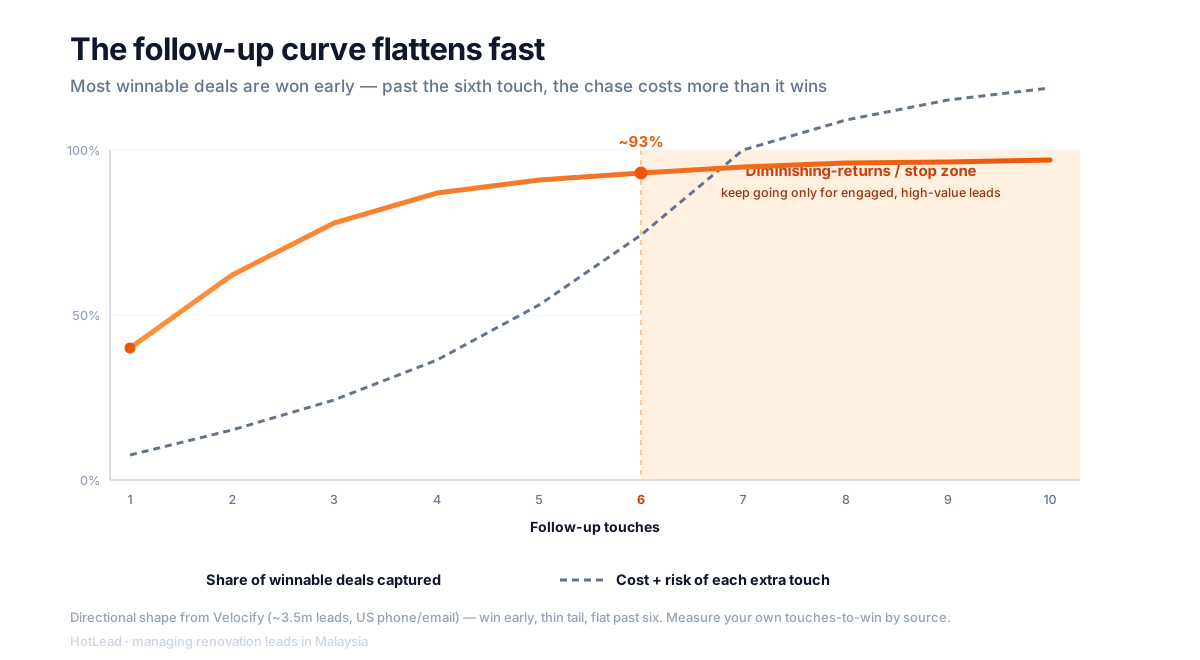
It rises steeply, then flattens hard — and the flattening starts around the fifth or sixth touch. The largest study on this is Velocify's The Ultimate Contact Strategy, built on roughly 3.5 million leads. Its headline for our purposes: about 93% of converted leads are reached by the sixth contact, so only about 7% ever convert after more than six — and leads that take more than seven calls to reach are around 45% less likely to convert in the first place. Past seven attempts, the study notes, prospects increasingly feel harassed rather than helped.
Read the shape, not the exact digits. Like the five-minute response-time rule, these numbers come from US inside-sales phone-and-email studies, so the literal call counts don't transfer cleanly to a Malaysian WhatsApp reno enquiry — where an acknowledgement counts as a touch and a "touch" might be a voice note, not a cold call. What does transfer is the curve: most of the winning is captured early, the tail is thin, and there's a point where the line goes flat while your effort keeps rising.
| Touch | Roughly what it captures | What to do |
|---|---|---|
| 1 (fast) | The ready-now buyers plus the first-responder edge | Acknowledge in minutes; never skip |
| 2–3 | Most of the remaining winnable deals | Add a reason to reply each time, not "any update?" |
| 4–6 | The tail — by here ~93% of wins are in (Velocify) | Keep going for engaged, higher-value leads |
| 7+ | Under ~7% of wins, with rising annoyance | Stop, or park with a wake-date — don't keep chasing a silent low-value lead |
The second leak nobody counts: over-following-up
Under-following-up loses the deal in front of you. Over-following-up loses the deals you never got to — and it's invisible, which is why almost no firm measures it. It costs you two ways.
Opportunity cost. For a small reno firm, the binding constraint isn't leads — it's owner-and-senior attention, the same scarce resource that makes crew-weeks, not enquiries, the thing you run out of. Every eighth or ninth chase you send a silent, cold, one-percent-close lead is time a fresh high-intent enquiry — the one that would have closed this month — spends waiting. You feel productive because you're "following up." You're actually spending your best hours on your worst odds.
The WhatsApp mechanical cost. This is the part the old phone studies never had to think about, and it's the un-Googleable bit for a Malaysian firm. Because about 90% of reno enquiries live on WhatsApp, your follow-ups run through a channel that actively scores your behaviour. Over-message people and some will block or report you; WhatsApp rates your number's quality partly from those block and spam signals over a rolling window, and a quality downgrade can throttle your messaging limits. Lean on marketing-template messages and you hit frequency caps designed to stop exactly this. In other words, over-chasing one dead lead doesn't just annoy that person — it can quietly degrade your ability to reach every other lead in your pipeline. No US call script carried that risk.
| Under-following-up (the famous leak) | Over-following-up (the invisible leak) | |
|---|---|---|
| The tell | You quit after 1–2 touches | You're on touch 8+ of a silent, low-value lead |
| What it costs | The winnable deal in front of you | The fresh lead that waited; goodwill; WhatsApp quality rating |
| Who it hurts | This lead | Every other lead in your pipeline |
| Why it hides | Feels like "respecting their space" | Feels like "being diligent" |
Why the right number of touches depends on the lead, not the calendar
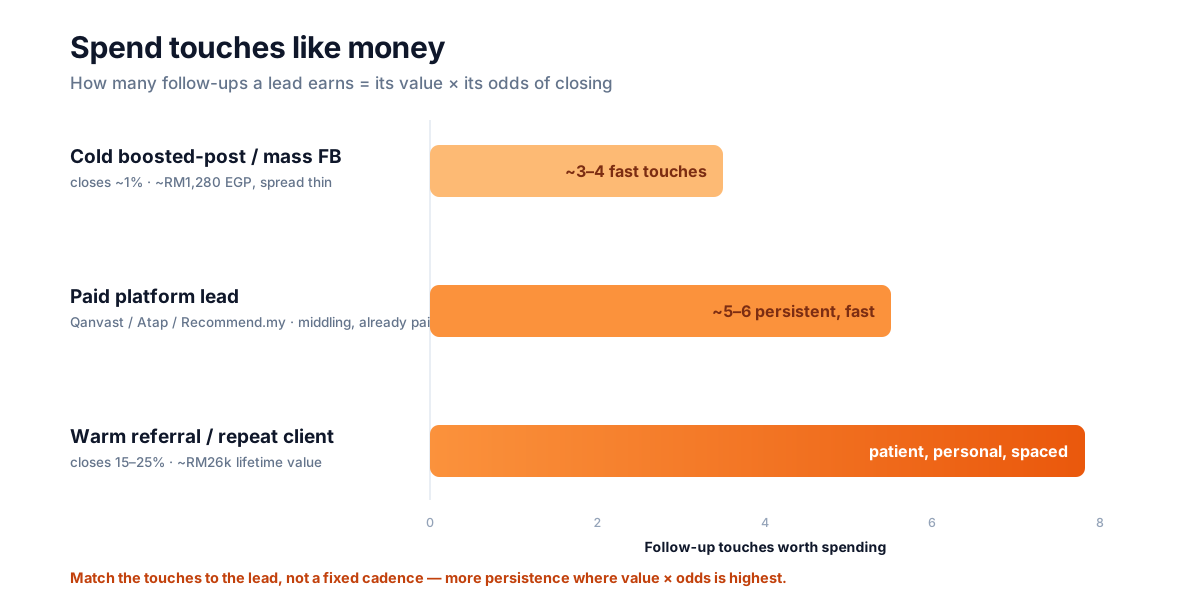
Here's the core of it: a follow-up cadence that treats every lead the same is guaranteed to over-invest in your worst leads and under-invest in your best. The right number of touches is an expected-value question — the extra chance a touch adds to closing, multiplied by what the lead is worth, minus what the touch costs you. Two reno leads can sit at opposite ends of that sum.
Take a cold boosted-post or mass FB/IG lead. It closes at roughly 1%, and the expected gross profit across all such enquiries is around RM1,280 — spread thin, because 99 in 100 never buy. A fast first touch and two or three good ones capture almost all the winnable ones; a ninth chase on a silent one has a marginal value close to zero. Now take a warm referral. It closes at 15–25%, and a won client is worth around RM26k once you count repeat work and the referrals they send. Every touch on that lead is worth more, and it deserves patience and a personal, non-templated hand — not the same three-line reminder you'd send a cold lead.
The third road: park the lead, don't chase it
"Chase or give up" is a false choice, and the third road is the one that fits reno best. A renovation "not now" is rarely a flat no — it's usually dated to a real event on the buyer's clock. Marketing Donut data puts roughly 63% of enquirers as not buying for three or more months and 20% as not buying for over a year. In Malaysia those delays have specific, knowable causes: a home loan working its way through approval, VP keys not collected yet, festive cash tied up, a spouse or a strata committee still deciding.
A lead like that doesn't need more touches now — more touches now just burns goodwill and risks the opt-out. It needs one relevant message when its situation changes. So the move is to stop the chasing, set a wake-date ("follow up when her loan clears in November"), and let it sit until then. That's not giving up; it's nurturing on the buyer's calendar instead of yours — the opposite of a monthly blast that gets you muted before the buyer is ready. The skill is telling the three apart: a dated not-now (park with a wake-date), a silent low-value lead (stop), and an engaged high-value lead (keep going, personally).
How do you find your own stop point?
Stop guessing at a cadence and measure the one number that answers the question: touches-to-win, by source. For each lead source, track how many touches your won deals actually took before they said yes. You'll almost always find the wins cluster in the first handful of touches — and that cluster, plus a touch or two of headroom, is your stop point for that source. Chasing a cold-source lead well past where any cold-source lead has ever converted isn't diligence; it's data you're choosing to ignore.
| Lead source | Rough close rate | What's at stake | Touch it to… | Then |
|---|---|---|---|---|
| Cold boosted-post / mass FB-IG | ~1% | ~RM1,280 expected GP, spread thin | ~3–4 fast, useful touches | No engagement → stop or park |
| Paid platform (Qanvast / Atap / Recommend.my) | Middling | Already paid for; competitive | ~5–6 persistent, fast touches | Park dated ones; drop silent ones |
| Warm referral / repeat client | 15–25% | ~RM26k lifetime value | Patient, personal, well-spaced | Keep going while engaged; park if dated |
How HotLead fits in
HotLead doesn't pick your stop point for you — that's your call, and now you have the arithmetic for it. What it does is make the number the whole decision turns on visible, so you're managing follow-up with data instead of guilt. Because every lead is captured with its source attached and tracked to won or lost, its funnel and per-channel view shows you touches-to-win by source — so you can see where your own wins actually cluster and set a real stop point per channel, instead of chasing every lead the same way.
It also makes the right persistence happen and the wrong persistence stop. Every lead gets one clear owner, a next action and an overdue nudge, so the warm referral that deserves a personal touch doesn't slip — and a "not now" lead can be parked with a next-action dated to when it actually matters, rather than chased weekly until it blocks you. You keep the persistence that wins deals, drop the persistence that costs you, and protect the WhatsApp number the whole pipeline runs on.
Start with the complete guide to managing renovation leads in Malaysia, see the renovation lead playbook, or go deeper on building a follow-up system that runs itself, what to do when a warm lead goes quiet after your quote, and the numbers every reno firm should track. Interior-design and construction firms run the same maths on their own sources — see the interior-design and construction playbooks.
Sources: The floor figures — 80% of sales requiring five or more follow-ups, and 44% of salespeople giving up after one — from Invesp's follow-up statistics. The diminishing-returns curve — about 93% of converted leads reached by the sixth contact (so 7% convert after that), leads needing more than seven calls around 45% less likely to convert, an optimal cadence of roughly six calls plus five emails, and prospects feeling harassed past seven attempts — from Velocify's The Ultimate Contact Strategy, an analysis of roughly 3.5 million leads (widely summarised, e.g. via the National Law Review and Sales Lead Management Association). These are US inside-sales phone-and-email studies, so treat the bands as directional shape, not exact counts, for a WhatsApp reno enquiry — the same caveat we apply to the five-minute response-time rule. Buyer-timing figures — roughly 63% of enquirers not buying for three or more months and 20% not for over a year — from Marketing Donut. WhatsApp per-user marketing-template frequency limits and the quality-rating mechanism (driven by block and spam reports over a rolling window, affecting messaging limits) are documented WhatsApp Business Platform behaviour. The close-rate bands (1% cold vs 15–25% referral, ~7–8% blended), the ~RM1,280 expected gross profit per enquiry, the ~RM26k lifetime value of a renovation client, and the ~90% WhatsApp share are the illustrative house figures used across this series — see cost per lead vs cost per job, the cost of a lost lead and the lifetime value of a renovation client. Plug in your own close rates and touches-to-win by source to find your real stop point.
Frequently asked questions
How many times should you follow up on a renovation lead?
There is no single right number — it depends on the lead's value and how likely it is to close. As a working rule for a small Malaysian reno firm, most winnable deals are landed inside the first five to six touches, which mirrors Velocify's finding that about 93% of converted leads are reached by the sixth contact. Beyond that, keep going only for high-value leads that are still engaging (a warm referral, a live quote), and for everything else either stop or park the lead with a wake-date rather than keep chasing a non-responder.
Isn't it true that 80% of sales need five or more follow-ups?
Yes — that Invesp figure is real, and it is why quitting after one attempt (which 44% of reps do) leaves money on the table. But it is a floor, not a target. It tells you the minimum persistence that pays; it does not tell you to chase every lead indefinitely. The same body of research shows returns flatten fast after five to six touches, so the honest reading is "don't quit early on winnable leads," not "never stop."
Can you follow up too much?
Yes, and it costs you two ways. First, opportunity cost — every hour spent on a near-dead lead is an hour a fresh, high-intent enquiry waits, and for a small firm owner-and-rep attention is the scarcest resource you have. Second, on WhatsApp there is a mechanical cost the old phone studies never had — over-messaging invites blocks and opt-outs, and WhatsApp scores your number's quality from spam and block reports, so over-chasing one lead can throttle your ability to reach every other lead.
Should I follow up the same number of times for every lead?
No. Match the number of touches to the lead, not a fixed cadence. Work out roughly what each lead is worth (a cold boosted-post enquiry versus a warm referral worth ~RM26k in lifetime value) and how likely it is to close (~1% versus 15–25%), and spend more persistence — and more personal, non-templated effort — where the value times the odds is highest. Track touches-to-win by lead source and you will find your own stop point instead of guessing.
What if a renovation lead just goes quiet — do I keep chasing?
Often the better move is to park, not chase. A reno "not now" is frequently dated to a real event on the buyer's calendar — a loan approval, collecting VP keys, festive cash, a spouse or committee decision. Marketing Donut data shows roughly 63% of enquirers won't buy for three or more months and 20% not for over a year. Those leads don't need more touches now; they need one relevant message when their situation changes. Set a wake-date, stop the chasing, and follow up when it actually matters.
Keep reading
- Did We Already Say RM68k? Using AI to Stop Quote Drift Across a Long Renovation ThreadOver a weeks-long WhatsApp thread with two or three quote revisions, a rep re-states a number that contradicts an earlier promise — and re-opening a settled price quietly invites a discount that eats a whole job's profit. So I pointed AI at the drift. It works beautifully as a flag, and dangerously as an auto-corrector.
- The Warranty as a Closing Lever: Why a Longer Guarantee Beats a Discount on a Renovation DealA quote is stalling and the buyer wants a reason to say yes. Before you drop the price, look at the other lever in your hand — a longer workmanship warranty. It is the same expected-value decision as a discount, but the math runs the opposite way — a price cut costs you thousands with certainty, while extending the defects cover costs you a couple of hundred ringgit in expectation, for arguably more trust with a scam-wary buyer. Here is the EV case for the non-price concession, the trap that turns it into a hidden liability, and which leads it actually moves.
- "Can You Just Build It, My Neighbour Also Did" — Handling the Renovation Lead That Needs Council Approval FirstSome renovation enquiries can't legally start next month, no matter how ready the buyer is — a kitchen extension, a hacked-through wall, a roofed-over air well all need the council's written approval first. Quote a fast build price to win the job and you either lose it to a "boss, can start" cowboy, or win it and inherit the stop-work order, the RM50,000 fine and a client who later can't sell the house. Here's how to spot the permit-first lead and sell the approval as protection.